
Clopidogrel - mechanism of action uses adverse effects according to KDT
I'll look up Clopidogrel in the medical library (KDT = KD Tripathi's Essentials of Medical Pharmacology) right away.
Reading File
Now let me search the library for Clopidogrel content in KDT (KD Tripathi):
Finding Sources
Finding Sources
I see KDT (KD Tripathi) isn't directly listed. Let me check which books are available and search specifically for KDT, plus look for antiplatelet drug sections:
Finding Sources
Finding Sources
KDT (KD Tripathi) doesn't appear to be in the library, but I have Harrison's, Katzung, Lippincott, and Braunwald. Let me read the most relevant sections - particularly from Katzung (thienopyridines section) and Harrison's (ADP receptor antagonists), plus the Lippincott section which has a mechanism diagram:
Reading File
Reading File
Reading File
Excellent content. Let me read more from the Lippincott section for adverse effects, and also check Braunwald's for complete adverse effects data, plus fetch the mechanism diagram:
Reading File
Reading File
Loading Image
I now have comprehensive information from multiple authoritative pharmacology references. Let me compile the full answer in KDT style.
Clopidogrel - KDT (KD Tripathi) Style
Note: KD Tripathi's Essentials of Medical Pharmacology is not directly available in the textbook library. The following is compiled from equivalent authoritative pharmacology references - Katzung's Basic & Clinical Pharmacology (16e), Lippincott Illustrated Reviews: Pharmacology, Harrison's Principles of Internal Medicine 22e, and Braunwald's Heart Disease - covering all KDT-relevant content.
Classification
Clopidogrel belongs to the thienopyridine class of antiplatelet drugs (along with ticlopidine and prasugrel). It is a P2Y12 ADP receptor antagonist.
Mechanism of Action
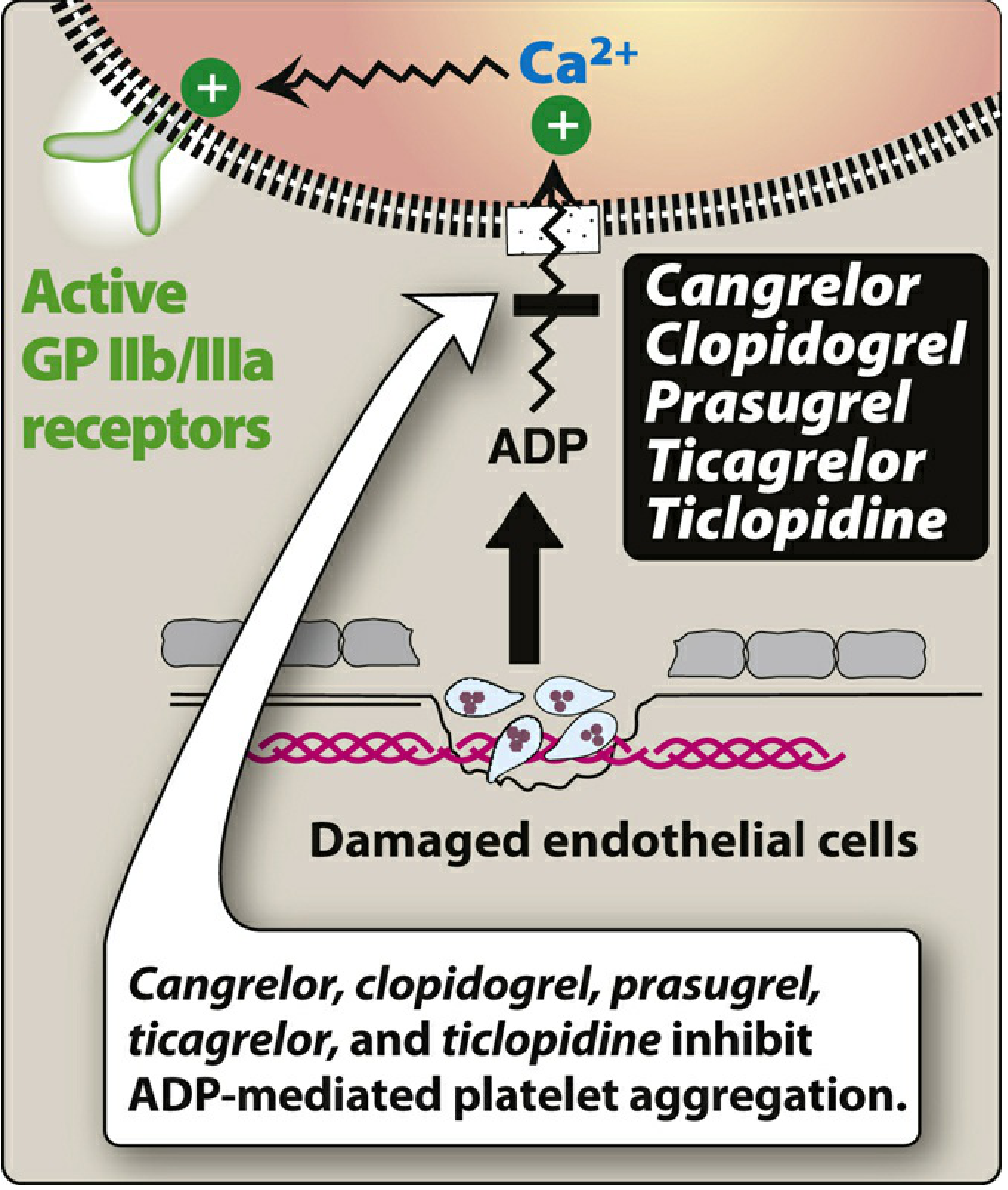
Clopidogrel is a prodrug that requires hepatic activation by the CYP2C19 enzyme (cytochrome P450 system) to generate its active metabolite.
Step-by-step mechanism:
- After oral ingestion, clopidogrel is converted to an active thiol metabolite via CYP2C19.
- The active metabolite irreversibly and selectively blocks the P2Y12 ADP receptor on the platelet surface.
- Normally, ADP binds P2Y12 → activates GP IIb/IIIa receptors → platelets bind fibrinogen → platelet aggregation occurs.
- By blocking P2Y12, clopidogrel prevents ADP-induced activation of GP IIb/IIIa receptors, thereby inhibiting platelet aggregation.
- Since binding is irreversible, the antiplatelet effect lasts for the entire platelet lifespan (~7-10 days).
Key points:
- Unlike aspirin, clopidogrel has no effect on prostaglandin/thromboxane metabolism.
- The block is irreversible - platelet function returns only when new platelets are generated.
- Maximum platelet inhibition with the 75 mg/day maintenance dose is achieved in 3-5 days; a loading dose of 300-600 mg produces 80% inhibition within 5 hours.
Pharmacokinetics
| Parameter | Detail |
|---|---|
| Route | Oral |
| Prodrug activation | CYP2C19 (hepatic) |
| Protein binding | Extensive |
| Onset (loading 300-600 mg) | 80% inhibition within 5 hours |
| Onset (75 mg/day) | 3-5 days for maximum effect |
| Duration of effect | 7-10 days (entire platelet lifespan) |
| Elimination | Renal and fecal |
| Genetic issue | CYP2C19 poor metabolizers - reduced antiplatelet effect |
Uses / Therapeutic Indications
-
Acute Coronary Syndromes (ACS):
- Unstable angina / NSTEMI: Loading dose 300 mg + aspirin, then 75 mg/day (dual antiplatelet therapy - DAPT)
- STEMI: 75 mg/day with aspirin
-
Post-PCI / Coronary Stenting:
- After bare metal stent: DAPT for at least 4 weeks
- After drug-eluting stent: DAPT for at least 1 year
-
Secondary prevention of atherosclerotic events:
- Recent MI, recent ischemic stroke, or established peripheral arterial disease (PAD)
- Clopidogrel is more effective than aspirin in this setting (8.7% relative risk reduction vs aspirin for cardiovascular death, MI, or stroke - CAPRIE trial)
-
As an aspirin alternative in patients intolerant to aspirin (e.g., GI intolerance)
Adverse Effects
| Adverse Effect | Details |
|---|---|
| Bleeding | Most common and important; prolonged bleeding time; no antidote available |
| GI effects | Nausea, dyspepsia, diarrhea (less common than with ticlopidine) |
| Thrombotic Thrombocytopenic Purpura (TTP) | Rare but serious; can occur with all P2Y12 inhibitors |
| Neutropenia | Low incidence (much less than ticlopidine) |
| Rash / skin reactions | Occasionally reported |
| Clopidogrel resistance | Due to CYP2C19 loss-of-function polymorphisms; up to 25% whites, 30% blacks, 50% Asians may be poor metabolizers |
Important Drug Interactions:
- Omeprazole / Esomeprazole (CYP2C19 inhibitors): Reduce conversion of clopidogrel to active metabolite → reduced antiplatelet efficacy - should be avoided or used cautiously
- Aspirin: Additive antiplatelet effect (benefit in ACS/stenting), but increases bleeding risk to ~2%/year
- CYP2C19 inducers: May increase active metabolite formation
- Opioids: May decrease clopidogrel exposure
Contraindications
- Active pathological bleeding (peptic ulcer, intracranial hemorrhage)
- Hypersensitivity to the drug
Comparison with Ticlopidine (KDT-relevant point)
| Feature | Clopidogrel | Ticlopidine |
|---|---|---|
| Receptor | P2Y12 (irreversible) | P2Y12 (irreversible) |
| Prodrug? | Yes (CYP2C19) | Yes |
| Neutropenia | Rare | Up to 1% (serious) |
| TTP | Rare | Reported |
| GI side effects | Mild | Up to 20% |
| Preferred? | Yes (better safety profile) | Reserved for aspirin-intolerant |
Key Points for Exams (KDT Style)
- Clopidogrel = thienopyridine prodrug, activated by CYP2C19
- Irreversible blockade of P2Y12 ADP receptor on platelets
- Prevents GP IIb/IIIa activation → blocks fibrinogen binding → inhibits platelet aggregation
- No prostaglandin pathway effect (unlike aspirin)
- Bleeding is the most important adverse effect - no antidote
- Avoid omeprazole/esomeprazole (CYP2C19 inhibitors reduce drug activation)
- CYP2C19 poor metabolizers → clopidogrel resistance → switch to prasugrel or ticagrelor
- Loading dose: 300-600 mg; Maintenance: 75 mg once daily
- Duration of antiplatelet effect after stopping: 7-10 days (platelet turnover time)
Pharmacology
Your credits are exhausted. You can purchase a top-up or subscribe to a plan to continue using Orris. If you're already subscribed, your daily credits will reset tomorrow.
This is a shared conversation. Sign in to Orris to start your own chat.