
What are the muscle attachments to scapula
Reading File
Finding Sources
Searching Images
scapula muscle attachments anatomy diagram
Finding Sources
Reading File
Finding Sources
Finding Sources
Reading File
Reading File
Finding Sources
Finding Sources
Reading File
Reading File
Reading File
The table at line 2026 was truncated. Let me get the full table content:
Finding Sources
Loading Image
I now have comprehensive data from the textbooks. Here is the full answer:
Muscle Attachments to the Scapula
A total of 18 muscles attach to the scapula. They are divided into two systems:
- Scapuloaxial system — connects the scapula to the axial skeleton (vertebral column, ribs, chest wall); controls scapular movement over the thorax
- Scapulorachial system — originates from the scapula and inserts into the bones of the arm; controls the glenohumeral joint
Visual Overview
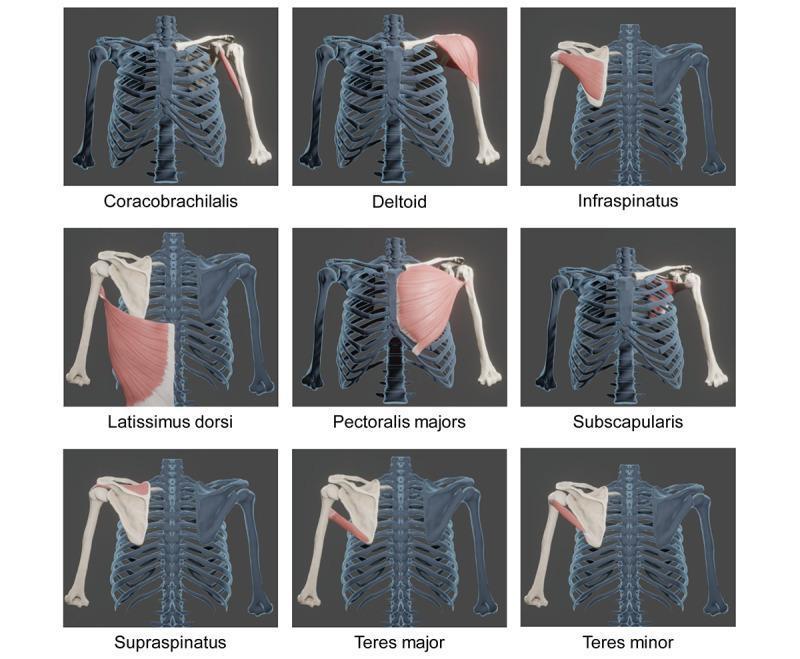
Complete Muscle Attachment Table
| Muscle | Scapular Attachment (Origin/Insertion) | Other Attachment | Nerve |
|---|---|---|---|
| Biceps brachii | Short head: tip of coracoid process; Long head: supraglenoid tubercle | Radial tuberosity | Musculocutaneous |
| Coracobrachialis | Coracoid process (origin) | Medial midshaft humerus | Musculocutaneous |
| Deltoid | Acromion + lower lip of spine of scapula (origin) | Deltoid tuberosity of humerus | Axillary |
| Infraspinatus | Infraspinous fossa (origin) | Greater tubercle of humerus (middle facet) | Suprascapular |
| Latissimus dorsi | Sometimes inferior angle of scapula (minor slip) | T7–sacrum, iliac crest → intertubercular groove | Thoracodorsal |
| Levator scapulae | Medial border — superior angle to root of spine (insertion) | Transverse processes C1–C4 | Dorsal scapular |
| Omohyoid (inferior belly) | Upper border of scapula (origin) | Hyoid bone | Ansa cervicalis |
| Pectoralis minor | Coracoid process (insertion) | Ribs 3–5 | Medial pectoral |
| Rhomboid major | Medial border inferior to spine of scapula (insertion) | Spines T2–T5 | Dorsal scapular |
| Rhomboid minor | Medial border at root of spine of scapula (insertion) | Ligamentum nuchae, spines C7–T1 | Dorsal scapular |
| Serratus anterior | Anterior aspect of entire medial border (insertion) | Upper 10 ribs | Long thoracic |
| Subscapularis | Medial two-thirds of costal (subscapular) fossa (origin) | Lesser tubercle of humerus | Upper & lower subscapular |
| Supraspinatus | Supraspinous fossa (origin) | Greater tubercle of humerus (highest facet) | Suprascapular |
| Teres major | Dorsal surface of inferior angle (origin) | Crest of lesser tubercle of humerus | Lower subscapular |
| Teres minor | Upper two-thirds of lateral border (origin) | Greater tubercle of humerus (lowest facet) | Axillary |
| Trapezius | Spine of scapula, acromion, lateral clavicle (insertion) | Occipital bone, ligamentum nuchae, C7–T12 | Accessory (CN XI) |
| Triceps brachii (long head) | Infraglenoid tubercle (origin) | Olecranon | Radial |
| Omohyoid (already listed above) |
Organized by Location on Scapula
Costal (Anterior) Surface
- Subscapularis — fills the entire subscapular fossa
Supraspinous Fossa
- Supraspinatus
Infraspinous Fossa
- Infraspinatus
Medial Border
- Serratus anterior — entire medial border (anterior aspect)
- Rhomboid major — medial border below the spine
- Rhomboid minor — medial border at the root of the spine
- Levator scapulae — superior angle to the root of the spine
Lateral Border
- Teres minor — upper two-thirds
- Teres major — inferior angle
Glenoid Region
- Biceps brachii (long head) — supraglenoid tubercle
- Triceps brachii (long head) — infraglenoid tubercle
Coracoid Process
- Biceps brachii (short head) — tip
- Coracobrachialis — tip
- Pectoralis minor — inserts here
Spine & Acromion
- Deltoid — lower lip of spine + acromion
- Trapezius — inserts onto spine and acromion
Superior Border
- Omohyoid (inferior belly) — superior border / scapular notch region
Key Clinical Notes
- The rotator cuff = supraspinatus + infraspinatus + teres minor + subscapularis; all originate from scapular fossae or borders and stabilize the glenohumeral joint
- Serratus anterior (long thoracic nerve) holds the scapula against the thorax; paralysis → winged scapula
- Rhomboids + levator scapulae + trapezius form the scapuloaxial system maintaining the scapula between T1–T9 levels
Sources: Imaging Anatomy Vol. 3 (Table 2.3); Rockwood & Green's Fractures in Adults 10th ed. (Chapter 33); Gray's Anatomy for Students
This is a shared conversation. Sign in to Orris to start your own chat.