
What is asthma
Asthma is a chronic inflammatory disease of the airways characterized by reversible airflow obstruction, bronchial hyperresponsiveness, and airway inflammation. It causes recurring episodes of wheezing, breathlessness, chest tightness, and coughing - typically worse at night or early morning. The airflow obstruction is usually reversible, either spontaneously or with treatment.
Searching sources...
Reading File
Searching the Web
asthma definition pathophysiology overview 2025
Finding Sources
Searching PubMed
"asthma"[MeSH Terms] AND "pathophysiology"
Reading File
Reading File
Finding Sources
Finding Sources
Reading File
Reading File
Now I have rich textbook content. Let me compile the comprehensive answer.
Asthma
Definition
Asthma is a chronic inflammatory disorder of the airways characterized by three core elements:
- Reversible airway obstruction - narrowing of airways that can reverse spontaneously or with treatment
- Airway inflammation - involving many different cell types
- Bronchial hyperresponsiveness - an exaggerated reaction to a wide variety of stimuli
"Asthma is a chronic inflammatory disorder of the airways in which many different cells play a role. In patients with asthma, this inflammation causes breathlessness, chest tightness, recurrent episodes of wheezing, and cough, particularly at night."
- Textbook of Family Medicine, 9th ed.
An important clinical reminder: not all wheezing is asthma, and not all asthma has wheezing.
Pathophysiology
The mechanism involves a cascade of events:
| Step | What Happens |
|---|---|
| Trigger exposure | Allergens, irritants, exercise, infections stimulate the immune system |
| Airway inflammation | Mast cells, eosinophils, T lymphocytes, and macrophages release inflammatory mediators |
| Bronchoconstriction | Smooth muscle contraction narrows the airway lumen |
| Mucosal edema | Airway wall swelling further reduces airway diameter |
| Mucus hypersecretion | Excessive secretions block smaller airways |
| Air trapping | Obstruction is worst during expiration, leading to hyperinflation |
Chronic asthma can also cause structural airway remodeling - subepithelial fibrosis, angiogenesis, and extracellular matrix deposition. This can make some obstruction less reversible over time.
- Murray & Nadel's Textbook of Respiratory Medicine
Common Triggers
- Environmental allergens: pollen, mold, house dust mites, cockroach excreta, animal dander
- Respiratory infections (especially viral)
- Exercise
- Tobacco smoke, strong odors, air pollutants
- Cold air / climate changes
- Certain medications (aspirin, NSAIDs, beta-blockers)
- Gastroesophageal reflux (GERD)
- Emotional stress
Symptoms
- Wheezing (high-pitched whistling sound during breathing)
- Dyspnea (shortness of breath)
- Chest tightness
- Cough - often worse at night or early morning
Symptoms are characteristically variable and episodic.
Diagnosis
Diagnosis has three stages:
- Suggestive symptoms with precipitating factors
- Confirmation with testing (spirometry is the gold standard - looks for reduced FEV1/FVC ratio with reversibility after bronchodilator)
- Symptomatic improvement with appropriate asthma therapy
Peak expiratory flow rate (PEFR) can be used for monitoring at home.
Differential Diagnosis to Consider
| In Children | In Adults |
|---|---|
| Viral bronchiolitis | COPD |
| GERD | Congestive heart failure |
| Cystic fibrosis | Pulmonary embolism |
| Foreign body | ACE inhibitor-induced cough |
| Paradoxical vocal cord motion | Paradoxical vocal cord motion |
Treatment (Stepwise Approach)
Treatment follows a step-up/step-down approach based on severity:
- Reliever (rescue): Short-acting beta-2 agonists (SABAs) like salbutamol - for acute symptoms. Should be needed less than twice per week; if more frequent, step up therapy.
- Controller (maintenance): Inhaled corticosteroids (ICS) are the preferred therapy for all persistent asthma - they address the underlying inflammation.
- Add-on therapies: Long-acting beta-2 agonists (LABAs), leukotriene receptor antagonists (LTRAs), or biologics for severe/uncontrolled disease.
- Acute exacerbations: Oral corticosteroids + nebulized SABAs + ipratropium (in the emergency setting).
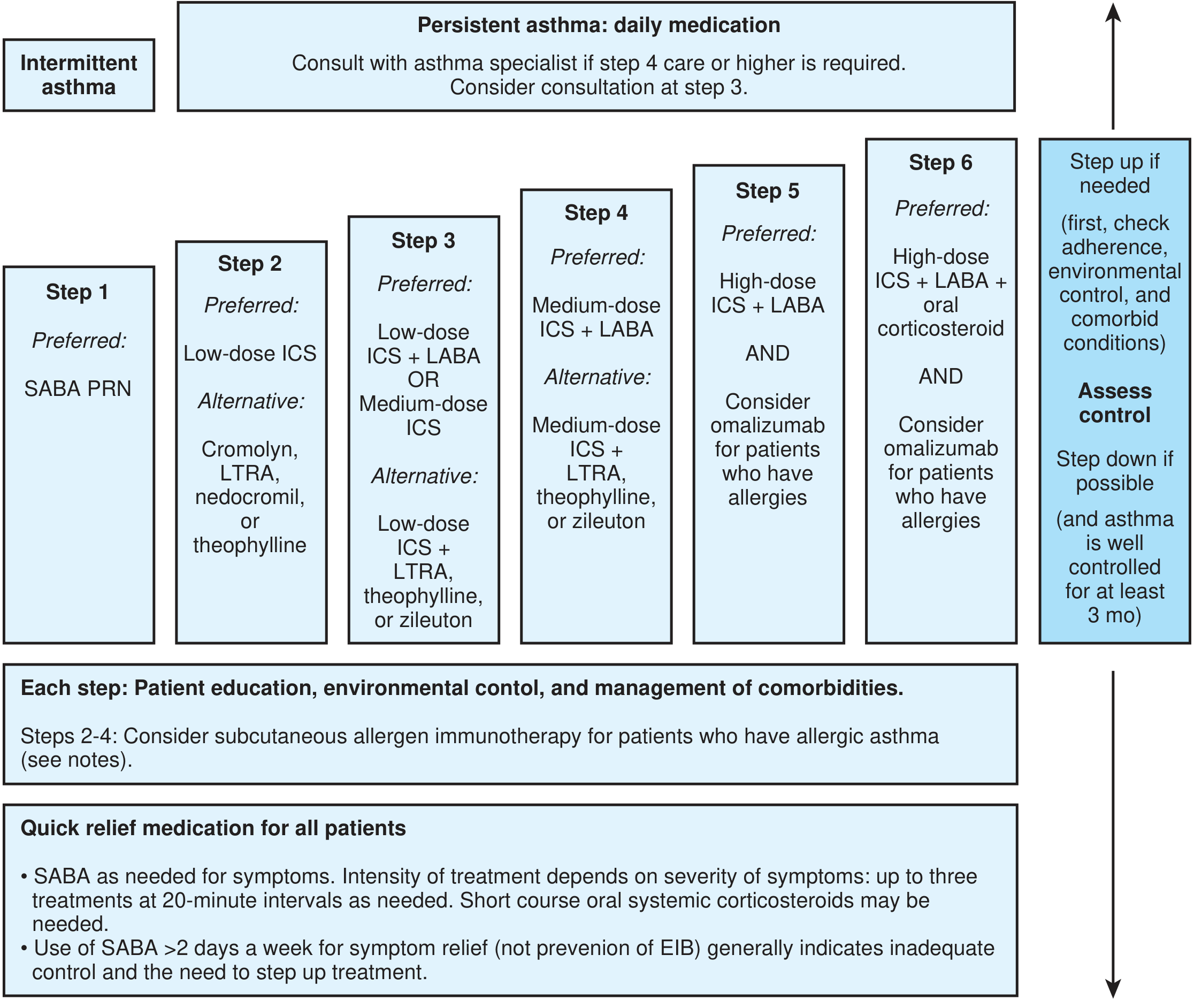
Step therapy for adults with asthma. ICS = inhaled corticosteroid; LABA = long-acting beta-agonist; LTRA = leukotriene receptor antagonist; SABA = short-acting beta-agonist.
Epidemiology
- Asthma affects approximately 26.8 million people in the United States
- It is the most common chronic disease of childhood, affecting ~4.5 million children in the US
- Prevalence increased from 1980 to 2010, but mortality and hospitalization rates have been declining since the late 1990s
- Affects over 5.4 million people in the UK
Key Takeaways
- Asthma = chronic airway inflammation + reversible obstruction + hyperresponsiveness
- Most cases are triggered by allergens or irritants; often co-exists with allergic rhinitis
- Spirometry is the diagnostic gold standard
- Inhaled corticosteroids are the cornerstone of maintenance treatment
- Good asthma control is achievable with proper identification of triggers and stepwise pharmacotherapy
Sources: Textbook of Family Medicine, 9th ed.; Murray & Nadel's Textbook of Respiratory Medicine
This is a shared conversation. Sign in to Orris to start your own chat.