
Different type of oxygen therapy
Reading File
Finding Sources
Searching the Web
types of oxygen therapy devices systems clinical overview
Reading File
Reading File
Finding Sources
Reading File
Reading File
Reading File
Reading File
Reading File
Reading File
Reading File
Loading Image
Finding Sources
Reading File
Reading File
I now have comprehensive information from multiple authoritative textbooks. Here is the full, detailed answer:
Types of Oxygen Therapy
Oxygen therapy is broadly divided based on flow delivery (low-flow vs. high-flow), delivery device, and setting (normobaric vs. hyperbaric). All devices aim to increase the fraction of inspired oxygen (FiO2) above room air (21%).
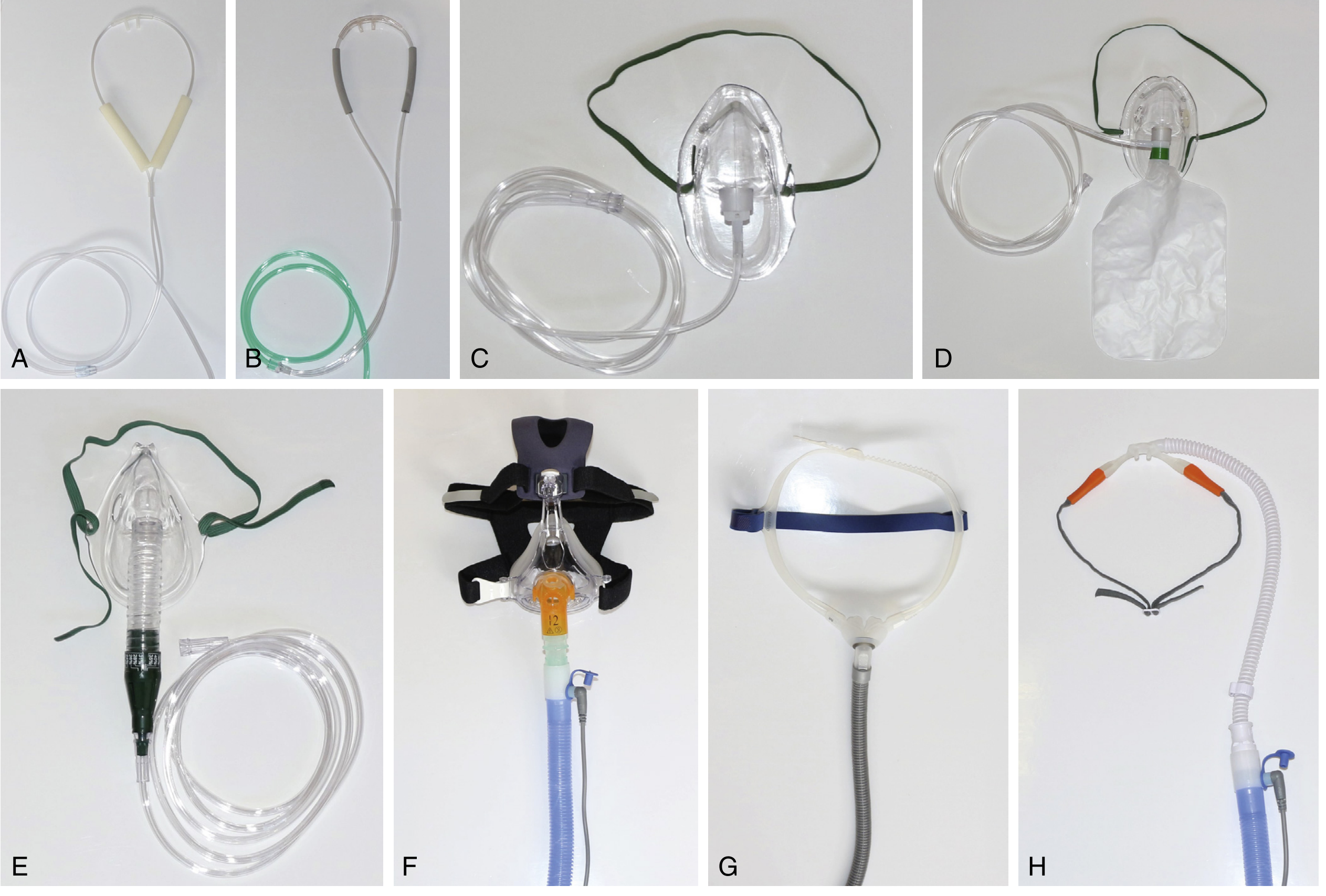
1. Low-Flow (Variable-Performance) Devices
These devices deliver oxygen at a flow rate that does not meet the patient's full inspiratory demand. Room air is entrained along with the delivered oxygen, so the actual FiO2 delivered varies with the patient's respiratory rate and tidal volume.
A. Nasal Cannula (Standard)
- Flow: 1-6 L/min
- FiO2: ~24-44% (each L/min adds approximately 4% FiO2 above room air)
- The most commonly used and best-tolerated device
- Above 4-5 L/min, patients often find the nasal jet flow uncomfortable; humidification is advised to prevent mucosal drying
- Requires nasal patency; FiO2 is unpredictable with mouth breathing
Reservoir variants (oxygen-conserving):
- Moustache-style reservoir cannula - a small (~20 mL) reservoir fills with oxygen during exhalation; delivers an oxygen bolus early in inspiration, reducing waste; patients can be maintained at a slightly lower flow rate
- Pendant reservoir cannula - a chest-worn reservoir (~same function) attached to standard nasal cannula tubing
B. Enhanced (Hudson) Nasal Cannula
- Flow: up to 15 L/min
- FiO2: 50-70%
- A three-channel design that allows higher flows than standard nasal prongs; not the same as heated high-flow nasal cannula (HFNC)
C. Simple Face Mask (Hudson Mask)
- Flow: 5-10 L/min (minimum 5 L/min to flush expired CO2)
- FiO2: ~35-60%
- Provides a larger oxygen reservoir than nasal cannulae (100-300 mL dead space of the mask cavity)
- FiO2 is variable, dependent on patient's minute ventilation
- Limitations: interferes with eating/drinking, risk of aspiration if vomiting, drying with prolonged use
2. Reservoir Mask Systems
These masks have a large attached reservoir bag (600-1000 mL) to store oxygen between breaths, enabling higher FiO2 delivery.
D. Partial Rebreathing Mask
- Flow: 10-15 L/min
- FiO2: ~50-75%
- The patient exhales the first third of tidal volume (mostly dead-space gas, high O2/low CO2) back into the reservoir bag, which then mixes with fresh oxygen for the next breath
- No one-way valves
- FiO2 still variable; largely replaced by the non-rebreather mask in clinical practice
E. Non-Rebreather Mask (NRB)
- Flow: ≥15 L/min (enough to keep reservoir bag at least half-full)
- FiO2: up to 80-95% (up to 60-80% with very high minute ventilation)
- A one-way valve between the reservoir bag and the mask prevents exhaled air from re-entering the reservoir; side-port one-way valves minimize ambient air inhalation
- First-line device for patients presenting with severe hypoxemia (SpO2 < 85%)
- Risk: prolonged high FiO2 can cause oxygen toxicity (pulmonary inflammation and reactive oxygen species injury)
3. High-Flow (Fixed-Performance) Devices
These devices deliver a flow that meets or exceeds the patient's inspiratory demand, so FiO2 is predictable and precise regardless of respiratory pattern.
F. Venturi Mask (Air-Entrainment Mask)
- Flow: variable (set by adapter/nozzle)
- FiO2: precisely 24%, 28%, 31%, 35%, 40%, or 50% (depending on the entrainment port/adapter used)
- Developed by E.J. Campbell (1967) based on the Bernoulli/Venturi principle: oxygen passes through a narrow jet nozzle at high velocity, creating a low-pressure zone that entrains a fixed, predictable ratio of ambient air
- Ideal for COPD patients requiring controlled, titrated oxygen (to avoid suppressing hypoxic drive) and for any condition where precise FiO2 is essential
- Humidification can slightly alter FiO2 (increases density of entrained air, resulting in a slightly higher FiO2)
G. High-Flow Nasal Cannula (HFNC)
- Flow: 40-60 L/min
- FiO2: 30-100% (fully adjustable and precise)
- Delivers heated (37°C), humidified (99.9% relative humidity) oxygen at very high flow rates through wide-bore nasal prongs
- Key physiological effects:
- FiO2 delivered equals that set on the device (flow exceeds patient's inspiratory demand)
- Produces a small CPAP effect (~1-3 cmH2O) from the high-velocity nasopharyngeal gas flow
- Flushes nasopharyngeal dead space with fresh oxygen-rich gas (CO2 washout)
- Reduces work of breathing
- Indications: hypoxemic respiratory failure (especially pneumonia, acute respiratory distress), post-extubation support, bridge before intubation
- FLORALI trial (2015): HFNC reduced intubation rate in patients with P/F ratio ≤200 compared with NIV or NRB mask
- Note: used cautiously in infectious conditions (e.g. COVID-19) due to aerosol generation concerns
4. Noninvasive Positive Pressure Devices
These provide oxygen while also applying positive airway pressure, improving both oxygenation and ventilation.
H. CPAP (Continuous Positive Airway Pressure)
- Delivers a fixed positive pressure throughout the respiratory cycle
- Recruits atelectatic alveoli, improves functional residual capacity (FRC), reduces work of breathing
- Used in OSA, cardiogenic pulmonary edema, postoperative hypoxemia
I. BiPAP / NIPPV (Non-Invasive Positive Pressure Ventilation)
- Delivers different pressures during inspiration (IPAP) and expiration (EPAP)
- Provides ventilatory support in addition to oxygenation
- Indications: COPD exacerbation with hypercapnia, acute cardiogenic pulmonary edema, immunocompromised patients with respiratory failure
- Delivered via full face mask, nasal mask, or nasal pillows
5. Invasive Mechanical Ventilation
- Endotracheal tube (ETT) or tracheostomy connected to a ventilator
- FiO2: 21-100% (precisely controlled)
- Reserved for patients failing all noninvasive methods, with severe respiratory failure, altered consciousness, or inability to protect airway
6. Hyperbaric Oxygen Therapy (HBO)
- Patient breathes 100% oxygen at pressures greater than 1 atmosphere (typically 2-3 atm) inside a sealed chamber
- At 2 atm: plasma oxygen content increases by ~125%; tissue oxygen tension increases 10-fold vs. room air
- Also produces vasoconstriction, reducing edema while maintaining enhanced oxygen delivery
- Indications: carbon monoxide poisoning, decompression sickness, necrotizing fasciitis, osteomyelitis, crush injuries, compromised wound healing, gas gangrene, central retinal artery occlusion, sudden sensorineural hearing loss
Quick Reference: FiO2 by Device
| Device | Flow Rate | FiO2 |
|---|---|---|
| Low-flow nasal cannula | 1-6 L/min | 24-44% |
| Simple face mask | 5-10 L/min | 35-60% |
| Partial rebreathing mask | 10-15 L/min | 50-75% |
| Non-rebreather mask | ≥15 L/min | 80-95% |
| Venturi mask | Fixed by adapter | 24-50% (precise) |
| High-flow nasal cannula | 40-60 L/min | 30-100% (precise) |
| Mechanical ventilator | - | 21-100% (precise) |
| Hyperbaric oxygen | - | 100% at >1 atm |
Key principle: The choice of device depends on the required FiO2, whether a precise/fixed FiO2 is needed (e.g., COPD = Venturi mask), the severity of hypoxemia, and patient tolerance.
- Fishman's Pulmonary Diseases and Disorders, Chapter 143
- Murray & Nadel's Textbook of Respiratory Medicine, Chapter 137
- Comprehensive Clinical Nephrology, 7th Edition, Table 15.3
- Miller's Anesthesia, 10th Edition
- Tintinalli's Emergency Medicine
Hey thanks for help
You're welcome! Happy to help anytime. Feel free to ask if you have more questions. 😊
This is a shared conversation. Sign in to Orris to start your own chat.