
Blood supply of intra orbital part of optic nerve
Reading File
Finding Sources
Finding Sources
Searching the Web
intraorbital optic nerve blood supply anatomy
Finding Sources
Finding Sources
Searching Images
intraorbital optic nerve blood supply diagram
Reading File
Loading Image
Reading File
I now have comprehensive information from both the textbook (Kanski's Clinical Ophthalmology) and web sources. Let me compile the complete answer.
Blood Supply of the Intraorbital Part of the Optic Nerve
The intraorbital segment of the optic nerve is 25–30 mm long, running from the posterior pole of the globe to the optic foramen at the orbital apex. It is supplied by two systems of vessels:
1. Periaxial System (Extrinsic / Peripheral)
These are vessels that surround the optic nerve, running in the pia mater and forming the pial plexus.
a) Ophthalmic Artery — the dominant contributor
- Arises from the internal carotid artery and runs inferolateral to the optic nerve as it enters the orbit, then crosses superomedially
- Gives off multiple direct pial branches along its course that supply the peripheral portions of the intraorbital nerve
- These branches enter the pia mater and form the pial arterial plexus (pia plexus), which encircles the nerve throughout its orbital course
b) Short Posterior Ciliary Arteries (SPCAs)
- 10–20 small branches arising from the ophthalmic artery
- Primarily supply the optic nerve head (prelaminar and laminar regions), but some branches also contribute to the proximal intraorbital segment via the pial plexus
c) Long Posterior Ciliary Arteries (LPCAs)
- Also contribute to the pial plexus supplying the intraorbital optic nerve
d) Other Branches
- Muscular branches and recurrent choroidal branches can contribute collaterally
The pial plexus is the key conduit — it supplies the peripheral portions (outer ~2/3) of the intraorbital nerve via centripetal branches penetrating inward through septal vessels.
2. Axial System (Intrinsic / Central)
These are vessels that run within the substance of the nerve itself.
Central Retinal Artery (CRA)
- The CRA is the first major branch of the ophthalmic artery
- It enters the optic nerve 8–12 mm behind the globe, piercing the inferior surface of the nerve
- As it travels anteriorly through the nerve to supply the retina, it gives off centrifugal branches that supply the central axial core of the intraorbital optic nerve
- These branches supply the inner ~1/3 of the nerve (axial zone)
Summary Table
| System | Main Vessels | Region Supplied |
|---|---|---|
| Periaxial (pial) | Ophthalmic artery branches → pial plexus | Peripheral/outer zone of intraorbital nerve |
| Axial (central) | Branches from central retinal artery | Central/axial core of intraorbital nerve |
Clinical Relevance
-
Posterior Ischemic Optic Neuropathy (PION): Ischemia of the retrolaminar intraorbital optic nerve, caused by compromise of the surrounding pial capillary plexus (supplied by small pial branches of the ophthalmic artery). Seen in major spine/cardiac surgeries with hypotension and blood loss. The CT scan may reveal enlargement of the intraorbital optic nerve. — Kanski's Clinical Ophthalmology, p. 778; Barash's Clinical Anesthesia
-
The central retinal artery enters the nerve 8–12 mm posterior to the globe; optic nerve sheath procedures or any mass posterior to this point can affect both the CRA (axial supply) and pial supply simultaneously.
-
Because the two systems (periaxial and axial) supply different zones, isolated CRA occlusion typically spares the outer nerve fibers.
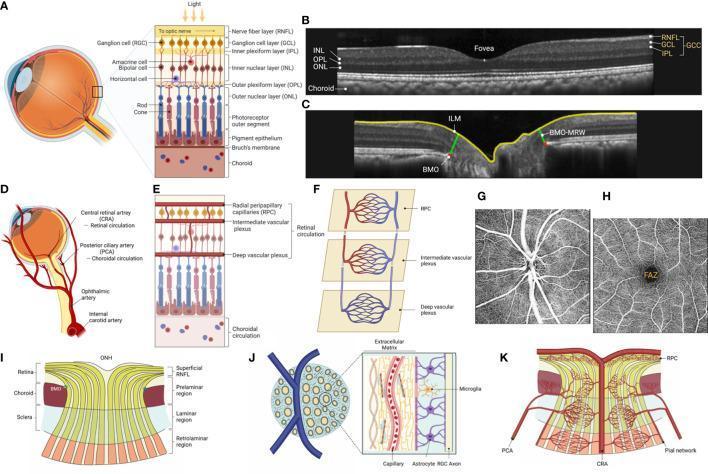
Panel D in the above figure shows the ophthalmic artery branching into the central retinal artery (CRA) and posterior ciliary arteries (PCA); Panel K shows the pial network alongside CRA supporting the optic nerve head.
Sources: Kanski's Clinical Ophthalmology: A Systematic Approach, 10th ed., p. 778; Barash's Clinical Anesthesia, 9th ed.
Pial plexus is formed by
Finding Sources
Finding Sources
Searching the Web
pial plexus optic nerve formed by branches anatomy
The pial plexus of the optic nerve has different contributors depending on the segment of the nerve. Here is a precise breakdown:
Pial Plexus of the Optic Nerve — Formed By:
The pial arterial plexus is a network of vessels lying within the pia mater that encircles the optic nerve. Its contributors vary by segment:
Retrolaminar (Proximal Intraorbital) — Anterior Segment
(between the optic disc and the point where the CRA enters the nerve)
The pial plexus here is supplied by multiple pial branches from:
- Peripapillary choroidal vessels
- Circle of Zinn–Haller (intrascleral arterial circle formed by SPCAs)
- Central retinal artery (pial branches given off before it enters the nerve)
- Ophthalmic artery (direct pial branches)
- Other orbital arteries (collateral pial branches)
Posterior Intraorbital — Posterior Segment
(between the entry of the CRA into the nerve and the orbital apex)
The pial plexus here is supplied predominantly by:
- Ophthalmic artery — multiple small collateral pial branches arising directly from the ophthalmic artery (the dominant and most consistent contributor)
- Other orbital arteries — less frequently
In ~10% of optic nerves, there is also an axial centrifugal system extending backward via intraneural branches of the CRA.
Summary
| Contributor | Role |
|---|---|
| Ophthalmic artery (direct pial branches) | Primary source, especially posterior intraorbital segment |
| Short posterior ciliary arteries | Via circle of Zinn–Haller; mainly anterior/retrolaminar |
| Central retinal artery (pial branches, pre-entry) | Contributes to anterior pial plexus |
| Peripapillary choroidal vessels | Anterior retrolaminar segment |
| Circle of Zinn–Haller | Retrolaminar/laminar region |
The pial plexus then sends centripetal branches inward through fibrous septa derived from the pia, supplying the peripheral ~2/3 of the nerve's cross-section. The central core is separately supplied by centrifugal branches of the CRA (axial system).
Key point (Hayreh): The ophthalmic artery is the single most important contributor to the pial plexus of the intraorbital optic nerve. Compromise of these small pial collaterals — as in perioperative hypotension or orbital compression — underlies Posterior Ischemic Optic Neuropathy (PION).
(Sources: Hayreh SS, Ischemic Optic Neuropathies, Springer 2011; Kanski's Clinical Ophthalmology 10e; EntoKey — The Optic Nerve)
This is a shared conversation. Sign in to Orris to start your own chat.