I now have comprehensive information from Yamada's Gastroenterology, Goodman & Gilman's, and Katzung's Pharmacology. Let me compile the full treatment protocol.
Ulcerative Colitis (UC) - Treatment Protocol with Drug Dosages
Disease Severity Classification
UC is classified by severity to guide therapy:
| Severity | Bowel Movements/Day | Rectal Bleeding | Systemic Signs |
|---|
| Mild | <4 | Mild/intermittent | None |
| Moderate | 4-6 | Moderate | Minimal |
| Severe | >6 | Frequent | Fever, tachycardia, anemia, elevated CRP |
| Acute Severe (ASUC) | ≥6 + 1 systemic sign | Present | Tachycardia, fever, Hb <10.5 g/dL, CRP >5 mg/dL |
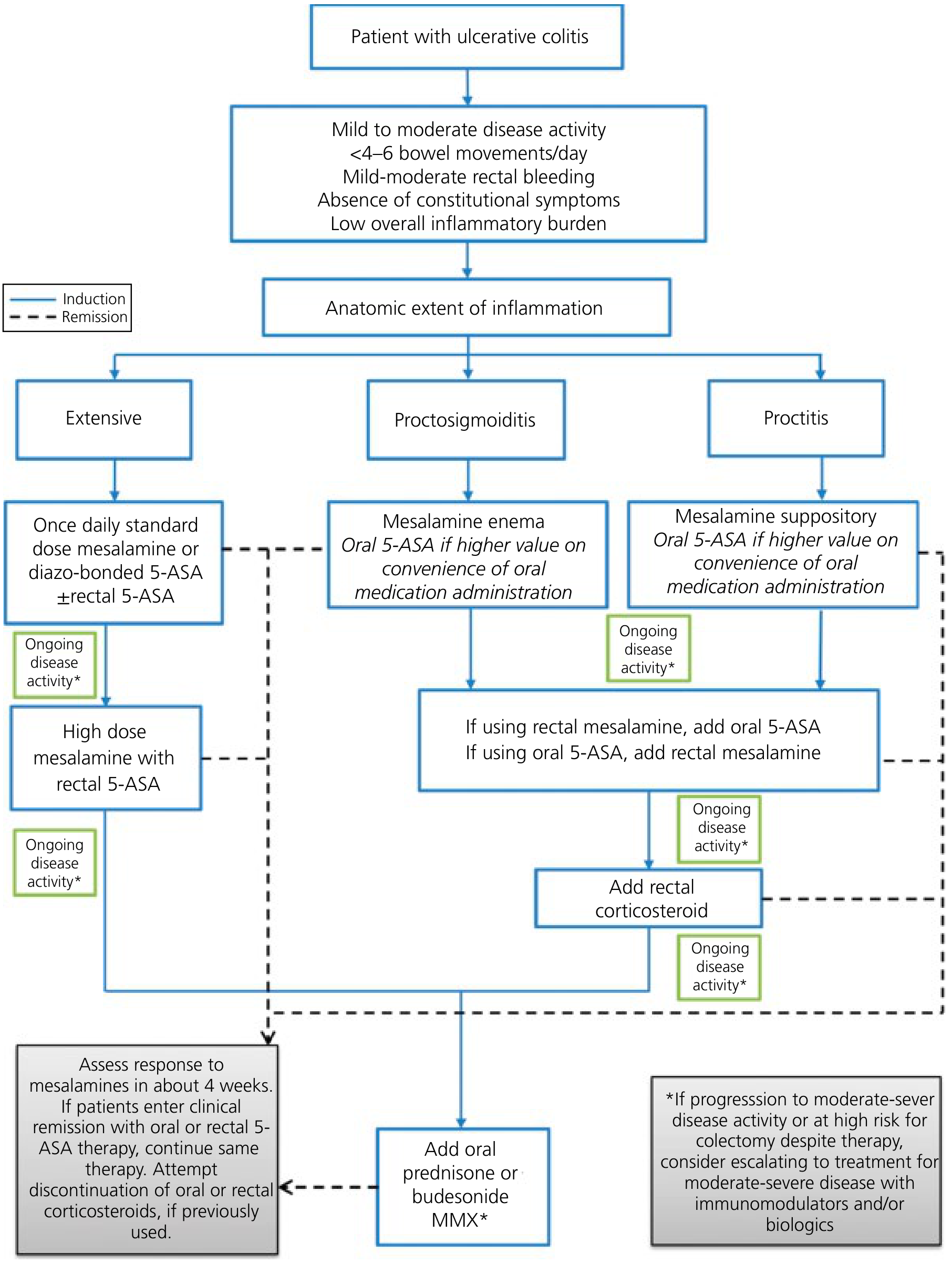
1. MILD TO MODERATE UC - Treatment Algorithm (AGA Guidelines)
Treatment is guided by the anatomic extent of disease.
A. Ulcerative Proctitis (inflammation limited to rectum)
First-line: Topical mesalamine (preferred over oral for proctitis)
| Drug | Formulation | Dosage |
|---|
| Mesalamine suppository | 1 g suppository | 1 g once nightly (can increase frequency in refractory cases); taper to alternate-day/twice-weekly in remission |
| Mesalamine foam/gel/liquid enema | 4 g/60 mL enema | 4 g rectally once at bedtime |
| Topical corticosteroids | Hydrocortisone foam 90 mg | Nightly as second-line after 5-ASA failure |
| Budesonide foam | 2 mg/actuation | 2 mg rectally once daily (less systemic absorption) |
Oral mesalamine may be used in patients who refuse rectal therapy, but is less effective than topical.
B. Proctosigmoiditis / Left-Sided Colitis
First-line: Mesalamine enema ± oral 5-ASA
- Start mesalamine enema; if inadequate response, add oral 5-ASA
- Or start oral 5-ASA and add rectal mesalamine if ongoing activity
- If still active: add rectal corticosteroid
C. Extensive Colitis (beyond splenic flexure)
First-line: Oral mesalamine ± rectal 5-ASA
| Drug | Standard Dose | High Dose |
|---|
| Mesalamine (Asacol, Lialda, Pentasa) | 2-3 g/day orally | >3 g/day (e.g., 4.8 g/day) |
| Balsalazide (diazo-bonded 5-ASA) | 6.75 g/day in 3 divided doses | - |
| Olsalazine | 1-3 g/day in divided doses | - |
| Sulfasalazine | 2-4 g/day (with folate supplementation) | Up to 6 g/day |
- Combined oral + rectal 5-ASA is ranked most efficacious for induction (~63% remission rate)
- High-dose mesalamine (>3 g/day) alone achieves ~33% remission
- Standard-dose mesalamine (2-3 g/day) achieves ~26% remission
If inadequate response to 5-ASA (~8 weeks):
Add oral prednisone (40-60 mg/day) or budesonide MMX (9 mg/day for 8 weeks - targeted release, less systemic side effects)
2. MODERATE TO SEVERE UC (High Risk of Complications)
Step 1 - Corticosteroids (Induction)
| Drug | Dose | Route | Duration |
|---|
| Prednisone | 40-60 mg/day | Oral | Taper over 8-12 weeks; do NOT use for maintenance |
| Methylprednisolone | ≤60 mg/day | IV (hospitalized) | 3-5 days |
| Hydrocortisone | 100 mg 3-4x/day | IV | 3-5 days |
| Budesonide MMX | 9 mg/day | Oral | Up to 8 weeks |
Corticosteroids are for induction only - never for maintenance. Steroid-dependent or steroid-refractory disease requires escalation to immunomodulators or biologics.
Step 2 - Immunomodulators (Maintenance / Steroid-Sparing)
| Drug | Dosage | Notes |
|---|
| Azathioprine (AZA) | 2-2.5 mg/kg/day orally | Check TPMT activity before starting; onset 3-6 months; used in combination with infliximab |
| 6-Mercaptopurine (6-MP) | 1-1.5 mg/kg/day orally | Alternative to AZA; same TPMT caution |
| Methotrexate | Not recommended as monotherapy for UC | May be used as combination with anti-TNF |
Step 3 - Biologics & Small Molecules (Moderate-Severe / Refractory Disease)
Anti-TNF-α Agents
| Drug | Induction Dose | Maintenance Dose | Route |
|---|
| Infliximab | 5 mg/kg at 0, 2, 6 weeks | 5 mg/kg every 8 weeks | IV infusion |
| Adalimumab | 160 mg at week 0, 80 mg at week 2 | 40 mg every 2 weeks | SC injection |
| Golimumab | 200 mg at week 0, 100 mg at week 2 | 100 mg every 4 weeks | SC injection |
Infliximab is preferred over adalimumab/golimumab in most patients. In high inflammatory burden, combine infliximab + azathioprine (superior to either alone). In ASUC: infliximab 5 mg/kg or 10 mg/kg if low serum albumin.
Integrin Antagonist (Gut-Selective Biologic)
| Drug | Induction Dose | Maintenance Dose | Route |
|---|
| Vedolizumab | 300 mg at 0, 2, 6 weeks | 300 mg every 8 weeks | IV infusion |
Preferred in patients at higher risk of treatment-related complications (prior serious infections, prior malignancy, older age, multiple comorbidities). Gut-selective mechanism - no systemic immunosuppression. Often used as monotherapy.
IL-12/23 Antagonist
| Drug | Induction Dose | Maintenance Dose | Route |
|---|
| Ustekinumab | 260-520 mg (weight-based) | 90 mg SC every 8 weeks | IV (induction), SC (maintenance) |
IV induction: <55 kg: 260 mg; 55-85 kg: 390 mg; >85 kg: 520 mg. Onset peak in 1-2 weeks. t½ up to 120 days.
JAK Inhibitors (Small Molecules - Oral)
| Drug | Induction Dose | Maintenance Dose |
|---|
| Tofacitinib | 10 mg twice daily x 8 weeks | 5 mg twice daily (or 10 mg BID if refractory) |
| Upadacitinib | 45 mg once daily x 8 weeks | 15 mg or 30 mg once daily |
Important FDA warning: Tofacitinib carries a black-box warning for increased risk of venous thromboembolism, serious cardiovascular events, and malignancy (especially at 10 mg BID). NOT recommended as first-line. Used after failure of anti-TNF agents. Upadacitinib has similar cautions.
Positioning of Biologics (Moderate-Severe UC)
First-line biologic choice:
- Vedolizumab - for risk-averse patients, elderly, prior infections/malignancy
- Infliximab - for high inflammatory burden, severe extraintestinal manifestations, rapid onset needed
After failure of infliximab (second-line):
- Ustekinumab or tofacitinib preferred
- Vedolizumab if more moderate burden + higher safety concern
3. ACUTE SEVERE ULCERATIVE COLITIS (ASUC) - Inpatient Protocol
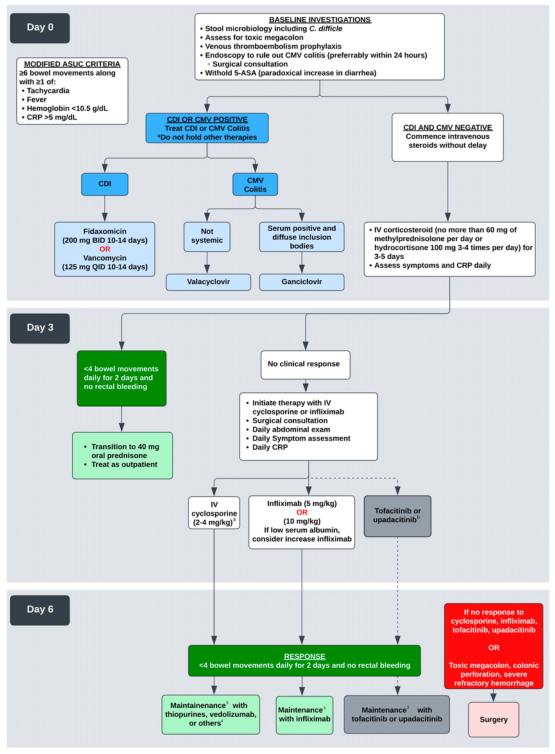
Modified ASUC Criteria: ≥6 bowel movements/day + ≥1 of: tachycardia, fever, Hb <10.5 g/dL, CRP >5 mg/dL
Day 0 - Initial Assessment
- Stool microbiology including C. difficile (CDI)
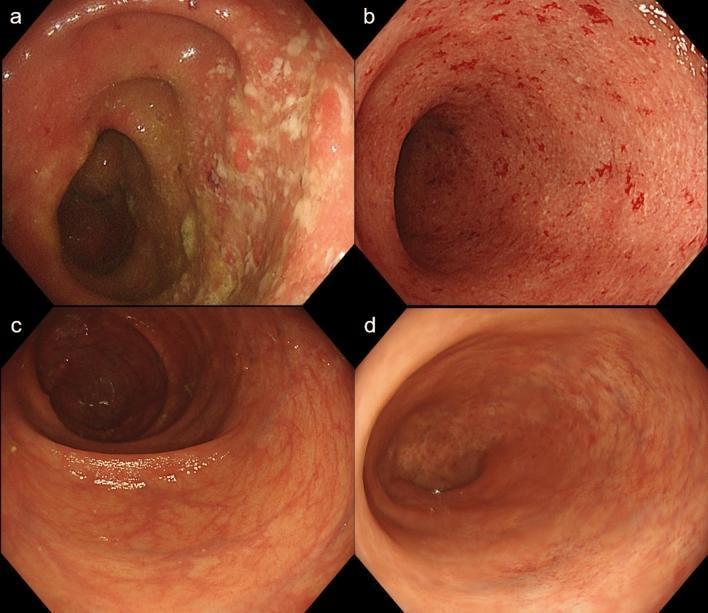
- Rule out CMV colitis by endoscopy (within 24 hours)
- Assess for toxic megacolon
- VTE prophylaxis
- Surgical consultation
- Withhold 5-ASA (paradoxical increase in diarrhea)
If CDI positive: Fidaxomicin 200 mg BID x 10-14 days OR Vancomycin 125 mg QID x 10-14 days (do NOT hold other therapies)
If CMV colitis: Valacyclovir (non-systemic) or Ganciclovir (systemic/diffuse inclusion bodies)
If CDI and CMV negative: Start IV corticosteroids immediately
- Methylprednisolone ≤60 mg/day IV, OR
- Hydrocortisone 100 mg IV 3-4x/day
- Duration: 3-5 days; assess symptoms and CRP daily
Day 3 - Response Assessment
Responding (<4 BMs/day for 2 days, no rectal bleeding):
- Transition to oral prednisone 40 mg/day; treat as outpatient
Not responding - Salvage Therapy:
| Drug | Dose | Notes |
|---|
| IV Cyclosporine | 2-4 mg/kg/day continuous IV infusion | Monitor levels; transition to oral; bridge to thiopurines |
| Infliximab | 5 mg/kg IV; consider 10 mg/kg if low albumin | Single or 3-dose induction |
| Tofacitinib | 10 mg BID | Oral; consider if biologic failure |
| Upadacitinib | 45 mg OD | Oral; emerging role |
Day 6 - Further Assessment
Responding: Maintain with:
- If cyclosporine used: thiopurines, vedolizumab, or others
- If infliximab used: continue infliximab maintenance
- If tofacitinib/upadacitinib used: continue same agent
Not responding / Complications present:
- Surgery (colectomy) - indicated for: no response to salvage therapy, toxic megacolon, colonic perforation, severe refractory hemorrhage
4. MAINTENANCE OF REMISSION
| Scenario | Preferred Maintenance Agent |
|---|
| Mild UC (5-ASA induced remission) | Mesalamine 1.5-4 g/day orally (long-term) |
| Proctitis in remission | Mesalamine suppository alternate-day to twice-weekly |
| Steroid-induced remission (moderate) | Add azathioprine 2-2.5 mg/kg/day OR 6-MP |
| Biologic-induced remission | Continue same biologic at maintenance dose |
| Post-cyclosporine remission | Bridge to thiopurines or vedolizumab |
Corticosteroids are never used for maintenance. Patients on long-term 5-ASA for maintenance: check renal function annually (risk of interstitial nephritis).
5. SPECIAL SITUATIONS
Pouchitis (after ileal pouch-anal anastomosis)
- First-line: Ciprofloxacin 500 mg BID x 2-4 weeks OR Metronidazole 500-1000 mg/day
- Refractory: combine both; for antibiotic-dependent pouchitis - cyclical antibiotics
Pregnancy
- Mesalamine is safe in pregnancy (all trimesters)
- Sulfasalazine: supplement with folate 2 mg/day
- Biologics (infliximab, adalimumab, vedolizumab): generally continued; avoid in third trimester if possible due to neonatal immunosuppression
Drug Summary Table
| Drug Class | Drug | Induction Dose | Maintenance Dose |
|---|
| 5-ASA (oral) | Mesalamine | 2.4-4.8 g/day | 1.5-4 g/day |
| 5-ASA (topical) | Mesalamine suppository | 1 g nightly | Alternate day to 2x/week |
| 5-ASA (topical) | Mesalamine enema | 4 g nightly | 4 g every 2-3 nights |
| Corticosteroid (oral) | Prednisone | 40-60 mg/day | Not for maintenance |
| Corticosteroid (oral) | Budesonide MMX | 9 mg/day x 8 wks | Not for maintenance |
| Corticosteroid (IV) | Methylprednisolone | ≤60 mg/day | N/A |
| Corticosteroid (IV) | Hydrocortisone | 100 mg 3-4x/day | N/A |
| Immunomodulator | Azathioprine | - | 2-2.5 mg/kg/day |
| Immunomodulator | 6-Mercaptopurine | - | 1-1.5 mg/kg/day |
| Anti-TNF | Infliximab | 5 mg/kg at 0,2,6 wks | 5 mg/kg q8 wks (IV) |
| Anti-TNF | Adalimumab | 160/80 mg (wk 0,2) | 40 mg q2 wks (SC) |
| Anti-TNF | Golimumab | 200/100 mg (wk 0,2) | 100 mg q4 wks (SC) |
| Integrin antagonist | Vedolizumab | 300 mg at 0,2,6 wks | 300 mg q8 wks (IV) |
| IL-12/23 antagonist | Ustekinumab | 260-520 mg IV (weight-based) | 90 mg SC q8 wks |
| JAK inhibitor | Tofacitinib | 10 mg BID x 8 wks | 5 mg BID (oral) |
| JAK inhibitor | Upadacitinib | 45 mg OD x 8 wks | 15-30 mg OD (oral) |
| Calcineurin inhibitor | Cyclosporine | 2-4 mg/kg/day IV | Bridge only |
Sources: Yamada's Textbook of Gastroenterology (7th ed.), Goodman & Gilman's Pharmacological Basis of Therapeutics, Katzung's Basic and Clinical Pharmacology (16th ed.)