
Give me a full notes on liver cirrhosis
Reading File
Now I'll search the medical library for comprehensive cirrhosis coverage across multiple dimensions simultaneously.
Finding Sources
Finding Sources
Searching PubMed
"liver cirrhosis"[MeSH Terms] AND "management"[MeSH Terms]
Excellent sources found. Now let me read the key textbook sections in parallel — Robbins (pathology), Harrison's (clinical), Sleisenger (GI), and Yamada (gastroenterology):
Reading File
Reading File
Reading File
Finding Sources
Rich content retrieved. Let me now read more sections for complications, diagnosis, treatment, and prognosis:
Reading File
Reading File
Reading File
Excellent content. Let me read more for clinical features, scoring systems, treatment, and get the key images:
Reading File
Reading File
Loading Image
Loading Image
Now I have comprehensive content. Let me read the treatment section and Child-Pugh/MELD scoring from the sources:
Reading File
Finding Sources
Reading File
Reading File
Reading File
I now have comprehensive content across all key domains. Let me compile the full, well-structured notes on liver cirrhosis.
Liver Cirrhosis — Comprehensive Notes
1. Definition
Cirrhosis is the diffuse transformation of the entire liver into regenerative parenchymal nodules surrounded by fibrous bands, representing the final common pathway of a wide variety of chronic liver diseases. It is a pathologic entity defined by:
- Diffuse hepatic fibrosis
- Replacement of normal liver architecture by nodules (both regenerative and fibrotic)
- Disruption of vascular relationships
Cirrhosis is not a specific diagnosis — it has variable prognostic implications depending on etiology, stage, and response to therapy. Regression of fibrosis (and even of established cirrhosis) may occur with disease remission or cure.
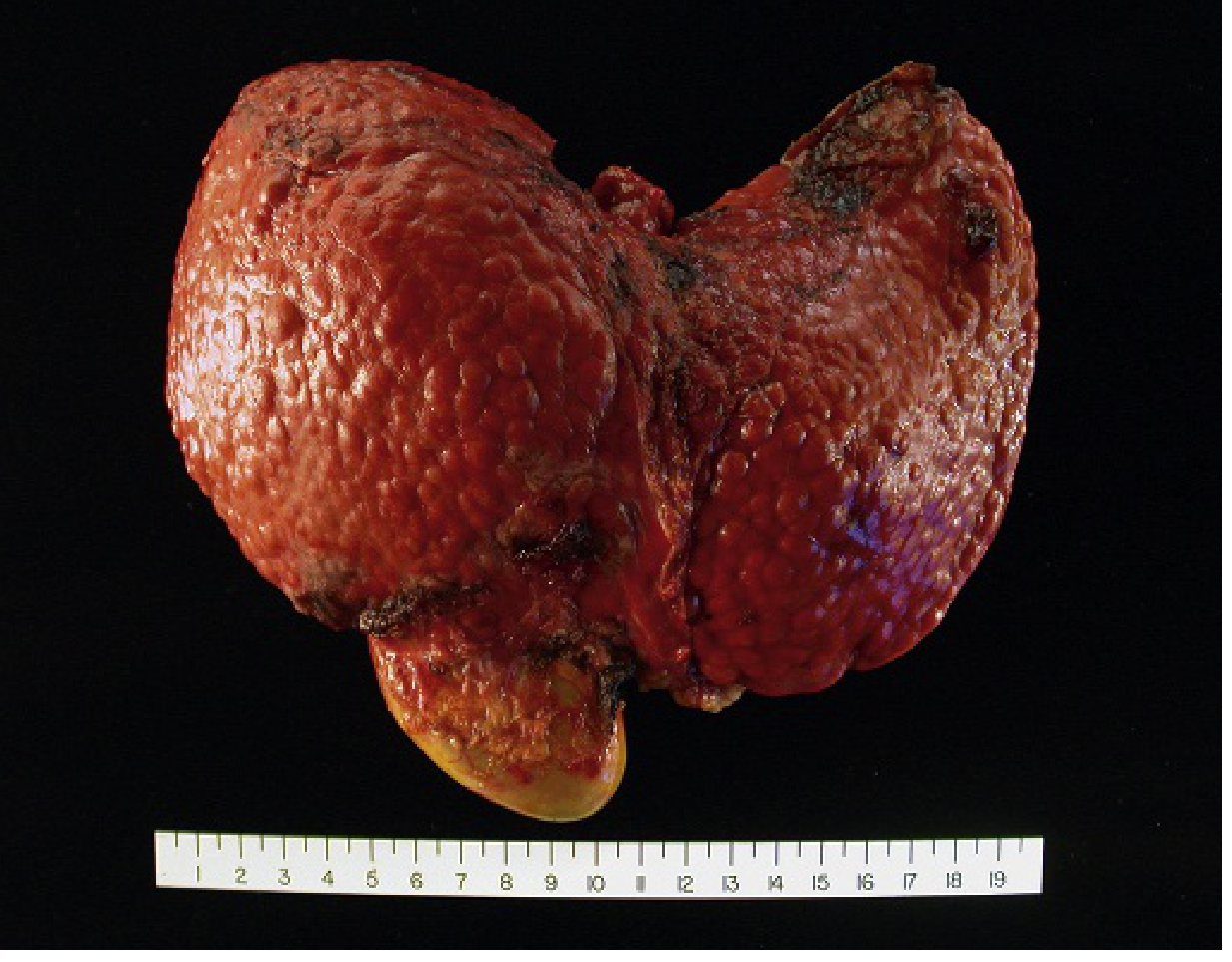
Gross appearance: The liver surface is covered with bulging regenerative nodules separated by broad scars.
2. Etiology / Causes
| Category | Specific Causes |
|---|---|
| Alcohol | Alcohol-associated liver disease (~48% of cirrhosis deaths in USA) |
| Viral | Chronic Hepatitis B, Chronic Hepatitis C |
| Metabolic | MASLD/NAFLD/NASH (metabolic dysfunction-associated steatotic liver disease) |
| Biliary | Primary biliary cholangitis (PBC), Primary sclerosing cholangitis (PSC), biliary obstruction |
| Autoimmune | Autoimmune hepatitis |
| Vascular | Cardiac cirrhosis (right heart failure), Budd-Chiari syndrome |
| Metabolic/Genetic | Hemochromatosis, Wilson's disease, α1-antitrypsin deficiency |
| Drugs/Toxins | High-dose vitamin A, methotrexate |
| Cryptogenic | No clear cause identified (~5–10% of cases) |
Alcohol-associated cirrhosis = micronodular (<3 mm). With cessation of alcohol, larger nodules may form → mixed micro- and macronodular.
3. Pathogenesis
Key Cellular Players
Hepatic stellate cell (HSC) is the principal cell responsible for fibrosis:
- Normally a pericyte in the Space of Dissé (abluminal to sinusoidal endothelium)
- Upon activation → transforms into myofibroblast
- Characterized by: ↑ smooth muscle actin expression, ↑ motility/contractility, collagen type 1 production
- Earliest matrix product = fibronectin, then collagen type 1
- Activating pathways: PDGF, TGF-β, integrin signaling
Other contributing cells:
- Portal fibroblasts → implicated in biliary forms of injury (PBC, PSC)
- Kupffer cells (macrophages) → release profibrogenic cytokines → activate stellate cells; some subclasses promote fibrosis, others resolve it
- Hepatocytes → epithelial cell injury (apoptosis, necrosis, inflammation) is the initiating event
Fibrosis Cascade (simplified)
Hepatocyte injury → Kupffer cell activation → cytokine release (TGF-β, PDGF)
→ Stellate cell activation → myofibroblast transformation
→ Collagen/ECM deposition → progressive fibrosis → nodule formation
→ Disruption of vascular architecture → CIRRHOSIS
Alcohol-Specific Mechanism
- Ethanol → ADH → acetaldehyde (highly reactive)
- Also via CYP2E1 (MEOS) → reactive oxygen species (ROS)
- Acetaldehyde adducts interfere with microtubule formation and protein trafficking
- ROS → Kupffer cell activation → stellate cell activation → collagen production
- Fatty acid oxidation ↓, lipoprotein secretion ↓ → steatosis
- Fibrosis: centrilobular, pericellular, or periportal → connects portal triads to central veins
4. Morphology
Gross
- Entire liver replaced by regenerative nodules separated by fibrous septa
- Surface nodularity easily visible
- Liver may be enlarged (early) or shrunken/small (late)
- Nodule size varies: micronodular (<3 mm, e.g., alcoholic) vs. macronodular (>3 mm, e.g., viral)
Microscopic
- Fibrous bands linking portal tracts to each other OR portal tracts to central veins
- Regenerative nodules surrounded by fibrosis
- Ductular reactions (stem cell-derived ductlike structures) increase with disease progression, most prominent in cirrhosis
- Variable degrees of parenchymal loss and vascular thrombosis (especially portal vein)
Reversibility
- Regression of fibrosis may follow disease remission/cure
- Scars become thinner, compact, then fragment
- Adjacent nodules coalesce into larger parenchymal islands
- All cirrhotic livers show elements of both progression and regression
5. Clinical Features
Compensated Cirrhosis (~40% asymptomatic)
- Often discovered incidentally on imaging, labs, or endoscopy
- Nonspecific: fatigue, weight loss, ↓ muscle mass, ↓ libido, sleep disturbances
- ~40% have esophageal varices (asymptomatic if not bleeding)
- Normal/near-normal liver synthetic function
Decompensated Cirrhosis (signs of organ failure)
- Ascites (most frequent sign of decompensation — present in 80%)
- Variceal hemorrhage
- Hepatic encephalopathy
- Jaundice
Physical Examination Findings
| Sign | Mechanism |
|---|---|
| Jaundice | ↓ bilirubin conjugation/excretion |
| Spider angiomata | ↑ estrogen, arteriovenous shunting |
| Palmar erythema | ↑ estrogen |
| Gynecomastia, testicular atrophy | ↑ estrogen (impaired hepatic metabolism) |
| Leukonychia (white nails) | Hypoalbuminemia |
| Clubbing | Hypoxia (hepatopulmonary syndrome) |
| Caput medusae | Portosystemic collaterals |
| Splenomegaly | Portal hypertension → hypersplenism |
| Dupuytren's contracture | Associated with alcohol use |
| Pruritus | Cholestasis — bile salt accumulation |
| Asterixis (flap) | Hepatic encephalopathy |
| Muscle wasting / sarcopenia | Malnutrition, hyperammonemia |
| Fetor hepaticus | Exhaled mercaptans |
6. Complications
Framework
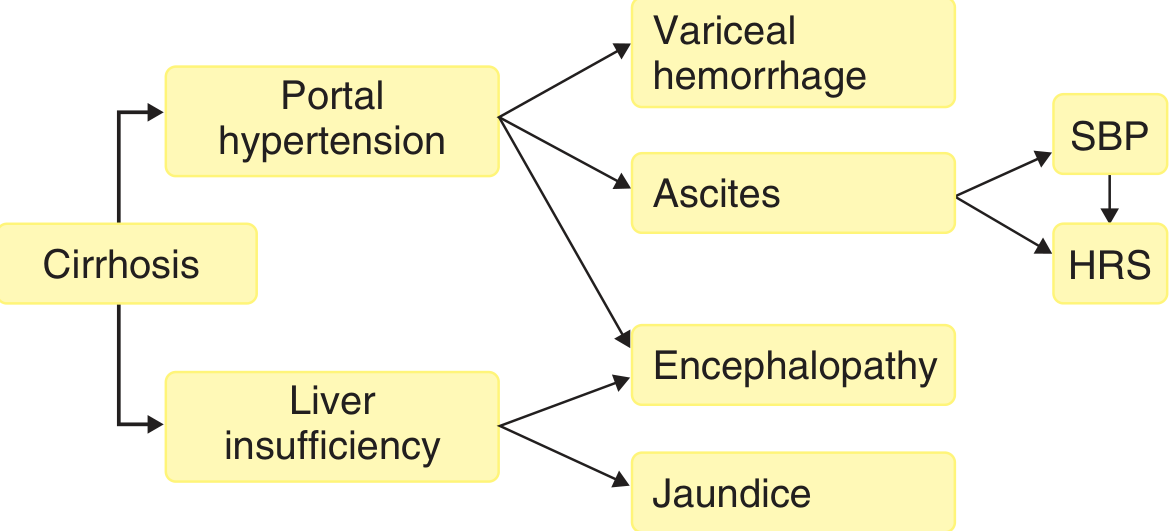
A. Portal Hypertension
- HVPG (Hepatic Venous Pressure Gradient) >10–12 mmHg → varices develop
- HVPG >12 mmHg → risk of variceal bleeding
- Mechanisms:
- Fixed component: fibrous tissue + nodule compression of sinusoids
- Functional component: intrahepatic NO deficiency → vasoconstriction
- Paradox: intrahepatic NO ↓ (vasoconstriction) but extrahepatic NO ↑ (splanchnic vasodilation)
- Splanchnic vasodilation → ↑ portal inflow → maintains portal hypertension
- Systemic vasodilation → ↓ effective arterial volume → RAAS activation → Na/water retention → hyperdynamic circulation
B. Varices and Variceal Hemorrhage
- Present in ~50% of newly diagnosed cirrhosis
- Prevalence: Child A 40% → Child C 85%
- Growth rate: 7–8%/year; small varices bleed ~5%/year; large varices ~15%/year
- Predictors of hemorrhage: large varices, severe liver disease (Child C), red wale markings
- Manifestation: hematemesis, melena, or both
- Diagnosis: upper GI endoscopy (active bleed, white nipple sign, clot on varix, or varices as only source)
C. Ascites
- Most common cause of decompensation; 80% of decompensated patients
- Rate of development: 7–10%/year in compensated cirrhosis
- Pathophysiology: Sinusoidal portal hypertension → splanchnic vasodilation → ↓ effective arterial volume → RAAS activation → Na/water retention
- SAAG (Serum-Ascites Albumin Gradient):
| Condition | SAAG | Ascites protein |
|---|---|---|
| Cirrhosis | High (>1.1 g/dL) | Low |
| Cardiac ascites | High | High |
| Malignant/TB ascites | Low | High |
- Paracentesis mandatory for new-onset ascites: check albumin, total protein, PMN count, culture, cytology
D. Spontaneous Bacterial Peritonitis (SBP)
- Ascites PMN count ≥250 cells/mm³ = diagnostic
- Most common organisms: E. coli, Klebsiella, Streptococcus pneumoniae
- Treatment: 3rd generation cephalosporins (e.g., cefotaxime)
- Prophylaxis: norfloxacin in high-risk patients
- Associated with 4-fold ↑ mortality
E. Hepatic Encephalopathy (HE)
- Results from portosystemic shunting + liver insufficiency → ↑ ammonia and other toxins reach brain
- Grades I–IV (West Haven criteria)
- Precipitants: GI bleed, infection, dehydration, constipation, electrolyte disturbance, sedatives
- Treatment: lactulose (reduces ammonia), rifaximin (non-absorbable antibiotic)
F. Hepatorenal Syndrome (HRS)
- Functional renal failure in advanced cirrhosis — no intrinsic kidney disease
- Type 1 (now HRS-AKI): rapid onset, sCr doubles to >2.5 mg/dL in <2 weeks
- Type 2 (now HRS-CKD): gradual, associated with refractory ascites
- Mechanism: extreme splanchnic vasodilation → renal vasoconstriction
- Treatment: terlipressin + albumin (preferred); norepinephrine + albumin; TIPS; liver transplant
G. Hepatopulmonary Syndrome
- Intrapulmonary vascular dilation → hypoxemia
- Classic: platypnea (SOB worse upright, better supine), orthodeoxia
- Diagnosis: contrast echocardiography (bubble test), 99mTc-MAA scan
H. Portopulmonary Hypertension
- Pulmonary arterial hypertension in setting of portal hypertension
- Diagnosis: right heart catheterization (mPAP ≥25 mmHg)
I. Hepatocellular Carcinoma (HCC)
- Can develop at any stage of cirrhosis; accelerates course
- Annual risk ~2–4% in cirrhotic patients
- Surveillance: liver ultrasound every 6 months ± AFP
J. Other Complications
- Hepatic hydrothorax: transdiaphragmatic movement of ascites → pleural effusion (usually right-sided)
- Cirrhotic cardiomyopathy: impaired cardiac contractile response to stress
- Coagulopathy: ↓ synthesis of clotting factors (II, V, VII, IX, X)
- Thrombocytopenia: hypersplenism, ↓ thrombopoietin
- Hyponatremia: dilutional (water retention > sodium)
- Osteoporosis: especially in cholestatic disease
- Hypogonadism, adrenal insufficiency, malnutrition
7. Diagnosis
Laboratory Tests
| Test | Finding in Cirrhosis |
|---|---|
| ALT/AST | Mildly elevated or normal (late cirrhosis — few hepatocytes left) |
| ALP, GGT | Elevated (especially biliary cirrhosis) |
| Bilirubin | Elevated (conjugated and unconjugated) |
| Albumin | ↓ (best marker of synthetic function) |
| PT/INR | Prolonged (↓ clotting factor synthesis) |
| Platelets | ↓ (hypersplenism) |
| Sodium | ↓ (dilutional hyponatremia) |
| Creatinine | ↑ in HRS |
| CBC | Pancytopenia from hypersplenism |
Imaging
- Ultrasound (US): Heterogeneous echogenicity, nodular surface, splenomegaly, ascites, collateral vessels — first-line
- CT scan: Nodular liver contour, varices, splenomegaly, HCC detection
- MRI/MRCP: Better soft tissue detail; useful for HCC characterization
- Transient Elastography (FibroScan): Liver stiffness >14 kPa suggests cirrhosis; >21 kPa associated with portal hypertension; <19.5 kPa — varices unlikely
- ARFI elastography: >2.6 m/sec suggests cirrhosis
- MR Elastography (MRE): Stiffness >5.9 kPa suggests cirrhosis; liver biopsy often not required
Liver Biopsy
- Gold standard for confirming cirrhosis and assessing fibrosis stage
- Required when non-invasive tests are inconclusive
- Contraindicated with significant coagulopathy (use transjugular approach)
- Fibrosis staging: Metavir F0–F4 (F4 = cirrhosis)
Non-invasive Fibrosis Markers
- FIB-4 index = (age × AST) / (platelets × √ALT)
- APRI score
- Commercial panels (FibroTest, ELF test)
- Useful for distinguishing early from late fibrosis, but not individual stages
8. Staging / Prognostic Scoring
Child-Pugh Score (Child-Turcotte-Pugh)
| Parameter | 1 point | 2 points | 3 points |
|---|---|---|---|
| Bilirubin (mg/dL) | <2 | 2–3 | >3 |
| Albumin (g/dL) | >3.5 | 2.8–3.5 | <2.8 |
| PT prolongation (sec) / INR | <4 / <1.7 | 4–6 / 1.7–2.3 | >6 / >2.3 |
| Ascites | None | Mild | Moderate–Severe |
| Encephalopathy | None | Grade 1–2 | Grade 3–4 |
| Class | Score | 1-year survival | 2-year survival |
|---|---|---|---|
| A (compensated) | 5–6 | 100% | 85% |
| B | 7–9 | 80% | 60% |
| C (decompensated) | 10–15 | 45% | 35% |
- Class B (score ≥7) = traditional criterion for liver transplant listing
- Class A = "compensated cirrhosis"
MELD Score (Model for End-Stage Liver Disease)
Formula:
MELD = 3.78 × ln[bilirubin mg/dL] + 11.2 × ln[INR] + 9.57 × ln[creatinine mg/dL] + 6.43- Uses: INR, bilirubin, creatinine
- Modified as MELD-Na (incorporates serum sodium) for better mortality prediction
- Current standard for liver transplant organ allocation in the USA (replaced Child-Pugh)
- Higher score = higher 90-day mortality on transplant waiting list
- Online calculator: OPTN MELD calculator
PELD Score
- Used for pediatric patients (<12 years)
9. Natural History
- Compensated → Decompensated: ~5–7% per year
- Median time to decompensation: ~6 years from diagnosis
- 10-year probability of decompensation from compensated state: 58%
- Annual decompensation rate by etiology:
- HCV-related: 4%/year
- Alcohol-related: 6–10%/year (higher if actively drinking)
- HBV-related: 10%/year
Survival
- Compensated cirrhosis: median survival 9–12 years
- Decompensated cirrhosis: median survival ~2 years
- Overall 5-year survival: ~38%; 10-year: ~22% (Danish population study)
- Patients with infection: 4× ↑ mortality
- Patients with renal failure: 7–8× ↑ mortality
10. Treatment
General Principles
- Treat the underlying cause (most important to slow/reverse fibrosis):
- HCV → direct-acting antivirals (cure possible → regression of fibrosis)
- HBV → nucleos(t)ide analogs (entecavir, tenofovir)
- Alcohol → abstinence (mandatory)
- MASLD/NASH → weight loss, metabolic control
- PBC → ursodeoxycholic acid (UDCA) 13–15 mg/kg/day
- Autoimmune hepatitis → corticosteroids ± azathioprine
- Hemochromatosis → phlebotomy
- Wilson's disease → penicillamine / trientine
Compensated Cirrhosis Management
- HCC surveillance: Liver US ± AFP every 6 months
- Variceal screening: Upper endoscopy at diagnosis; repeat every 1–3 years if no varices
- Non-selective beta-blockers (propranolol, nadolol, carvedilol) for medium/large varices — reduce portal pressure
- Endoscopic band ligation (EBL): Primary prophylaxis for large varices
- Immunizations: HAV, HBV, pneumococcal, influenza, COVID-19
- Statins: Use in chronic viral hepatitis → reduced risk of decompensation and mortality
- Avoid NSAIDs, aminoglycosides
- Acetaminophen ≤2 g/day acceptable
- Alcohol abstinence
- Weight loss reduces portal pressure
Decompensated Cirrhosis Management
Ascites
- Grade 1 (mild): Sodium restriction (<2 g/day)
- Grade 2 (moderate): Spironolactone (100–400 mg/day) ± furosemide (40–160 mg/day)
- Grade 3 (large/tense): Large-volume paracentesis (LVP) + IV albumin (6–8 g per liter removed)
- Refractory ascites: TIPS (transjugular intrahepatic portosystemic shunt) or repeated LVP
Variceal Hemorrhage
- Acute bleeding:
- IV terlipressin (preferred) or octreotide/somatostatin
- Endoscopic band ligation (EBL) within 12 hours
- IV antibiotics (ceftriaxone) — reduce risk of SBP and improve survival
- Consider early TIPS (pre-emptive TIPS) in Child C patients
- Secondary prophylaxis: NSBB + EBL (combination)
- Primary prophylaxis (large varices): NSBB or EBL
Hepatic Encephalopathy
- Identify and treat precipitants
- Lactulose — titrate to 2–3 soft stools/day
- Rifaximin 550 mg BID — secondary prophylaxis; reduces recurrence by ~58%
- Adequate protein intake (1.2–1.5 g/kg/day; do NOT restrict protein)
- BCAA supplements in refractory cases
Spontaneous Bacterial Peritonitis
- IV cefotaxime 2 g q8h × 5 days
- IV albumin 1.5 g/kg on day 1, 1 g/kg on day 3 → prevents HRS
- Long-term prophylaxis: norfloxacin 400 mg/day or trimethoprim-sulfamethoxazole
Hepatorenal Syndrome
- Terlipressin + albumin (1st line where available)
- Norepinephrine + albumin (in ICU setting)
- Discontinue diuretics, nephrotoxins
- TIPS as bridge; liver transplantation = definitive treatment
Liver Transplantation
- Definitive therapy for end-stage cirrhosis
- Indications: MELD ≥15, Child-Pugh class B/C, refractory complications
- Contraindications: active alcohol/substance use (usually requires 6-month sobriety), extrahepatic malignancy, severe cardiopulmonary disease
- 5-year post-transplant survival: ~70–80%
- Milan criteria for HCC: single nodule ≤5 cm OR up to 3 nodules ≤3 cm, no vascular invasion, no extrahepatic spread
Acute-on-Chronic Liver Failure (ACLF)
- Defined as acute decompensation of cirrhosis with organ failure
- Precipitants: bacterial infection, GI bleeding, alcohol-associated hepatitis, reactivation of HBV
- Management: treat precipitant, organ support, consider LT
- G-CSF + erythropoietin combination shown to reduce mortality in some studies
- Prognosis poor with multiple organ failures
11. Fibrosis Reversal
Regression of cirrhosis is now well established:
- Hepatitis C cure with DAAs → demonstrated fibrosis regression/reversal
- HBV suppression → fibrosis regression
- Abstinence from alcohol → regression in some patients
- Mechanisms: macrophage-mediated matrix degradation, stellate cell deactivation/apoptosis, scar remodeling
- Fibrous septa become thinner, denser, then fragment; nodules coalesce
12. Summary Table
| Feature | Compensated | Decompensated |
|---|---|---|
| Symptoms | Absent or nonspecific | Ascites, jaundice, encephalopathy, GI bleed |
| Liver function | Mostly preserved | Impaired |
| Portal pressure | Mildly elevated | Markedly elevated |
| MELD | Usually <15 | Usually >15 |
| Median survival | 9–12 years | ~2 years |
| 5-year mortality | ~5× general population | ~10× general population |
Sources:
- Robbins & Kumar Basic Pathology, p. 598
- Sleisenger and Fordtran's GI and Liver Disease, Ch. 74
- Goldman-Cecil Medicine, Ch. 139
- Harrison's Principles of Internal Medicine 22e, Ch. 355 & 347
- Yamada's Textbook of Gastroenterology, 7th ed.
This is a shared conversation. Sign in to Orris to start your own chat.