
Give a midsaggital section of head and neck image with labelling for my anatomy viva
Reading File
Searching Images
midsagittal section of head and neck labeled diagram
query_images_db
Finding Sources
Reading File
Loading Image
Loading Image
Here's a labeled midsagittal section of the head and neck for your viva, from Bailey and Love's Short Practice of Surgery:
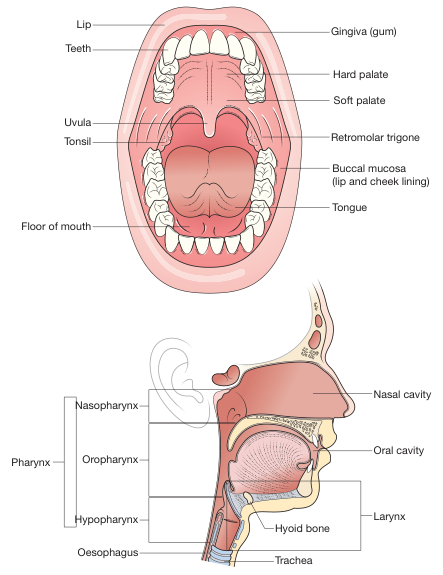
Key structures to identify and describe
Anterior compartment (top to bottom):
- Nasal cavity - roofed by the cribriform plate, floor formed by the hard palate
- Oral cavity - bounded by lips, cheeks, tongue, and palate
- Hyoid bone - suspends the larynx, attachment point for suprahyoid/infrahyoid muscles
- Larynx - continues into the trachea below
- Oesophagus - lies posterior to the trachea, continuing the alimentary tract
Pharynx (posterior compartment, divided into 3 parts):
- Nasopharynx - extends from the base of skull to the soft palate; posterior to the choanae; contains the pharyngeal tonsil (adenoid) and opening of the eustachian tube
- Oropharynx - from soft palate to the tip of the epiglottis (upper border of epiglottis/hyoid level); posterior to the oral cavity; contains the palatine tonsils
- Hypopharynx (laryngopharynx) - from the tip of the epiglottis to the lower border of the cricoid cartilage, where it becomes the oesophagus; contains the piriform fossae
Viva tips for this section
- Boundaries of nasopharynx/oropharynx/hypopharynx are a classic examiner favorite — know the exact levels (soft palate, epiglottis, cricoid cartilage).
- Waldeyer's ring - be ready to name all components (pharyngeal tonsil, tubal tonsils, palatine tonsils, lingual tonsil) even though only the palatine tonsil and uvula are visible here.
- Relations of larynx and trachea to oesophagus - trachea lies anterior, oesophagus posterior; important for surgical and swallowing viva questions.
- Be able to trace the path of a food bolus (oral cavity → oropharynx → hypopharynx → oesophagus) versus air (nasal cavity → nasopharynx → oropharynx or directly via larynx → trachea) — oropharynx is the common crossing point of the digestive and respiratory tracts.
- Common add-on question: hyoid bone relations — it's a common viva pivot point since it anchors tongue muscles, larynx, and epiglottis via the hyoepiglottic ligament.
If you also want a version showing the cranial base, brain, and vertebral column in the same section (more relevant for neuroanatomy vivas), or a close-up of just the pharynx subdivisions, I can pull those separately - let me know.
This is a shared conversation. Sign in to Orris to start your own chat.