
Medial malleolus plating
I'll start by reading the medical library skill, then search for content on medial malleolus plating.
Reading File
Searching sources...
Finding Sources
Finding Sources
Searching PubMed
"medial malleolus" AND "plate fixation"
Good hits. Now I'll read the key sections in parallel - Campbell's fixation of medial malleolus, Rockwood & Green's fixation section, and the PubMed meta-analysis abstract.
Reading File
Reading File
Reading Article
PMID: 39299603
Now let me get more details from Campbell's on the plating technique and indications, and also look at Rockwood's technique section for plating.
Reading File
Reading File
Finding Sources
Now let me get the Rockwood section on medial malleolus technique (including plating details) and the Miller's review testable concepts on this topic.
Reading File
Reading File
Now let me fetch the key images from Campbell's for the medial malleolus fixation technique.
Loading Image
Finding Sources
I have comprehensive information to write a thorough answer. Let me now compile everything.
Medial Malleolus Plating
Overview
Plating of the medial malleolus is indicated in specific fracture patterns where standard screw fixation is insufficient. The decision to plate versus screw is driven primarily by fracture morphology, fragment size, and comminution.
Indications for Plate Fixation
Lag screw fixation is the workhorse for most medial malleolar fractures (oblique/transverse patterns), but plating is preferred or required in the following scenarios:
| Indication | Rationale |
|---|---|
| Vertical/shear fractures (Supination-Adduction / SAD type) | Screws placed parallel to the joint are not enough - the fracture plane is vertical, so a buttress plate is needed to resist shear forces and prevent loss of reduction |
| Small or comminuted fragments | Insufficient bone stock for lag screw purchase; minifragment or K-wire constructs may be augmented with plate |
| Proximal comminution | Loss of reduction risk is high with screws alone |
| Medial malleolar osteotomy closure | Buttress plate used at osteotomy takedown to prevent shear failure |
| Nonunion revision | Combined bone grafting and plate stabilization |
From Miller's Review of Orthopaedics 9th Ed: "Medial buttress plate/screws parallel to joint - vertical fracture patterns (supination-adduction). Compression of fracture through plate affords neutralization function additionally."
Fracture Pattern Context: SAD Type 2
The supination-adduction mechanism produces a vertical fracture line through the medial malleolus (AO type A equivalent). This is the classic indication for a buttress plate:
-
The shear forces are directed vertically - a horizontally placed lag screw will not resist this
-
The plate is applied to the medial surface, acting as a buttress/antiglide construct
-
The fibular fracture (transverse, at or below the joint) may be stabilized with a plate, nail, or tension band
-
Rockwood & Green's Fractures in Adults 10th Ed 2025, p. 3423
-
Miller's Review of Orthopaedics 9th Ed, p. 6006
Surgical Technique (ORIF Medial Malleolus with Plate)
Patient Setup and Approach
- Position: Supine with a bolster under the ipsilateral hip to rotate the limb medially; radiolucent platform elevating the ankle is useful for fluoroscopy
- Tourniquet: Applied; inflate to 250-325 mmHg after exsanguination
- Incision: Anteromedial, beginning ~2 cm proximal to the fracture line, extending distally and slightly posteriorly, ending ~2 cm distal to the tip of the medial malleolus
- This protects the posterior tibial tendon and sheath
- Allows visualization of the anteromedial articular surface
- Protect the greater saphenous vein and its accompanying nerve
- Skin handling: The blood supply to this region is poor - handle with care, reflect the flap intact with underlying subcutaneous tissue to avoid skin sloughing
Reduction
- The distal fragment is typically displaced distally and anteriorly
- A small fold of periosteum is commonly interposed at the fracture site - this must be removed sharply to expose the fracture surfaces
- Debride small loose osseous/chondral fragments; preserve and bone graft large osteochondral fragments
- Reduce the malleolus with a bone-holding clamp or pointed tenaculum
- Hold reduction with 1.6-2 mm smooth K-wires as temporary fixation
Plate Application
- Verify reduction with AP and lateral fluoroscopy
- Apply a small one-third tubular plate or low-profile minifragment plate as a buttress
- Place screws parallel to the joint surface (orthogonal to the vertical fracture line) to achieve compression across the fracture
- For very small or comminuted fragments: minifragment screws, K-wires, or tension band wiring may supplement or replace the plate
Campbell's Operative Orthopaedics 15th Ed 2026: "Large vertical fractures of the medial malleolus that involve proximal comminution often require a buttress plate to prevent loss of reduction; a small, one third tubular plate or low-profile minifragment plates usually are sufficient. To avoid wound complications, extreme care must be taken when applying bulky implants to this area of poor skin coverage."
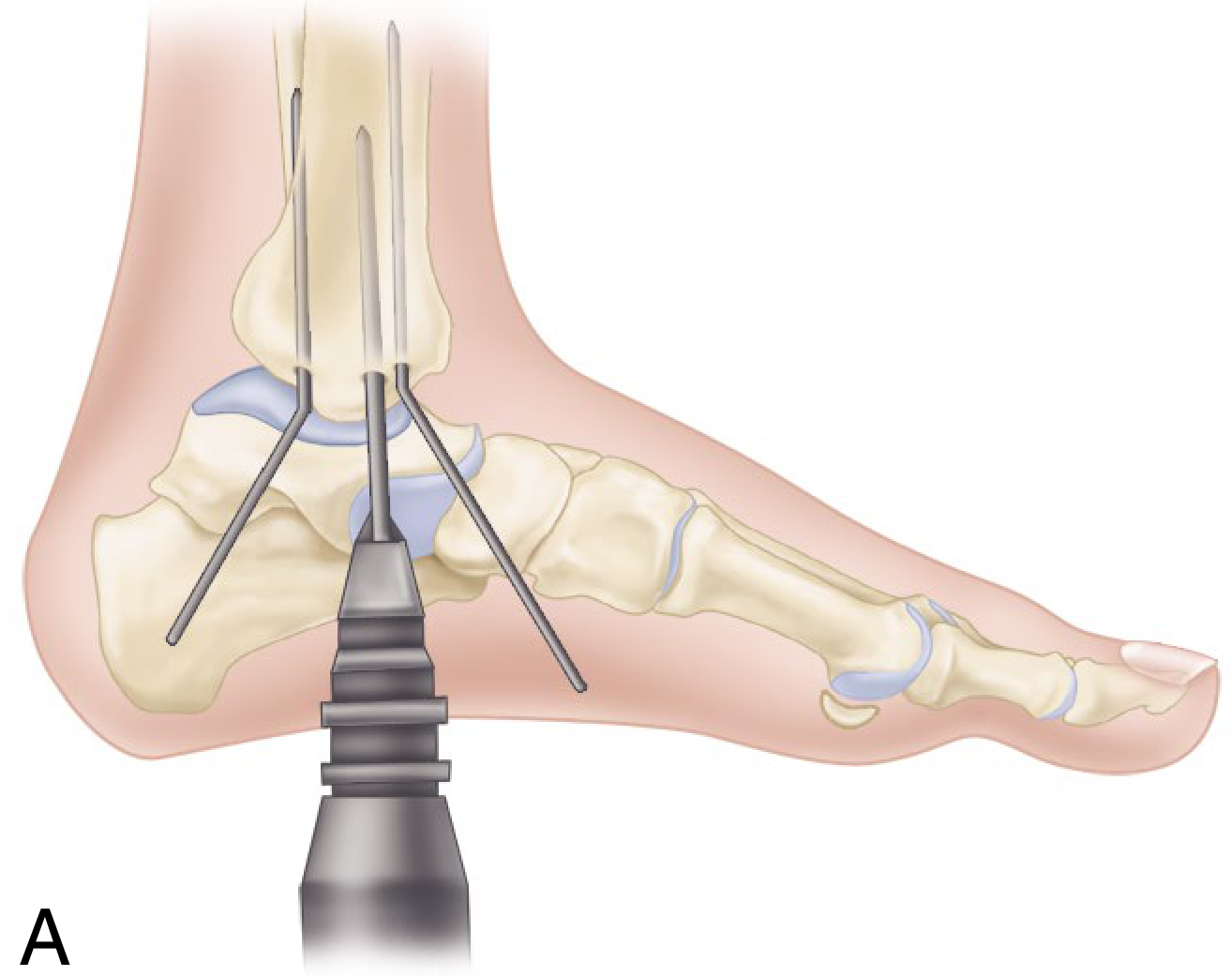
Final Checks
- Inspect the ankle joint interior, especially the superomedial corner, to confirm no screw crosses the articular surface
- Confirm syndesmosis stability (stress test) - if unstable, stabilize with syndesmotic screw or suture button device
Postoperative Care
-
Ankle immobilized in posterior plaster splint in neutral position and elevated
-
If bone quality is good and fixation secure: splint removed at first postoperative visit, replaced with removable splint or fracture boot; ROM exercises begun
-
Weight bearing restricted for 6 weeks (in the absence of syndesmotic injury), then progressive partial weight bearing
-
If skin conditions, bone quality, comorbidities (diabetes, neuropathy), or other factors compromise fixation: protected longer in short-leg cast, non-weight bearing until 8-12 weeks
-
Campbell's Operative Orthopaedics 15th Ed 2026
Plating vs. Lag Screw: Current Evidence
A 2025 systematic review and meta-analysis (Tai et al., 5 retrospective studies, n=394 patients) directly compared locking plate fixation (LPF) vs. lag screw fixation (LSF):
| Outcome | Result |
|---|---|
| AOFAS score | Significantly higher with LPF (MD +2.21; 95% CI 0.37-4.04; p=0.02) |
| Pain scores | Significantly lower with LPF (MD -0.35; 95% CI -0.64 to -0.05; p=0.02) |
| Delayed union | No significant difference (RR 1.43; p=0.42) |
| Fixation failure | Trend toward higher failure with LSF (RR 3.11; p=0.08) |
Conclusion: LPF yields superior functional outcomes and patient comfort compared to LSF, with comparable complication rates. Locking plates also better resist rotation and apply compressive forces across the fracture site, facilitating management of different fracture types. However, this is based on retrospective data only - larger RCTs are needed. [Tai et al., OTSR 2025 - PMID 39299603]
Key Points to Remember
-
Vertical fractures (SAD pattern) = buttress plate - this is the classic exam answer
-
Plate screws run parallel to the joint to resist vertical shear
-
The medial malleolus region has poor skin coverage - avoid bulky implants and handle skin with care
-
One-third tubular or low-profile minifragment plates are preferred to minimize soft tissue complications
-
Always check joint for articular screw penetration after fixation
-
Medial malleolar nonunions require bone grafting + internal fixation; percutaneous approaches are inadequate as they do not allow debridement of nonunion scar tissue
-
Campbell's Operative Orthopaedics 15th Ed 2026, pp. 5840-5893
-
Rockwood & Green's Fractures in Adults 10th Ed 2025, pp. 3423, 3658-3664
-
Miller's Review of Orthopaedics 9th Ed, pp. 6006, 6987-6997
This is a shared conversation. Sign in to Orris to start your own chat.