
Olfactory neuroblastoma
Reading File
Olfactory neuroblastoma (esthesioneuroblastoma) is a rare malignant tumor arising from olfactory neuroepithelium in the upper nasal cavity/cribriform plate region.
Searching sources...
Finding Sources
Finding Sources
Searching PubMed
olfactory neuroblastoma esthesioneuroblastoma
Good results from multiple books. Let me read all the relevant sections in parallel.
Reading File
Reading File
Reading File
Reading File
I have rich data. Let me now get the remaining sections - the Scott-Brown's block 5 data was cut off (staging, management), and let me get the Cummings section on staging/Kadish system.
Reading File
Reading File
Reading File
Loading Image
I now have comprehensive data from multiple authoritative textbooks. Let me compile the full answer.
Olfactory Neuroblastoma (Esthesioneuroblastoma)
Definition and Origin
Olfactory neuroblastoma (ONB) - also called esthesioneuroblastoma - is a rare malignant neuroectodermal tumor arising from the specialized olfactory mucosa of the upper nasal cavity. It accounts for less than 5% of all sinonasal malignancies, with an incidence of approximately 4 cases per million population.
The tumor arises specifically from the superior nasal cavity - including the superior turbinate, cribriform plate, and upper third of the nasal septum.
- Cummings Otolaryngology; Scott-Brown's Otorhinolaryngology
Epidemiology
- Bimodal age distribution: peaks in the 2nd and 6th decades
- No sex or racial predilection
- ~50% of cases present as Kadish stage C (advanced disease)
Clinical Presentation
| Feature | Frequency |
|---|---|
| Nasal obstruction | 70% |
| Epistaxis | 46% |
| Anosmia | Variable |
On examination: a reddish-gray, soft, polypoidal, highly vascular mucosa-covered mass in the olfactory groove.
- K.J. Lee's Essential Otolaryngology; Scott-Brown's
Histopathology
ONB is a small round blue cell tumor - morphologically similar to lymphoma, small cell carcinoma, Ewing sarcoma, PNET, rhabdomyosarcoma, and retinoblastoma. Key distinguishing features:
Architecture:
- Well-circumscribed nests and lobules separated by fibrovascular stroma
- Fibrillary matrix (tangled neuronal cell processes / neuropil)
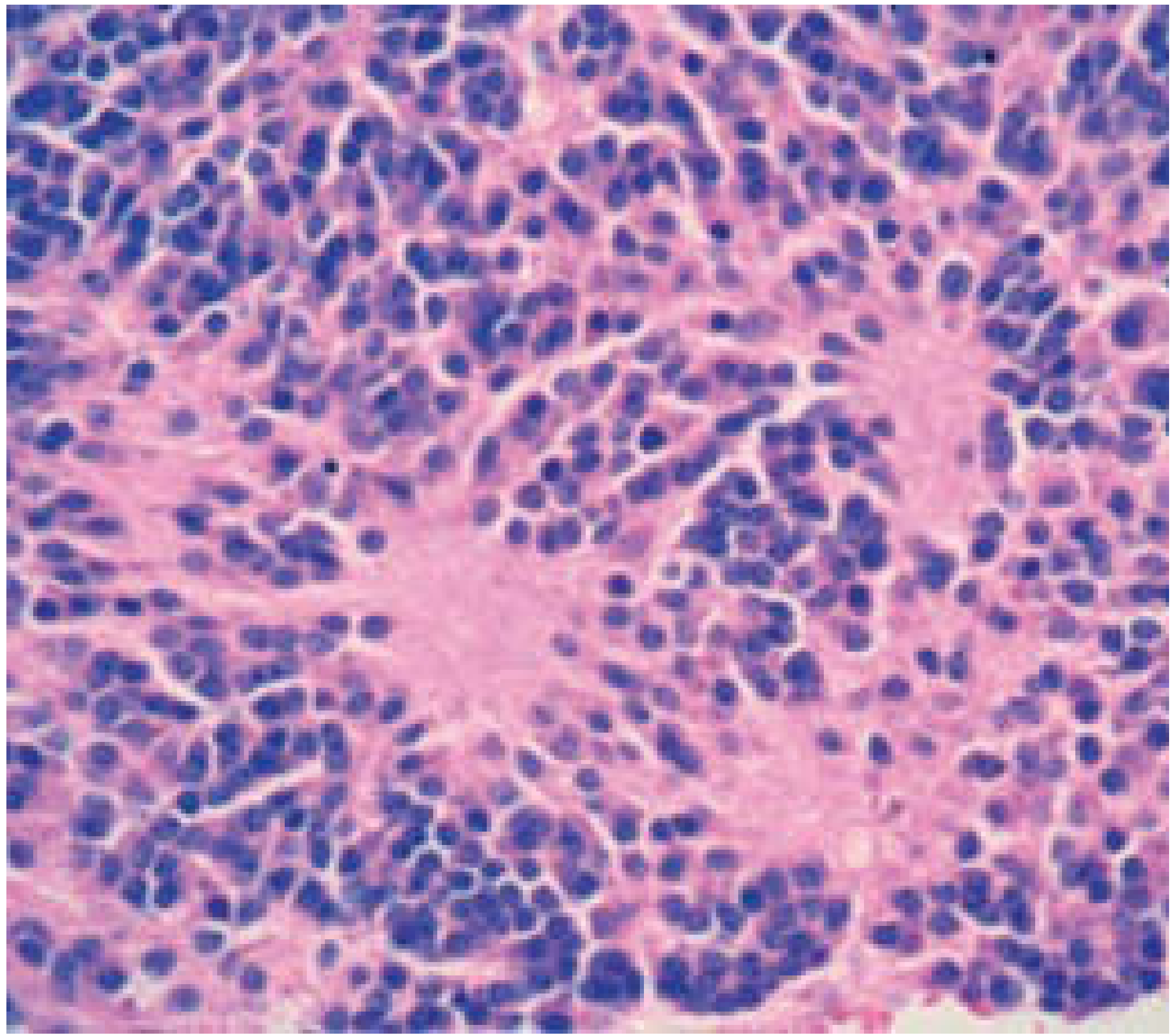
- Homer-Wright pseudorosettes: tumor cells mantling solid fibrillary neuropil stroma (characteristic)
- Flexner-Wintersteiner rosettes: cells surrounding an empty pseudolumen
- Perivascular rosettes may also occur
Cytology: Uniform small round cells with small nuclei, scant cytoplasm, and finely stippled ("salt and pepper") chromatin
Immunohistochemistry:
- Positive: synaptophysin, chromogranin, INSM1, CD56, neuron-specific enolase (NSE), S-100 protein
- Negative: cytokeratin (helps distinguish from carcinoma)
- No single pathognomonic marker exists
Histological image (H&E, Grade I/II ONB - Homer-Wright pseudorosettes with fibrillary neuropil):
- Robbins, Cotran & Kumar Pathologic Basis of Disease; Scott-Brown's
Hyams' Grading System
The Hyams system divides ONB into four histological grades (I-IV). Grades I and II (better-differentiated) are sometimes specifically called "aesthesioneuroblastoma." Higher grades show more mitoses, less neuropil, and necrosis.
Staging: Modified Kadish System
| Stage | Description |
|---|---|
| A | Tumor confined to the nasal fossa |
| B | Extension to the paranasal sinuses |
| C | Extension beyond the nasal cavity/paranasal sinuses |
| D | Cervical lymphadenopathy or distant metastasis (modified system) |
~50% of patients present at Stage C.
- K.J. Lee's Essential Otolaryngology; Cummings Otolaryngology
Metastasis
- Locoregional (cervical) metastasis: 5% at presentation; up to 20-25% lifetime; ~60% of neck metastases appear within 6 months of diagnosis
- Distant metastasis: lung and bone
- Late recurrences can occur more than a decade after initial treatment, necessitating long-term follow-up
Local recurrence 29%, regional recurrence 16%, distant recurrence 17% (meta-analysis by Dulguerov et al.).
Management
ONB is typically radiosensitive. Best outcomes come from multimodality therapy.
Surgery
- Standard approach: craniofacial resection (open) or increasingly endoscopic resection
- A 2025 systematic review in Frontiers in Oncology comparing endoscopic vs. open approaches found equivalent oncologic outcomes with lower morbidity for endoscopic surgery
- Endoscopic surgery is associated with earlier Kadish stage and improved survival even after accounting for publication year (Devaiah & Andreoli meta-analysis, 23 series, 361 patients)
Radiation Therapy
- Combined surgery + RT is superior to either modality alone
- Surgery + RT: 73% 5-year OS vs. 68% surgery alone vs. 35% RT alone (SEER database)
- Surgery + RT improves survival by ~20% over surgery alone
- Postoperative RT dose: 50-65 Gy; IMRT/proton beam preferred for sparing orbital/intracranial structures
- Elective neck irradiation is favored over surgery for the N0 neck given the risk of high Level II and retropharyngeal nodal failures
Chemotherapy
-
Added for Stage C disease
-
Regimens: cisplatin, cyclophosphamide, etoposide, doxorubicin, vincristine
-
Some centers use preoperative chemoradiotherapy (50 Gy ± cyclophosphamide/vincristine) to reduce tumor burden before surgery - reported 5- and 10-year survival 81% and 54.5% respectively (Polin et al., 34 patients)
-
Palliative chemotherapy for intracranial metastases: modest efficacy, median survival 10.5 months
-
Cummings Otolaryngology, p. 2277
Prognosis
| Stage | Approximate 5-year Survival |
|---|---|
| A/B (Stage-limited) | 92% (craniofacial resection) |
| C | 50-70% |
| Overall range | 40-90% (surgery + RT + chemo) |
Genetic changes are heterogeneous, with varying chromosomal gains/losses across cases.
Recent Evidence
Three recent systematic reviews (2024-2025) confirm:
- Endoscopic vs. open approaches (Koch et al., 2025): endoscopic surgery achieves comparable oncologic control with reduced morbidity
- Olfaction preservation with unilateral endoscopic resection (Rodas et al., 2024): promising results for preserving smell in select patients
- Combined surgery + radiation remains the evidence-based standard of care per current literature
This is a shared conversation. Sign in to Orris to start your own chat.