
Aldosterone escape
Reading File
Aldosterone escape is the phenomenon where sodium retention from chronic aldosterone excess is self-limited - after a few days, the kidneys "escape" and restore sodium balance, preventing overt edema. This happens via pressure natriuresis, ANP release, and reduced proximal tubule reabsorption. Potassium wasting, however, continues unabated.
Searching sources...
Finding Sources
Searching PubMed
"aldosterone escape" sodium renal
Reading File
Finding Sources
Reading File
Reading File
Loading Image
Finding Sources
Reading File
Reading File
Here is a thorough breakdown of aldosterone escape:
Aldosterone Escape
Definition
Aldosterone escape is the phenomenon where, despite sustained high levels of aldosterone, the kidneys "escape" from sodium retention after 1-2 days, and urinary sodium excretion returns to normal. The result is that the body does not develop progressive edema - but a new steady state is reached with mildly expanded ECF volume and hypertension. Importantly, potassium wasting continues unabated; only the sodium retention is escaped.
Mechanism
When aldosterone is chronically elevated (e.g., primary hyperaldosteronism), the following sequence unfolds:
Phase 1 - Initial sodium retention (days 1-2):
- Aldosterone acts on ENaC and Na+/K+-ATPase in principal cells of the collecting duct
- Sodium is avidly reabsorbed, potassium is excreted
- ECF volume expands by 5-15% above normal
Phase 2 - The escape (day 2 onward):
Three overlapping mechanisms drive the escape:
| Mechanism | How it works |
|---|---|
| Pressure natriuresis / diuresis | Rising arterial pressure (15-25 mmHg above normal) directly forces sodium and water out through the kidney (Guyton mechanism) |
| ANP release | ECF expansion stretches atria → releases atrial natriuretic peptide → promotes natriuresis, inhibits renin/aldosterone |
| Reduced proximal tubular reabsorption | Volume expansion reduces peritubular capillary oncotic pressure and increases hydrostatic pressure, delivering excess sodium to distal segments that overwhelm collecting duct reabsorption |
The pressure natriuresis / diuresis and ANP effects together restore urinary sodium excretion to match intake, despite continued aldosterone action. Angiotensin II formation is also suppressed by the expanded volume, further blunting sodium retention.
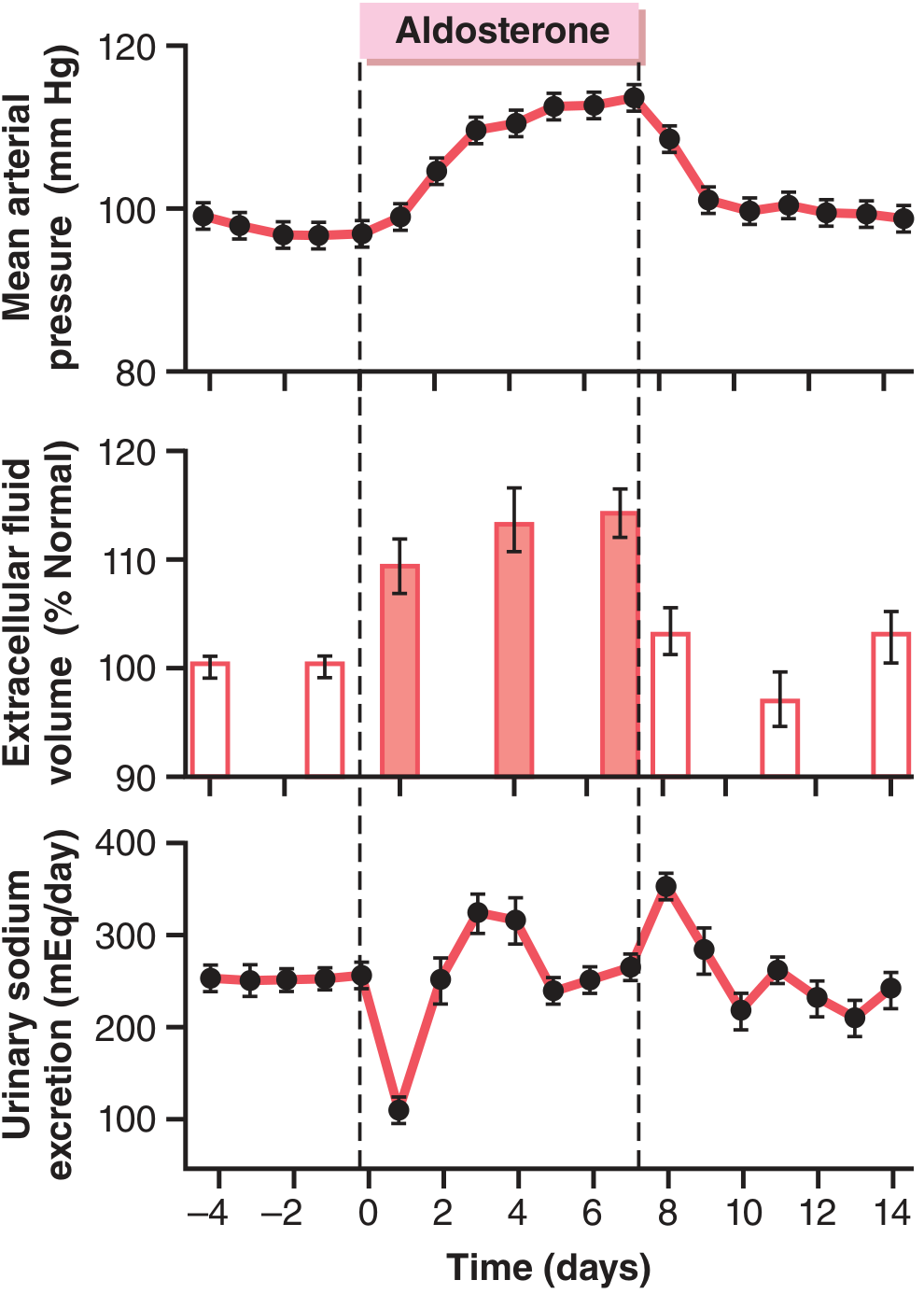
Figure from Guyton & Hall showing that even at 20x normal aldosterone levels, sodium excretion escapes back to baseline by day 2.
What Does NOT Escape
- Potassium wasting - continues throughout. The distal nephron keeps secreting K+ regardless of the escape from sodium retention. This leads to hypokalemia, metabolic alkalosis, and muscle weakness in primary hyperaldosteronism.
- Hypertension - persists as long as aldosterone is elevated, because the body is locked into a new steady state with expanded ECF.
Why No Edema in Primary Hyperaldosteronism?
Because escape occurs - sodium retention is transient. This is why patients with primary hyperaldosteronism (Conn's syndrome) present with hypertension and hypokalemia rather than pitting edema, distinguishing them from secondary hyperaldosteronism states.
When Escape FAILS (Clinical Disease)
Escape depends on an intact ability to raise arterial pressure and respond to ANP. In certain diseases, these mechanisms are impaired:
| Condition | Why escape fails |
|---|---|
| Heart failure | Cardiac output is low → pressure cannot rise sufficiently; ANP is secreted but renal resistance to its effects is high |
| Cirrhosis | Splanchnic vasodilation creates "effective underfilling" despite total body sodium overload; RAAS stays activated |
| Nephrotic syndrome | Low oncotic pressure drives fluid into interstitium; effective circulating volume remains low |
In these states, aldosterone-mediated sodium retention is continuous and progressive, leading to edema, ascites, and anasarca. This is the rationale for using mineralocorticoid receptor antagonists (spironolactone, eplerenone) in heart failure and cirrhotic ascites.
RAAS-Blocker Context: A Different "Aldosterone Escape"
There is a separate but related clinical phenomenon also called "aldosterone escape" (or "aldosterone breakthrough"): in patients on ACE inhibitors or ARBs for heart failure or CKD, aldosterone levels initially fall but then rise again over months. This is because:
- Angiotensin II production is not fully suppressed (ACE-independent pathways via chymase)
- Aldosterone is also regulated by plasma K+ and Na+ independently of angiotensin II
This breakthrough phenomenon is associated with worse cardiac fibrosis and faster GFR decline (especially in diabetic nephropathy), and is the rationale for adding MRAs to RAAS blockade. A 2026 review in JASN (PMID 41056081) addresses the full story of aldosterone escape.
Summary Table
| Feature | Aldosterone escape (classic) | Failure of escape |
|---|---|---|
| Setting | Primary hyperaldosteronism (Conn's), exogenous mineralocorticoids | Heart failure, cirrhosis, nephrotic syndrome |
| Sodium balance | Temporarily positive, then restored | Persistently positive |
| Edema | Absent | Present (ascites, anasarca) |
| Potassium | Still lost | Still lost |
| Hypertension | Present | Variable |
| Key mediators | Pressure natriuresis, ANP, reduced AngII | ANP resistance, persistent RAAS activation |
Sources: Guyton & Hall Textbook of Medical Physiology, p. 946-947 | Ganong's Review of Medical Physiology, p. 359 | Harrison's Principles of Internal Medicine 22E, p. 2415 | Goodman & Gilman's Pharmacological Basis of Therapeutics
This is a shared conversation. Sign in to Orris to start your own chat.