
Hi
Hey! How can I help you today?

IMG_7745.jpg
What is this medical condition
analyse_media
Reading File
Finding Sources
Finding Sources
Reading File
Reading File
Based on the image and textbook confirmation, here is what this condition is:
Keratolysis Exfoliativa
(also called: Lamellar Dyshidrosis, Recurrent Focal Palmar Peeling, Dyshidrosis Lamellosa Sicca)
The image shows bilateral, symmetrical, small circular/ring-shaped peeling patches (annular collarettes of scale) scattered across the palms and fingers of both hands - a textbook presentation of keratolysis exfoliativa.
What it is
A common, benign, superficial desquamative (peeling) skin condition affecting the thick skin of the palms and occasionally soles. It is non-inflammatory - meaning no redness, blistering, or pain is typical.
- Dermatology 2-Volume Set 5e describes it as: "an irregular annular or circinate pattern of scaling, 2 to 15 mm in diameter... no antecedent or concurrent vesicles or papules, and no fungi are recoverable from the lesions."
Key features visible in the image
- Small, round, peeling skin collarettes (1-4 mm)
- Bilateral and symmetrical distribution
- Concentrated on the volar (palm side) surfaces of fingers and palms
- No obvious blistering, redness, or raw skin - consistent with non-inflammatory peeling
Common triggers
- Warm weather / sweating (hyperhidrosis)
- Frequent hand washing or water exposure
- Friction or mild irritant contact
- It often worsens in summer months
Treatment
- Moisturizers with urea, ammonium lactate, or lactic acid applied frequently
- Keratolytic agents containing salicylic acid (5-6%) can help
- Petroleum jelly (plain Vaseline) as a barrier cream
- Avoid picking or peeling the skin manually
- Use fragrance-free, mild soap; wear gloves when doing wet work
- Topical steroids are not useful unless there is associated dermatitis
When to see a doctor
If there is associated intense itching, deep blisters, spread beyond the palms/soles, or if it does not improve with moisturizers within 2-3 weeks - a dermatologist can rule out pompholyx (dyshidrotic eczema) or fungal infection.
Disclaimer: This is for informational purposes only and does not replace a clinical diagnosis by a healthcare professional.
Is there itching or pain with these lesions?
Based on what the dermatology textbook states and clinical knowledge about keratolysis exfoliativa:
Symptoms: Itching & Pain
Keratolysis Exfoliativa (most likely diagnosis here)
- Typically asymptomatic - no itching, no pain
- The textbook (Dermatology 2-Volume Set 5e) explicitly describes it as a "common, asymptomatic, superficial desquamative process"
- Most people only notice it because of the visual peeling
- Occasionally there may be a very mild burning or tightness sensation, but this is not a defining feature
How symptoms help distinguish between conditions:
| Feature | Keratolysis Exfoliativa | Dyshidrotic Eczema (Pompholyx) | Fungal Infection |
|---|---|---|---|
| Itching | None / minimal | Intense itching - hallmark | Mild to moderate itch |
| Pain | None | Can be painful if severe | Usually none |
| Burning | Rare | Common | Rare |
| Blistering | No | Yes (precedes peeling) | No |
| Course | Self-limiting | Recurrent flares | Persistent without treatment |
What to watch for
If the person with these hands does experience:
- Intense itching - points more toward dyshidrotic eczema
- Pain or burning - could suggest secondary bacterial infection or contact dermatitis
- No symptoms at all - strongly supports keratolysis exfoliativa, which is benign and self-limiting
The absence of symptoms in this condition is actually reassuring - it means the skin barrier is intact enough that no nerve endings are being irritated.
Do you know whether the person is experiencing any itching or other symptoms? That would help narrow the diagnosis further.
No those are not pealing its a small bumps
Thank you for the correction! Small bumps (not peeling) on the palms changes the picture significantly.
Searching sources...
Finding Sources
Finding Sources
Finding Sources
Finding Sources
Reading File
Loading Image
Good correction - small bumps (not peeling) points much more clearly to Dyshidrotic Eczema (Pompholyx). Here's the updated picture:
Revised Diagnosis: Dyshidrotic Eczema (Pompholyx / Dyshidrosis)
This is a textbook image of the condition from Andrews' Diseases of the Skin:
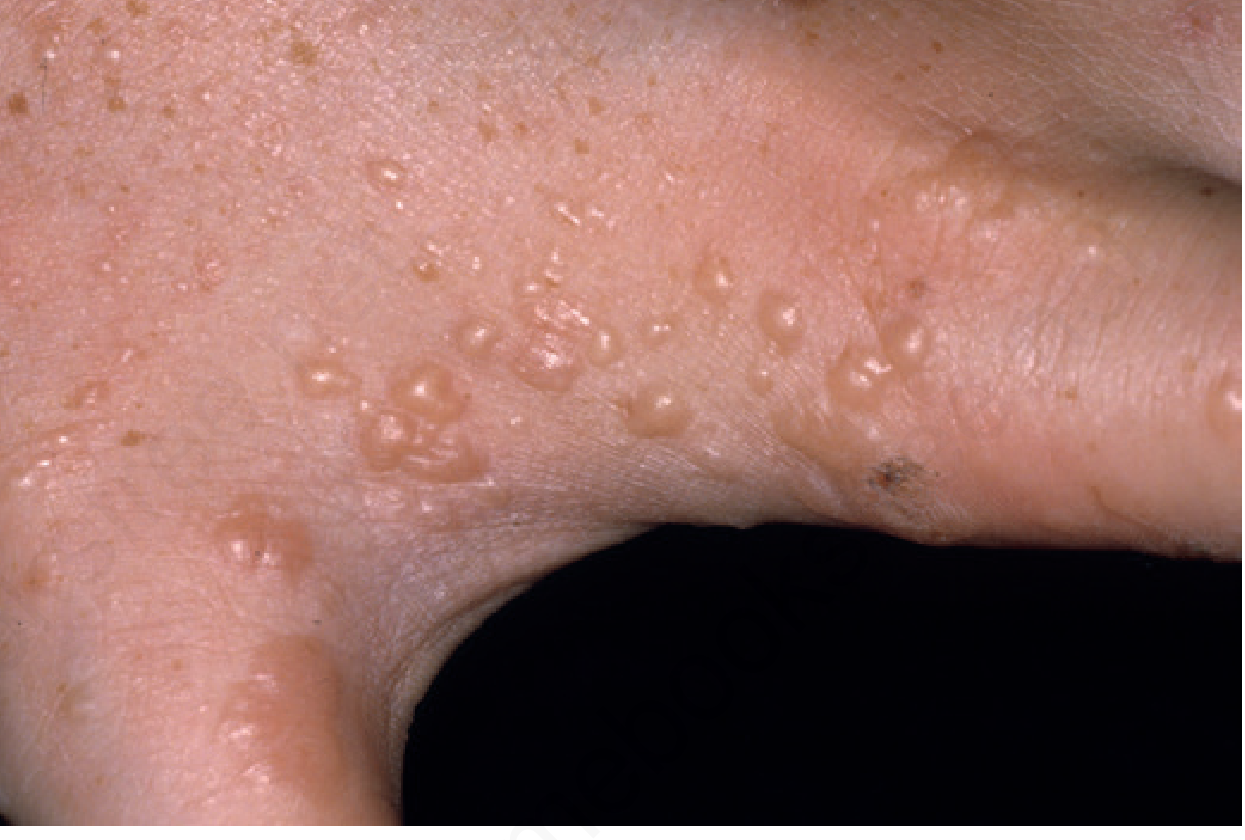
Notice how closely this matches the bumps in the image you shared.
What is it?
The bumps are vesicles - small, fluid-filled blisters that sit deep within the thick skin of the palm. Andrews' Diseases of the Skin describes them as:
"Deep-seated multilocular vesicles resembling tapioca on the sides of the fingers, palms, and soles. The eruption is symmetric and pruritic, with pruritus often preceding the eruption."
Key features
- Bilateral and symmetric - both hands affected equally (as seen in the photo)
- Deep-seated small bumps - they feel like they are under the skin, not superficial
- Itching is the hallmark - often the itch comes BEFORE the bumps appear
- Bumps are concentrated on fingers and palms - exactly as shown
- Individual outbreaks resolve on their own over several weeks
Now - does the person have itching?
This is the most important question. In dyshidrotic eczema:
- Itching is intense and often the first symptom - it typically precedes the visible bumps
- Some people describe burning or a prickling sensation before bumps appear
- If there is no itching at all, other causes like warts (palmar warts) or scabies should also be considered
Common Triggers
| Trigger | Notes |
|---|---|
| Sweating / hot weather | Very common - flares in summer |
| Stress | A major trigger |
| Nickel / metal allergy | Can trigger outbreaks |
| Wet work / detergents | Hairdressers, healthcare workers, kitchen staff |
| Atopic history | More common in people with eczema, asthma, or hay fever |
Treatment
- Mild-moderate: Strong topical corticosteroids (e.g. clobetasol) for 2-4 weeks
- Moisturizers regularly to restore the skin barrier
- Avoid triggers - wear gloves for wet work, reduce stress
- Antihistamines for the itch
- Severe/recurrent cases: Phototherapy (UVB/PUVA) or immunosuppressants (tacrolimus, ciclosporin)
A dermatologist visit is recommended, especially if the bumps are recurring or spreading.
Disclaimer: This is for educational purposes only - a proper clinical examination is needed for a definitive diagnosis.
This is a shared conversation. Sign in to Orris to start your own chat.