
Define health write about determinants and dimensions of health
Reading File
Now let me search the medical library for relevant content on health definitions, determinants, and dimensions.
Finding Sources
Finding Sources
Finding Sources
Park's Textbook of Preventive and Social Medicine is the primary source. Let me read the relevant sections in parallel.
Reading File
Reading File
Reading File
Reading File
Reading File
Reading File
Reading File
Reading File
Reading File
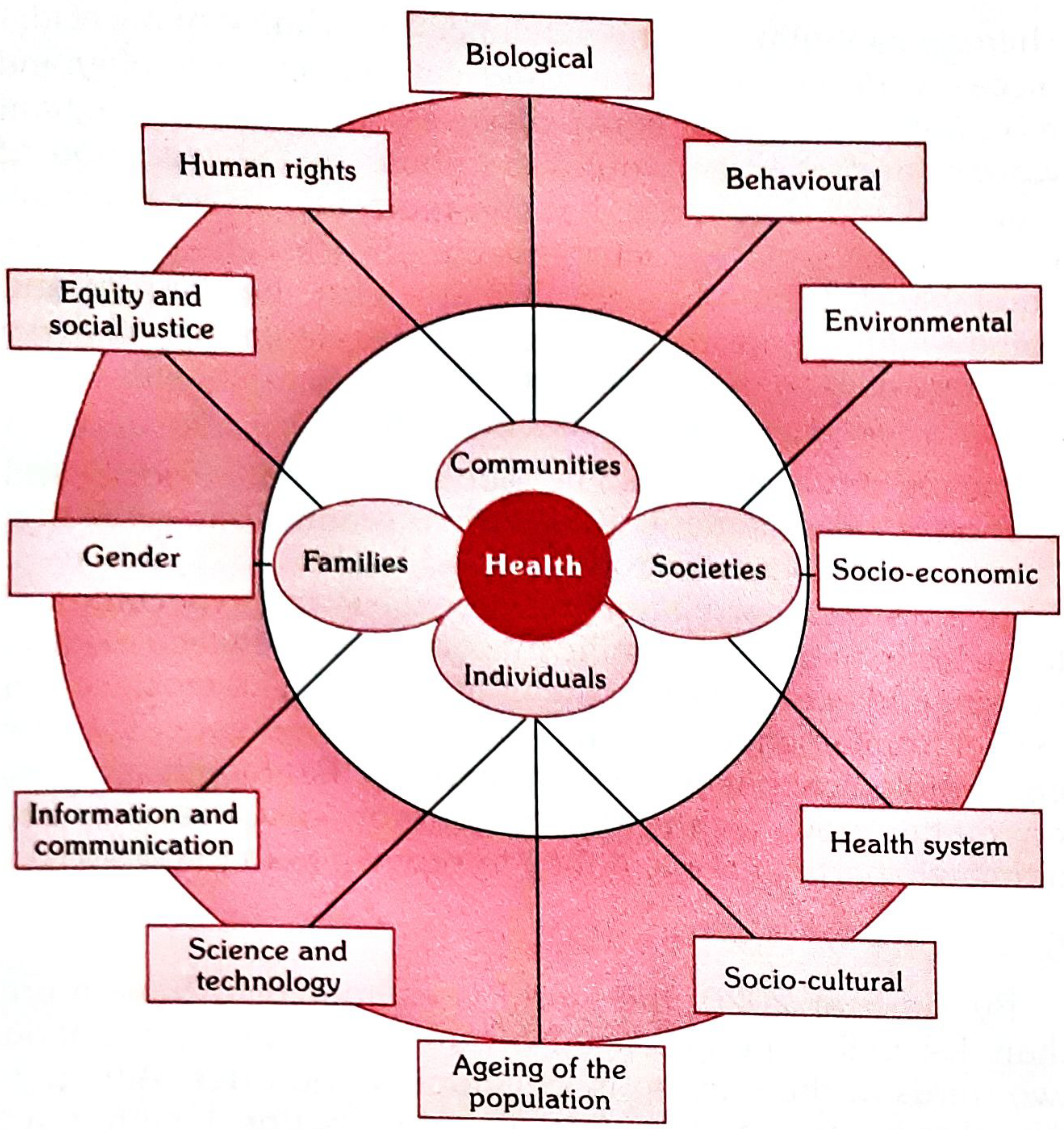
Now let me fetch the determinants of health diagram image and also read the remaining determinants section.
Loading Image
Reading File
I now have comprehensive content from Park's Textbook of Preventive and Social Medicine to write a thorough answer. Let me compile the full response.
Health: Definition, Determinants, and Dimensions
Source: Park's Textbook of Preventive and Social Medicine
Definition of Health
"Health" is one of those terms most people find difficult to define, although they feel confident of its meaning. Many definitions have been offered over time.
WHO Definition (1948)
The most widely accepted definition is from the World Health Organization, stated in the preamble to its constitution:
"Health is a state of complete physical, mental and social well-being and not merely an absence of disease or infirmity."
In recent years this has been amplified to include "the ability to lead a socially and economically productive life."
The WHO definition, despite being criticized as too broad and idealistic (some argue health cannot be a fixed "state" but a continuous process of adjustment), remains the global standard. It is broad and positive, setting the benchmark of "positive health" and symbolizing people's aspirations worldwide.
Other Definitions
- Biomedical concept: Health = absence of disease (based on the germ theory of disease; the body as a machine that needs repair). Criticized for ignoring social, psychological, and cultural determinants.
- Ecological concept (Dubos): "Health implies the relative absence of pain and discomfort and a continuous adaptation and adjustment to the environment to ensure optimal function." This views health as a dynamic equilibrium between man and his environment.
- Psychosocial concept: Health is not only a biomedical phenomenon but is influenced by social, psychological, cultural, economic and political factors. Health is both a biological and a social phenomenon.
- Holistic concept: A synthesis of all the above. It recognizes the strength of social, economic, political and environmental influences on health, described as "a sound mind, in a sound body, in a sound family, in a sound environment." All sectors of society (agriculture, education, housing, industry) have an effect on health.
Operational Definition
The WHO definition is not an "operational" one - it does not lend itself to direct measurement. Studies of the epidemiology of health are hampered because health and well-being cannot be measured directly. Attempts to define health operationally focus on measurable indicators such as mortality rates, morbidity rates, and disability-adjusted life years.
Health as a Fundamental Right
Health is a fundamental human right and a worldwide social goal. The 30th World Health Assembly (1977) declared that the main social target should be "Health for All" - enabling all citizens to lead socially and economically productive lives. This principle was reinforced by the Millennium Development Goals (2000) and Sustainable Development Goals (2015).
Changing Concepts of Health
| Concept | Core Idea |
|---|---|
| Biomedical | Absence of disease; body as machine |
| Ecological | Dynamic equilibrium between man and environment |
| Psychosocial | Health shaped by social, cultural, economic, political forces |
| Holistic | Unified, multidimensional; sound mind in sound body in sound environment |
Dimensions of Health
Health is multidimensional. The WHO definition specifies three dimensions (physical, mental, social), but many more have been identified. All dimensions function together and interact with one another.
1. Physical Dimension
The easiest to understand. Physical health conceptualizes the body biologically as a state where every cell and organ is functioning at optimum capacity and in perfect harmony with the rest of the body. Signs include: good complexion, clean skin, bright eyes, firm flesh, sweet breath, good appetite, sound sleep, regular bowel and bladder activity, and smooth coordinated body movements. All organs are of normal size and function; resting pulse, blood pressure and exercise tolerance are within normal range for age and sex.
Evaluation tools include:
- Self-assessment of overall health
- Inquiry into symptoms and risk factors
- Clinical examination
- Nutrition and dietary assessment
- Biochemical and laboratory investigations
- Community-level indicators: death rate, infant mortality rate, life expectancy
2. Mental Dimension
Mental health is not mere absence of mental illness. It is "a state of balance between the individual and the surrounding world - a state of harmony between oneself and others, a coexistence between the realities of the self and that of other people and that of the environment."
Attributes of a mentally healthy person:
- Free from internal conflicts; not at "war" with himself
- Well-adjusted; gets along with others; accepts criticism
- Searches for identity and has a strong sense of self-esteem
- Knows himself - his needs, problems, and goals (self-actualization)
- Good self-control; balances rationality and emotionality
- Faces problems and tries to solve them intelligently (copes with stress and anxiety)
Psychological factors can induce physical illness (hypertension, peptic ulcer, bronchial asthma - the psychosomatic relationship). Assessment at population level uses mental status questionnaires administered by trained interviewers.
3. Social Dimension
Social well-being implies "harmony and integration within the individual, between each individual and other members of society, and between individuals and the world in which they live." It has been defined as "the quantity and quality of an individual's interpersonal ties and the extent of involvement with the community."
Social health takes into account that every individual is part of a family and wider community. It is rooted in:
- Positive material environment - financial and residential matters
- Positive human environment - the social network of the individual
Social health includes levels of social skills, social functioning, and the ability to see oneself as a member of the larger society.
4. Spiritual Dimension
Spiritual health refers to that part of the individual which reaches out and strives for meaning and purpose in life - the intangible "something" that transcends physiology and psychology. It includes integrity, principles and ethics, the purpose in life, commitment to some higher being, and belief in concepts not subject to scientific explanation. Holistic health practitioners argue that this dimension plays a significant role in health and disease.
5. Emotional Dimension
Distinct from mental health - mental health relates to "knowing" (cognition) while emotional health relates to "feeling." Research in psychobiology has isolated these two separate dimensions. Emotional health reflects how individuals feel about themselves and their lives, manage their emotions, and relate emotionally to others.
6. Vocational Dimension
When work is adapted to human goals, capacities and limitations, it promotes both physical and mental health. Physical work improves physical capacity; goal achievement and self-realization in work are sources of satisfaction and enhanced self-esteem. The importance of this dimension becomes apparent when individuals lose their jobs or face mandatory retirement - often triggering psychological and physical health consequences.
7. Other Dimensions
Several additional dimensions have been proposed:
- Philosophical dimension
- Cultural dimension
- Socio-economic dimension
- Environmental dimension
- Educational dimension
- Nutritional dimension
- Curative dimension
- Preventive dimension
The existence of many "non-medical" dimensions (social, cultural, educational, etc.) means that sectors beyond health - agriculture, education, housing, public works - must contribute for all people to attain a level of health that enables a productive life.
Determinants of Health
Health is multifactorial. The factors influencing health lie both within the individual and externally in the society. Health of individuals and communities is the result of interactions among genetic factors and environmental factors.
1. Biological Determinants
The physical and mental traits of every human being are determined to some extent by genetic make-up at conception - which cannot be altered afterward. Diseases of genetic origin include chromosomal anomalies, errors of metabolism, mental retardation, and some types of diabetes. Medical genetics now offers tools for genetic screening and gene therapy. Positive health is achieved when a person is allowed to live in healthy relationship with his environment, allowing genetic potentialities to become phenotypic realities.
2. Behavioural and Socio-Cultural Conditions (Lifestyle)
"Lifestyle" denotes "the way people live" - reflecting social values, attitudes and activities. It comprises cultural and behavioural patterns and lifelong personal habits (smoking, alcoholism) developed through socialization. Lifestyles are learnt through parents, peer groups, friends, siblings, school, and mass media.
- In developed countries: coronary heart disease, obesity, lung cancer, drug addiction - all linked to lifestyle changes.
- In developing countries like India: risks are connected with lack of sanitation, poor nutrition, poor personal hygiene, and cultural patterns.
Note: not all lifestyle factors are harmful. Adequate nutrition, sufficient sleep, and regular physical activity actually promote health.
3. Environment
Hippocrates first related disease to environment (climate, water, air). Environment is classified as:
- Internal environment: every tissue, organ, and organ-system and their harmonious functioning (domain of internal medicine)
- External/macro-environment: "all that which is external to the individual human host," divided into physical, biological, and psychosocial components
Environmental factors range from housing, water supply, and psychosocial stress through family structure, social and economic support systems, to organization of health and welfare services. If the environment is favorable, the individual makes full use of physical and mental capabilities. The physical, biological, and psychological components are inextricably linked and must be viewed as a whole.
4. Socio-Economic Conditions
Socio-economic conditions have long been known to influence human health. For most of the world's people, health is determined primarily by the level of socio-economic development. Key components:
- (i) Economic status: Per capita GNP is the most widely accepted measure. Economic progress has been the major factor in reducing morbidity, increasing life expectancy, and improving quality of life in developing countries. However, affluence can also cause illness (coronary heart disease, diabetes, obesity in upper socio-economic groups).
- (ii) Education: Especially female education. The world map of illiteracy closely coincides with maps of poverty, malnutrition, ill-health, and high infant/child mortality. Kerala (India) is a striking example - with a female literacy rate of 97.9% it achieves an infant mortality rate of 10 vs. the all-India rate of 34.
- (iii) Occupation: Being in productive work promotes health; the unemployed show higher incidence of ill-health and death. Loss of work causes psychological and social damage.
- (iv) Political system: Health is related to a country's political system. Resource allocation, manpower policy, and accessibility of health services are shaped by political decisions. WHO sets the target of at least 5% of GNP on health care; India spends about 1%.
5. Health Services
Health and family welfare services cover preventive, promotive, curative, and rehabilitative care. The availability, accessibility, and quality of these services directly affect the health status of the community. The health system is itself listed as one of the outer determinants in the WHO framework (see diagram above).
Summary
Health is not a static state but a dynamic process of continuous adjustment. The WHO (1948) definition - "a state of complete physical, mental and social well-being and not merely an absence of disease or infirmity" - remains the gold standard. Health has seven recognized dimensions (physical, mental, social, spiritual, emotional, vocational, and others) and is shaped by five major categories of determinants: biological, behavioural/lifestyle, environmental, socio-economic conditions, and health services. Achieving health requires input from all sectors of society, not just the health sector alone.
- Park's Textbook of Preventive and Social Medicine, pp. 17-25 (Changing Concepts, Definitions, Dimensions, and Determinants of Health)
This is a shared conversation. Sign in to Orris to start your own chat.