
What is this condition, explain in detail
file /home/daytona/workspace/attachments/fe9de6af-4650-40bb-8e88-87efe8564f14/VID-20260528-WA0000.mp4 && ls -lh /home/daytona/workspace/attachments/fe9de6af-4650-40bb-8e88-87efe8564f14/
ffmpeg -i /home/daytona/workspace/attachments/fe9de6af-4650-40bb-8e88-87efe8564f14/VID-20260528-WA0000.mp4 -vf "fps=1" -frames:v 6 /home/daytona/workspace/attachments/fe9de6af-4650-40bb-8e88-87efe8564f14/frame_%02d.jpg 2>&1 | tail -20
"neonatal seizures"[MeSH Terms] AND diagnosis AND management
Neonatal Seizures
- Repetitive, stereotyped limb movements (arms raised, hands brought toward face)
- Subtle, semi-purposeful-looking but involuntary motor activity
- The baby is on cardiac/respiratory monitoring, has an NG tube (yellow), IV lines, and a pulse oximeter - all consistent with a critically ill neonate under intensive monitoring
What Are Neonatal Seizures?
- Immature synaptic connections prevent organized, widespread spread of seizure activity
- Incomplete myelination prevents bihemispheric propagation
Types of Neonatal Seizures (Clinical Semiology)
| Type | Features |
|---|---|
| Subtle (most common, ~50%) | Lip smacking, eye deviation, bicycling, apnea, chewing |
| Clonic - focal | Rhythmic jerking of a limb or face, usually conscious |
| Clonic - multifocal | Migrating clonic jerks across body parts |
| Tonic - focal | Sustained posturing of a limb (as seen in the video) |
| Tonic - generalized | Stiffening of entire body, ominous sign |
| Myoclonic | Single or repetitive rapid jerks; fragmental or massive |
Why Are Neonates So Prone to Seizures? - The Pathophysiology
- In adult neurons, GABA-A receptor activation causes chloride influx → membrane hyperpolarization → inhibition
- In immature neurons, the cotransporter NKCC1 dominates over KCC2, causing high intracellular chloride → GABA activation leads to chloride efflux → membrane depolarization → excitation
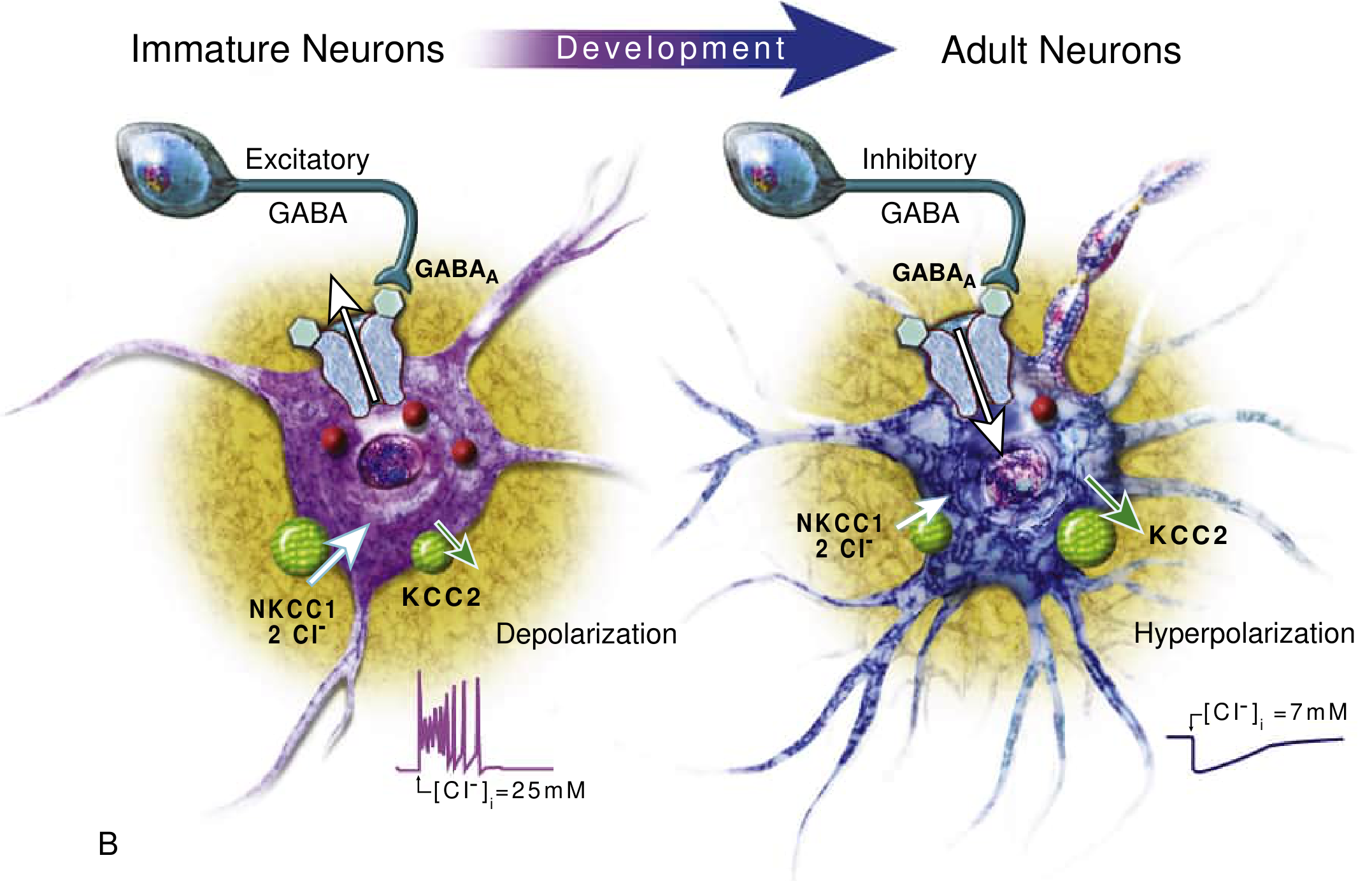
Causes (Etiology)
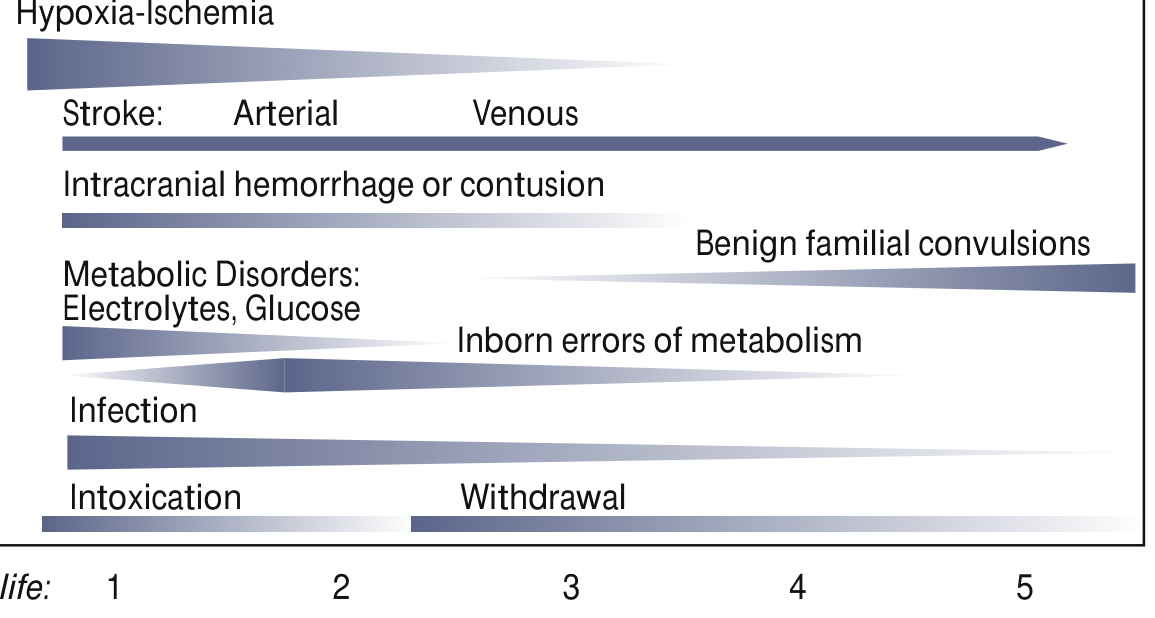
Most Common Causes:
-
Hypoxic-Ischemic Encephalopathy (HIE) - ~50% in term newborns
- Birth asphyxia, cord accidents, placental abruption
- Onset within first 24-48 hours of life
- Carries poor prognosis; about half of survivors severely disabled
-
Intracranial hemorrhage - ~30% in preterm newborns
- Intraventricular hemorrhage (IVH) from germinal matrix rupture
- Subarachnoid or subdural hemorrhage
-
Ischemic stroke / Perinatal arterial stroke
-
Metabolic causes (onset days 2-7):
- Hypoglycemia (most common metabolic cause)
- Hypocalcemia (now less common)
- Hypomagnesemia, hypo/hypernatremia
-
Infections (onset days 3-7):
- Bacterial meningitis (GBS, E. coli, Listeria)
- Herpes simplex virus encephalitis (HSV) - potentially fatal if untreated
-
Inborn errors of metabolism:
- Pyridoxine (B6) deficiency - treatable with 100 mg IV pyridoxine
- Biotinidase deficiency
- Nonketotic hyperglycinemia, maple syrup urine disease, organic acidemias
-
Structural/Developmental brain abnormalities (5-10%)
- Cortical dysplasias - particularly refractory
-
Genetic Channelopathies:
- KCNQ2, KCNQ3 mutations → Benign familial neonatal epilepsy (autosomal dominant, resolves within first year)
- SCN2A mutations
- Ohtahara syndrome (severe epileptic encephalopathy, burst-suppression on EEG)
-
Drug withdrawal - maternal opioid use, barbiturates
Diagnosis
- EEG / amplitude-integrated EEG (aEEG) - gold standard; continuous monitoring preferred
- Blood glucose and electrolytes (Ca²⁺, Mg²⁺, Na⁺) - immediately correctable causes
- Blood culture, LP with CSF analysis - rule out infection
- HSV PCR from CSF - start acyclovir empirically
- Neuroimaging - cranial ultrasound first; MRI brain preferred for full characterization
- Metabolic panel: lactate, ammonia, serum amino acids, urine organic acids
- Genetic testing (next-generation sequencing) if etiology unclear
Management
- IV dextrose for hypoglycemia
- IV calcium gluconate for hypocalcemia
- IV magnesium sulfate for hypomagnesemia
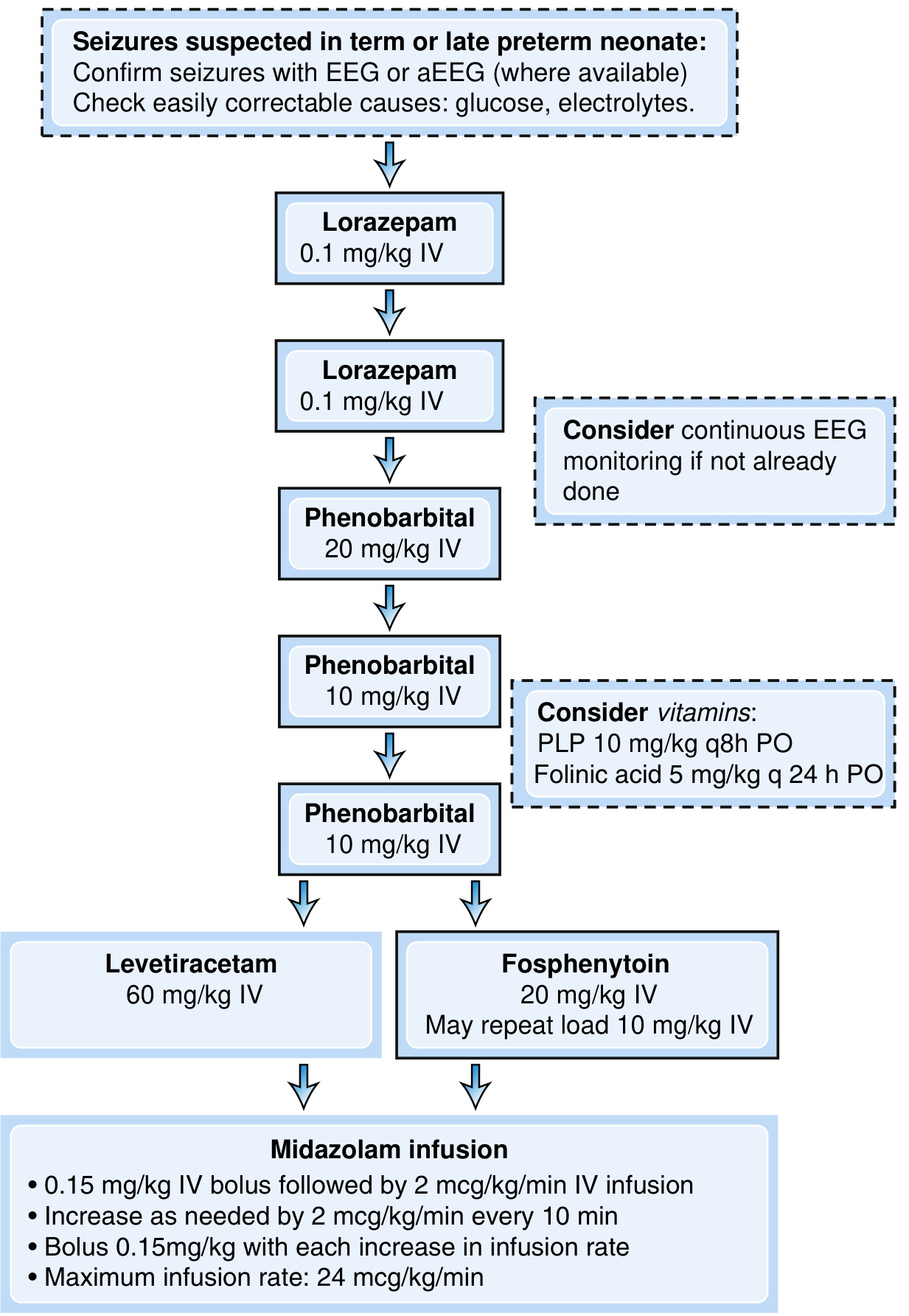
- Lorazepam 0.1 mg/kg IV (repeat once if needed)
- Phenobarbital 20 mg/kg IV → additional 10+10 mg/kg if needed
- Consider empiric pyridoxal phosphate (PLP 10 mg/kg q8h) + folinic acid (5 mg/kg q24h) if metabolic etiology suspected
- Levetiracetam 60 mg/kg IV OR Fosphenytoin 20 mg/kg IV
- Midazolam infusion for refractory status epilepticus
- For genetic channelopathies (KCNQ2/3), sodium channel blockers (phenytoin, carbamazepine) are specifically effective
- For HSV encephalitis: IV acyclovir started empirically
Prognosis
- Seizures within 24-48 hours of a difficult birth (HIE): high mortality; ~50% of survivors have severe disability
- Seizures starting days-weeks later (metabolic causes): better prognosis if identified and treated
- Benign familial neonatal seizures: excellent prognosis, resolve within 1st year of life
- Ohtahara syndrome / early epileptic encephalopathy: poor; often evolves into West syndrome or Lennox-Gastaut
- Early-onset myoclonic jerks with burst-suppression EEG = particularly ominous sign
- Risk factors for later epilepsy include: status epilepticus, severe HIE, requiring multiple antiepileptics
Put this every detail in one ppt including the video
mkdir -p /home/daytona/workspace/neonatal-seizures-ppt && ls /home/daytona/workspace/neonatal-seizures-ppt/
cd /home/daytona/workspace/neonatal-seizures-ppt && node /home/daytona/skills/shared/scripts/fetch_images.js \ "https://cdn.orris.care/cdss_images/d0301b4606c93a651c4147da63dbd6aad26df5d704677b42dde4591a261bcaf5.png" \ "https://cdn.orris.care/cdss_images/e043e2b19068490859d9d52d4eeeb4f10e6cbcfb220f1d327ec34c1b23e19745.png" \ "https://cdn.orris.care/cdss_images/80e87f513c784b1affc34d63d39528a2c4a98e12ae7c746a048abb693840fe05.png" \ > images.json 2>&1 echo "Exit: $?" wc -c images.json
ffmpeg -i /home/daytona/workspace/attachments/fe9de6af-4650-40bb-8e88-87efe8564f14/VID-20260528-WA0000.mp4 -ss 00:00:01 -frames:v 1 /home/daytona/workspace/neonatal-seizures-ppt/video_thumb.jpg 2>&1 | tail -5 ls -lh /home/daytona/workspace/neonatal-seizures-ppt/video_thumb.jpg
~/neonatal-seizures-ppt/build.js
const pptxgen = require("pptxgenjs");
const fs = require("fs");
const path = require("path");

// Load downloaded images
const images = JSON.parse(fs.readFileSync("images.json", "utf8"));
const mgmtAlgoImg   = images[0].base64; // management algorithm
const etiologyImg   = images[1].base64; // etiology by day
const gabaImg       = images[2].base64; // GABA immature vs adult

// Load video thumbnail
function imgToBase64(filePath) {
  const buf = fs.readFileSync(filePath);
  return "image/jpeg;base64," + buf.toString("base64");
}
const videoThumb = imgToBase64("video_thumb.jpg");

// ── Palette ──────────────────────────────────────────────────────────────────
const C = {
  navy:     "0B2545",   // dominant dark
  teal:     "1B6CA8",   // supporting blue
  accent:   "E63946",   // sharp red accent
  lightBg:  "EDF2F7",   // light slide bg
  white:    "FFFFFF",
  offWhite: "F7F9FC",
  mid:      "4A6FA5",   // mid blue
  gold:     "F4A261",   // warm orange
  darkText: "1A202C",
  mutedText:"64748B",
};

let pres = new pptxgen();
pres.layout = "LAYOUT_WIDE"; // 13.3" × 7.5"
pres.author  = "Orris AI";
pres.title   = "Neonatal Seizures";
pres.subject = "Clinical Presentation & Management";

// ── Helper: dark section header bar ──────────────────────────────────────────
function addSlideHeader(slide, title, subtitle) {
  slide.addShape(pres.shapes.RECTANGLE, {
    x: 0, y: 0, w: 13.3, h: 1.15,
    fill: { color: C.navy }, line: { color: C.navy }
  });
  slide.addShape(pres.shapes.RECTANGLE, {
    x: 0, y: 1.1, w: 13.3, h: 0.06,
    fill: { color: C.accent }, line: { color: C.accent }
  });
  slide.addText(title, {
    x: 0.35, y: 0.1, w: 12.6, h: 0.65,
    fontSize: 26, bold: true, color: C.white, fontFace: "Calibri", margin: 0
  });
  if (subtitle) {
    slide.addText(subtitle, {
      x: 0.35, y: 0.72, w: 12.6, h: 0.38,
      fontSize: 14, color: "90B8D8", fontFace: "Calibri", italic: true, margin: 0
    });
  }
  slide.background = { color: C.offWhite };
}

// ── Helper: bullet list box ───────────────────────────────────────────────────
function addBullets(slide, items, x, y, w, h, opts = {}) {
  const textArr = items.map((item, i) => {
    const isLast = i === items.length - 1;
    if (typeof item === "string") {
      return { text: item, options: { bullet: { code: "25CF", indent: 14 }, breakLine: !isLast, fontSize: opts.fontSize || 15, color: opts.color || C.darkText, fontFace: "Calibri" } };
    }
    // { text, sub: true } for sub-bullets
    return { text: item.text, options: { bullet: { code: "25CB", indent: 28 }, breakLine: !isLast, fontSize: opts.subFontSize || 13, color: opts.subColor || C.mutedText, fontFace: "Calibri" } };
  });
  slide.addText(textArr, { x, y, w, h, valign: "top", margin: 6, ...opts });
}

// ── Helper: card box ─────────────────────────────────────────────────────────
function addCard(slide, x, y, w, h, headerText, headerColor, bodyItems, bodyFontSize = 13) {
  slide.addShape(pres.shapes.RECTANGLE, {
    x, y, w, h,
    fill: { color: C.white },
    shadow: { type: "outer", color: "000000", blur: 6, offset: 2, angle: 135, opacity: 0.10 },
    line: { color: "DDE3EC", pt: 0.8 }
  });
  slide.addShape(pres.shapes.RECTANGLE, {
    x, y, w: w, h: 0.38,
    fill: { color: headerColor }, line: { color: headerColor }
  });
  slide.addText(headerText, {
    x: x + 0.12, y: y + 0.02, w: w - 0.24, h: 0.35,
    fontSize: 13, bold: true, color: C.white, fontFace: "Calibri", margin: 0
  });
  if (bodyItems.length) {
    addBullets(slide, bodyItems, x + 0.12, y + 0.44, w - 0.24, h - 0.52, { fontSize: bodyFontSize });
  }
}

// ════════════════════════════════════════════════════════════════════════════
// SLIDE 1 — TITLE
// ════════════════════════════════════════════════════════════════════════════
{
  let sl = pres.addSlide();
  sl.background = { color: C.navy };

  // Full bleed red accent strip at bottom
  sl.addShape(pres.shapes.RECTANGLE, {
    x: 0, y: 7.1, w: 13.3, h: 0.4,
    fill: { color: C.accent }, line: { color: C.accent }
  });
  // Left dark panel
  sl.addShape(pres.shapes.RECTANGLE, {
    x: 0, y: 0, w: 5.5, h: 7.5,
    fill: { color: "08172E" }, line: { color: "08172E" }
  });

  // Video thumbnail on right side with play icon overlay
  sl.addImage({ data: videoThumb, x: 5.7, y: 0.6, w: 7.3, h: 6.0 });
  sl.addShape(pres.shapes.RECTANGLE, {
    x: 5.7, y: 0.6, w: 7.3, h: 6.0,
    fill: { color: "000000", transparency: 35 }, line: { color: "000000", transparency: 35 }
  });
  // Play button hint
  sl.addShape(pres.shapes.OVAL, {
    x: 8.7, y: 2.8, w: 1.3, h: 1.3,
    fill: { color: C.accent, transparency: 20 }, line: { color: C.white, pt: 2 }
  });
  sl.addText("▶", { x: 8.9, y: 3.02, w: 0.9, h: 0.7, fontSize: 28, color: C.white, align: "center", fontFace: "Calibri", bold: true });

  // Caption on image
  sl.addText("Clinical Video: Neonatal Seizure in NICU", {
    x: 5.7, y: 6.2, w: 7.3, h: 0.4,
    fontSize: 12, color: "CCDCEE", italic: true, align: "center", fontFace: "Calibri"
  });

  // Title text left panel
  sl.addText("NEONATAL\nSEIZURES", {
    x: 0.3, y: 1.2, w: 5.0, h: 2.5,
    fontSize: 46, bold: true, color: C.white, fontFace: "Calibri",
    charSpacing: 2, valign: "top"
  });
  sl.addShape(pres.shapes.RECTANGLE, {
    x: 0.3, y: 3.9, w: 1.6, h: 0.08,
    fill: { color: C.accent }, line: { color: C.accent }
  });
  sl.addText("A Comprehensive Clinical Review", {
    x: 0.3, y: 4.1, w: 5.0, h: 0.5,
    fontSize: 15, color: "90B8D8", fontFace: "Calibri", italic: true
  });
  sl.addText([
    { text: "Topics Covered", options: { bold: true, breakLine: true, fontSize: 13, color: C.gold } },
    { text: "Definition & Pathophysiology", options: { breakLine: true, fontSize: 12, color: "AABFCF" } },
    { text: "Seizure Types & Semiology", options: { breakLine: true, fontSize: 12, color: "AABFCF" } },
    { text: "Causes & Timing", options: { breakLine: true, fontSize: 12, color: "AABFCF" } },
    { text: "Diagnosis & Workup", options: { breakLine: true, fontSize: 12, color: "AABFCF" } },
    { text: "Management Algorithm", options: { breakLine: true, fontSize: 12, color: "AABFCF" } },
    { text: "Prognosis", options: { fontSize: 12, color: "AABFCF" } },
  ], { x: 0.3, y: 4.75, w: 5.0, h: 2.3, valign: "top" });
}

// ════════════════════════════════════════════════════════════════════════════
// SLIDE 2 — CLINICAL VIDEO OBSERVATION
// ════════════════════════════════════════════════════════════════════════════
{
  let sl = pres.addSlide();
  addSlideHeader(sl, "Clinical Video — What We Observe", "NICU recording: Neonate exhibiting subtle/tonic seizure activity");

  // Video thumbnail large
  sl.addImage({ data: videoThumb, x: 0.4, y: 1.35, w: 5.5, h: 5.5 });
  sl.addShape(pres.shapes.RECTANGLE, {
    x: 0.4, y: 1.35, w: 5.5, h: 5.5,
    fill: { color: "000000", transparency: 30 }, line: { color: "000000", transparency: 30 }
  });
  sl.addShape(pres.shapes.OVAL, {
    x: 2.65, y: 3.5, w: 1.0, h: 1.0,
    fill: { color: C.accent, transparency: 10 }, line: { color: C.white, pt: 2 }
  });
  sl.addText("▶", { x: 2.82, y: 3.68, w: 0.65, h: 0.55, fontSize: 22, color: C.white, align: "center", bold: true });
  sl.addText("Video: Neonatal Seizure (NICU)", {
    x: 0.4, y: 6.6, w: 5.5, h: 0.3,
    fontSize: 11, color: C.mutedText, italic: true, align: "center"
  });

  // Observations card right
  addCard(sl, 6.3, 1.35, 6.6, 2.5, "Observable Features in Video", C.teal, [
    "Repetitive, stereotyped limb movements",
    "Arms raised; hands drawn toward face",
    "Semi-purposeful but involuntary motor activity",
    "No generalized tonic-clonic pattern (age-specific)",
    "Baby in distress — monitored in NICU",
  ]);

  addCard(sl, 6.3, 4.0, 6.6, 2.8, "NICU Equipment Visible", C.navy, [
    "Cardiac & respiratory monitor leads",
    "NG tube (yellow) — enteral nutrition/medication",
    "IV lines — medication delivery",
    "Pulse oximeter (foot) — SpO₂ monitoring",
    "ECG patch (chest) — continuous cardiac monitoring",
    "Warmer bed — thermoregulation",
  ]);
}

// ════════════════════════════════════════════════════════════════════════════
// SLIDE 3 — DEFINITION & OVERVIEW
// ════════════════════════════════════════════════════════════════════════════
{
  let sl = pres.addSlide();
  addSlideHeader(sl, "Definition & Overview", "Neonatal seizures — the most common neurological emergency in newborns");

  // Large definition box
  sl.addShape(pres.shapes.RECTANGLE, {
    x: 0.35, y: 1.3, w: 12.6, h: 1.05,
    fill: { color: "EBF4FF" }, line: { color: C.teal, pt: 1.5 }
  });
  sl.addShape(pres.shapes.RECTANGLE, {
    x: 0.35, y: 1.3, w: 0.12, h: 1.05,
    fill: { color: C.accent }, line: { color: C.accent }
  });
  sl.addText([
    { text: "Definition: ", options: { bold: true, fontSize: 16, color: C.navy } },
    { text: "A paroxysmal alteration in neurological function (motor, behavioral, or autonomic) accompanied by electrographic seizure activity on EEG, occurring within the first 28 days of life.", options: { fontSize: 15, color: C.darkText } }
  ], { x: 0.6, y: 1.35, w: 12.2, h: 0.95, valign: "middle", fontFace: "Calibri" });

  // 4 key fact cards
  const facts = [
    { title: "Most Frequent\nNeonatal Neuro Emergency", icon: "⚡", color: C.accent },
    { title: "Higher Incidence than\nAny Other Age", icon: "📈", color: C.teal },
    { title: "80% May Be\nClinically Silent", icon: "⚠️", color: "D97706" },
    { title: "Almost Always\nAcute Symptomatic", icon: "🔍", color: C.mid },
  ];
  facts.forEach((f, i) => {
    const x = 0.35 + i * 3.15;
    sl.addShape(pres.shapes.RECTANGLE, {
      x, y: 2.55, w: 2.95, h: 1.8,
      fill: { color: C.white },
      shadow: { type: "outer", color: "000000", blur: 6, offset: 2, angle: 135, opacity: 0.12 },
      line: { color: "DDE3EC", pt: 0.8 }
    });
    sl.addShape(pres.shapes.RECTANGLE, {
      x, y: 2.55, w: 2.95, h: 0.1,
      fill: { color: f.color }, line: { color: f.color }
    });
    sl.addText(f.icon, { x: x + 0.1, y: 2.68, w: 0.6, h: 0.7, fontSize: 26 });
    sl.addText(f.title, {
      x: x + 0.1, y: 3.35, w: 2.75, h: 0.9,
      fontSize: 13, bold: true, color: C.navy, fontFace: "Calibri", valign: "top"
    });
  });

  // Two column bullets
  addCard(sl, 0.35, 4.55, 6.1, 2.7, "Why Neonates Differ", C.navy, [
    "Immature, incomplete synaptic connections",
    "Incomplete corticocortical myelination prevents bihemispheric spread",
    "No classic generalized tonic-clonic seizures",
    "Electroclinical dissociation common (EEG ≠ clinical signs)",
    "Normal newborn movements can mimic seizures",
  ], 13);

  addCard(sl, 6.65, 4.55, 6.3, 2.7, "Key Clinical Facts", C.teal, [
    "Occur in first 28 days of life",
    "Incidence: ~1–5 per 1,000 live births",
    "EEG confirmation mandatory for diagnosis",
    "Represent common manifestation of neonatal brain injury",
    "Timing of onset informs etiology",
  ], 13);
}

// ════════════════════════════════════════════════════════════════════════════
// SLIDE 4 — PATHOPHYSIOLOGY
// ════════════════════════════════════════════════════════════════════════════
{
  let sl = pres.addSlide();
  addSlideHeader(sl, "Pathophysiology", "Why the immature brain is inherently hyperexcitable");

  // GABA image
  sl.addImage({ data: gabaImg, x: 7.0, y: 1.3, w: 6.0, h: 4.2 });
  sl.addText("Fig: GABA developmental switch — immature vs adult neuron (Bradley & Daroff's Neurology)", {
    x: 7.0, y: 5.55, w: 6.0, h: 0.4,
    fontSize: 10, color: C.mutedText, italic: true, align: "center"
  });

  // Left side content
  sl.addShape(pres.shapes.RECTANGLE, {
    x: 0.3, y: 1.3, w: 6.5, h: 5.9,
    fill: { color: C.white },
    shadow: { type: "outer", color: "000000", blur: 5, offset: 2, angle: 135, opacity: 0.10 },
    line: { color: "DDE3EC", pt: 0.8 }
  });

  sl.addText("The GABA Paradox in Neonates", {
    x: 0.45, y: 1.4, w: 6.2, h: 0.5,
    fontSize: 17, bold: true, color: C.navy, fontFace: "Calibri"
  });

  const rows = [
    ["", "Immature Neuron", "Adult Neuron"],
    ["Dominant transporter", "NKCC1", "KCC2"],
    ["Intracellular [Cl⁻]", "HIGH", "Low"],
    ["GABA-A activation →", "Cl⁻ efflux → depolarization", "Cl⁻ influx → hyperpolarization"],
    ["Net effect of GABA", "EXCITATION ⚠️", "Inhibition ✓"],
    ["Phenobarbital effect", "Often inadequate / paradoxical", "Effective inhibition"],
  ];
  sl.addTable(rows.map((r, ri) => r.map((cell, ci) => ({
    text: cell,
    options: {
      fill: { color: ri === 0 ? C.navy : (ri % 2 === 0 ? "F0F5FF" : C.white) },
      color: ri === 0 ? C.white : (ci === 1 && ri > 0 ? C.accent : C.darkText),
      bold: ri === 0 || ci === 0,
      fontSize: 12,
      fontFace: "Calibri",
      align: ci === 0 ? "left" : "center",
    }
  }))), {
    x: 0.45, y: 1.95, w: 6.0,
    colW: [2.0, 2.0, 2.0],
    border: { pt: 0.5, color: "DDE3EC" },
    rowH: 0.42
  });

  sl.addText("Clinical Consequences", {
    x: 0.45, y: 4.6, w: 6.2, h: 0.4,
    fontSize: 15, bold: true, color: C.navy, fontFace: "Calibri"
  });
  addBullets(sl, [
    "Developing brain prone to excitatory cascades",
    "Seizures impair cerebral energy metabolism → excitotoxicity",
    "Prolonged seizures → neuronal injury, ATP depletion",
    "Subclinical seizures still cause harm → must treat EEG seizures",
    "NKCC1 blocker bumetanide under investigation as adjunct therapy",
  ], 0.45, 5.05, 6.1, 2.0, { fontSize: 13 });
}

// ════════════════════════════════════════════════════════════════════════════
// SLIDE 5 — SEIZURE TYPES
// ════════════════════════════════════════════════════════════════════════════
{
  let sl = pres.addSlide();
  addSlideHeader(sl, "Types of Neonatal Seizures", "Clinical semiology — how they present");

  const types = [
    {
      name: "Subtle (Most Common ~50%)",
      color: C.accent,
      items: ["Lip smacking / chewing / sucking", "Eye deviation / blinking / staring", "Bicycling / rowing movements", "Apnea episodes", "Autonomic changes (BP, HR)"],
    },
    {
      name: "Focal Clonic",
      color: C.teal,
      items: ["Rhythmic jerking of a limb or face", "Usually conscious / aware", "Correlates with focal cortical discharge", "Most often: face, arm, or leg"],
    },
    {
      name: "Multifocal Clonic",
      color: C.mid,
      items: ["Migrating clonic jerks across body parts", "Not synchronous", "Multiple foci on EEG", "Often associated with metabolic causes"],
    },
    {
      name: "Focal Tonic",
      color: "7C3AED",
      items: ["Sustained posturing of a limb", "Seen in the clinical video", "Focal cortical origin", "May mimic decerebrate posturing"],
    },
    {
      name: "Generalized Tonic",
      color: "B91C1C",
      items: ["Stiffening of entire body", "Extension of all limbs", "Ominous sign — often brainstem release", "Associated with severe encephalopathy"],
    },
    {
      name: "Myoclonic",
      color: "D97706",
      items: ["Rapid single or repetitive jerks", "Fragmental or massive", "Early-onset → poor prognosis", "Burst-suppression on EEG → encephalopathy"],
    },
  ];

  types.forEach((t, i) => {
    const col = i % 3;
    const row = Math.floor(i / 3);
    const x = 0.3 + col * 4.3;
    const y = 1.35 + row * 3.0;
    const w = 4.1;
    const h = 2.85;
    addCard(sl, x, y, w, h, t.name, t.color, t.items, 12);
  });

  sl.addText("⚠️  Up to 80% of electrographic neonatal seizures have NO clinical manifestation — EEG confirmation is mandatory", {
    x: 0.3, y: 7.15, w: 12.7, h: 0.33,
    fontSize: 12, color: C.white, bold: true, align: "center",
    fill: { color: C.accent }, fontFace: "Calibri"
  });
}

// ════════════════════════════════════════════════════════════════════════════
// SLIDE 6 — ETIOLOGY
// ════════════════════════════════════════════════════════════════════════════
{
  let sl = pres.addSlide();
  addSlideHeader(sl, "Etiology of Neonatal Seizures", "Timing of onset is key — almost always acute symptomatic");

  // Etiology by day image
  sl.addImage({ data: etiologyImg, x: 0.3, y: 1.35, w: 7.8, h: 3.5 });
  sl.addText("Fig: Common etiologies of neonatal seizures by day of life (Bradley & Daroff's Neurology in Clinical Practice)", {
    x: 0.3, y: 4.9, w: 7.8, h: 0.35,
    fontSize: 10, color: C.mutedText, italic: true, align: "center"
  });

  // Etiology list right
  const etiologies = [
    { cause: "Hypoxic-Ischemic Encephalopathy (HIE)", pct: "~50% in term", color: C.accent },
    { cause: "Intracranial Hemorrhage (IVH)", pct: "~30% in preterm", color: "DC2626" },
    { cause: "Perinatal Arterial Stroke", pct: "5-10%", color: C.teal },
    { cause: "Metabolic (Hypoglycemia, Hypocalcemia)", pct: "Onset Day 2-7", color: C.mid },
    { cause: "CNS Infection (GBS, E.coli, HSV)", pct: "Onset Day 3-7", color: "7C3AED" },
    { cause: "Inborn Errors of Metabolism", pct: "Later onset", color: "D97706" },
    { cause: "Structural/Cortical Dysplasia", pct: "5-10%", color: "059669" },
    { cause: "Genetic Channelopathies (KCNQ2/3)", pct: "Benign or severe", color: C.navy },
  ];

  etiologies.forEach((e, i) => {
    const y = 1.35 + i * 0.75;
    sl.addShape(pres.shapes.RECTANGLE, {
      x: 8.4, y, w: 4.6, h: 0.65,
      fill: { color: C.white },
      shadow: { type: "outer", color: "000000", blur: 3, offset: 1, angle: 135, opacity: 0.08 },
      line: { color: "DDE3EC", pt: 0.5 }
    });
    sl.addShape(pres.shapes.RECTANGLE, {
      x: 8.4, y, w: 0.1, h: 0.65,
      fill: { color: e.color }, line: { color: e.color }
    });
    sl.addText(e.cause, {
      x: 8.6, y: y + 0.04, w: 3.2, h: 0.35,
      fontSize: 12, bold: true, color: C.darkText, fontFace: "Calibri", valign: "top", margin: 0
    });
    sl.addText(e.pct, {
      x: 8.6, y: y + 0.36, w: 3.4, h: 0.22,
      fontSize: 10, color: e.color, fontFace: "Calibri", italic: true, margin: 0
    });
  });

  // Treatable causes callout
  sl.addShape(pres.shapes.RECTANGLE, {
    x: 0.3, y: 5.3, w: 7.8, h: 1.9,
    fill: { color: "FFF7ED" }, line: { color: C.gold, pt: 1.5 }
  });
  sl.addText("⭐  Treatable Metabolic Causes (Must Not Miss)", {
    x: 0.45, y: 5.35, w: 7.5, h: 0.38,
    fontSize: 13, bold: true, color: "92400E", fontFace: "Calibri"
  });
  addBullets(sl, [
    "Pyridoxine (B6) deficiency → 100 mg IV pyridoxine (may stop seizures immediately)",
    "Biotinidase deficiency → biotin supplementation",
    "Hypoglycemia → IV dextrose | Hypocalcemia → IV calcium gluconate",
  ], 0.45, 5.77, 7.6, 1.35, { fontSize: 12, color: "92400E" });
}

// ════════════════════════════════════════════════════════════════════════════
// SLIDE 7 — GENETIC & EPILEPSY SYNDROMES
// ════════════════════════════════════════════════════════════════════════════
{
  let sl = pres.addSlide();
  addSlideHeader(sl, "Neonatal Epilepsy Syndromes", "Genetic channelopathies & early epileptic encephalopathies");

  const syndromes = [
    {
      name: "Benign Familial Neonatal Epilepsy",
      color: "059669",
      items: [
        "Autosomal dominant — KCNQ2, KCNQ3, SCN2A mutations",
        "Onset: first week of life",
        "Resolves within first year — normal neurodevelopment",
        "Non-familial cases: benign neonatal seizures (onset day 4-6)",
        "Treatment: sodium channel blockers",
      ]
    },
    {
      name: "Ohtahara Syndrome",
      color: C.accent,
      items: [
        "Severe early epileptic encephalopathy",
        "Intractable tonic seizures",
        "Burst-suppression pattern on EEG",
        "Genetic abnormalities (multiple loci)",
        "Poor prognosis — evolves to West / Lennox-Gastaut",
      ]
    },
    {
      name: "Early Myoclonic Encephalopathy",
      color: "B91C1C",
      items: [
        "Erratic focal myoclons shifting around body",
        "Asynchronous pattern",
        "Burst-suppression on EEG",
        "Particularly ominous prognosis",
        "Often caused by metabolic/structural insults",
      ]
    },
    {
      name: "Pyridoxine-Dependent Epilepsy",
      color: C.gold,
      items: [
        "ALDH7A1 (antiquitin) gene mutations",
        "Can cause seizures in utero",
        "Dramatically responds to IV pyridoxine 100 mg",
        "Also: folinic acid-responsive variant",
        "Biomarker: elevated urinary AASA, CSF pipecolic acid",
      ]
    },
  ];

  syndromes.forEach((s, i) => {
    const col = i % 2;
    const row = Math.floor(i / 2);
    addCard(sl, 0.3 + col * 6.5, 1.35 + row * 2.9, 6.25, 2.75, s.name, s.color, s.items, 12);
  });

  sl.addText("Other metabolic encephalopathies: Nonketotic hyperglycinemia · Maple syrup urine disease · Peroxisomal biogenesis defects · Sulfite oxidase deficiency · Menkes disease", {
    x: 0.3, y: 7.1, w: 12.7, h: 0.38,
    fontSize: 11, color: C.white, align: "center",
    fill: { color: C.navy }, fontFace: "Calibri"
  });
}

// ════════════════════════════════════════════════════════════════════════════
// SLIDE 8 — DIAGNOSIS
// ════════════════════════════════════════════════════════════════════════════
{
  let sl = pres.addSlide();
  addSlideHeader(sl, "Diagnosis & Workup", "EEG is the gold standard — clinical observation alone is insufficient");

  // EEG callout
  sl.addShape(pres.shapes.RECTANGLE, {
    x: 0.3, y: 1.35, w: 12.7, h: 0.85,
    fill: { color: "FFF1F2" }, line: { color: C.accent, pt: 1.5 }
  });
  sl.addText([
    { text: "Key Principle: ", options: { bold: true, color: C.accent, fontSize: 15 } },
    { text: "Up to 80% of electrographic neonatal seizures have no clinical manifestation (electroclinical dissociation). Continuous EEG or amplitude-integrated EEG (aEEG) is mandatory for accurate diagnosis and treatment monitoring.", options: { color: C.darkText, fontSize: 14 } }
  ], { x: 0.5, y: 1.4, w: 12.3, h: 0.75, valign: "middle", fontFace: "Calibri" });

  const workup = [
    {
      cat: "Immediate Bedside",
      color: C.accent,
      items: ["Blood glucose (correct hypoglycemia instantly)", "Electrolytes: Na⁺, Ca²⁺, Mg²⁺", "EEG / continuous aEEG monitoring"],
    },
    {
      cat: "Blood Tests",
      color: C.teal,
      items: ["CBC, blood culture", "Lactate, ammonia", "Serum amino acids", "Coagulation profile"],
    },
    {
      cat: "CSF Analysis",
      color: C.mid,
      items: ["Cell count, protein, glucose", "Gram stain & culture", "HSV PCR — start acyclovir empirically", "CSF amino acids (pipecolic acid)"],
    },
    {
      cat: "Neuroimaging",
      color: "7C3AED",
      items: ["Cranial ultrasound — IVH (first-line in preterm)", "MRI brain — best for full characterization", "CT scan — if NAT, hemorrhage, infarct suspected"],
    },
    {
      cat: "Metabolic Screen",
      color: "D97706",
      items: ["Urine organic acids", "Plasma amino acids", "Biotinidase assay", "Urine AASA (pyridoxine deficiency)"],
    },
    {
      cat: "Genetic Testing",
      color: C.navy,
      items: ["Next-generation sequencing panel", "If seizures of unknown etiology", "KCNQ2/3, SCN2A, ALDH7A1 genes", "Chromosomal microarray"],
    },
  ];

  workup.forEach((w, i) => {
    const col = i % 3;
    const row = Math.floor(i / 3);
    addCard(sl, 0.3 + col * 4.25, 2.4 + row * 2.45, 4.05, 2.3, w.cat, w.color, w.items, 12);
  });

  sl.addText("Differential Diagnosis: Jitteriness (stimulus-sensitive, suppressed by holding) · Benign sleep myoclonus · Hyperekplexia · Normal newborn startles", {
    x: 0.3, y: 7.1, w: 12.7, h: 0.38,
    fontSize: 11, color: C.white, align: "center",
    fill: { color: C.teal }, fontFace: "Calibri"
  });
}

// ════════════════════════════════════════════════════════════════════════════
// SLIDE 9 — MANAGEMENT ALGORITHM
// ════════════════════════════════════════════════════════════════════════════
{
  let sl = pres.addSlide();
  addSlideHeader(sl, "Management Algorithm", "Stepwise approach — Hospital for Sick Children (Toronto) Protocol");

  // Algorithm image
  sl.addImage({ data: mgmtAlgoImg, x: 0.3, y: 1.35, w: 5.5, h: 5.8 });
  sl.addText("Fig: Neonatal Seizure Management Algorithm (adapted — Bradley & Daroff's Neurology)", {
    x: 0.3, y: 7.1, w: 5.5, h: 0.35,
    fontSize: 10, color: C.mutedText, italic: true, align: "center"
  });

  // Step-by-step right
  const steps = [
    { step: "Step 1 — Correct Reversible Causes", color: "059669", items: ["IV Dextrose → hypoglycemia", "IV Calcium gluconate → hypocalcemia", "IV Magnesium sulfate → hypomagnesemia", "Check & normalize Na⁺"] },
    { step: "Step 2 — First-Line AED", color: C.teal, items: ["Lorazepam 0.1 mg/kg IV (repeat x1)"] },
    { step: "Step 3 — Second-Line AED", color: C.mid, items: ["Phenobarbital 20 mg/kg IV loading dose", "Additional 10+10 mg/kg if needed", "Continuous EEG monitoring"] },
    { step: "Step 4 — Consider Empiric Vitamins", color: "D97706", items: ["Pyridoxal phosphate (PLP) 10 mg/kg q8h PO", "Folinic acid 5 mg/kg q24h PO", "(If metabolic epilepsy suspected)"] },
    { step: "Step 5 — Third-Line Options", color: "7C3AED", items: ["Levetiracetam 60 mg/kg IV  OR", "Fosphenytoin 20 mg/kg IV (repeat 10 mg/kg)"] },
    { step: "Step 6 — Refractory Status", color: C.accent, items: ["Midazolam 0.15 mg/kg IV bolus", "Infusion: 2 mcg/kg/min, titrate up to 24 mcg/kg/min"] },
  ];

  steps.forEach((s, i) => {
    const y = 1.35 + i * 1.02;
    sl.addShape(pres.shapes.RECTANGLE, {
      x: 6.1, y, w: 7.0, h: 0.95,
      fill: { color: C.white },
      shadow: { type: "outer", color: "000000", blur: 4, offset: 1, angle: 135, opacity: 0.08 },
      line: { color: "DDE3EC", pt: 0.5 }
    });
    sl.addShape(pres.shapes.RECTANGLE, {
      x: 6.1, y, w: 0.12, h: 0.95,
      fill: { color: s.color }, line: { color: s.color }
    });
    sl.addText(s.step, {
      x: 6.3, y: y + 0.02, w: 6.7, h: 0.32,
      fontSize: 12, bold: true, color: s.color, fontFace: "Calibri", margin: 0
    });
    sl.addText(s.items.join("  ·  "), {
      x: 6.3, y: y + 0.34, w: 6.7, h: 0.55,
      fontSize: 11, color: C.darkText, fontFace: "Calibri", margin: 0, valign: "top"
    });
  });

  sl.addText("Note: Phenobarbital may have paradoxical excitatory effect in neonates due to GABA-chloride immaturity", {
    x: 6.1, y: 7.12, w: 7.0, h: 0.33,
    fontSize: 11, color: "92400E", italic: true, fontFace: "Calibri",
    fill: { color: "FFF7ED" }, align: "center"
  });
}

// ════════════════════════════════════════════════════════════════════════════
// SLIDE 10 — PROGNOSIS
// ════════════════════════════════════════════════════════════════════════════
{
  let sl = pres.addSlide();
  addSlideHeader(sl, "Prognosis & Long-Term Outcomes", "Highly dependent on the underlying etiology");

  const prognosisGroups = [
    {
      group: "HIE Seizures\n(within 24-48h of birth asphyxia)",
      color: C.accent,
      icon: "🔴",
      outcome: "POOR",
      items: ["High neonatal mortality", "~50% of survivors severely disabled", "Cerebral palsy, cognitive impairment", "Risk of post-neonatal epilepsy"],
    },
    {
      group: "Metabolic Causes\n(hypoglycemia, hypocalcemia)",
      color: C.gold,
      icon: "🟡",
      outcome: "VARIABLE",
      items: ["Good if rapidly identified & treated", "Persistent hypoglycemia → brain damage", "Normal outcome possible with prompt care", "Inborn errors → worse if untreated"],
    },
    {
      group: "Benign Familial\nNeonatal Epilepsy",
      color: "059669",
      icon: "🟢",
      outcome: "EXCELLENT",
      items: ["Seizures remit within first year of life", "Normal neurodevelopment expected", "Autosomal dominant — family history", "Rare recurrence in later life"],
    },
    {
      group: "Ohtahara Syndrome /\nEarly Epileptic Encephalopathy",
      color: "B91C1C",
      icon: "🔴",
      outcome: "VERY POOR",
      items: ["Intractable, refractory seizures", "Evolves into West or Lennox-Gastaut", "Severe developmental delay", "Often medication-resistant"],
    },
  ];

  prognosisGroups.forEach((g, i) => {
    const x = 0.3 + (i % 2) * 6.5;
    const y = 1.35 + Math.floor(i / 2) * 2.85;
    const w = 6.25;
    const h = 2.7;
    sl.addShape(pres.shapes.RECTANGLE, {
      x, y, w, h,
      fill: { color: C.white },
      shadow: { type: "outer", color: "000000", blur: 6, offset: 2, angle: 135, opacity: 0.12 },
      line: { color: "DDE3EC", pt: 0.8 }
    });
    sl.addShape(pres.shapes.RECTANGLE, {
      x, y, w, h: 0.5,
      fill: { color: g.color }, line: { color: g.color }
    });
    sl.addText(g.group, {
      x: x + 0.12, y: y + 0.05, w: w - 0.9, h: 0.42,
      fontSize: 12, bold: true, color: C.white, fontFace: "Calibri", margin: 0
    });
    sl.addText(g.outcome, {
      x: x + w - 1.2, y: y + 0.06, w: 1.1, h: 0.35,
      fontSize: 10, bold: true, color: g.color, fontFace: "Calibri",
      fill: { color: C.white }, align: "center", valign: "middle"
    });
    addBullets(sl, g.items, x + 0.12, y + 0.58, w - 0.24, h - 0.68, { fontSize: 12 });
  });

  // Risk factors for epilepsy
  sl.addShape(pres.shapes.RECTANGLE, {
    x: 0.3, y: 7.05, w: 12.7, h: 0.43,
    fill: { color: C.navy }, line: { color: C.navy }
  });
  sl.addText("Risk Factors for Later Epilepsy: Status epilepticus  ·  Severe HIE  ·  Multiple antiepileptics required  ·  Structural brain abnormality", {
    x: 0.3, y: 7.06, w: 12.7, h: 0.4,
    fontSize: 12, color: C.white, bold: true, align: "center", fontFace: "Calibri"
  });
}

// ════════════════════════════════════════════════════════════════════════════
// SLIDE 11 — SUMMARY / CLOSING
// ════════════════════════════════════════════════════════════════════════════
{
  let sl = pres.addSlide();
  sl.background = { color: C.navy };

  sl.addShape(pres.shapes.RECTANGLE, {
    x: 0, y: 0, w: 13.3, h: 0.12,
    fill: { color: C.accent }, line: { color: C.accent }
  });
  sl.addShape(pres.shapes.RECTANGLE, {
    x: 0, y: 7.38, w: 13.3, h: 0.12,
    fill: { color: C.accent }, line: { color: C.accent }
  });

  sl.addText("KEY TAKEAWAYS", {
    x: 0.5, y: 0.25, w: 12.3, h: 0.7,
    fontSize: 32, bold: true, color: C.white, fontFace: "Calibri", charSpacing: 4, align: "center"
  });
  sl.addShape(pres.shapes.RECTANGLE, {
    x: 5.5, y: 0.95, w: 2.3, h: 0.06,
    fill: { color: C.accent }, line: { color: C.accent }
  });

  const takeaways = [
    { num: "1", text: "Neonatal seizures are the most common neonatal neurological emergency — highest incidence of any age group" },
    { num: "2", text: "Up to 80% are electrographically silent — clinical observation alone misses most seizures; continuous EEG is essential" },
    { num: "3", text: "The immature brain is paradoxically excitable — GABA is excitatory in neonates, making phenobarbital partially ineffective" },
    { num: "4", text: "HIE is the #1 cause (~50% in term neonates); always check correctable metabolic causes first (glucose, calcium, magnesium)" },
    { num: "5", text: "Do not miss treatable causes: pyridoxine deficiency, biotinidase deficiency — give empiric vitamins if unknown etiology" },
    { num: "6", text: "Prognosis depends on etiology — benign familial seizures resolve completely; HIE and encephalopathies carry severe disability risk" },
  ];

  takeaways.forEach((t, i) => {
    const col = i % 2;
    const row = Math.floor(i / 2);
    const x = 0.4 + col * 6.45;
    const y = 1.15 + row * 2.0;
    sl.addShape(pres.shapes.RECTANGLE, {
      x, y, w: 6.25, h: 1.85,
      fill: { color: "0F2E4F" }, line: { color: C.teal, pt: 0.8 }
    });
    sl.addShape(pres.shapes.OVAL, {
      x: x + 0.15, y: y + 0.6, w: 0.55, h: 0.55,
      fill: { color: C.accent }, line: { color: C.accent }
    });
    sl.addText(t.num, {
      x: x + 0.15, y: y + 0.62, w: 0.55, h: 0.5,
      fontSize: 16, bold: true, color: C.white, align: "center", fontFace: "Calibri"
    });
    sl.addText(t.text, {
      x: x + 0.85, y: y + 0.3, w: 5.25, h: 1.25,
      fontSize: 13, color: "D1E4F5", fontFace: "Calibri", valign: "middle"
    });
  });

  sl.addText("Sources: Adams & Victor's Principles of Neurology 12th Ed. · Bradley & Daroff's Neurology in Clinical Practice · Tintinalli's Emergency Medicine · Rosen's Emergency Medicine", {
    x: 0.4, y: 7.1, w: 12.5, h: 0.28,
    fontSize: 9, color: "4A6FA5", italic: true, align: "center", fontFace: "Calibri"
  });
}

// ── Write file ────────────────────────────────────────────────────────────────
pres.writeFile({ fileName: "/home/daytona/workspace/neonatal-seizures-ppt/Neonatal_Seizures.pptx" })
  .then(() => console.log("✅ Presentation saved: Neonatal_Seizures.pptx"))
  .catch(err => { console.error("❌ Error:", err); process.exit(1); });
cd /home/daytona/workspace/neonatal-seizures-ppt && node build.js 2>&1
ls -lh /home/daytona/workspace/neonatal-seizures-ppt/Neonatal_Seizures.pptx
Neonatal Seizures
Presentation · PPTX
Neonatal Seizures
Presentation · PPTX
| Slide | Content |
|---|---|
| 1 | Title Slide — Video thumbnail with play overlay, topic overview |
| 2 | Clinical Video Observation — Video still + annotated NICU equipment + observed seizure features |
| 3 | Definition & Overview — Key facts, why neonates differ, key clinical points |
| 4 | Pathophysiology — GABA paradox table (immature vs adult neuron), NKCC1/KCC2 diagram, consequences |
| 5 | Types of Neonatal Seizures — 6 seizure type cards (Subtle, Focal Clonic, Multifocal, Tonic, Generalized, Myoclonic) |
| 6 | Etiology — Etiology-by-day-of-life diagram + 8 causes with timing, treatable causes callout |
| 7 | Genetic & Epilepsy Syndromes — BFNE, Ohtahara, EME, Pyridoxine-dependent epilepsy |
| 8 | Diagnosis & Workup — 6-category workup cards, differential diagnosis footer |
| 9 | Management Algorithm — Full algorithm image + 6-step drug ladder with doses |
| 10 | Prognosis — 4 outcome groups (HIE, metabolic, benign familial, encephalopathy), risk factors |
| 11 | Key Takeaways — 6 summary points on dark background |
Note on the video: PowerPoint does not support embedded MP4 video playback via this method, but the clinical video thumbnail is shown on slides 1 and 2 with a play button overlay. For live video playback, open the PPTX in PowerPoint, go to slide 2, and use Insert → Video → Video on My PC to embed the.mp4file directly.
How to reduce the dose of betahistine 16 mg for BPPV pateint
Retry