
Imaging of all possible pediatrics renal mass and it pathophysiology character findings imaging findings -- willms tumour vs neuroblastoma -- xray ct mri findings staging if possible associated syndrome
Reading File
Now let me run comprehensive parallel searches across the medical library for all aspects of this query.
Finding Sources
Finding Sources
Finding Sources
Finding Sources
Finding Sources
Finding Sources
Excellent findings. Now let me read the key textbook sections in parallel - especially the radiology textbook and the urology sections:
Reading File
Reading File
Reading File
Reading File
Reading File
Finding Sources
Now let me read the Campbell-Walsh section on pediatric solid masses and imaging of Wilms, plus search for staging information:
Reading File
Finding Sources
Finding Sources
Reading File
Searching the Web
pediatric renal mass imaging Wilms tumor neuroblastoma staging CT MRI findings 2024
Excellent! Let me now fetch the key images from the textbooks and the detailed PMC review article simultaneously:
Loading Image
Reading Web Page
https://pmc.ncbi.nlm.nih.gov/articles/PMC4446071
Loading Image
I now have comprehensive data from authoritative textbooks and literature. Let me compile the full, detailed response.
Pediatric Renal Masses: Comprehensive Imaging Guide
Overview of Pediatric Renal/Retroperitoneal Masses
Pediatric abdominal masses have a broad differential. The key solid masses encountered are:
| Tumor | Peak Age | Origin | Key Feature |
|---|---|---|---|
| Wilms tumor (nephroblastoma) | 2-5 years | Renal parenchyma | Most common childhood renal tumor |
| Neuroblastoma | < 2 years | Adrenal medulla / sympathetic chain | Most common extracranial solid tumor in childhood |
| Congenital mesoblastic nephroma | < 3 months | Renal stroma | Most common renal tumor in neonates |
| Clear cell sarcoma of kidney (CCSK) | 1-4 years | Renal | "Bone-metastasizing" tumor |
| Rhabdoid tumor of kidney (RTK) | < 2 years | Renal | Most aggressive; associated with brain tumors |
| Multilocular cystic nephroma | Bimodal (< 2 yr, 30-50 yr women) | Renal | Benign, cystic |
| Renal cell carcinoma | Adolescents | Renal cortex | Rare in children |
| Metanephric adenoma | Any age | Renal | Rare, benign |
PART I: WILMS TUMOR (NEPHROBLASTOMA)
Epidemiology & Clinical Features
- Most common solid renal tumor of childhood, ~5% of all childhood cancers
- ~650 new cases/year in the USA; peak age is 3rd year of life
- Equal sex distribution, equal kidney frequency; bilateral in 5% of cases
- Most present as an asymptomatic abdominal mass noticed by a parent; sometimes found on a well-child visit
- ~10-15% have metastatic disease at diagnosis; lungs (85-95%) and liver (10-15%) are most common sites
Pathophysiology
- Arises from metanephric blastema - pluripotent embryonal renal precursor cells
- Two-hit hypothesis (Knudson-Strong, 1972): sporadic form = 2 post-zygotic somatic mutations; familial form = 1 germline + 1 somatic mutation
- WT1 gene on chromosome 11p13 is implicated (though only 5-10% of sporadic tumors have WT1 mutations)
- Other genes: IGF1, H19, p57 (Beckwith-Wiedemann), WT2 on 11p15
- Nephrogenic rests (NRs): precursor lesions classified as:
- Perilobar NRs - located at the periphery of the renal lobe; associated with Beckwith-Wiedemann syndrome
- Intralobar NRs - within the renal lobe; associated with WAGR, Denys-Drash syndrome
Pathology (Histology)
- Classic triphasic composition: blastema + epithelial + stromal elements in varying proportions
- Favorable histology (FH): all tumors without anaplasia (~90%)
- Unfavorable histology (UH): anaplastic tumors (focal or diffuse), CCSK, rhabdoid tumors
- Anaplasia in 5%; more common in older children and African-Americans; linked to p53 mutations
- Diffuse anaplasia = worse prognosis than focal
- Grossly: large, multilobulated, gray-tan with hemorrhage and necrosis; fibrous pseudocapsule often present

Imaging of Wilms Tumor
Plain Radiography (X-ray / KUB)
- Large soft-tissue flank mass displacing bowel medially and contralaterally
- Calcifications uncommon - present in only ~10% (rim/curvilinear pattern; much less than neuroblastoma)
- Bowel gas pattern shows displacement; rarely a mass effect on the ipsilateral psoas shadow
- Chest X-ray: look for pulmonary metastases ("cannon ball" lesions)
Ultrasound (First-line modality)
- Intrarenal origin confirmed - normal renal tissue seen displaced/compressed around the mass ("claw sign")
- Large, heterogeneous, echogenic or mixed echogenicity mass
- Assessment of renal vein and IVC tumor thrombus (Doppler critical)
- Can identify bilateral tumors and contralateral kidney
- Cystic components, hemorrhage, or necrosis seen as hypoechoic areas
- Nephrogenic rests appear as peripheral hypoechoic rim lesions
CT (Computed Tomography) - Primary staging modality
- Pre-contrast: heterogeneous, well-circumscribed intrarenal mass, usually hypodense to normal renal parenchyma
- Post-contrast (nephrographic phase): heterogeneous enhancement; the "claw sign" of normal enhancing renal parenchyma curving around the tumor margin is characteristic
- Confirms renal origin of mass
- Evaluates: bilateral tumors, lymph nodes, IVC/renal vein thrombus, liver metastases
- Calcifications in ~10% (peripheral/scattered, unlike neuroblastoma's coarse stippled calcification)
- Tumor does NOT cross midline (unlike neuroblastoma which encases/displaces great vessels across midline)
- Aorta displaced posteriorly by the mass (contrast with neuroblastoma which displaces aorta anteriorly)
- Pulmonary metastases: CT chest detects small lesions not seen on CXR; COG vs SIOP differ on chest CT significance
- "Rule of 10's": ~10% unfavorable histology, 10% bilateral, 10% vascular invasion, 10% calcifications, 10% lung metastases at presentation
MRI - Preferred for bilateral tumors and vascular assessment
- T1W: low signal intensity mass with variable heterogeneity
- T2W: variable to high signal intensity; high signal nephrogenic rests (if cystic) or hypointense sclerotic NRs
- "Claw sign" of normal renal tissue well shown on T2W
- DWI (Diffusion-weighted imaging): restricted diffusion in non-cystic Wilms components; ADC substantially higher than neuroblastoma - useful differentiator
- Gadolinium-enhanced MRI: heterogeneous enhancement pattern
- Superior to CT for: bilateral tumors, nephroblastomatosis, IVC extension, no ionizing radiation
- MRA (MR angiography): useful for surgical resectability planning
Wilms Tumor Staging (COG/NWTS System)
| Stage | Description | Management |
|---|---|---|
| I | Tumor confined to kidney, capsule intact, complete excision | Surgery + VCR + AMD |
| II | Local spread beyond kidney (including renal vein involvement); tumor spillage confined to flank; complete resection still possible | Surgery + VCR + AMD, no RT |
| III | Residual non-hematogenous disease after surgery; lymph node involvement; peritoneal contamination; positive margins | Surgery + VCR + AMD + DOX + abdominal RT |
| IV | Hematogenous metastases (lungs, liver, bone, brain) or extra-abdominal lymph nodes | Surgery + VCR + AMD + DOX + whole-lung/liver RT if needed |
| V | Bilateral renal involvement at diagnosis | Bilateral biopsies → chemotherapy → nephron-sparing surgery |
VCR = vincristine, AMD = dactinomycin, DOX = doxorubicin, RT = radiation therapy
(COG uses upfront surgery; SIOP uses pre-operative chemotherapy then post-surgical staging)
Associated Syndromes with Wilms Tumor
| Syndrome | Features | Gene/Locus | Risk of Wilms |
|---|---|---|---|
| WAGR syndrome | Wilms tumor + Aniridia + Genitourinary abnormalities + mental Retardation | Deletion 11p13 (WT1 + PAX6) | ~30-50% |
| Denys-Drash syndrome | Wilms + diffuse mesangial sclerosis (nephropathy) + pseudohermaphroditism | WT1 mutation | ~90% |
| Beckwith-Wiedemann syndrome | Macroglossia + omphalocele + organomegaly + hemihypertrophy + hypoglycemia | 11p15 (IGF2/H19) | ~4-10% |
| Isolated hemihypertrophy | Asymmetric body growth | 11p15 | Moderate risk |
| Frasier syndrome | Nephrotic syndrome + gonadal dysgenesis | WT1 splice site | Low |
| Trisomy 18 | Edwards syndrome features | Chromosome 18 | Associated |
| Isolated aniridia | Absent/rudimentary iris | PAX6 (11p13) | ~30% |
Screening recommendation: abdominal ultrasound every 3 months until age 7-8 for high-risk syndromes.
PART II: NEUROBLASTOMA
Epidemiology & Clinical Features
- Most common extracranial solid tumor of childhood; ~8-10% of all pediatric cancers
- Median age at diagnosis: 18 months; 90% diagnosed before age 5
- Arises from neural crest cells of the adrenal medulla (most common site, ~35%) or anywhere along the sympathetic chain (paravertebral, paraspinal, mediastinum, neck, pelvis)
- Often presents as an ill child with abdominal distension, weight loss, fever, hypertension, bone pain, "raccoon eyes" (periorbital ecchymosis from orbital metastases), "blueberry muffin" skin nodules (neonatal)
- Elevated urinary catecholamine metabolites (VMA, HVA) in >90% of cases - key diagnostic marker
Pathophysiology
- Differentiates along sympathoadrenal lineage
- Spectrum: neuroblastoma (undifferentiated) → ganglioneuroblastoma (intermediate) → ganglioneuroma (benign, well-differentiated)
- Key prognostic molecular markers: MYCN amplification (poor prognosis), ALK mutation, chromosomal abnormalities (1p deletion, 11q deletion, 17q gain)
- Segmental chromosomal abnormalities vs numerical chromosomal abnormalities (better prognosis)
Imaging of Neuroblastoma
Plain Radiography
- Calcifications visible in 50-60% on plain film (stippled, granular, "popcorn" pattern) - much more common than Wilms
- Soft-tissue mass; may show rib erosion or vertebral body involvement
- Chest X-ray may show paraspinal widening (posterior mediastinal mass) or pleural effusion
Ultrasound
- Suprarenal heterogeneous mass with coarse echogenic foci (calcifications)
- Displaces the kidney inferiorly and laterally (vs Wilms which is intrarenal)
- Doppler: assesses vascular encasement; the aorta may be elevated/lifted
- Liver: assess for metastatic involvement (diffuse infiltration or focal hypoechoic masses)
CT - Key imaging modality
- Large retroperitoneal suprarenal mass, often crossing the midline
- Calcifications in 80-90% on CT (coarse, stippled, amorphous)
- Aorta encased/displaced ANTERIORLY - classic distinguishing feature from Wilms (which pushes aorta posteriorly)
- Heterogeneous enhancement with necrotic areas
- Engulfs and encases great vessels (aorta, IVC, celiac axis, SMA) without occluding them - "vascular encasement sign"
- Lymphadenopathy: retroperitoneal, paraaortic nodes
- Intraspinal extension via neural foramina ("dumbbell tumor") in 10% abdominal, 28% thoracic
- Liver metastases: focal hypoenhancing masses or diffuse infiltration
- Bone cortex involvement, marrow infiltration
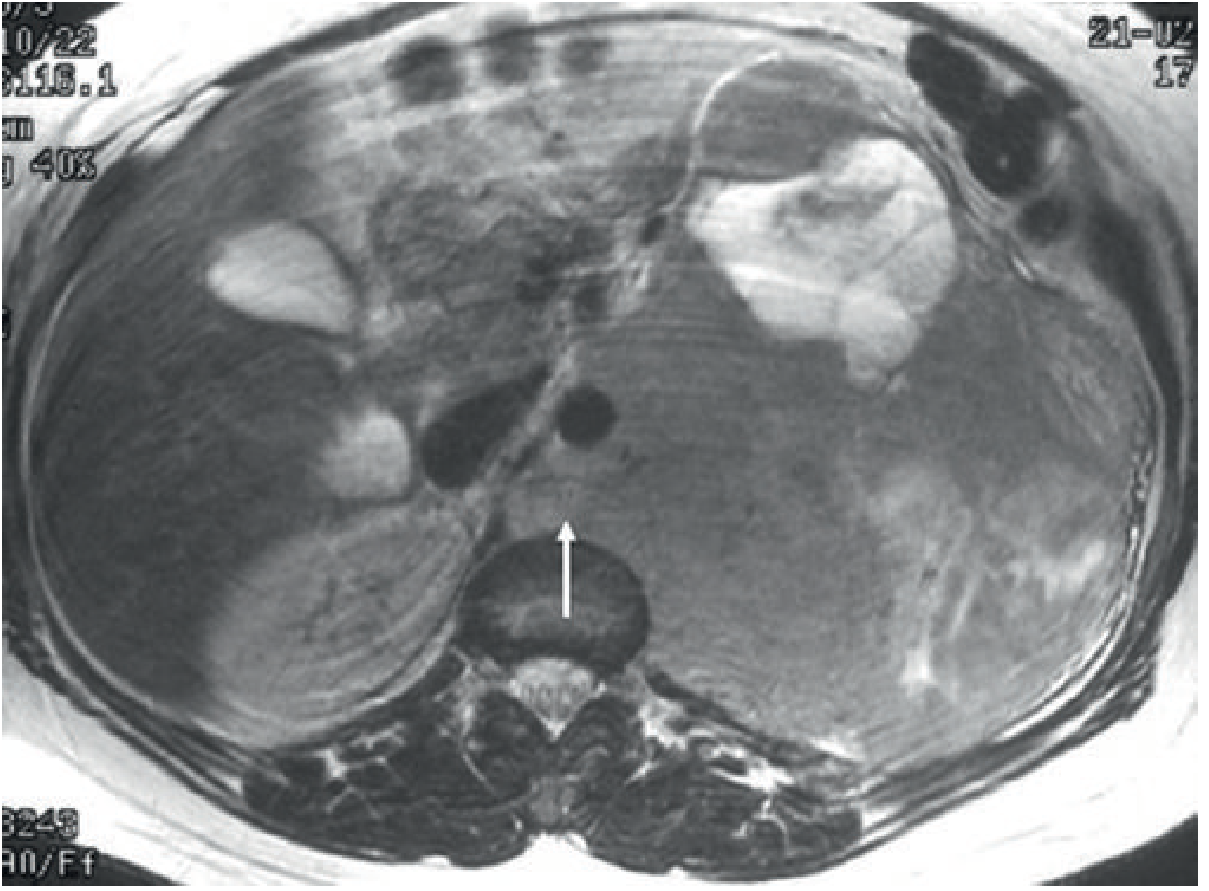
MRI - Preferred for staging and intraspinal extension
- T1W: low to intermediate signal
- T2W: high signal intensity; excellent contrast between tumor and surrounding tissues; preferred for intraspinal dumbbell extension
- DWI: restricted diffusion with low ADC values (substantially lower than Wilms - key differentiator)
- MIBG scintigraphy (meta-iodobenzylguanidine): functional imaging - highest specificity (85%) for staging bone/marrow disease; positive in ~90% of tumors
- Combined MRI + MIBG: sensitivity 99%, specificity 95%
- MRI preferred over CT for: intraspinal extension, liver metastases (T2W hyperintense), bone marrow infiltration, radiation avoidance
- ¹²³I-MIBG scan: whole-body staging for bone, bone marrow, soft tissue disease
Neuroblastoma Staging (INRG / INSS)
INSS (International Neuroblastoma Staging System) - post-surgical
| Stage | Description |
|---|---|
| 1 | Localized, complete gross resection, ipsilateral nodes negative |
| 2A | Localized, incomplete resection, ipsilateral nodes negative |
| 2B | Localized ± complete resection, ipsilateral nodes positive |
| 3 | Unresectable, crosses midline ± regional node involvement; OR contralateral nodes positive |
| 4 | Distant metastases (bone, bone marrow, liver, lymph nodes except 4S) |
| 4S | Localized primary + metastases to skin, liver, and/or bone marrow (< 1 year old); favorable spontaneous regression |
INRG (International Neuroblastoma Risk Group) - pre-surgical, image-defined
Uses Image Defined Risk Factors (IDRFs) to predict surgical resectability:
- Vascular encasement (aorta, IVC, renal vessels, celiac axis, SMA)
- Intraspinal extension (> 1/3 spinal canal)
- Involvement of adjacent organs (liver, diaphragm, kidney)
- Infiltration of structures at neck/thoracic inlet
Associated Syndromes with Neuroblastoma
| Syndrome | Association |
|---|---|
| Beckwith-Wiedemann | Rare association |
| NF-1 (Neurofibromatosis type 1) | Increased risk |
| Hirschsprung disease | Some association (rare) |
| Costello syndrome | HRAS mutation, predisposed to neuroblastoma |
| ALK germline mutation | Familial neuroblastoma |
| Gorlin syndrome (PHACES) | Vascular + neuroblastoma association |
| Opsoclonus-myoclonus syndrome | Paraneoplastic - associated with localized/favorable neuroblastoma |
PART III: HEAD-TO-HEAD COMPARISON - WILMS vs NEUROBLASTOMA
| Feature | Wilms Tumor | Neuroblastoma |
|---|---|---|
| Age | 2-5 years (peak 3rd year) | < 2 years (median 18 months) |
| Origin | Intrarenal (metanephric blastema) | Suprarenal/extrarenal (adrenal medulla, sympathetic chain) |
| Clinical presentation | Asymptomatic abdominal mass; well child | Ill child; fever, weight loss, bone pain, raccoon eyes |
| Calcification (plain film) | Uncommon (~10%) | Common (50-60%) |
| Calcification (CT) | ~10%, peripheral rim | ~80-90%, stippled/coarse/amorphous |
| Kidney | Kidney is the mass; intrarenal; shows "claw sign" | Kidney displaced/compressed but separate; extrinsic mass |
| Aorta displacement | Pushed posteriorly | Lifted/displaced anteriorly; often encased |
| Midline crossing | Rarely crosses midline | Frequently crosses midline; encases vessels |
| IVC involvement | IVC/renal vein tumor thrombus (10%) | Encasement (extrinsic) without thrombosis |
| Metastases | Lungs > liver | Bone, bone marrow, liver, skin (4S) |
| Liver mets pattern | Focal nodular masses | Diffuse infiltration OR focal hypoenhancing |
| DWI/ADC | Higher ADC (less restricted) | Lower ADC (more restricted) |
| MRI T2W | Variable-high signal; claw sign | Very high signal; engulfs vessels |
| Nuclear medicine | No standard nuclear medicine role | MIBG scan (¹²³I) - high specificity |
| Urinary catecholamines | Normal | Elevated VMA, HVA (>90%) |
| Intraspinal extension | Rare | 10% abdominal (dumbbell tumor) |
| Bilateral disease | 5% bilateral | Rare |
| Prognosis | Generally excellent (>90% cure FH Stage I-II) | Variable; 4S has excellent prognosis; Stage 4 poor |
PART IV: OTHER PEDIATRIC RENAL MASSES
1. Congenital Mesoblastic Nephroma (CMN)
- Most common renal tumor in neonates (< 3 months); mean age at presentation 3.5 months
- Benign spindle-cell tumor; two subtypes: classic (fibrous) and cellular (more aggressive)
- Imaging: large, solid, intrarenal mass replacing most of the kidney; hypoechoic on US; heterogeneous on CT/MRI; no calcifications; no pseudocapsule
- Treated with nephrectomy alone (classic type); cellular type may recur - close follow-up
2. Clear Cell Sarcoma of Kidney (CCSK)
- "Bone-metastasizing renal tumor of childhood" - propensity for bone metastases (unlike Wilms)
- Peak age 1-4 years; males predominate
- Pathology: monomorphous spindle/ovoid cells with arborizing vasculature; mucoid extracellular matrix
- Imaging: large, homogeneous, intrarenal mass; CT shows hypodense well-circumscribed mass; may have cysts and calcifications; MRI preferred - intermediate T1, heterogeneous T2
- No specific imaging features to distinguish from Wilms preoperatively
- Treatment includes doxorubicin (unlike favorable-histology Wilms Stage I-II)
3. Rhabdoid Tumor of Kidney (RTK)
- Most aggressive renal tumor of childhood; very young infants (< 2 years, peak 11 months)
- Associated with brain tumors (primitive neuroectodermal tumors/AT/RT) - SMARCB1/INI1 mutation
- Pathology: large vesicular cells with prominent nucleoli and cytoplasmic inclusions
- Imaging: infiltrative large intrarenal mass; subcapsular fluid collection is characteristic; calcifications (~25%); often metastatic at diagnosis (bone, brain, lungs)
- CT: heterogeneous mass; subcapsular crescent may be seen
- Brain MRI mandatory to exclude synchronous primitive neuroectodermal tumor of brain
4. Multilocular Cystic Nephroma (MLCN)
- Benign cystic renal tumor; bimodal age distribution (boys < 2 years; women 30-50 years)
- Imaging: well-circumscribed multi-septated cystic mass; septa may herniate into renal pelvis (CT/MRI "herniation sign" into collecting system)
- CT: multiple non-communicating cysts separated by enhancing septa
- Shares features with multicystic dysplastic kidney (MCDK) and cystic Wilms; cystic Wilms occurs in children ~2-4 years
5. Renal Cell Carcinoma (RCC) in Children
- Rare in children (<5% of pediatric renal tumors); more common in adolescents
- Often associated with: Xp11.2 translocation (TFE3 gene), VHL disease, tuberous sclerosis, hereditary papillary RCC
- Imaging: similar to adult RCC - heterogeneous solid renal mass, CT shows arterial phase enhancement; calcifications more common than in adults with childhood RCC
- Xp11.2 translocation RCC: calcifications, lymph node metastases, may have papillary architecture
6. Renal Lymphoma
- Rare primary; secondary involvement more common in NHL
- Bilateral diffuse infiltration or multiple hypoechoic/hypodense masses
- CT: "multiple soft tissue masses" pattern; minimal enhancement
PART V: IMAGING MODALITY SUMMARY FOR PEDIATRIC RENAL MASSES
| Modality | Role | Key Points |
|---|---|---|
| Ultrasound | First-line; establishes renal vs extra-renal origin | Claw sign; Doppler for IVC thrombus; no radiation |
| CT abdomen/pelvis with contrast | Primary staging; lymph nodes, vascular extension, bilateral tumors | Heterogeneous enhancement; midline crossing; calcifications; aortic displacement |
| CT chest | Pulmonary metastases | Superior to CXR; COG/SIOP differ on significance for small CT-only lesions |
| MRI | Preferred for bilateral Wilms, nephroblastomatosis, intraspinal neuroblastoma, serial surveillance | No radiation; superior soft tissue; DWI for characterization |
| MIBG scintigraphy | Neuroblastoma staging (bone, marrow) | Highest specificity (85%); combined with MRI: sensitivity 99%, specificity 95% |
| Bone scan | CCSK (bone mets), neuroblastoma (if MIBG negative) | Tc-99m MDP |
| PET-CT | Limited role in Wilms (reserved for relapse); some role in MIBG-negative neuroblastoma | Increased radiation; ADC on DWI is preferred for Wilms |
| DWI/ADC | Differentiate Wilms from neuroblastoma | ADC higher in Wilms; lower in neuroblastoma |
Quick Reference: Key Distinguishing Imaging Clues
Clue: Intrarenal mass with claw sign + no calcification + no midline crossing → Wilms tumor
Clue: Suprarenal mass, coarse calcifications, aorta anteriorly displaced, crosses midline, ill child → Neuroblastoma
Clue: Neonate with intrarenal mass, no pseudocapsule → Mesoblastic nephroma
Clue: Mass + subcapsular fluid crescent + brain tumor → Rhabdoid tumor
Clue: Multi-septated cystic mass herniating into renal pelvis → Multilocular cystic nephroma
Clue: Young child, bone metastases, intrarenal mass → Clear cell sarcoma
Sources: Smith & Tanagho's General Urology 19e; Campbell-Walsh-Wein Urology 3-Vol Set; Grainger & Allison's Diagnostic Radiology; Mulholland & Greenfield's Surgery 7e; PMC4446071 - Neuroblastoma and nephroblastoma: a radiological review (2015); NCI PDQ Wilms Tumor Treatment Guidelines 2024
This is a shared conversation. Sign in to Orris to start your own chat.