
i am 24 year old mail facing from a issue that my arm pits having swollen lymph nodes which retain for 10 days and get settle after 10 days amd the pattern is continue for past 2 month and now there is 2 small lump on my body one is on my nack which is painless and another is in my armpits which is painful and i have history of allergic rhinitis and i am having symptoms of fatique some times and there is no fever what is the most probable diagnose and test should i perform or is this a serious issue
Reading File
Now let me search the medical library and PubMed in parallel for the most relevant information on this clinical presentation.
Finding Sources
Finding Sources
Searching PubMed
lymphadenopathy young adult diagnosis evaluation
Searching the Web
recurrent axillary lymphadenopathy young adult painless neck lump diagnosis
Now let me read the key textbook sections on lymphadenopathy differential diagnosis and get more specific content:
Reading File
Finding Sources
Finding Sources
Reading File
Finding Sources
Finding Sources
Let me fetch the diagnostic algorithm image and get Harrison's section on lymphadenopathy workup:
Loading Image
Reading File
I now have comprehensive information to give a thorough, well-cited answer. Let me compile everything.
Clinical Assessment: Your Presentation
Based on your description, here is a structured analysis of what you are experiencing and what it likely means.
Your key clinical features:
- 24-year-old male
- Recurrent axillary (armpit) lymph node swelling - cycles of ~10 days on, then settling, for 2 months
- Painless neck (cervical) lump - new
- Painful axillary lump - new, persistent
- History of allergic rhinitis
- Fatigue (intermittent)
- No fever
Most Probable Diagnoses
This combination of findings - recurrent bilateral lymphadenopathy + a painless neck node + fatigue in a 24-year-old male - requires serious evaluation. Here are the diagnoses ranked by probability:
1. Reactive / Infectious Lymphadenopathy (Most Common, Most Likely Benign)
Your allergic rhinitis history is important. The upper respiratory tract is a major driver of cervical and axillary lymph node reactivity. Recurrent viral upper respiratory infections (even subclinical ones) can cause lymph nodes to swell and settle in cycles, exactly as you describe.
- Key cause: Epstein-Barr Virus (EBV) / Infectious Mononucleosis - affects young adults 15-25 years, causes fatigue + cervical + axillary lymphadenopathy, sometimes with minimal or no fever. As noted in Robbins & Kumar Basic Pathology, "atypical presentations are not unusual. Sometimes there is little or no fever and only fatigue and lymphadenopathy."
- Other viral causes: CMV (cytomegalovirus), similar presentation to EBV
2. Hodgkin Lymphoma (Must Be Excluded - Red Flag)
This is the diagnosis that cannot be missed. Hodgkin lymphoma has a bimodal age peak at 15-34 years and >55 years, making a 24-year-old male squarely in the primary risk group. Classic features include:
- Painless rubbery cervical or axillary nodes (your painless neck lump fits this)
- Fatigue
- "Alcohol-induced pain" in affected nodes (some patients describe painful nodes)
- "B symptoms" (fever >38°C, drenching night sweats, >10% weight loss) - their absence does not rule out lymphoma, as B symptoms occur in only ~40% of cases at presentation
The fact that you have nodes in two separate regions (neck + axilla) over 2 months is a pattern that needs to be evaluated to exclude this. - Sabiston Textbook of Surgery
3. Kikuchi-Fujimoto Disease (Histiocytic Necrotizing Lymphadenitis)
A benign, self-limiting condition that frequently affects young adults. It presents with recurrent cervical lymphadenopathy, fatigue, and often resolves spontaneously over weeks. It can mimic lymphoma on clinical exam. The 2025 systematic review (PMID: 40056750) highlighted its sometimes complex presentation.
4. Sarcoidosis
Can affect young adults and classically causes painless cervical and axillary lymphadenopathy, fatigue, and sometimes overlaps with allergic/atopic conditions. Often no fever.
5. Cat-Scratch Disease (Bartonella henselae)
If you have had any contact with cats (especially kittens), this bacteria causes axillary and cervical lymphadenopathy - the axillary nodes can be painful, which matches one of your lumps. It usually follows a scratch or bite by several weeks.
6. Non-Hodgkin Lymphoma
Less likely in your age group than Hodgkin, but still on the differential. Tends to present more extranodally and in older adults.
7. HIV / Other Infections
Persistent generalized lymphadenopathy is an early sign of HIV infection. Given your age, if there is any relevant exposure history, this warrants testing.
What the Textbook Says About Duration and Pattern
This is a critical reassuring point from Sabiston Textbook of Surgery:
"For lymphadenopathy that lasts less than 2 weeks or lasts longer than 12 months without a change in size, or if the patient reports a fluctuation in lymph node size, the likelihood of it being caused by a malignant process is extremely low."
Your fluctuating/cycling nodes over 2 months lean toward a benign reactive process. However, the appearance of new, persistent, fixed nodes (the neck lump especially) changes the picture and requires investigation.
Recommended Tests
Here is the workup algorithm, matching the standard approach:
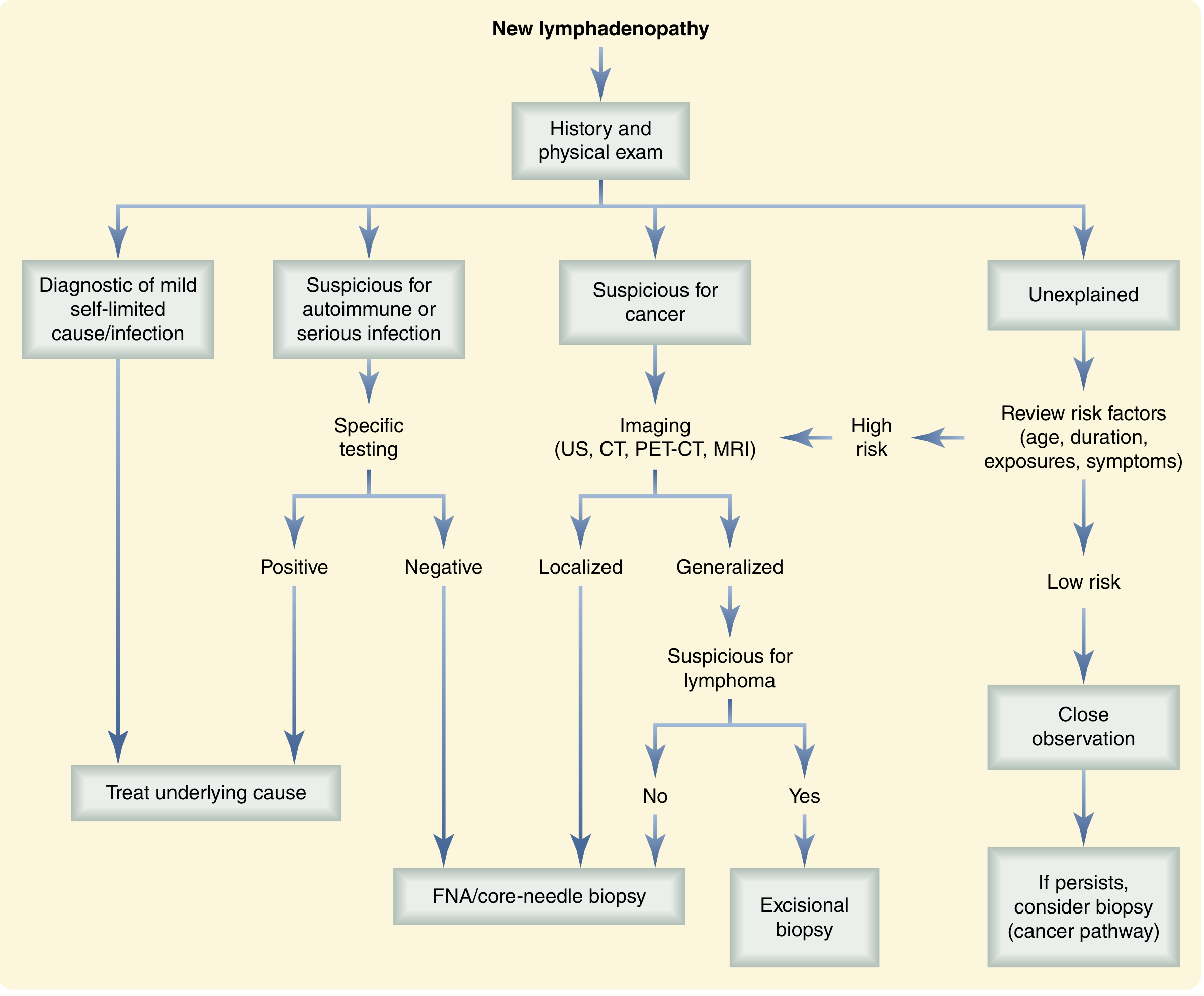
Blood Tests (First Line)
| Test | What It Checks For |
|---|---|
| Complete Blood Count (CBC) with differential | Leukemia, lymphoma, EBV/CMV mononucleosis, infections |
| Peripheral blood smear | Atypical lymphocytes (mono), blast cells |
| Monospot test / EBV IgM antibodies | Infectious mononucleosis |
| CMV serology (IgM/IgG) | CMV mononucleosis |
| ESR, CRP, LDH | Inflammatory activity; elevated LDH raises concern for lymphoma |
| HIV test | HIV-associated lymphadenopathy |
| ANA, anti-dsDNA | Autoimmune (SLE, etc.) if other features present |
Imaging (Second Line)
- Ultrasound of neck and axilla - First-line imaging; can characterize node size, shape, cortical thickness, and vascularity. An L/S ratio <2.0 on ultrasound has 95% sensitivity and specificity for distinguishing malignant from benign nodes. - Harrison's Internal Medicine, 22nd Edition
- Chest X-ray - To look for mediastinal adenopathy (important in lymphoma workup)
- CT scan (if ultrasound is abnormal or lymphoma is suspected) - Better characterization of all node stations
Biopsy (If Required)
Per Harrison's Principles of Internal Medicine: "If no mucosal lesion is detected, an excisional biopsy of the largest node should be performed. Fine-needle aspiration should not be performed as the first diagnostic procedure" when lymphoma is suspected - it does not preserve lymph node architecture needed for lymphoma subtyping.
Indications for early biopsy include:
- Firm, movable, rubbery node suggestive of lymphoma
- Supraclavicular adenopathy
- Node not responding to watchful waiting over 2-4 weeks
- Abnormal CBC or elevated LDH
Is This Serious?
Honestly, it needs evaluation - but there are reassuring features too.
| Feature | Reassuring | Concerning |
|---|---|---|
| Age (24M) | Cancer risk in <40yo is only ~0.4% for unexplained lymphadenopathy | Hodgkin lymphoma peaks exactly at your age |
| Duration pattern | Fluctuating/cycling nodes are less likely malignant | 2 months duration with new persistent nodes |
| Symptoms | No B symptoms (no fever, no night sweats, no weight loss) | Fatigue present; painless neck node |
| Location | Axillary reactivity common with rhinitis/infections | Two separate node regions involved |
Bottom line: The most likely cause is still reactive/infectious (EBV or viral), but the new persistent, painless neck node combined with the pattern over 2 months means you should not wait further. This is not an emergency, but it is not something to dismiss.
What You Should Do
- See a doctor this week - don't delay further
- Get a CBC, LDH, ESR, EBV serology as a starting panel
- Get an ultrasound of your neck and axilla
- If blood tests or ultrasound raise any concern, your doctor will refer you for a biopsy or to a hematologist
Disclaimer: This information is for educational purposes only and does not replace a clinical evaluation. Please consult a qualified physician - the neck lump especially needs to be physically examined and investigated promptly.
This is a shared conversation. Sign in to Orris to start your own chat.