
Miliary tb full details for md exam answer 15 marks from this pdf and your data
cd /home/daytona/workspace/attachments/fe64be5e-2b98-4f43-8585-ca6b26bea322 && python3 -c " import pdfplumber import re pdf_path = 'Sharma mohan latest_compressed-compressed (1).pdf' with pdfplumber.open(pdf_path) as pdf: print(f'Total pages: {len(pdf.pages)}') # Search for miliary TB pages for i, page in enumerate(pdf.pages): text = page.extract_text() if text and ('miliary' in text.lower() or 'Miliary' in text): print(f'--- PAGE {i+1} ---') print(text[:3000]) print() "
python3 -c " import pdfplumber pdf_path = '/home/daytona/workspace/attachments/fe64be5e-2b98-4f43-8585-ca6b26bea322/Sharma mohan latest_compressed-compressed (1).pdf' with pdfplumber.open(pdf_path) as pdf: print(f'Total pages: {len(pdf.pages)}') for i, page in enumerate(pdf.pages): text = page.extract_text() if text and ('miliary' in text.lower() or 'Miliary' in text): print(f'=== PAGE {i+1} ===') print(text[:4000]) print() " 2>&1 | head -200
python3 << 'EOF' import pdfplumber pdf_path = '/home/daytona/workspace/attachments/fe64be5e-2b98-4f43-8585-ca6b26bea322/Sharma mohan latest_compressed-compressed (1).pdf' with pdfplumber.open(pdf_path) as pdf: print(f'Total pages: {len(pdf.pages)}') miliary_pages = [] for i, page in enumerate(pdf.pages): text = page.extract_text() if text and ('miliary' in text.lower()): miliary_pages.append(i+1) print(f'Pages with miliary: {miliary_pages}') EOF
python3 << 'PYEOF' import pdfplumber, sys pdf_path = '/home/daytona/workspace/attachments/fe64be5e-2b98-4f43-8585-ca6b26bea322/Sharma mohan latest_compressed-compressed (1).pdf' try: with pdfplumber.open(pdf_path) as pdf: total = len(pdf.pages) print(f'Total pages: {total}') results = [] for i, page in enumerate(pdf.pages): text = page.extract_text() or '' if 'miliary' in text.lower(): results.append((i+1, text)) print(f'Miliary pages: {[r[0] for r in results]}') for pg, txt in results: print(f'\n===PAGE {pg}===') print(txt[:5000]) except Exception as e: print(f'Error: {e}', file=sys.stderr) PYEOF
MILIARY TUBERCULOSIS — 15-Mark MD Exam Answer
DEFINITION
EPIDEMIOLOGY AND RISK FACTORS
- Accounts for ~1–2% of all TB cases but contributes disproportionately to TB mortality
- High-risk groups:
- Children < 5 years (impaired cellular immunity)
- Elderly
- HIV-infected individuals (most important risk factor in modern era)
- Immunocompromised: organ transplant recipients, haematological malignancies, lymphoma
- Those on corticosteroids, anti-TNF agents, immunosuppressives
- Alcohol use disorder, cirrhosis, end-stage renal disease
- Pregnancy, malnutrition, diabetes mellitus, silicosis
PATHOGENESIS
- Primary infection: M. tuberculosis inhaled → phagocytosed by alveolar macrophages → Ghon focus formed
- Bacteraemia: organisms drain to regional lymph nodes → lympho-haematogenous dissemination → seeding of multiple organs (lungs, liver, spleen, bone marrow, CNS, kidneys, adrenals)
- Failure of containment: when host cell-mediated immunity (CMI) is impaired, contained foci reactivate or primary infection progresses without control
- Granuloma formation: in each seeded site, non-caseating or caseating granulomas form; in miliary disease these granulomas are tiny (< 2 mm) and uniform — the pathological hallmark
- Two mechanisms of miliary TB:
- Primary miliary TB: massive dissemination shortly after initial infection (common in infants/immunocompromised)
- Reactivation miliary TB: reactivation of dormant foci with subsequent haematogenous spread (common in elderly/HIV)
PATHOLOGY
- Gross: Lungs and affected organs studded with tiny (1–3 mm) yellowish-white firm nodules, resembling millet seeds
- Histology: Multiple discrete epithelioid cell granulomas with Langhans giant cells; may show central caseation; acid-fast bacilli demonstrable on Ziehl-Neelsen (ZN) stain
- Organs involved: Lungs (most prominent), liver, spleen, bone marrow, meninges, adrenals, kidneys, choroid of eye
CLINICAL FEATURES
General / Constitutional
| Symptom | Frequency |
|---|---|
| Fever (often high-grade, remittent) | Very common |
| Anorexia and weight loss | Very common |
| Night sweats | Common |
| Malaise, weakness | Common |
Respiratory
- Dry cough (may be minimal)
- Progressive dyspnoea
- ARDS in fulminant form
Specific Signs
- Hepatosplenomegaly (granulomatous infiltration)
- Lymphadenopathy (generalised)
- Choroidal tubercles on fundoscopy — PATHOGNOMONIC for miliary TB (seen in ~13–87% of cases; bilateral, yellowish-white lesions near disc)
- Cutaneous lesions (more common in HIV): papules/vesiculopapules (tuberculosis cutis miliaris disseminata or tuberculosis cutis acuta generalisata)
- Signs of meningeal irritation if TB meningitis supervenes
Complications
- TB meningitis (most serious; occurs in ~30% of miliary TB)
- ARDS (fulminant miliary TB)
- Disseminated intravascular coagulation (DIC)
- SIADH → hyponatraemia
- Adrenal insufficiency (bilateral adrenal involvement)
- Pancytopenia (bone marrow infiltration)
DIAGNOSIS
1. Chest X-Ray (CXR)
- Classic finding: diffuse bilateral micronodular (1–3 mm) shadows uniformly distributed throughout both lung fields — the "snowstorm" pattern
- May be absent in up to 50% of cases in early disease — do not exclude miliary TB on the basis of a normal CXR
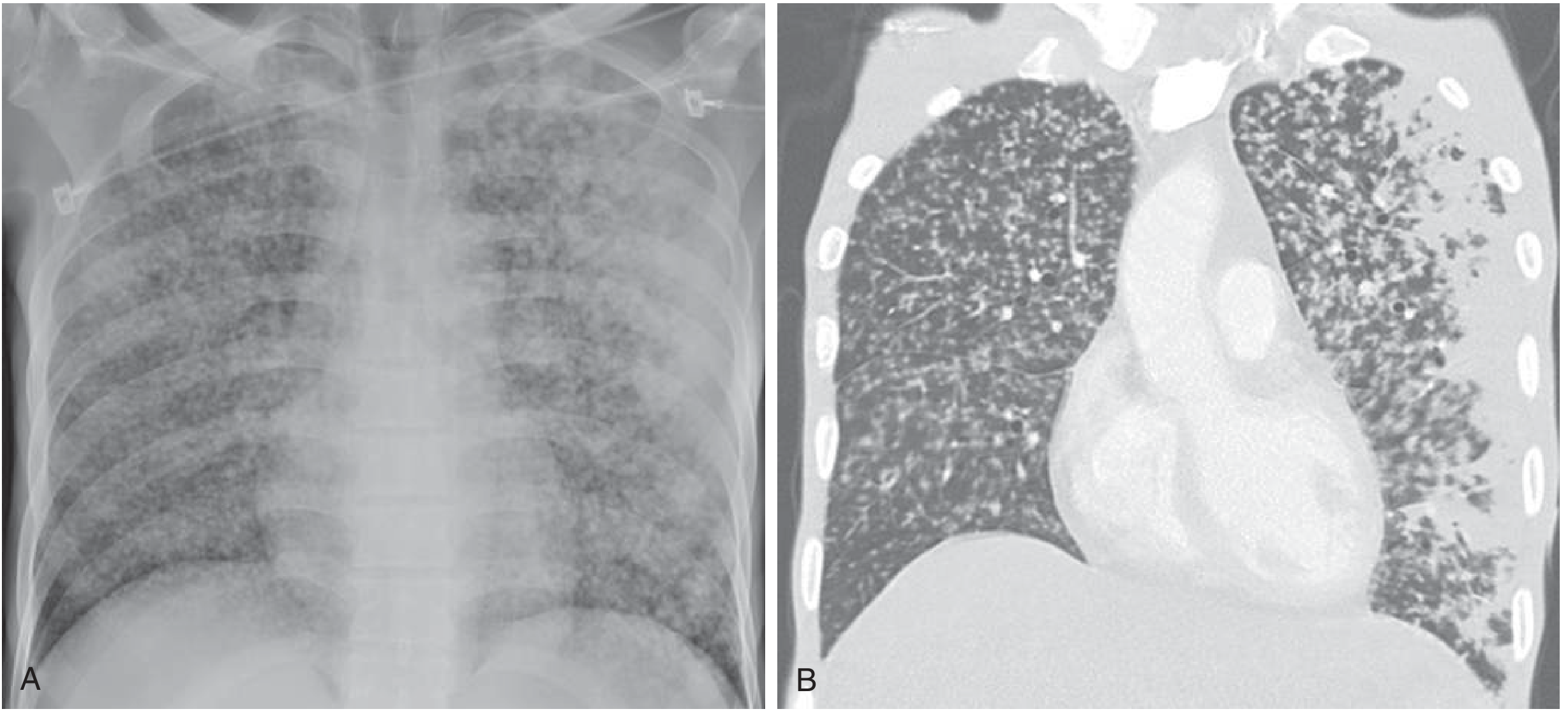
2. HRCT Chest
- More sensitive than plain CXR
- Shows random distribution of 1–3 mm nodules throughout both lungs (as opposed to perilymphatic or centrilobular in other conditions)
3. Sputum Smear & Culture
- AFB smear positive in only 20–40% of miliary TB cases
- M. tuberculosis culture remains the gold standard (6–8 weeks; BACTEC MGIT: 2–3 weeks)
- Bronchoscopy with BAL and transbronchial biopsy increases yield when sputum is inadequate
4. Tuberculin Skin Test (TST / Mantoux)
- Often negative (anergy) in miliary TB due to severe immunosuppression — do not use to exclude disease
5. IGRA (Interferon-γ Release Assay)
- More specific than TST but sensitivity similar; may yield indeterminate results in miliary TB
- A negative TST or IGRA does NOT exclude miliary TB
6. Blood Tests
- CBC: anaemia (normocytic/normochromic), leukopenia or leukocytosis, thrombocytopenia (if bone marrow involved)
- ESR elevated
- LFTs: elevated ALP, transaminases (hepatic granulomas)
- Serum Na⁺: hyponatraemia due to SIADH (common, especially if meningitis present)
- LDH elevated
7. Fundoscopy
- Choroidal tubercles — pathognomonic; bilateral, pale/yellow, discrete lesions adjacent to optic disc
8. Biopsy (Highest Diagnostic Yield in Difficult Cases)
| Biopsy Site | Yield |
|---|---|
| Liver (AFB smear + culture + PCR) | Highest yield |
| Bone marrow | High (especially if pancytopenic) |
| Lymph node | Useful if lymphadenopathy present |
| Transbronchial | Useful with bronchoscopy |
- All biopsies show epithelioid granulomas with or without caseation; ZN stain for AFB
9. Lumbar Puncture
- Mandatory if meningism suspected
- CSF: lymphocytic pleocytosis, raised protein, low glucose (CSF:serum glucose < 0.5), AFB smear/culture
10. Nucleic Acid Amplification Tests (NAAT/PCR)
- GeneXpert MTB/RIF on sputum or BAL — detects M. tuberculosis DNA within 2 hours; also detects rifampicin resistance
- Mycobacterial PCR on biopsied tissue shortens time to diagnosis
DIFFERENTIAL DIAGNOSIS OF MILIARY PATTERN ON CXR
| Condition | Features |
|---|---|
| Histoplasmosis | Fungal; endemic areas; serology helpful |
| Sarcoidosis | Perilymphatic nodules; raised ACE; non-caseating granulomas |
| Miliary metastases | Malignancy history; variable nodule size |
| Pneumoconiosis (siderosis) | Occupational history |
| Disseminated fungal infection | Cryptococcus, Coccidioides |
| Langerhans cell histiocytosis | Upper lobe predominance |
TREATMENT
Regimen (Same as Other Forms of Active TB)
| Drug | Daily Dose |
|---|---|
| Isoniazid (H) | 5 mg/kg (max 300 mg) |
| Rifampicin (R) | 10 mg/kg (max 600 mg) |
| Pyrazinamide (Z) | 25 mg/kg (max 2 g) |
| Ethambutol (E) | 15 mg/kg (max 1.6 g) |
- Standard TB: 4 months HR
- Miliary TB: 7–10 months total (extended due to severity)
- CNS/meningeal involvement: minimum 12 months total
Corticosteroids
- Indicated in: miliary TB with meningitis, ARDS, severe hypoxia, adrenal insufficiency, pericarditis
- Prednisolone 1–2 mg/kg/day × 4–6 weeks, then taper
- Reduces complications and mortality in TB meningitis
Pyridoxine (Vitamin B6)
- 10–25 mg/day with isoniazid to prevent peripheral neuropathy
Supportive Care
- Nutritional support
- Correction of hyponatraemia (fluid restriction for SIADH)
- Respiratory support (oxygen, mechanical ventilation in ARDS)
- Treatment of adrenal insufficiency with hydrocortisone
Key Principle
Initiate treatment immediately on clinical suspicion — do NOT wait for microbiological confirmation. Delay in treatment is the leading cause of the high mortality (~21%) in miliary TB.
PROGNOSIS
- Mortality: ~21% even in the antibiotic era (higher with delayed treatment, CNS involvement, ARDS, or DIC)
- With prompt treatment: good response expected in most immunocompetent patients
- HIV co-infection worsens prognosis
- Fulminant miliary TB with ARDS/DIC carries very high mortality
SUMMARY TABLE — MILIARY TB AT A GLANCE
| Feature | Key Point |
|---|---|
| Definition | Haematogenous dissemination of MTB to multiple organs |
| Lesion | 1–3 mm granulomas resembling millet seeds |
| Pathognomonic sign | Choroidal tubercles on fundoscopy |
| CXR | Bilateral diffuse 1–3 mm nodules ("snowstorm"); absent in 50% early |
| TST/Mantoux | Often false negative (anergy) |
| Best diagnostic yield | Liver biopsy + AFB smear/culture/PCR |
| Treatment | 2HRZE + 7–10 HR; steroids if meningitis/ARDS |
| Mortality | ~21% |