
Class 11th mein jo chapter h biologycal classification vo smjhao zero se
Class 11 biological classification chapter NCERT five kingdom classification explained Hindi
https://ncert.nic.in/textbook/pdf/kebo102.pdf
🌿 Biological Classification - Class 11 | Chapter 2
(Jeevan Jagat ka Vargikaran)
📌 Sabse Pehle - Classification Kyun Zaroori Hai?
Aristotle ka attempt (sabse purana)
- Aristotle pehle scientist the jinhone classification ki koshish ki
- Unhone jaanwaron ko blood wale (vertebrates) aur blood-less (invertebrates) mein baanta
- Plants ko: trees, shrubs, herbs mein baanta
- Problem: Yeh kafi incomplete tha
📌 Two Kingdom Classification (Linnaeus - 1758)
- Plantae (Plants)
- Animalia (Animals)
Problems jo aayi:
- Bacteria kahaan rakhein? (na plant hai, na animal)
- Fungi kahaan rakhein? (plant jaise dikhti hai, lekin khud khana nahi bana sakti)
- Euglena kahaan rakhein? (plant + animal dono jaisi properties hain)
📌 Five Kingdom Classification - R.H. Whittaker (1969) ✅ MOST IMPORTANT
| Kingdom | Examples |
|---|---|
| Monera | Bacteria, Cyanobacteria |
| Protista | Amoeba, Paramecium, Euglena |
| Fungi | Mushroom, Yeast, Mould |
| Plantae | Sabhi plants |
| Animalia | Sabhi animals |
Criteria (kitne basis par baanta?):
- Cell structure - Prokaryotic ya Eukaryotic?
- Body organization - Unicellular ya Multicellular?
- Mode of nutrition - Autotrophic (khud banata) ya Heterotrophic (doosron se leta)?
- Reproduction - Kaise reproduce karta?
- Phylogenetic relationships - Evolutionary relation kya hai?
🔵 Kingdom 1 - MONERA
Key Features:
- Prokaryotic cell (nucleus nahi hota - nuclear membrane absent)
- Unicellular (single cell)
- Kuch autotrophic (khud khana banate - like cyanobacteria/blue-green algae)
- Kuch heterotrophic (doosron par depend - like most bacteria)
- Cell wall hoti hai (lekin plant cell wall se different)
- No membrane-bound organelles (mitochondria, ER waghera nahi)
Examples:
- Bacteria - sabse common
- Cyanobacteria (Blue-Green Algae) - jaise Nostoc, Anabaena
- Mycoplasma - cell wall bhi nahi hoti! Sabse chota jeev
Bacteria ke types (shape ke basis par):
| Shape | Name | Example |
|---|---|---|
| Gol/Round | Coccus (pl. Cocci) | Staphylococcus |
| Lamba/Rod | Bacillus (pl. Bacilli) | E. coli |
| Spiral/Helix | Spirillum | Spirillum |
| Comma-shaped | Vibrio | Vibrio cholerae |
Bacteria ka nutrition (Doosra important point):
- Autotrophs:
- Photosynthetic - light se energy (Cyanobacteria)
- Chemosynthetic - chemical reactions se energy (Nitrifying bacteria)
- Heterotrophs: Dead matter se ya living organisms se nutrition lete hain
💡 Exam Tip: Archaebacteria (Archaea) bhi Monera mein aate hain! Yeh extreme conditions mein rehte hain:
- Halophiles - bahut zyada salt wali jagah (Dead Sea)
- Thermoacidophiles - bahut zyada temperature + acid (volcanic areas)
- Methanogens - methane gas banate hain (cattle ke gut mein!)
🟢 Kingdom 2 - PROTISTA
Key Features:
- Eukaryotic cell (nucleus hota hai - nuclear membrane present) ✅
- Mostly unicellular (kuch colonial bhi)
- Aquatic environments mein milte hain
- Locomotion ke liye cilia ya flagella hote hain
Important Groups:
1. Chrysophytes (Diatoms + Golden Algae)
- Aquatic environments mein milte hain
- Diatoms ki cell wall silica se bani hoti hai
- "Chief producers" of ocean (ocean ka food chain inse shuru hota)
- Dead diatoms ka diatomaceous earth banta hai - filtering mein use hota
2. Dinoflagellates
- Marine environments mein
- Mostly photosynthetic
- Bioluminescence - raat ko glow karte hain (ocean mein chamak!)
- Red tides - jab inka bahut zyada growth ho, sea red dikhta hai - fish marti hai
- Example: Gonyaulax - red tide banata hai
3. Euglenoids
- Freshwater mein milte hain
- Euglena - sabse famous example
- Plant + Animal dono jaisi properties:
- Light mein: Photosynthesis (plant jaisa)
- Darkness mein: Heterotrophic (animal jaisa)
- Cell wall nahi, pellicle hoti hai (protein ki layer)
- Flagella hoti hai - swim karte hain
4. Slime Moulds
- Saprotrophic - dead organic matter khaate hain
- Body: plasmodium (multinucleate mass) banate hain
- Unfavorable conditions mein spores banate hain - extreme conditions mein survive
- Interesting: Ek alag alag cell bhi ho sakte, aur mil bhi sakte
5. Protozoans
- Heterotrophic (khud khana nahi banate)
- 4 types:
| Type | Movement | Example |
|---|---|---|
| Amoeboid | Pseudopodia se | Amoeba, Entamoeba |
| Flagellated | Flagella se | Trypanosoma (sleeping sickness) |
| Ciliated | Cilia se | Paramecium |
| Sporozoans | Movement nahi | Plasmodium (malaria!) |
💡 Plasmodium - malaria ka causative agent - Sporozoans mein aata hai!
🟤 Kingdom 3 - FUNGI
Key Features:
- Eukaryotic
- Heterotrophic - khud khana nahi banate
- Saprotrophic mostly - dead matter digest karte hain
- Cell wall = Chitin se bani hoti hai (plant ki nahi, insect exoskeleton jaisi!)
- Filamentous structure - thin threads jise hyphae kehte hain
- Hyphae ka network = Mycelium
- Spores se reproduce karte hain
Types of Hyphae:
- Coenocytic hyphae - no cross walls (septum absent), many nuclei
- Septate hyphae - cross walls (septum) hoti hain
Nutrition modes:
- Saprotrophic - dead organic matter par
- Parasitic - living host par (disease causing)
- Mutualistic - doosre organism ke saath benefit-benefit relationship
Important Associations:
🤝 Lichens
- Fungi + Algae ka mutualistic association
- Fungi = shelter/water/minerals deta
- Algae = photosynthesis karta (food banata)
- Pollution indicators hain - polluted areas mein nahi milte
- Example: Cladonia
🌱 Mycorrhiza
- Fungi + Plant roots ka association
- Fungi plant ko minerals absorb karne mein help karta
- Plant fungi ko food (photosynthate) deta
- Example: Glomus
Major Groups of Fungi:
| Class | Common Name | Hyphae | Spore | Example |
|---|---|---|---|---|
| Phycomycetes | Algal Fungi | Coenocytic | Zoospores/Zygospores | Mucor, Rhizopus (bread mould) |
| Ascomycetes | Sac Fungi | Septate | Ascospores (in ascus) | Yeast, Penicillium, Aspergillus, Neurospora |
| Basidiomycetes | Club Fungi | Septate | Basidiospores (in basidium) | Mushrooms, Puffballs, Agaricus |
| Deuteromycetes | Imperfect Fungi | Septate | Conidia | Alternaria, Colletotrichum |
💡 Deuteromycetes ko "imperfect fungi" isliye kehte kyunki inki sexual reproduction known nahi!
💡 Penicillium se Penicillin antibiotic banta hai - Alexander Fleming ne discover kiya!
🌿 Kingdom 4 - PLANTAE
Key Features:
- Eukaryotic
- Autotrophic - Photosynthesis karte hain (chlorophyll present)
- Cell wall = Cellulose se bani
- Multicellular
- Kuch partial heterotrophs bhi:
- Insectivorous plants - jaise Venus flytrap, Pitcher plant (insects khaate)
- Parasitic plants - jaise Cuscuta (amar bel)
Includes:
- Algae
- Bryophytes (mosses)
- Pteridophytes (ferns)
- Gymnosperms (pine)
- Angiosperms (flowering plants)
🐾 Kingdom 5 - ANIMALIA
Key Features:
- Eukaryotic
- Heterotrophic - doosron par depend for food
- No cell wall
- Multicellular
- Sexual reproduction mostly
- Nervous system + muscle tissue hota hai (movement possible)
📌 Viruses, Viroids, Prions, Lichens - Special Topics
🦠 Viruses - "Na jeev, na nirjeev" (Living or Non-living?)
- Living characteristics: Reproduction (inside host), genetic material (DNA or RNA)
- Non-living characteristics: Koi host nahi to crystal form mein, no metabolism
- Acellular - cell nahi hoti
- Structure: Genetic material (DNA or RNA) + Protein coat (Capsid)
- Obligate intracellular parasites - sirf host cell ke andar reproduce kar sakte
- Discovered by: D.J. Ivanowski (1892) - tobacco mosaic disease mein
- "Virus" word diya: M.W. Beijerinck ne
Types:
- Plant viruses - RNA as genetic material mostly
- Animal viruses - DNA ya RNA
- Bacteriophages - bacteria ko infect karte (usually DNA)
Common Diseases:
- Mumps, Measles, Chicken pox, AIDS (animal viruses)
- Tobacco Mosaic Virus (TMV) - tobacco plants mein
🔬 Viroids
- Virus se bhi chote!
- Sirf free RNA - koi protein coat nahi
- T.O. Diener ne discover kiya (1971)
- Potato spindle tuber disease banate hain
🧬 Prions
- Sirf abnormal protein - koi nucleic acid nahi!
- Mad cow disease (BSE) - Bovine Spongiform Encephalopathy
- Creutzfeldt-Jakob disease in humans
- Normal protein ko abnormal bana dete chain reaction mein
📝 Quick Revision Table
| Feature | Monera | Protista | Fungi | Plantae | Animalia |
|---|---|---|---|---|---|
| Cell type | Prokaryotic | Eukaryotic | Eukaryotic | Eukaryotic | Eukaryotic |
| Cell wall | Present (non-cellulose) | Mostly absent | Present (Chitin) | Present (Cellulose) | Absent |
| Nuclear membrane | Absent | Present | Present | Present | Present |
| Body | Unicellular | Mostly unicellular | Multicellular (hyphae) | Multicellular | Multicellular |
| Nutrition | Auto/Hetero | Auto/Hetero | Heterotrophic | Autotrophic | Heterotrophic |
| Locomotion | Flagella/None | Cilia/Flagella | Absent | Absent | Present |
🎯 Exam ke liye Most Important Points
- Whittaker (1969) = Five Kingdom system
- Monera = only Prokaryotes
- Mycoplasma = cell wall nahi - smallest living organism
- Euglena = both autotrophic + heterotrophic
- Fungi cell wall = Chitin (yaad rakhna!)
- Lichens = Fungi + Algae (pollution indicator)
- Mycorrhiza = Fungi + Plant roots
- Penicillin = Penicillium (Ascomycetes)
- Viroids = free RNA only (Diener, 1971)
- Prions = abnormal protein only (BSE/Mad cow disease)
- Bacteriophage = virus jo bacteria ko infect kare
- Plasmodium = malaria, Sporozoans mein aata hai
🔑 Important Scientists to Remember
| Scientist | Contribution |
|---|---|
| Aristotle | First classification attempt |
| Carolus Linnaeus | Two Kingdom system |
| R.H. Whittaker | Five Kingdom system (1969) |
| D.J. Ivanowski | Virus discovery (1892) |
| M.W. Beijerinck | Coined "virus" term |
| T.O. Diener | Viroid discovery (1971) |
| Stanley | Crystallized virus |
Acha Monera ko aaram se smjhao diagram ke sath jivo ke ya bacteria ke taki kuch familiar lge mere ko pta hi nhi bga ya euglina kya hota h Monera tk chapter smjha do uske aage raat ko kre ge
bacteria diagram labeled cell structure simple euglena diagram class 11
bacteria cell structure labeled diagram prokaryotic NCERT class 11 biology
🦠 KINGDOM MONERA - Bilkul Zero Se
Pehle Samjho - "Cell" Kya Hoti Hai?
- Ghar ki diwar = Cell wall
- Ghar ki deewar ke andar ki skin = Plasma membrane
- Kamre = Organelles (mitochondria, ER, etc.)
- Ghar ka mukhiya (sab decisions leta hai) = Nucleus
🚨 Nucleus ka kamra hi nahi hai! Mukhiya seedha floor par baitha hai - koi room nahi, koi door nahi!
🔬 Bacteria ki Structure - Diagram ke Saath
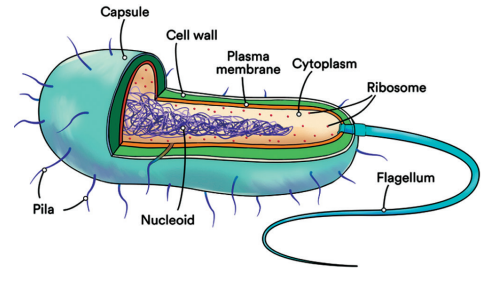
🧱 1. Capsule (Baahri Covering)
- Bacteria ka raincoat samjho
- Slimy polysaccharide ki layer hoti hai
- Kaam: Bacteria ko white blood cells se bachata hai - isliye kuch bacteria itne dangerous hote hain!
- Example: TB ka bacteria (Mycobacterium) ka capsule bahut strong hota hai
🧱 2. Cell Wall
- Capsule ke andar - pakki deewar hai
- Bacteria mein peptidoglycan se bani hoti hai (plant ki cellulose se alag)
- Gram Staining - bacteria ki cell wall ke structure se 2 types bante hain:
- 🟣 Gram Positive - thick wall, purple color leta hai staining mein
- 🔴 Gram Negative - thin wall, pink/red color leta hai
💡 Doctor antibiotic dete waqt yeh check karte hain ki bacteria Gram + hai ya Gram - , kyunki dono ko alag antibiotic lagti hai!
🫧 3. Plasma Membrane
- Cell wall ke andar ki skin - ek thin layer
- Kya andar aayega, kya bahar jaayega - yeh decide karti hai
- Selectively permeable kehte hain ise
🌊 4. Cytoplasm
- Andar ka sara jelly jaise liquid hissa
- Isme hi sab kuch floating karta rehta hai
- Koi bhi membrane-bound organelle nahi hota (mitochondria nahi, ER nahi, Golgi nahi!)
🧬 5. Nucleoid (DNA region)
- Bacteria mein nucleus nahi hota, par DNA hota zaroor hai
- Yeh DNA freely cytoplasm mein ek gunde-gunde ball ki tarah pada rehta hai
- Ise Nucleoid kehte hain - "nucleus jaisi jagah"
- Iske alawa Plasmid bhi hota hai - extra circular DNA ka chhota piece
- Antibiotic resistance plasmid ke through hi spread hoti hai bacteria mein!
🟢 6. Ribosomes
- Yeh protein factory hain
- Bacteria mein 70S type ribosomes hote hain (humara - 80S)
- Bacteria ke 70S ribosome ko target karke antibiotics kaam karti hain (jaise Streptomycin)
🐾 7. Flagellum (Pair: Flagella)
- Bacteria ki ponch/tail - isse swim karta hai
- E. coli bacteria is se tairta hai
- Pili / Pilus - chhoti chhoti hair-like structures - doosri cells se chipakne ke kaam aate hain
🔵 Bacteria ke Types - Shape ke Basis Par
🟢 COCCUS (Gol)       ══► Staphylococcus aureus (skin infections)
                            S.pneumoniae (pneumonia)

🟩 BACILLUS (Lamba)   ══► E. coli (hamare gut mein!)
                            Mycobacterium tuberculosis (TB)
                            Lactobacillus (dahi mein!)

🌀 SPIRILLUM (Spiral) ══► Helicobacter pylori (pet ka ulcer!)
   VIBRIO (Comma)     ══► Vibrio cholerae (CHOLERA!)
😮 Dahi mein bacteria?! Haan! Lactobacillus bacteria hi doodh ko dahi banata hai - yeh ek helpful bacteria hai!
🌟 Bacteria ke Types - Nutrition ke Basis Par
                    BACTERIA
                       |
         ┌─────────────┴─────────────┐
    AUTOTROPHS                 HETEROTROPHS
  (Khud khana banate)        (Doosron se lete)
         |                          |
    ┌────┴────┐              ┌──────┴──────┐
Phototrophs Chemotrophs   Saprotrophic  Parasitic
(Light se)  (Chemical se) (Dead matter) (Living host)
    |            |
Cyanobacteria  Nitrifying
(Blue-green    bacteria
 algae)        (Soil mein)
Examples with Real Life:
| Bacteria | Kya karta hai | Milta kahan |
|---|---|---|
| Cyanobacteria (Nostoc) | Photosynthesis - oxygen banata hai! | Pond, wet soil |
| Nitrosomonas | Ammonium ko nitrite mein convert karta (soil fertile banata) | Soil |
| Lactobacillus | Doodh → Dahi | Dahi mein |
| E. coli | Hamare intestine mein rehta, Vitamin K banata! | Human gut |
| Mycobacterium tuberculosis | TB disease | Lungs |
| Vibrio cholerae | Cholera | Contaminated water |
| Methanogens | Methane gas banate hain | Cow/buffalo ka pet! |
🌿 Special - CYANOBACTERIA (Blue-Green Algae)
- Photosynthesis karta hai - bilkul plants ki tarah!
- Lekin plant nahi hai - Monera mein hai kyunki PROKARYOTIC hai
- Nitrogen fixation bhi karte hain kuch (Nostoc, Anabaena)
- Matlab: Hawa ka N₂ gas le kar isko soil mein useable form mein daalte hain - khet ke liye bahut zaroori!
- Filamentous structure - chain ki tarah jude hue cells
🌾 Paddy (chawal) ke khet mein Anabaena naturally nitrogen fix karta hai - isliye purane zamane mein bhi paddy ki kheti hoti thi bina fertilizer ke!
🧫 ARCHAEBACTERIA - Monera ka Special Group
🧂 HALOPHILES      = Bahut zyada namak wali jagah
                     (Dead Sea, salt lakes)

🌋 THERMOACIDOPHILES = Bahut zyada garam + acidic jagah
                      (Volcanic hot springs, 80°C+ temperature!)

🐄 METHANOGENS     = Methane gas banate hain
                     (Cattle/buffalo ka gut, marshy areas)
                     → Biogas plants mein kaam aate hain!
- Inki cell wall normal bacteria se bilkul alag hoti hai
- Inka DNA bhi thoda alag type ka hota hai
- Maana jaata hai yeh Earth ke sabse purane jeev hain!
🦠 MYCOPLASMA - Monera ka Chota Sa Member
- Cell wall bilkul nahi hoti! (sabse alag baat)
- Sabse chote living organisms
- Pleomorphic - koi fixed shape nahi (koi bhi shape le sakte)
- Parasitic - doosre organisms ke andar hi rahte
- PPLO (Pleuropneumonia Like Organisms) bhi kehte hain
- Plant aur animal dono mein disease bana sakte hain
📊 Monera - Quick Summary Card
╔══════════════════════════════════════════╗
║          KINGDOM MONERA                  ║
╠══════════════════════════════════════════╣
║ Cell Type    : PROKARYOTIC               ║
║ Nucleus      : ABSENT (nucleoid hai)     ║
║ Cell Wall    : PRESENT (peptidoglycan)   ║
║ Organelles   : NO membrane-bound ones   ║
║ Ribosome     : 70S type                  ║
║ Size         : 1-10 micrometer           ║
║ Nutrition    : Both auto + hetero        ║
║ Reproduction : Binary fission (mainly)   ║
╠══════════════════════════════════════════╣
║ MEMBERS:                                 ║
║  • Bacteria (most common)               ║
║  • Cyanobacteria (photosynthetic)       ║
║  • Archaebacteria (extreme conditions)  ║
║  • Mycoplasma (no cell wall!)           ║
╚══════════════════════════════════════════╝
🟢 KINGDOM PROTISTA - Euglena Tak
Pehle Samjho - Protista Kya Hai?
- Bacteria = bahut simple (prokaryotic)
- Plants/Animals = bahut complex (multicellular, specialized organs)
- Protista = in dono ke beech mein - Eukaryotic hai (nucleus hai!) lekin mostly unicellular
Simple formula: Eukaryotic + Mostly Unicellular = Protista mein dekho
🌿 EUGLENOIDS - Euglena Kya Hai?
Euglena ka Diagram:

Ab Ek Ek Part:
- Ek lamba, thoda curved single cell
- Ek sar, ek pooch wali shape
- Cell wall nahi - uski jagah Pellicle hai (protein ki flexible layer)
- Isliye Euglena apni shape thodi change kar sakta hai!
- Ek lamba tail (bahar nikla hua)
- Ek chhota flagellum bhi hota hai andar
- Isse swim karta hai pani mein
- Lal rang ka chhota dot - Euglena ki "aankh"
- Light detect karta hai - photoreceptor ke saath connected
- Euglena light ki taraf move karta hai (Phototaxis)
- Exam mein yeh point zaroor aata hai!
- Andar green chloroplasts hote hain
- Isse photosynthesis karta hai - bilkul plant ki tarah!
- Chlorophyll a aur b dono hote hain (same as plants)
- Clear nucleus dikh ta hai - Eukaryotic proof
- Pani ka balance maintain karta hai
- Extra pani bahar pump karta rehta hai
🤔 Euglena - Plant Hai ya Animal?
SUN NIKLA HAI (light available)
        ↓
Euglena → PHOTOSYNTHESIS karta hai 🌿
        ↓
Apna khana khud banata hai = PLANT jaisa!

SUN CHHUP GAYA (dark conditions)
        ↓
Euglena → HETEROTROPHIC ho jaata hai 🐾
        ↓
Bahar se organic matter absorb karta hai = ANIMAL jaisa!
💡 Isliye Euglena ko "mixotrophic" kehte hain - both modes use kar sakta hai! Linnaeus ke 2-kingdom system ki yahi sabse badi problem thi - Euglena ko plant mein rakhein ya animal mein?
Euglena Real Life Mein Kahaan Milta Hai?
- Freshwater ponds, lakes, puddles mein
- Jab bahut zyada Euglena ho - paani green ya red color ka dikh sakta hai
- Pollution indicator bhi hai - organic pollution wali jagahon mein zyada milta hai
Final Comparison - Bacteria vs Euglena
| Feature | Bacteria (Monera) | Euglena (Protista) |
|---|---|---|
| Cell type | Prokaryotic | Eukaryotic |
| Nucleus | Nahi (nucleoid) | Haan (proper) |
| Cell wall | Haan (peptidoglycan) | Nahi (pellicle hai) |
| Chloroplast | Nahi | Haan |
| Mitochondria | Nahi | Haan |
| Movement | Flagella (simple) | Flagella + swim |
| Nutrition | Auto ya Hetero | Both (mixotrophic) |
| Visible in | Electron microscope | Light microscope |
🎯 Exam ke liye Top 5 Points - Monera + Euglena
- Monera = Only PROKARYOTES - nuclear membrane absent
- Mycoplasma = No cell wall - sabse chote living organisms
- Cyanobacteria = Photosynthetic + Nitrogen fixing (plant nahi, bacteria hai!)
- Methanogens = Biogas banate, cattle ke gut mein milte
- Euglena = Eukaryotic, Pellicle (no cell wall), Eyespot, Both autotrophic + heterotrophic
Physics bhi aati h tumhe
📐 Class 11 Physics
- Units & Measurements
- Motion (1D, 2D, 3D)
- Laws of Motion (Newton ke teeno)
- Work, Energy, Power
- Rotational Motion
- Gravitation
- Thermodynamics
- Waves & Oscillations
⚡ Class 12 Physics
- Electrostatics
- Current Electricity
- Magnetism
- Electromagnetic Induction
- Optics (Ray + Wave)
- Modern Physics (Photoelectric effect, Atoms, Nuclei)
- Semiconductors
🔬 Aage bhi
- Quantum Mechanics (basics)
- Relativity
- Nuclear Physics
- Astrophysics
- Simple Hindi mein
- Real life examples se
- Diagrams aur visuals ke saath
- Zero se shuru
Acha hmare motion chapter ch rha h usme hmne 1d motion pdh lia usme jese equation ka use pdh lia ab motion due to gravity chl rha h usme formula h jese T= 2u/g etc vo ydd to h lekin kha lgane h kb lgege ye nhi pta yrr
Gravity wale motion mein kaun kaun se cases tum logon ne padhein hain abhi tak?
🎯 Motion Due to Gravity - "Kab Kaunsa Formula?"
Sabse Pehle - Ek Baat Clear Karo
Acceleration = g = 10 m/s² (neeche ki taraf, hamesha)
🔑 Sign Convention - Sabse Zaroori Cheez
⬆️  Upar = POSITIVE (+)
⬇️  Neeche = NEGATIVE (-)

isliye g = -10 m/s²  (kyunki gravity neeche kheenchti hai)
💡 Yahi confusion ka root cause hai! Sign galat = sab galat.
🎬 3 Cases - Scene Dekh ke Pakad lo
CASE 1 - Ball Seedha Neeche Girna (Free Fall)
          😶 ← chhod diya (u = 0)
          |
          | g kaam kar raha hai
          ↓
         💥 zameen
| Jaanna hai | Formula | Sign dhyan |
|---|---|---|
| Kitni speed se gira | v = gt | g = +10 (neeche positive lete hain free fall mein) |
| Kitna neeche gaya | h = ½gt² | |
| Kitni height se gira | v² = 2gh |
CASE 2 - Ball Seedha Upar Fekna (Vertical Throw Up)
         😤 ← THROW kiya (u = ? upar)
          ↑
          | upar jaata hai, slow hota hai
          |
         🏆 MAX HEIGHT (v = 0 yahan!)
          |
          | neeche aata hai, fast hota hai
          ↓
         😤 wapas aaya
Moment A → Ball throw ki (u = speed upar)
Moment B → Ball highest point par (v = 0) ← GOLD POINT!
Moment C → Ball wapas haath mein (v = u, neeche)
- u = diya hua (positive, upar)
- a = -g = -10 m/s² (gravity oppose kar rahi)
- v = 0 at top
- u = 0 (top se start)
- a = +g = +10 m/s²
- v = jitna neeche aaya
📦 Saare Formulas - "Kab Lagao" ke Saath
Formula 1: T = 2u/g (Total Time of Flight)
T = 2u/g
- Jab ball upar fekai aur wapas same jagah aai
- Question mein "total time", "time of flight", "kitne second baad wapas aaya" puchha ho
- u = initial speed jis se upar feka
Example: Ball ko 20 m/s se upar feka. Kitne second mein wapas aayegi? T = 2×20/10 = 4 seconds ✅
Formula 2: H = u²/2g (Maximum Height)
H = u²/2g
- "Maximum height", "kitna upar jayega", "highest point" puchha ho
- Ball upar fekai gayi ho
Example: Ball ko 20 m/s se upar feka. Kitni height tak jayegi? H = 20²/(2×10) = 400/20 = 20 metres ✅
Formula 3: t = u/g (Time to Reach Top)
t = u/g
- "Kitne time mein highest point pahunchega"
- "Time to reach maximum height"
- Note: T = 2t (upar jaane ka time = neeche aane ka time - symmetric!)
Example: 20 m/s se feka → Top tak time = 20/10 = 2 seconds (Aur neeche aane mein bhi 2 second = Total 4 second ✅ same as T formula!)
Formula 4: Seedha 1D Equations Use Karo
v = u + at
s = ut + ½at²
v² = u² + 2as
🧠 Formula Chooser - Decision Tree
Ball upar fekai gayi?
        |
        YES
        |
   ┌────┴────────────────┐
   |                     |
"Total time           "Max height
 puchha?"              puchha?"
   |                     |
T = 2u/g             H = u²/2g

"Top tak time?"      "Beech mein kuch?"
   |                     |
t = u/g           v=u+at, s=ut+½at²
                   (a = -10)

Ball neeche girna (free fall)?
   |
u = 0, a = g = 10
v = gt
h = ½gt²
v² = 2gh
🔥 3 Questions - Abhi Saath Mein Solve Karte Hain
Q1: Ek ball ko 30 m/s se seedha upar feka. Find: (a) Max height (b) Total time
H = u²/2g = 30²/(2×10) = 900/20 = 45 metres ✅
T = 2u/g = 2×30/10 = 6 seconds ✅
Q2: Ek pathar 5 second mein zameen par gira. Kitni height se gira? (Free fall)
h = ½ × 10 × 5² = ½ × 10 × 25 = 125 metres ✅
Q3: Ball upar fekai, 3 second baad max height par pahunchi. Initial speed kya thi?
t = u/g → 3 = u/10 → u = 30 m/s ✅
📝 Ek Line Trick - Yaad Rakhne ke Liye
| Formula | Yaad karo |
|---|---|
| T = 2u/g | "2 baar upar-neeche" = 2u |
| H = u²/2g | "Square karo, aadha karo" |
| t = u/g | "T ka aadha" |
| Free fall: h = ½gt² | "Aadha g t square" |
Cases ko aaram se smjhao jese tumne kha sign positive lekin hmne to g niche negative consider kia h
📌 Pehle Sign Convention Fix Karo - Ek Baar, Hamesha ke Liye
⬆️  Upar ki taraf = POSITIVE (+)
⬇️  Neeche ki taraf = NEGATIVE (-)

isliye:
g = -10 m/s²  ✅ (tumhara wala - CORRECT hai)
🎬 CASE 1 - FREE FALL (Seedha Neeche Girna)
Scene:
😶 ← haath se chhod diya (rest se)
|
| ↓ gravity kheench rahi hai
|
|
💥 zameen
Values set karo:
u = 0         (rest se chhoda, koi speed nahi thi)
a = -10 m/s²  (gravity neeche = negative)
s = -h        (neeche gaya = negative)
⚠️ Yahan ek common mistake hoti hai - displacement bhi negative hogi kyunki neeche gaya!
Equations lagate hain:
v = 0 + (-10)(t)
v = -10t
-h = 0 + ½(-10)t²
-h = -5t²
h = 5t²   ← height positive aa gayi ✅
v² = 0 + 2(-10)(-h)
v² = 20h   ✅
🎬 CASE 2 - BALL UPAR FEKNA (Vertical Throw Up)
Scene - Step by Step:
          🏆 ← HIGHEST POINT
          ↑  (v = 0 yahan, rukti hai)
          |
          |  jaate time slow hoti hai
          |
         😤 → u = +20 m/s (upar = positive)

         (phir wapas giregi)
Values:
u = +20 m/s   (upar feka = positive)
a = -10 m/s²  (gravity hamesha neeche = negative)
3 Situations - Ek Ek Karo
🔴 Situation A: Ball Top Par Pahunchi - Time Nikalna
0 = 20 + (-10)(t)
0 = 20 - 10t
10t = 20
t = 2 sec  ✅
🔴 Situation B: Max Height Nikalna
v² = u² + 2as
0² = 20² + 2(-10)(H)
0 = 400 - 20H
20H = 400
H = 20 m  ✅
🔴 Situation C: Total Time (Upar + Neeche)
s = ut + ½at²
0 = 20t + ½(-10)t²
0 = 20t - 5t²
0 = t(20 - 5t)
t = 0  ya  t = 4 sec
- t = 0 → ball abhi fekai thi (start)
- t = 4 sec → ball wapas aayi ✅
🎬 CASE 3 - BALL UPAR FEKI, PHIR NEECHE BUILDING SE GIRTI
Scene:
               😤 ← Chhad se u = +15 m/s upar feka
               |
          ↑    |
          |    |  building
          |    |  (h = 20m)
          |    |
               💥 ← zameen (building ke neeche)
Values:
u = +15 m/s    (upar = positive)
a = -10 m/s²
s = -20 m      (zameen neeche hai = NEGATIVE!)
-20 = 15t + ½(-10)t²
-20 = 15t - 5t²
5t² - 15t - 20 = 0
t² - 3t - 4 = 0
(t-4)(t+1) = 0
t = 4 sec  ✅  (t = -1 reject, time negative nahi hota)
💡 Yahan sign galat liya toh answer hi galat aata! s = -20 likhna zaroori tha.
🔁 Summary - Sign ke Saath Sab Cases
╔═══════════════════════════════════════════════════════╗
║  Convention: Upar = +,  Neeche = -,  g = -10 m/s²   ║
╠═══════════════════════════════════════════════════════╣
║                                                       ║
║  FREE FALL:                                           ║
║  u = 0, a = -10, s = -h (neeche gaya)                ║
║                                                       ║
║  UPAR FEKNA:                                          ║
║  u = +value, a = -10                                  ║
║  → Top par: v = 0                                     ║
║  → Wapas same point: s = 0                            ║
║  → Neeche kisi point: s = -value                      ║
║                                                       ║
╠═══════════════════════════════════════════════════════╣
║  FORMULAS (kaise derive hue):                         ║
║  t (top tak)  → v=0 in v=u+at  → t = u/g             ║
║  H (max ht.)  → v=0 in v²=u²+2as → H = u²/2g         ║
║  T (total)    → s=0 in s=ut+½at² → T = 2u/g          ║
╚═══════════════════════════════════════════════════════╝
✏️ Ek Practice Question - Tu Khud Solve Kar
Ball ko 25 m/s se seedha upar feka gaya. Find: (a) Top tak pahunchne ka time (b) Maximum height (c) Wapas same point par aane ka total time
A ka uptr h 3.5 sec b ka utr h 43.75 meter c ka utr hoga 5 sec
✅ Check - Ball u = 25 m/s se Upar Feki
(a) Top tak time - t = u/g
t = 25/10 = 2.5 sec
v = u + at
0 = 25 + (-10)t
10t = 25
t = 25/10 = 2.5 sec
25 ÷ 10 = 2.5 hai, 3.5 nahi - calculation mein galti hui bas!
(b) Max Height - H = u²/2g
H = 25²/(2×10)
H = 625/20
H = 31.25 m
Lagta hai tune u = 25 ki jagah u = 29.5 ya kuch aur use kiya, ya formula mein kuch alag hua.
25² = 625
2 × 10 = 20
625 ÷ 20 = 31.25 m  ✅
(c) Total Time - T = 2u/g
T = 2×25/10 = 50/10 = 5 sec
📊 Final Answers
| Part | Tera Answer | Sahi Answer | Result |
|---|---|---|---|
| (a) t = ? | 3.5 sec | 2.5 sec | ❌ |
| (b) H = ? | 43.75 m | 31.25 m | ❌ |
| (c) T = ? | 5 sec | 5 sec | ✅ |
🔎 Asli Problem - Calculation
Agar T = 5 sec sahi hai (T = 2u/g)
Toh t = T/2 = 5/2 = 2.5 sec  ← (a) ka answer seedha!

Aur H = u × t/2 = 25 × 2.5/2 = 31.25 m
Ya seedha: H = u²/2g = 625/20 = 31.25 m
💡 Golden Rule: T = 2t hamesha! Agar T pata hai, t = T/2 bas.
Bss itna hi h kya vo formula kha gye t is equal to root 2h by g
📐 t = √(2h/g) - Kahan Se Aaya?
Free Fall mein:
u = 0, a = g = 10 (neeche positive lete hain)

s = ut + ½at²
h = 0 + ½ × 10 × t²
h = 5t²

t² = h/5
t² = 2h/10
t² = 2h/g

t = √(2h/g)   ✅  yahi formula hai!
🎯 Kab Lagaao - Ek Line Mein
Jab height di ho, time nikalna ho, aur ball REST se NEECHE giri ho
4 Free Fall Formulas - Ek Jagah
| Puchha kya | Formula | Use kab |
|---|---|---|
| Time (h diya) | t = √(2h/g) | Height di, time nikalna |
| Height (t diya) | h = ½gt² | Time diya, height nikalni |
| Final speed (t diya) | v = gt | Time diya, speed nikalni |
| Final speed (h diya) | v = √(2gh) | Height di, speed nikalni |
💡 Yeh chaaon formulas actually 2 equations se hi derive hote hain - yaad rakhna easy ho jaata hai!
🔥 Example
Ek pathar 80m uunchi building se girta hai. Zameen tak pahunchne mein kitna time lagega?
u = 0 (rest se giraa)
h = 80 m
g = 10 m/s²

t = √(2h/g)
t = √(2×80/10)
t = √(160/10)
t = √16
t = 4 sec  ✅
📦 Ab Saare Formulas Ek Jagah - Complete Set
╔══════════════════════════════════════════════════╗
║         FREE FALL (u = 0)                        ║
║  h = ½gt²     → t = √(2h/g)                     ║
║  v = gt        → v = √(2gh)                      ║
╠══════════════════════════════════════════════════╣
║         UPAR FEKNA (u = given)                   ║
║  Top tak time   → t = u/g                        ║
║  Max height     → H = u²/2g                      ║
║  Total time     → T = 2u/g  (= 2t)               ║
╚══════════════════════════════════════════════════╝
Ratio ka concept bhi hota h hna
📐 Ratio Concept - Motion Due to Gravity
2 Types ke Ratio Questions Aate Hain:
TYPE 1 - "nth Second Mein Kitna Distance?"
Pehle Formula Samjho:
Sₙ = u + g/2 × (2n - 1)

Free fall mein u = 0:
Sₙ = g/2 × (2n - 1)
Matlab kya?
1st second mein: S₁ = g/2 × (2×1 - 1) = g/2 × 1 = g/2
2nd second mein: S₂ = g/2 × (2×2 - 1) = g/2 × 3 = 3g/2
3rd second mein: S₃ = g/2 × (2×3 - 1) = g/2 × 5 = 5g/2
4th second mein: S₄ = g/2 × (2×4 - 1) = g/2 × 7 = 7g/2
Pattern dekho! 👀
S₁ : S₂ : S₃ : S₄ = 1 : 3 : 5 : 7
💡 Golden Rule: Free fall mein har second mein distance ka ratio = 1:3:5:7:9... (odd numbers!)
TYPE 2 - "n Seconds Mein Total Distance?"
h = ½gt²

1 sec baad: h₁ = ½g(1)² = ½g × 1
2 sec baad: h₂ = ½g(2)² = ½g × 4
3 sec baad: h₃ = ½g(3)² = ½g × 9
4 sec baad: h₄ = ½g(4)² = ½g × 16
Pattern:
h₁ : h₂ : h₃ : h₄ = 1 : 4 : 9 : 16
💡 Golden Rule: Total distance ka ratio = 1:4:9:16... (perfect squares!)
🔥 Exam Mein Kaise Aata Hai - Examples
Q1: Free fall mein 1st, 2nd, 3rd second mein distances ka ratio kya hoga?
Seedha likho: 1 : 3 : 5  ✅
(Odd numbers - yaad hai?)
Q2: 1st, 2nd, 3rd second ke BAAD total distance ka ratio?
Seedha likho: 1 : 4 : 9  ✅
(Squares - yaad hai?)
Q3: Ek ball girti hai. 2nd second aur 4th second mein covered distance ka ratio?
Sₙ = g/2 × (2n-1) use karo

S₂ = g/2 × (2×2-1) = g/2 × 3
S₄ = g/2 × (2×4-1) = g/2 × 7

Ratio = 3 : 7  ✅
Q4: 3 second aur 5 second mein TOTAL distance ka ratio?
h = ½gt²

h₃ = ½g × 9
h₅ = ½g × 25

Ratio = 9 : 25  ✅
🏗️ Building/Tower wala Ratio Question
Equal parts mein divide building se ball girne ka time ratio?
h₁ : h₂ : h₃ = 1 : 2 : 3 (equal parts)

t = √(2h/g)

t₁ = √(2×1/g)  ∝  √1
t₂ = √(2×2/g)  ∝  √2
t₃ = √(2×3/g)  ∝  √3

Time ratio = √1 : √2 : √3  ✅
📦 Ratio Cheat Sheet
╔═══════════════════════════════════════════════════╗
║           FREE FALL RATIO TRICKS                  ║
╠═══════════════════════════════════════════════════╣
║  nth SECOND ka distance  →  ODD numbers           ║
║  1st:2nd:3rd = 1:3:5:7:9...                       ║
╠═══════════════════════════════════════════════════╣
║  n SECONDS BAAD total distance  →  SQUARES        ║
║  1s:2s:3s = 1:4:9:16:25...                        ║
╠═══════════════════════════════════════════════════╣
║  Equal heights se TIME ratio  →  √1:√2:√3...      ║
╚═══════════════════════════════════════════════════╝
Acha time intervals same ho to ratio aata h 1 3 5 7 9 etc distance ka hna or jb distance same ho to root 1 , root 3 root 5 ese or jb
✅ Pehle Jo Sahi Kaha - Confirm Karte Hain
Same Time Intervals → Distance Ratio = 1:3:5:7:9
Har 1 second mein kitna distance:
━━━━━━━━━━━━━━━━━━━━━━━━━━━━━━━

0→1 sec  : ████ (1 part)
1→2 sec  : ████████████ (3 parts)
2→3 sec  : ████████████████████ (5 parts)
3→4 sec  : ████████████████████████████ (7 parts)

Ratio = 1:3:5:7 ✅
❌ Same Distance → Time Ratio - Yahan Galti Hai!
Case A - Equal Distance Parts (Jaise Building ke Equal Floors)
Building = 3 equal parts

━━━━━━ ← top (0)
  h        → t₁ = √(2h/g)
━━━━━━ ← h
  h        → t₂ = √(2×2h/g)
━━━━━━ ← 2h
  h        → t₃ = √(2×3h/g)
━━━━━━ ← zameen (3h)
T₁ : T₂ : T₃ = √1 : √2 : √3
t₁ = √1
t₂ = √2 - √1
t₃ = √3 - √2
Case B - "√1:√3:√5" Kab Aata Hai?
📦 Teeno Cases Ek Jagah - CLEAR
╔══════════════════════════════════════════════════════════╗
║  CASE 1: Same time intervals (1s, 1s, 1s...)            ║
║          Distance ratio = 1 : 3 : 5 : 7 : 9            ║
║          (Odd numbers)                                   ║
╠══════════════════════════════════════════════════════════╣
║  CASE 2: Total distance after 1s, 2s, 3s, 4s...         ║
║          Distance ratio = 1 : 4 : 9 : 16                ║
║          (Perfect squares)                               ║
╠══════════════════════════════════════════════════════════╣
║  CASE 3: Equal distance parts (h, h, h...)               ║
║          Total TIME ratio = √1 : √2 : √3 : √4           ║
║          (Square roots of natural numbers)               ║
╚══════════════════════════════════════════════════════════╝
🔥 Question dekh ke Case Pehchano
| Question mein likha | Case | Ratio |
|---|---|---|
| "1st, 2nd, 3rd second mein distance" | Case 1 | 1:3:5 |
| "1s, 2s, 3s baad total distance" | Case 2 | 1:4:9 |
| "Equal parts mein divide building, time" | Case 3 | √1:√2:√3 |
✏️ Quick Test - Bol kaunsa case hai:
Acha ab tk jo hmne pdha h physics ka or jitne formula jitne ratio is se phle jo hmne disscus nhi kiye mtlb ise aage ka nhi ise piche piche jha se chapter shuru hota h vha se kya tum a colourfull white page pr pdf bna skte ho please
mkdir -p /tmp/workspace/motion-pdf && ls /tmp/workspace/
~/motion-pdf/create_pdf.py
from reportlab.lib.pagesizes import A4
from reportlab.lib import colors
from reportlab.lib.units import cm
from reportlab.platypus import (
    SimpleDocTemplate, Paragraph, Spacer, Table, TableStyle,
    HRFlowable, PageBreak
)
from reportlab.lib.styles import getSampleStyleSheet, ParagraphStyle
from reportlab.lib.enums import TA_CENTER, TA_LEFT, TA_JUSTIFY
from reportlab.platypus import KeepTogether

# ── Color Palette ──────────────────────────────────────────────
DARK_BLUE   = colors.HexColor("#1A237E")
MED_BLUE    = colors.HexColor("#1565C0")
LIGHT_BLUE  = colors.HexColor("#E3F2FD")
TEAL        = colors.HexColor("#00695C")
TEAL_LIGHT  = colors.HexColor("#E0F2F1")
ORANGE      = colors.HexColor("#E65100")
ORANGE_LIGHT= colors.HexColor("#FFF3E0")
GREEN       = colors.HexColor("#2E7D32")
GREEN_LIGHT = colors.HexColor("#E8F5E9")
PURPLE      = colors.HexColor("#6A1B9A")
PURPLE_LIGHT= colors.HexColor("#F3E5F5")
RED         = colors.HexColor("#C62828")
RED_LIGHT   = colors.HexColor("#FFEBEE")
YELLOW_LIGHT= colors.HexColor("#FFFDE7")
GRAY_LIGHT  = colors.HexColor("#F5F5F5")
DARK_GRAY   = colors.HexColor("#424242")
WHITE       = colors.white
BLACK       = colors.black

W, H = A4

doc = SimpleDocTemplate(
    "/tmp/workspace/motion-pdf/Motion_Chapter_Notes.pdf",
    pagesize=A4,
    rightMargin=1.5*cm, leftMargin=1.5*cm,
    topMargin=1.5*cm,   bottomMargin=1.5*cm
)

# ── Styles ─────────────────────────────────────────────────────
def make_style(name, parent_name='Normal', **kwargs):
    base = getSampleStyleSheet()[parent_name]
    return ParagraphStyle(name, parent=base, **kwargs)

styles = getSampleStyleSheet()

# Title styles
title_style = make_style('MyTitle',
    fontSize=26, textColor=WHITE, alignment=TA_CENTER,
    fontName='Helvetica-Bold', spaceAfter=4, leading=32)

subtitle_style = make_style('MySubtitle',
    fontSize=13, textColor=colors.HexColor("#BBDEFB"),
    alignment=TA_CENTER, fontName='Helvetica', spaceAfter=2)

# Section heading
sec_style = make_style('SecHead',
    fontSize=14, textColor=WHITE, fontName='Helvetica-Bold',
    spaceAfter=6, spaceBefore=4, leading=18)

# Sub-section heading
subsec_style = make_style('SubSecHead',
    fontSize=12, textColor=DARK_BLUE, fontName='Helvetica-Bold',
    spaceAfter=4, spaceBefore=6, leading=16)

# Body text
body_style = make_style('Body',
    fontSize=10, textColor=DARK_GRAY, fontName='Helvetica',
    spaceAfter=3, leading=15)

# Formula text
formula_style = make_style('Formula',
    fontSize=11, textColor=DARK_BLUE, fontName='Helvetica-Bold',
    alignment=TA_CENTER, spaceAfter=4, leading=16)

# Box text
box_style = make_style('Box',
    fontSize=10, textColor=DARK_GRAY, fontName='Helvetica',
    spaceAfter=2, leading=14, leftIndent=6)

# Tip style
tip_style = make_style('Tip',
    fontSize=10, textColor=GREEN, fontName='Helvetica-BoldOblique',
    spaceAfter=3, leading=14, leftIndent=8)

# Small label
small_style = make_style('Small',
    fontSize=9, textColor=DARK_GRAY, fontName='Helvetica',
    spaceAfter=2, leading=12)

story = []

# ══════════════════════════════════════════════════════════════
# COVER / TITLE BLOCK
# ══════════════════════════════════════════════════════════════
def title_table():
    data = [[Paragraph("🚀  Motion in a Straight Line", title_style)],
            [Paragraph("Class 11 Physics  •  Chapter 3  •  Complete Notes", subtitle_style)],
            [Paragraph("1D Motion  ➜  Equations of Motion  ➜  Gravity  ➜  Ratio Tricks", subtitle_style)]]
    t = Table(data, colWidths=[W - 3*cm])
    t.setStyle(TableStyle([
        ('BACKGROUND', (0,0), (-1,-1), DARK_BLUE),
        ('ROUNDEDCORNERS', [12]),
        ('TOPPADDING',    (0,0), (-1,0), 18),
        ('BOTTOMPADDING', (0,-1),(-1,-1), 18),
        ('LEFTPADDING',   (0,0), (-1,-1), 16),
        ('RIGHTPADDING',  (0,0), (-1,-1), 16),
    ]))
    return t

story.append(title_table())
story.append(Spacer(1, 0.4*cm))

# ══════════════════════════════════════════════════════════════
# HELPER FUNCTIONS
# ══════════════════════════════════════════════════════════════
def section_header(text, bg=MED_BLUE):
    data = [[Paragraph(text, sec_style)]]
    t = Table(data, colWidths=[W - 3*cm])
    t.setStyle(TableStyle([
        ('BACKGROUND', (0,0), (-1,-1), bg),
        ('ROUNDEDCORNERS', [8]),
        ('TOPPADDING',    (0,0), (-1,-1), 8),
        ('BOTTOMPADDING', (0,0), (-1,-1), 8),
        ('LEFTPADDING',   (0,0), (-1,-1), 12),
    ]))
    return t

def colored_box(content_rows, bg=LIGHT_BLUE, border=MED_BLUE):
    """content_rows = list of Paragraphs or strings"""
    data = [[p] for p in content_rows]
    t = Table(data, colWidths=[W - 3*cm])
    t.setStyle(TableStyle([
        ('BACKGROUND',    (0,0), (-1,-1), bg),
        ('LINEAFTER',     (0,0), (0,-1),  2, border),
        ('LINEBEFORE',    (0,0), (0,-1),  4, border),
        ('TOPPADDING',    (0,0), (-1,-1), 6),
        ('BOTTOMPADDING', (0,0), (-1,-1), 6),
        ('LEFTPADDING',   (0,0), (-1,-1), 12),
        ('RIGHTPADDING',  (0,0), (-1,-1), 8),
        ('ROUNDEDCORNERS', [6]),
    ]))
    return t

def formula_box(formulas, bg=YELLOW_LIGHT, border=ORANGE):
    """formulas = list of strings"""
    paras = [Paragraph(f, formula_style) for f in formulas]
    data = [[p] for p in paras]
    t = Table(data, colWidths=[W - 3*cm])
    t.setStyle(TableStyle([
        ('BACKGROUND',    (0,0), (-1,-1), bg),
        ('BOX',           (0,0), (-1,-1), 2, border),
        ('LINEBEFORE',    (0,0), (0,-1),  5, ORANGE),
        ('TOPPADDING',    (0,0), (-1,-1), 8),
        ('BOTTOMPADDING', (0,0), (-1,-1), 8),
        ('LEFTPADDING',   (0,0), (-1,-1), 16),
        ('ROUNDEDCORNERS', [6]),
    ]))
    return t

def tip_box(text, emoji="💡"):
    data = [[Paragraph(f"{emoji}  <b>Trick / Tip:</b>  {text}", tip_style)]]
    t = Table(data, colWidths=[W - 3*cm])
    t.setStyle(TableStyle([
        ('BACKGROUND',    (0,0), (-1,-1), GREEN_LIGHT),
        ('BOX',           (0,0), (-1,-1), 1.5, GREEN),
        ('TOPPADDING',    (0,0), (-1,-1), 7),
        ('BOTTOMPADDING', (0,0), (-1,-1), 7),
        ('LEFTPADDING',   (0,0), (-1,-1), 10),
        ('ROUNDEDCORNERS', [6]),
    ]))
    return t

def sp(h=0.25):
    return Spacer(1, h*cm)

def hr():
    return HRFlowable(width="100%", thickness=0.5,
                      color=colors.HexColor("#BDBDBD"), spaceAfter=6)

# ══════════════════════════════════════════════════════════════
# PAGE 1 - BASICS OF MOTION
# ══════════════════════════════════════════════════════════════
story.append(section_header("📌  SECTION 1 — Basics of Motion"))
story.append(sp(0.3))

# Key definitions table
story.append(Paragraph("🔑  Key Definitions", subsec_style))
def_data = [
    ["Term", "Definition", "Formula / Unit"],
    ["Distance", "Kitna total path chala (scalar)", "metre (m)"],
    ["Displacement", "Seedha start → end (vector)", "metre (m), + ya -"],
    ["Speed", "Distance / Time (scalar)", "v = d/t  •  m/s"],
    ["Velocity", "Displacement / Time (vector)", "v = s/t  •  m/s"],
    ["Acceleration", "Velocity kitni badh/ghat rahi", "a = Δv/Δt  •  m/s²"],
]
def_table = Table(def_data, colWidths=[3.5*cm, 7*cm, 5.5*cm])
def_table.setStyle(TableStyle([
    ('BACKGROUND',    (0,0), (-1,0),  DARK_BLUE),
    ('TEXTCOLOR',     (0,0), (-1,0),  WHITE),
    ('FONTNAME',      (0,0), (-1,0),  'Helvetica-Bold'),
    ('FONTSIZE',      (0,0), (-1,-1), 9.5),
    ('BACKGROUND',    (0,1), (-1,-1), GRAY_LIGHT),
    ('ROWBACKGROUNDS',(0,1), (-1,-1), [WHITE, LIGHT_BLUE]),
    ('GRID',          (0,0), (-1,-1), 0.5, colors.HexColor("#90CAF9")),
    ('TOPPADDING',    (0,0), (-1,-1), 6),
    ('BOTTOMPADDING', (0,0), (-1,-1), 6),
    ('LEFTPADDING',   (0,0), (-1,-1), 8),
    ('FONTNAME',      (0,1), (-1,-1), 'Helvetica'),
    ('ALIGN',         (0,0), (-1,0),  'CENTER'),
    ('VALIGN',        (0,0), (-1,-1), 'MIDDLE'),
]))
story.append(def_table)
story.append(sp(0.3))

# Scalar vs Vector
story.append(Paragraph("⚖️  Scalar vs Vector", subsec_style))
sv_data = [
    ["SCALAR  (sirf magnitude)", "VECTOR  (magnitude + direction)"],
    ["Distance, Speed, Time\nMass, Temperature", "Displacement, Velocity\nAcceleration, Force"],
]
sv_table = Table(sv_data, colWidths=[(W-3*cm)/2, (W-3*cm)/2])
sv_table.setStyle(TableStyle([
    ('BACKGROUND',    (0,0), (0,0),  ORANGE),
    ('BACKGROUND',    (1,0), (1,0),  TEAL),
    ('TEXTCOLOR',     (0,0), (-1,0), WHITE),
    ('FONTNAME',      (0,0), (-1,0), 'Helvetica-Bold'),
    ('FONTSIZE',      (0,0), (-1,-1),10),
    ('BACKGROUND',    (0,1), (0,1),  ORANGE_LIGHT),
    ('BACKGROUND',    (1,1), (1,1),  TEAL_LIGHT),
    ('GRID',          (0,0), (-1,-1),0.5, colors.HexColor("#BDBDBD")),
    ('TOPPADDING',    (0,0), (-1,-1),8),
    ('BOTTOMPADDING', (0,0), (-1,-1),8),
    ('LEFTPADDING',   (0,0), (-1,-1),10),
    ('ALIGN',         (0,0), (-1,-1),'CENTER'),
    ('VALIGN',        (0,0), (-1,-1),'MIDDLE'),
    ('FONTNAME',      (0,1), (-1,-1),'Helvetica'),
]))
story.append(sv_table)
story.append(sp(0.3))

# Uniform vs Non-uniform
story.append(Paragraph("🚗  Types of Motion", subsec_style))
motion_data = [
    ["Type", "Kya hota hai", "Acceleration", "Example"],
    ["Uniform Motion",    "Equal distance in equal time", "a = 0",      "Highway par constant speed car"],
    ["Non-Uniform Motion","Unequal distance in equal time","a ≠ 0",     "City traffic mein car"],
    ["Uniform Accel.",    "Velocity equally badh/ghatti hai","a = const","Free fall, gravity"],
]
m_table = Table(motion_data, colWidths=[3.8*cm, 5.5*cm, 3*cm, 3.7*cm])
m_table.setStyle(TableStyle([
    ('BACKGROUND',    (0,0), (-1,0),  TEAL),
    ('TEXTCOLOR',     (0,0), (-1,0),  WHITE),
    ('FONTNAME',      (0,0), (-1,0),  'Helvetica-Bold'),
    ('FONTSIZE',      (0,0), (-1,-1), 9.5),
    ('ROWBACKGROUNDS',(0,1), (-1,-1), [WHITE, TEAL_LIGHT]),
    ('GRID',          (0,0), (-1,-1), 0.5, colors.HexColor("#80CBC4")),
    ('TOPPADDING',    (0,0), (-1,-1), 6),
    ('BOTTOMPADDING', (0,0), (-1,-1), 6),
    ('LEFTPADDING',   (0,0), (-1,-1), 7),
    ('FONTNAME',      (0,1), (-1,-1), 'Helvetica'),
    ('VALIGN',        (0,0), (-1,-1), 'MIDDLE'),
]))
story.append(m_table)

# ══════════════════════════════════════════════════════════════
# PAGE 2 - EQUATIONS OF MOTION
# ══════════════════════════════════════════════════════════════
story.append(PageBreak())
story.append(section_header("📐  SECTION 2 — Equations of Motion (1D)", bg=PURPLE))
story.append(sp(0.3))

story.append(colored_box([
    Paragraph("✅  <b>Ye 3 equations tabhi use karo jab acceleration CONSTANT ho!</b>", box_style),
    Paragraph("u = initial velocity  |  v = final velocity  |  a = acceleration  |  t = time  |  s = displacement", small_style),
], bg=PURPLE_LIGHT, border=PURPLE))
story.append(sp(0.3))

# The 3 equations - big display
eq_data = [
    ["Eq 1", "v  =  u  +  at",             "Velocity nikalni ho (time diya)"],
    ["Eq 2", "s  =  ut  +  ½at²",          "Distance/displacement (time diya)"],
    ["Eq 3", "v²  =  u²  +  2as",          "Velocity nikalni ho (distance diya, time nahi)"],
]
eq_table = Table(eq_data, colWidths=[1.5*cm, 6.5*cm, 8*cm])
eq_table.setStyle(TableStyle([
    ('BACKGROUND',    (0,0), (0,-1), PURPLE),
    ('BACKGROUND',    (1,0), (1,-1), PURPLE_LIGHT),
    ('BACKGROUND',    (2,0), (2,-1), GRAY_LIGHT),
    ('TEXTCOLOR',     (0,0), (0,-1), WHITE),
    ('FONTNAME',      (0,0), (0,-1), 'Helvetica-Bold'),
    ('FONTNAME',      (1,0), (1,-1), 'Helvetica-Bold'),
    ('FONTNAME',      (2,0), (2,-1), 'Helvetica'),
    ('FONTSIZE',      (0,0), (-1,-1),11),
    ('FONTSIZE',      (1,0), (1,-1), 13),
    ('TEXTCOLOR',     (1,0), (1,-1), DARK_BLUE),
    ('GRID',          (0,0), (-1,-1),0.5, colors.HexColor("#CE93D8")),
    ('TOPPADDING',    (0,0), (-1,-1),10),
    ('BOTTOMPADDING', (0,0), (-1,-1),10),
    ('LEFTPADDING',   (0,0), (-1,-1),10),
    ('ALIGN',         (0,0), (0,-1), 'CENTER'),
    ('VALIGN',        (0,0), (-1,-1),'MIDDLE'),
]))
story.append(eq_table)
story.append(sp(0.3))

# How to choose equation
story.append(Paragraph("🎯  Kaunsi Equation Kab Use Karein?", subsec_style))
choose_data = [
    ["Diya kya?", "Nikalna kya?", "Use karo"],
    ["u, a, t",   "v",           "v = u + at"],
    ["u, a, t",   "s",           "s = ut + ½at²"],
    ["u, a, s",   "v",           "v² = u² + 2as"],
    ["u, v, t",   "a ya s",      "Pehle a nikaalo, phir s"],
    ["u, v, a",   "t ya s",      "v = u+at se t, phir s"],
]
ch_table = Table(choose_data, colWidths=[4*cm, 4*cm, 8*cm])
ch_table.setStyle(TableStyle([
    ('BACKGROUND',    (0,0), (-1,0),  DARK_BLUE),
    ('TEXTCOLOR',     (0,0), (-1,0),  WHITE),
    ('FONTNAME',      (0,0), (-1,0),  'Helvetica-Bold'),
    ('FONTSIZE',      (0,0), (-1,-1), 10),
    ('ROWBACKGROUNDS',(0,1), (-1,-1), [WHITE, LIGHT_BLUE]),
    ('GRID',          (0,0), (-1,-1), 0.5, colors.HexColor("#90CAF9")),
    ('TOPPADDING',    (0,0), (-1,-1), 7),
    ('BOTTOMPADDING', (0,0), (-1,-1), 7),
    ('LEFTPADDING',   (0,0), (-1,-1), 10),
    ('FONTNAME',      (0,1), (-1,-1), 'Helvetica'),
    ('ALIGN',         (0,0), (-1,0),  'CENTER'),
    ('VALIGN',        (0,0), (-1,-1), 'MIDDLE'),
    ('BACKGROUND',    (2,1), (2,-1),  YELLOW_LIGHT),
    ('FONTNAME',      (2,1), (2,-1),  'Helvetica-Bold'),
    ('TEXTCOLOR',     (2,1), (2,-1),  ORANGE),
]))
story.append(ch_table)
story.append(sp(0.3))

story.append(tip_box("Agar question mein TIME nahi diya aur nahi nikalna - seedha Eq 3 (v² = u² + 2as) use karo!", "⚡"))
story.append(sp(0.2))
story.append(tip_box("Sign convention hamesha pehle fix karo: Upar/Aage = POSITIVE (+), Neeche/Peeche = NEGATIVE (-)", "📌"))

# ══════════════════════════════════════════════════════════════
# PAGE 3 - MOTION DUE TO GRAVITY
# ══════════════════════════════════════════════════════════════
story.append(PageBreak())
story.append(section_header("🌍  SECTION 3 — Motion Under Gravity", bg=TEAL))
story.append(sp(0.3))

story.append(colored_box([
    Paragraph("🔑  <b>Sign Convention (NCERT Standard):</b>  Upar = + (Positive)  |  Neeche = − (Negative)", box_style),
    Paragraph("g  =  −10 m/s²   (kyunki gravity neeche hai = negative direction)", box_style),
    Paragraph("Normal equations hi use karo — bas a = −g = −10 daalo!", box_style),
], bg=RED_LIGHT, border=RED))
story.append(sp(0.35))

# CASE 1 - Free Fall
story.append(Paragraph("📦  CASE 1 — Free Fall  (Rest se Seedha Neeche Girna)", subsec_style))
c1_data = [
    ["Scene", "Ball / pathar haath se CHHODA — already at rest"],
    ["u", "0  (rest se chhoda, koi initial speed nahi)"],
    ["a", "+10 m/s²  (is case mein neeche positive lete hain for simplicity)"],
    ["Formulas", "h = ½gt²      |      t = √(2h/g)      |      v = gt      |      v² = 2gh"],
]
c1_table = Table(c1_data, colWidths=[2.5*cm, 13.5*cm])
c1_table.setStyle(TableStyle([
    ('BACKGROUND',    (0,0), (0,-1), TEAL),
    ('BACKGROUND',    (1,0), (1,-1), TEAL_LIGHT),
    ('TEXTCOLOR',     (0,0), (0,-1), WHITE),
    ('FONTNAME',      (0,0), (0,-1), 'Helvetica-Bold'),
    ('FONTNAME',      (1,0), (1,-1), 'Helvetica'),
    ('FONTSIZE',      (0,0), (-1,-1),10),
    ('FONTNAME',      (1,3), (1,3),  'Helvetica-Bold'),
    ('TEXTCOLOR',     (1,3), (1,3),  TEAL),
    ('GRID',          (0,0), (-1,-1),0.5, colors.HexColor("#80CBC4")),
    ('TOPPADDING',    (0,0), (-1,-1),8),
    ('BOTTOMPADDING', (0,0), (-1,-1),8),
    ('LEFTPADDING',   (0,0), (-1,-1),10),
    ('VALIGN',        (0,0), (-1,-1),'MIDDLE'),
]))
story.append(c1_table)
story.append(sp(0.25))

# CASE 2 - Vertical throw up
story.append(Paragraph("📦  CASE 2 — Vertical Throw Up  (Seedha Upar Fekna)", subsec_style))
c2_data = [
    ["Scene", "Ball ko upar THROW kiya — u = given (positive, upar hai)"],
    ["u", "+value (upar = positive)"],
    ["a", "−10 m/s²  (gravity hamesha neeche = negative)"],
    ["Top par", "v = 0  ← YEH SABSE IMPORTANT POINT HAI!"],
]
c2_table = Table(c2_data, colWidths=[2.5*cm, 13.5*cm])
c2_table.setStyle(TableStyle([
    ('BACKGROUND',    (0,0), (0,-1), ORANGE),
    ('BACKGROUND',    (1,0), (1,-1), ORANGE_LIGHT),
    ('TEXTCOLOR',     (0,0), (0,-1), WHITE),
    ('FONTNAME',      (0,0), (0,-1), 'Helvetica-Bold'),
    ('FONTNAME',      (1,0), (1,-1), 'Helvetica'),
    ('FONTSIZE',      (0,0), (-1,-1),10),
    ('BACKGROUND',    (1,3), (1,3),  colors.HexColor("#FFD54F")),
    ('FONTNAME',      (1,3), (1,3),  'Helvetica-Bold'),
    ('TEXTCOLOR',     (1,3), (1,3),  RED),
    ('GRID',          (0,0), (-1,-1),0.5, colors.HexColor("#FFCC80")),
    ('TOPPADDING',    (0,0), (-1,-1),8),
    ('BOTTOMPADDING', (0,0), (-1,-1),8),
    ('LEFTPADDING',   (0,0), (-1,-1),10),
    ('VALIGN',        (0,0), (-1,-1),'MIDDLE'),
]))
story.append(c2_table)
story.append(sp(0.3))

# Special formulas for throw up
story.append(Paragraph("🔢  Special Derived Formulas — Vertical Throw Up", subsec_style))
throw_data = [
    ["Formula", "Matlab", "Kab Use Karein", "Derivation Hint"],
    ["t = u/g",    "Time to reach TOP",     "\"Top tak time\" / \"Max height tak\"",  "v=0 in v=u+at"],
    ["H = u²/2g",  "Max Height",            "\"Maximum height\" / \"Kitna upar\"",    "v=0 in v²=u²+2as"],
    ["T = 2u/g",   "Total Time of Flight",  "\"Total time\" / \"Wapas same point\"",  "s=0 in s=ut+½at²"],
    ["T = 2t",     "Total = 2 × (upar ka time)", "Quick check / shortcut",           "Symmetry of motion"],
]
th_table = Table(throw_data, colWidths=[3*cm, 3.5*cm, 5*cm, 4.5*cm])
th_table.setStyle(TableStyle([
    ('BACKGROUND',    (0,0), (-1,0),  ORANGE),
    ('TEXTCOLOR',     (0,0), (-1,0),  WHITE),
    ('FONTNAME',      (0,0), (-1,0),  'Helvetica-Bold'),
    ('FONTSIZE',      (0,0), (-1,-1), 9.5),
    ('ROWBACKGROUNDS',(0,1), (-1,-1), [WHITE, ORANGE_LIGHT]),
    ('GRID',          (0,0), (-1,-1), 0.5, colors.HexColor("#FFCC80")),
    ('TOPPADDING',    (0,0), (-1,-1), 7),
    ('BOTTOMPADDING', (0,0), (-1,-1), 7),
    ('LEFTPADDING',   (0,0), (-1,-1), 8),
    ('FONTNAME',      (0,1), (-1,-1), 'Helvetica'),
    ('FONTNAME',      (0,1), (0,-1),  'Helvetica-Bold'),
    ('TEXTCOLOR',     (0,1), (0,-1),  DARK_BLUE),
    ('FONTSIZE',      (0,1), (0,-1),  11),
    ('ALIGN',         (0,0), (-1,0),  'CENTER'),
    ('VALIGN',        (0,0), (-1,-1), 'MIDDLE'),
]))
story.append(th_table)
story.append(sp(0.25))

# CASE 3 - Ball thrown up from building
story.append(Paragraph("📦  CASE 3 — Ball from Building Top  (Upar + Neeche zameen tak)", subsec_style))
story.append(colored_box([
    Paragraph("• u = +value (upar feka), a = −10 m/s²", box_style),
    Paragraph("• Zameen tak displacement = −H  (neeche = negative)  ← YEH SIGN BHOOLTE HAIN LOG!", box_style),
    Paragraph("• s = ut + ½at²  mein  s = −H  daalo → quadratic equation milegi", box_style),
    Paragraph("• 2 answers milenge: negative time REJECT karo, positive time = answer", box_style),
], bg=PURPLE_LIGHT, border=PURPLE))
story.append(sp(0.2))
story.append(tip_box("Upar-neeche wale questions mein displacement ka sign galat liya toh answer wrong aayega — hamesha scene draw karo!", "⚠️"))

# ══════════════════════════════════════════════════════════════
# PAGE 4 - RATIO TRICKS
# ══════════════════════════════════════════════════════════════
story.append(PageBreak())
story.append(section_header("📊  SECTION 4 — Ratio Tricks  (Free Fall)", bg=RED))
story.append(sp(0.3))

story.append(colored_box([
    Paragraph("Ratio questions mein value nahi nikalni — sirf <b>pattern/shortcut</b> se answer likhna hai!", box_style),
    Paragraph("Free fall assume karo jab tak question mein kuch aur na likha ho  (u = 0, a = g)", box_style),
], bg=RED_LIGHT, border=RED))
story.append(sp(0.3))

# 3 ratio cases
ratio_data = [
    ["CASE", "Question Mein Kya Puchha", "RATIO", "Pattern"],
    ["📏  CASE 1",
     "Same time intervals (1s, 1s, 1s...)\nmein alag alag distance ka ratio?",
     "1 : 3 : 5 : 7 : 9 ...",
     "ODD Numbers"],
    ["📐  CASE 2",
     "1s, 2s, 3s ke BAAD\nTOTAL distance ka ratio?",
     "1 : 4 : 9 : 16 : 25 ...",
     "Perfect SQUARES"],
    ["🏗️  CASE 3",
     "Equal distance parts (h, h, h...)\nmein ball cross karne ka TOTAL TIME ratio?",
     "√1 : √2 : √3 : √4 ...",
     "Square ROOTS"],
]
r_table = Table(ratio_data, colWidths=[2.5*cm, 5.5*cm, 5*cm, 3*cm])
r_table.setStyle(TableStyle([
    ('BACKGROUND',    (0,0), (-1,0),  RED),
    ('TEXTCOLOR',     (0,0), (-1,0),  WHITE),
    ('FONTNAME',      (0,0), (-1,0),  'Helvetica-Bold'),
    ('FONTSIZE',      (0,0), (-1,-1), 10),
    ('ROWBACKGROUNDS',(0,1), (-1,-1), [WHITE, RED_LIGHT]),
    ('GRID',          (0,0), (-1,-1), 0.5, colors.HexColor("#EF9A9A")),
    ('TOPPADDING',    (0,0), (-1,-1), 9),
    ('BOTTOMPADDING', (0,0), (-1,-1), 9),
    ('LEFTPADDING',   (0,0), (-1,-1), 8),
    ('FONTNAME',      (0,1), (-1,-1), 'Helvetica'),
    ('FONTNAME',      (2,1), (2,-1),  'Helvetica-Bold'),
    ('FONTSIZE',      (2,1), (2,-1),  11),
    ('TEXTCOLOR',     (2,1), (2,-1),  RED),
    ('FONTNAME',      (3,1), (3,-1),  'Helvetica-BoldOblique'),
    ('TEXTCOLOR',     (3,1), (3,-1),  TEAL),
    ('ALIGN',         (0,0), (-1,0),  'CENTER'),
    ('VALIGN',        (0,0), (-1,-1), 'MIDDLE'),
]))
story.append(r_table)
story.append(sp(0.35))

# How to identify
story.append(Paragraph("🔍  Question Dekh Ke Case Pehchano", subsec_style))
id_data = [
    ["Question Mein Likha...", "→", "Use This"],
    ['"1st second, 2nd second, 3rd second mein distance"',     "→", "CASE 1 — Odd: 1:3:5"],
    ['"1 second baad, 2 second baad total distance"',           "→", "CASE 2 — Squares: 1:4:9"],
    ['"Building equal parts mein divide, crossing time"',       "→", "CASE 3 — Roots: √1:√2:√3"],
    ['"nth second mein distance"',                               "→", "Formula: Sₙ = g/2 × (2n−1)"],
]
id_table = Table(id_data, colWidths=[8*cm, 1*cm, 7*cm])
id_table.setStyle(TableStyle([
    ('BACKGROUND',    (0,0), (-1,0),  DARK_BLUE),
    ('TEXTCOLOR',     (0,0), (-1,0),  WHITE),
    ('FONTNAME',      (0,0), (-1,0),  'Helvetica-Bold'),
    ('FONTSIZE',      (0,0), (-1,-1), 10),
    ('ROWBACKGROUNDS',(0,1), (-1,-1), [WHITE, LIGHT_BLUE]),
    ('GRID',          (0,0), (-1,-1), 0.5, colors.HexColor("#90CAF9")),
    ('TOPPADDING',    (0,0), (-1,-1), 8),
    ('BOTTOMPADDING', (0,0), (-1,-1), 8),
    ('LEFTPADDING',   (0,0), (-1,-1), 10),
    ('FONTNAME',      (0,1), (-1,-1), 'Helvetica'),
    ('FONTNAME',      (2,1), (2,-1),  'Helvetica-Bold'),
    ('TEXTCOLOR',     (2,1), (2,-1),  ORANGE),
    ('ALIGN',         (1,0), (1,-1),  'CENTER'),
    ('VALIGN',        (0,0), (-1,-1), 'MIDDLE'),
]))
story.append(id_table)
story.append(sp(0.35))

# Derivation box
story.append(Paragraph("📎  Kaise Derive Hote Hain Ye Ratios?", subsec_style))
story.append(colored_box([
    Paragraph("<b>CASE 1</b>  →  Sₙ = u + g/2 × (2n−1)   Free fall mein u=0 → Sₙ ∝ (2n−1) = 1, 3, 5, 7...", box_style),
    Paragraph("<b>CASE 2</b>  →  h = ½gt²   →   h ∝ t²   →   1², 2², 3²... = 1:4:9:16...", box_style),
    Paragraph("<b>CASE 3</b>  →  h = ½gt²   →   t = √(2h/g)   →   t ∝ √h   →   √1 : √2 : √3...", box_style),
], bg=YELLOW_LIGHT, border=ORANGE))

# ══════════════════════════════════════════════════════════════
# PAGE 5 - MASTER FORMULA SHEET
# ══════════════════════════════════════════════════════════════
story.append(PageBreak())
story.append(section_header("⭐  MASTER FORMULA SHEET — Quick Revision", bg=GREEN))
story.append(sp(0.3))

master_data = [
    ["#", "Formula", "Use Kab", "Remember As"],
    ["1",  "v = u + at",           "v nikalna, t diya",         "Velocity = start + change"],
    ["2",  "s = ut + ½at²",        "Distance, t diya",          "Distance = start×t + half×a×t²"],
    ["3",  "v² = u² + 2as",        "v nikalna, t nahi diya",    "No-time formula ⭐"],
    ["4",  "t = u/g",              "Top tak time (throw up)",   "T ka aadha"],
    ["5",  "H = u²/2g",            "Max height (throw up)",     "u square by 2g"],
    ["6",  "T = 2u/g",             "Total flight time",         "2 × (upar ka time)"],
    ["7",  "t = √(2h/g)",          "Free fall time (h diya)",   "Root 2h by g"],
    ["8",  "v = gt",               "Free fall speed (t diya)",  "Simple: g times t"],
    ["9",  "v = √(2gh)",           "Free fall speed (h diya)",  "Root 2gh"],
    ["10", "Sₙ = g/2 × (2n−1)",   "nth second distance",       "Odd number formula"],
]
mf_table = Table(master_data, colWidths=[1*cm, 4.5*cm, 5*cm, 5.5*cm])
mf_table.setStyle(TableStyle([
    ('BACKGROUND',    (0,0), (-1,0),  GREEN),
    ('TEXTCOLOR',     (0,0), (-1,0),  WHITE),
    ('FONTNAME',      (0,0), (-1,0),  'Helvetica-Bold'),
    ('FONTSIZE',      (0,0), (-1,-1), 10),
    ('ROWBACKGROUNDS',(0,1), (-1,-1), [WHITE, GREEN_LIGHT]),
    ('GRID',          (0,0), (-1,-1), 0.5, colors.HexColor("#A5D6A7")),
    ('TOPPADDING',    (0,0), (-1,-1), 7),
    ('BOTTOMPADDING', (0,0), (-1,-1), 7),
    ('LEFTPADDING',   (0,0), (-1,-1), 8),
    ('FONTNAME',      (0,1), (-1,-1), 'Helvetica'),
    ('FONTNAME',      (1,1), (1,-1),  'Helvetica-Bold'),
    ('TEXTCOLOR',     (1,1), (1,-1),  DARK_BLUE),
    ('FONTSIZE',      (1,1), (1,-1),  11),
    ('ALIGN',         (0,0), (-1,0),  'CENTER'),
    ('ALIGN',         (0,1), (0,-1),  'CENTER'),
    ('VALIGN',        (0,0), (-1,-1), 'MIDDLE'),
    # Highlight no-time formula
    ('BACKGROUND',    (0,3), (-1,3),  colors.HexColor("#FFF9C4")),
    ('FONTNAME',      (3,3), (3,3),   'Helvetica-BoldOblique'),
    ('TEXTCOLOR',     (3,3), (3,3),   ORANGE),
]))
story.append(mf_table)
story.append(sp(0.35))

# Ratio summary
story.append(Paragraph("📊  Ratio Quick Reference", subsec_style))
ratio_ref = [
    ["Condition", "Ratio", "Memory Trick"],
    ["Same time intervals → each distance",  "1 : 3 : 5 : 7 : 9",        "ODD numbers 🔢"],
    ["After 1s, 2s, 3s → total distance",    "1 : 4 : 9 : 16 : 25",      "SQUARES 📐"],
    ["Equal height parts → total time",       "√1 : √2 : √3 : √4",        "ROOTS 🌱"],
]
rr_table = Table(ratio_ref, colWidths=[6*cm, 5*cm, 5*cm])
rr_table.setStyle(TableStyle([
    ('BACKGROUND',    (0,0), (-1,0),  RED),
    ('TEXTCOLOR',     (0,0), (-1,0),  WHITE),
    ('FONTNAME',      (0,0), (-1,0),  'Helvetica-Bold'),
    ('FONTSIZE',      (0,0), (-1,-1), 10.5),
    ('ROWBACKGROUNDS',(0,1), (-1,-1), [WHITE, RED_LIGHT]),
    ('GRID',          (0,0), (-1,-1), 0.5, colors.HexColor("#EF9A9A")),
    ('TOPPADDING',    (0,0), (-1,-1), 9),
    ('BOTTOMPADDING', (0,0), (-1,-1), 9),
    ('LEFTPADDING',   (0,0), (-1,-1), 10),
    ('FONTNAME',      (0,1), (-1,-1), 'Helvetica'),
    ('FONTNAME',      (1,1), (1,-1),  'Helvetica-Bold'),
    ('TEXTCOLOR',     (1,1), (1,-1),  RED),
    ('FONTSIZE',      (1,1), (1,-1),  11),
    ('FONTNAME',      (2,1), (2,-1),  'Helvetica-BoldOblique'),
    ('TEXTCOLOR',     (2,1), (2,-1),  TEAL),
    ('ALIGN',         (0,0), (-1,0),  'CENTER'),
    ('VALIGN',        (0,0), (-1,-1), 'MIDDLE'),
]))
story.append(rr_table)
story.append(sp(0.35))

# Final tips box
tips_data = [
    [Paragraph("🏆  TOP 5 EXAM TIPS", make_style('TH', fontSize=12, textColor=WHITE,
               fontName='Helvetica-Bold', alignment=TA_CENTER))],
    [Paragraph("1.  Sign convention PEHLE fix karo — upar positive, neeche negative, g = −10", box_style)],
    [Paragraph("2.  Free fall mein u = 0 hamesha — equation simple ho jaati hai", box_style)],
    [Paragraph("3.  Top par v = 0 hamesha — yahi se t=u/g aur H=u²/2g derive hota hai", box_style)],
    [Paragraph("4.  Ratio question mein time/distance same hai ya nahi — pehle yeh dekho", box_style)],
    [Paragraph("5.  Building waale case mein displacement = −H likhna mat bhoolo!", box_style)],
]
tips_table = Table(tips_data, colWidths=[W - 3*cm])
tips_table.setStyle(TableStyle([
    ('BACKGROUND',    (0,0), (-1,0),  DARK_BLUE),
    ('BACKGROUND',    (0,1), (-1,-1), LIGHT_BLUE),
    ('TOPPADDING',    (0,0), (-1,-1), 8),
    ('BOTTOMPADDING', (0,0), (-1,-1), 8),
    ('LEFTPADDING',   (0,0), (-1,-1), 14),
    ('BOX',           (0,0), (-1,-1), 2, DARK_BLUE),
    ('LINEBELOW',     (0,0), (-1,0),  1, MED_BLUE),
    ('ROUNDEDCORNERS', [8]),
]))
story.append(tips_table)
story.append(sp(0.3))

# Footer
footer_data = [[
    Paragraph("📚  Class 11 Physics  •  Motion in a Straight Line  •  Notes by Orris AI",
              make_style('Footer', fontSize=9, textColor=colors.HexColor("#9E9E9E"),
                         alignment=TA_CENTER))
]]
footer_table = Table(footer_data, colWidths=[W - 3*cm])
footer_table.setStyle(TableStyle([
    ('TOPPADDING',    (0,0), (-1,-1), 4),
    ('BOTTOMPADDING', (0,0), (-1,-1), 4),
    ('LINEABOVE',     (0,0), (-1,0),  0.5, colors.HexColor("#BDBDBD")),
]))
story.append(footer_table)

# ── BUILD ──────────────────────────────────────────────────────
doc.build(story)
print("PDF created successfully!")
cd /tmp/workspace/motion-pdf && python create_pdf.py
ls -lh /tmp/workspace/motion-pdf/
Motion Chapter Notes
PDF Document · PDF
| Page | Content |
|---|---|
| Page 1 | Basics - Distance/Displacement, Speed/Velocity, Scalar/Vector, Types of Motion |
| Page 2 | Equations of Motion (3 formulas) + Kaunsi Kab Use Karein - full table |
| Page 3 | Motion Under Gravity - Case 1 (Free Fall), Case 2 (Throw Up), Case 3 (Building) |
| Page 4 | Ratio Tricks - Teeno cases, identification guide, derivation |
| Page 5 | Master Formula Sheet - Saare 10 formulas + Ratio Reference + Top 5 Exam Tips |
- 🔵 Blue = Basic definitions
- 🟣 Purple = Equations of motion
- 🟢 Teal = Free fall
- 🟠 Orange = Throw up
- 🔴 Red = Ratio tricks
- 💚 Green = Master sheet
Thanks buddy love you
- ✅ Biology - Monera + Euglena samajh liya
- ✅ Physics - Motion equations, Gravity cases, Ratio tricks
- ✅ PDF bana li revision ke liye
Chemistry bhi aasan basha mein smjha ddoge 11th 12th neet level ki
🧪 Class 11 Chemistry (NEET)
- Some Basic Concepts (Mole concept) - NEET ka favourite!
- Atomic Structure
- Chemical Bonding
- States of Matter
- Thermodynamics
- Equilibrium
- Redox Reactions
- Periodic Table & Properties
- Hydrogen
- s-Block, p-Block Elements
- Basic Organic Chemistry
- Hydrocarbons
⚗️ Class 12 Chemistry (NEET)
- Solutions, Electrochemistry
- Chemical Kinetics, Surface Chemistry
- d & f Block, Coordination Compounds
- Alcohols, Aldehydes, Ketones
- Amines, Biomolecules, Polymers
🎯 NEET mein Chemistry ka weightage:
| Section | Questions | Marks |
|---|---|---|
| Physical | ~13-15 | 52-60 |
| Organic | ~14-16 | 56-64 |
| Inorganic | ~9-11 | 36-44 |
Chemical equilibrium chalu krvage aaj ya kl suno tum na animal kingdom chapter h na uski phi ek pdf bna do please usme english line rkha ho important h ncert se uthana h tumhe dito or hindi lines bhi jisese smjh aa jaye sare diagram jo ncert mein fir uske example or etc diagram bhi jese mere ko annalida , corrdeta , etc ye basic bhi nhi pta to unke bhi example or dia gram ,, or ga neet mein ise bhar nhi aana chahiye or agr kuch or bhi ho jo ish chapter mein nhi h lekin dusre 11th ke ya 12th ke chapter mein dia hua h or vo linked h to use bhi utha lena important ko highlight kr dena ookk
Animal Kingdom chapter 4 class 11 NCERT all phyla key features examples NEET important
Porifera Coelenterata Annelida Arthropoda Chordata examples diagram NEET class 11
animal kingdom phyla diagram examples images Porifera Annelida Echinodermata Chordata NEET
https://byjus.com/neet/important-notes-of-biology-for-neet-a…
Create a comprehensive, colorful, multi-page PDF for Class 11 Biology - Animal Kingdom chapter for NEET preparation. Save to: /tmp/workspace/animal-kingdom-pdf/Animal_Kingdom_Notes.pdf Use ReportLab (reportlab library) to create the PDF. Create the directory first. ## PDF Requirements: - White background, very colorful (different colors per phylum section) - Each phylum: English key features (NCERT exact) + Hindi explanation lines - Diagrams drawn using ReportLab shapes/canvas (ASCII-art style tables showing body plans) - Real examples with common names - NEET important points highlighted in yellow/orange boxes - Cross-chapter links highlighted in purple boxes - Each phylum on clear sections with colored headers ## Complete Content to Include: ### PAGE 1 - COVER + BASIS OF CLASSIFICATION Title: "Animal Kingdom - Chapter 4 | Class 11 Biology | NEET Notes" Subtitle: "English + Hindi | Complete NCERT + NEET Level" Basis of Classification table (colored): | Feature | Details | Hindi | |---------|---------|-------| | Levels of Organisation | Cellular → Tissue → Organ → Organ System | Shareerik sangathan ke star | | Symmetry | Asymmetrical / Radial / Bilateral | Akaar ki symmetry | | Diploblastic vs Triploblastic | 2 germ layers vs 3 germ layers | Jann staron ki sankhya | | Coelom | Acoelomate / Pseudocoelomate / Coelomate | Coelom ki sthiti | | Segmentation | Metamerism | Khando mein vibhajan | | Notochord | Present/Absent | Notochord | Quick reference table: | Phylum | Coelom | Symmetry | Germ Layers | Notochord | |--------|--------|----------|-------------|-----------| | Porifera | Absent | Asymmetrical | Diploblastic | No | | Cnidaria | Absent | Radial | Diploblastic | No | | Ctenophora | Absent | Radial | Diploblastic | No | | Platyhelminthes | Acoelomate | Bilateral | Triploblastic | No | | Aschelminthes | Pseudocoelomate | Bilateral | Triploblastic | No | | Annelida | Coelomate | Bilateral | Triploblastic | No | | Arthropoda | Coelomate | Bilateral | Triploblastic | No | | Mollusca | Coelomate | Bilateral | Triploblastic | No | | Echinodermata | Coelomate | Radial(adult)/Bilateral(larva) | Triploblastic | No | | Hemichordata | Coelomate | Bilateral | Triploblastic | No | | Chordata | Coelomate | Bilateral | Triploblastic | Yes | ### PAGE 2 - PHYLUM PORIFERA Section color: Blue English features (NCERT): - Commonly called sponges; mostly marine, asymmetrical - Cellular level of organisation; diploblastic - Water transport system (canal system): water enters through ostia, exits through osculum - Choanocytes (collar cells) line the spongocoel and canals - Skeleton made of spicules or spongin fibres - Hermaphrodite; asexual by fragmentation, sexual reproduction also occurs - Fertilisation internal, development indirect (free-swimming larva) Hindi lines: Yeh sponge hote hain. Inke andar pani andar aata hai chhoti chhoti holes (ostia) se aur bahar jaata hai osculum se. Koi tissue nahi hota - sirf cells hoti hain. Draw a simple ASCII/shape diagram of sponge body plan showing: Osculum (top opening), Spongocoel (central cavity), Ostia (small pores), Choanocytes Examples with common names: - Sycon (Scypha) - "Sycamore sponge" - Spongilla - "Freshwater sponge" (ONLY freshwater sponge - NEET important!) - Euspongia - "Bath sponge" NEET Highlight box: "Spongilla = only freshwater sponge | Canal system = water transport | Choanocytes = collar cells | Spicules = CaCO3 or silica" ### PAGE 2 continued - PHYLUM CNIDARIA (Coelenterata) Section color: Cyan/Teal English features: - Aquatic, mostly marine; tissue level of organisation - Radially symmetrical, diploblastic, acoelomate - Cnidoblasts/cnidocytes with nematocysts (stinging cells) on tentacles - for defence and prey capture - Central gastrovascular cavity (coelenteron); digestion extracellular and intracellular - Polymorphism: polyp form (sessile, asexual) and medusa form (free-swimming, sexual) - Metagenesis: alternation of polyp and medusa generations - Corals have calcareous skeleton Hindi: Inke paas nematocysts (sting karne wali cells) hoti hain. Kuch mein polyp form (chipka hua) aur medusa form (taira hua) dono hote hain - ise metagenesis kehte hain. Examples: - Physalia - "Portuguese man of war" (colonial) - Adamsia - "Sea anemone" - Pennatula - "Sea pen" - Gorgonia - "Sea fan" - Meandrina - "Brain coral" - Hydra - freshwater (NEET very important - only freshwater cnidarian commonly asked) - Aurelia - "Jellyfish" (only medusa form) - Obelia - has both polyp and medusa (metagenesis example) NEET Highlight: "Hydra = freshwater Cnidarian | Aurelia = only medusa | Obelia = both polyp+medusa (metagenesis) | Nematocysts = defence weapon" ### PAGE 3 - PHYLUM CTENOPHORA Section color: Light purple English features: - Marine, tissue level, diploblastic, radially symmetrical, acoelomate - 8 rows of ciliated comb plates (ctenes) - locomotion - Bioluminescence present - Hermaphrodite; external fertilisation; indirect development Examples: Pleurobrachia, Ctenoplana Hindi: Inke paas 8 rows mein kankti jaisi plates hoti hain. Yeh andheron mein glow kar sakte hain (bioluminescence). NEET: "Ctenophora = comb jellies | 8 comb plates | Bioluminescence | Hermaphrodite" ### PAGE 3 continued - PHYLUM PLATYHELMINTHES (Flatworms) Section color: Pink English features: - Flatworms; mostly endoparasites; bilaterally symmetrical - Triploblastic, acoelomate; organ level of organisation - Hooks and suckers in parasitic forms - No circulatory system; flame cells for excretion - Hermaphrodite; fertilisation internal; development direct or indirect - Tapeworm shows high regeneration ability; Planaria shows remarkable regeneration Hindi:납작한 worms (납작 =납작). Parasites hote hain jaise tapeworm hamare intestine mein. Hooks aur suckers se chipakte hain. Flame cells se nikasite karte hain. Examples: - Taenia solium - "Tapeworm" (NEET: pork tapeworm, lives in human intestine) - Taenia saginata - beef tapeworm - Fasciola hepatica - "Liver fluke" (NEET important - infects liver) - Planaria - can regenerate fully (free-living flatworm) NEET Highlight: "Taenia solium = pork tapeworm | Fasciola = liver fluke | Flame cells = excretion | Acoelomate | Planaria = regeneration" ### PAGE 4 - PHYLUM ASCHELMINTHES (Nematoda/Roundworms) Section color: Yellow-orange English features: - Roundworms; mostly parasitic, some free-living - Bilaterally symmetrical, triploblastic, pseudocoelomate - Organ system level of organisation - Complete digestive system (mouth to anus) - NEET important distinction from Platyhelminthes - Muscular pharynx - Dioecious (separate sexes); sexual dimorphism (female larger than male) - Oviparous; development direct Hindi: Yeh gol worms hain. Inke paas mouth bhi hai aur anus bhi - complete digestive system. Male aur female alag alag hote hain. Female badi hoti hai. Examples: - Ascaris lumbricoides - "Roundworm" (NEET: lives in human intestine) - Wuchereria bancrofti - causes filariasis/elephantiasis (NEET important disease!) - Ancylostoma - hookworm - Enterobius - pinworm NEET Highlight: "Wuchereria = filariasis (elephantiasis) | Ascaris = human roundworm | Pseudocoelomate | Female > Male size | Complete gut (mouth+anus)" ### PAGE 4 continued - PHYLUM ANNELIDA (Segmented Worms) Section color: Brown/Earthy English features: - Segmented/metameric body (true segmentation) - MOST IMPORTANT feature - Bilaterally symmetrical, triploblastic, coelomate - Organ system level of organisation - Closed circulatory system (NEET: first phylum with closed circulation!) - Nephridia for excretion - Neural system: ventral nerve cord with ganglia - Setae/parapodia for locomotion - Hermaphrodite (earthworm) or dioecious (leech) Hindi: Inka sharir ring jaise khando mein divided hota hai - jaise earthworm ko dekho, uske rings dikhte hain. PEHLI baar closed circulation milti hai. Nephridia se paani nikaalte hain (hamare kidneys jaisa). Draw simple segmented worm diagram showing: Segments (rings), Setae (bristles), Clitellum on earthworm Examples with details: - Nereis (Neanthes) - "Polychaete worm" - marine, has parapodia, dioecious - Pheretima (Earthworm) - hermaphrodite, farmer's friend, closed circulation - Hirudinaria - "Indian leech" - no setae, suckers, feeds on blood - Aphrodite - sea mouse NEET Highlight Box: "Annelida = FIRST closed circulatory system | Nephridia = excretion | Earthworm = Pheretima | Leech = Hirudinaria | Nereis = marine, parapodia | Metameric segmentation" ### PAGE 5 - PHYLUM ARTHROPODA (Largest phylum!) Section color: Orange English features: - LARGEST phylum in animal kingdom (more than 2/3 of all animals!) - Bilaterally symmetrical, triploblastic, coelomate - Jointed appendages (arthros = joint, poda = legs) - name meaning - Exoskeleton of chitin - Open circulatory system (blood-filled haemocoel) - NEET: open circulation! - Compound eyes; antennae present - Malpighian tubules for excretion (in insects) - NEET important! - Book gills (aquatic) or book lungs/tracheae (terrestrial) for respiration - Mostly dioecious; oviparous; development indirect (metamorphosis) Hindi: Sabse bada phylum - insaan se zyada insects hain duniya mein! Inke paas jointed legs hote hain (dekho crab ke legs - hinge jaisi joints). Chitin ka hard cover hota hai bahar. Open circulation - blood freely flow karta hai. Malpighian tubules waste nikaalne ke liye. Classes with examples: 1. Crustacea - Prawns (Palaemon), Crabs, Lobsters, Daphnia, Balanus, Cancer 2. Arachnida - Spiders, Scorpions, Ticks, Mites, Limulus (King crab - LIVING FOSSIL!) 3. Myriapoda - Centipede (Scolopendra), Millipede (Julus) 4. Insecta - Bees (Apis), Butterflies, Moths, Mosquitoes (Anopheles, Aedes, Culex), Silkworm (Bombyx mori), Locust, Louse, Firefly NEET Highlight: "Largest phylum | Chitin exoskeleton | Malpighian tubules = excretion | Open circulation | Limulus = living fossil | Bombyx = silk | Apis = honey | Anopheles = malaria vector | Aedes = dengue vector | Culex = filariasis vector" ### PAGE 5 continued - PHYLUM MOLLUSCA (2nd largest!) Section color: Purple English features: - Second largest phylum - Bilaterally symmetrical (except snails-asymmetrical), triploblastic, coelomate - Soft body covered by calcareous shell (in most) - Distinct head, muscular foot, visceral hump - Mantle covers visceral hump, secretes shell - Radula - rasping organ for feeding (NEET important!) - Feather-like gills (ctenidia) for respiration and excretion - Open circulatory system (except Cephalopods - closed!) - Mostly dioecious; oviparous; indirect development Hindi: Inke paas shell hoti hai (jaise ghongha). Foot se chalte hain. Radula ek rasping tongue jaisi structure hai khana khaane ke liye. Cephalopods (octopus, squid) mein closed circulation hoti hai - baaki mein open. Examples: - Pila (Apple snail) - garden snail - Pinctada - pearl oyster (NEET: nacre = mother of pearl) - Sepia - cuttlefish (has internal shell) - Loligo - squid - Octopus - devilfish (no shell, most intelligent mollusc) - Aplysia - sea hare - Dentalium - tusk shell - Chaetopleura - chiton NEET Highlight: "Radula = rasping organ | Pinctada = pearl oyster | Octopus = closed circulation | Cephalopods = most advanced molluscs | 2nd largest phylum" ### PAGE 6 - PHYLUM ECHINODERMATA Section color: Red-orange English features: - Spiny-skinned animals; all MARINE - Adult: radially symmetrical; Larva: bilaterally symmetrical - NEET GOLD! - Triploblastic, coelomate - Endoskeleton of calcareous ossicles - Water vascular system (hydraulic system) for locomotion, feeding, respiration - Tube feet (podia) for movement - Mouth ventral, anus dorsal - Poorly developed nervous system; NO brain - Dioecious; high regeneration power - External fertilisation; indirect development Hindi: Yeh sirf samudri jeev hain. Adult mein star jaisi shape (radial), lekin bachpan mein bilateral hote hain. Paani wali pipe system se chalte hain - tube feet inflate/deflate ho kar chalte hain. Cante jaisi skin hoti hai (spiny). Draw: Starfish (Asterias) with 5 arms, tube feet visible below, madreporite on top Examples: - Asterias - "Starfish/Sea star" (5 arms, can regenerate) - Echinus - "Sea urchin" (round, spiny) - Antedon - "Sea lily / Feather star" (sessile) - Ophiura - "Brittle star" - Cucumaria/Holothuria - "Sea cucumber" NEET Highlight: "Only MARINE | Adult radial, Larva bilateral | Water vascular system | Tube feet | Endoskeleton (ossicles) | Asterias = starfish | Echinus = sea urchin | Antedon = sea lily" ### PAGE 6 continued - PHYLUM HEMICHORDATA Section color: Olive green English features: - Worm-like marine animals - Bilaterally symmetrical, triploblastic, coelomate - Cylindrical body: proboscis, collar, trunk - Gill slits present - Open circulatory system; buccal diverticulum (stomochord - NOT true notochord) - Dioecious; external fertilisation; indirect development Hindi: Yeh Chordata aur non-Chordata ke beech ki link hain. Inke paas gill slits hote hain lekin notochord nahi - sirf stomochord hoti hai. Examples: Balanoglossus, Saccoglossus NEET: "Balanoglossus = acorn worm | Stomochord ≠ Notochord | Link between invertebrates and chordates | Tornaria larva similar to Echinoderm larva" ### PAGE 7 - PHYLUM CHORDATA (The VIP Phylum!) Section color: Dark blue/navy Three fundamental characters (ALL must be present at SOME stage): 1. Notochord 2. Dorsal hollow nerve cord 3. Paired pharyngeal gill slits Sub-phyla: A. Urochordata (Tunicata) - notochord only in larval tail: Ascidia, Salpa, Doliolum B. Cephalochordata - notochord extends to head: Branchiostoma (Amphioxus/Lancelet) C. Vertebrata - notochord replaced by vertebral column ### VERTEBRATA CLASSES - PAGE 7-8: CLASS 1: CYCLOSTOMATA - Jawless vertebrates (Agnatha) - Ectoparasites on fish - Sucking mouth without jaws - Marine but migrate to freshwater for spawning - Examples: Petromyzon (lamprey), Myxine (hagfish) - NEET: "Jawless vertebrates | Sucking mouth | Migrate for spawning" CLASS 2: CHONDRICHTHYES (Cartilaginous Fish) - Marine; cartilaginous endoskeleton - Streamlined body; tail fin heterocercal (unequal lobes) - Placoid scales (tooth-like, rough skin - like sandpaper!) - Jaws present; teeth modified placoid scales - Ventral mouth; spiracle present - No swim bladder → must keep swimming or sink! - Dioecious; internal fertilisation; mostly viviparous - Poikilotherms (cold-blooded) - Electroreceptors (Ampullae of Lorenzini) in sharks - Examples: Scoliodon (dogfish shark), Pristis (sawfish), Carcharodon (great white shark), Trygon (stingray), Torpedo (electric ray) - NEET: "Cartilage skeleton | No swim bladder | Placoid scales | Internal fertilisation | Torpedo = electric organ | Trygon = sting" CLASS 3: OSTEICHTHYES (Bony Fish) - Marine and freshwater; bony endoskeleton - Streamlined; terminal mouth; cycloid/ctenoid scales - Four pairs gills covered by operculum - Swim bladder for buoyancy (NEET: unlike sharks!) - Poikilotherms; dioecious - Mostly oviparous; external fertilisation - Examples: Labeo (Rohu), Catla, Clarias (Magur/catfish), Exocoetus (flying fish), Hippocampus (seahorse), Pterophyllum (angelfish), Latimeria (Coelacanth - living fossil!) - NEET: "Operculum | Swim bladder | Bony skeleton | Latimeria = living fossil | Hippocampus = seahorse | Exocoetus = flying fish" CLASS 4: AMPHIBIA - Can live in water AND land (amphi = both, bios = life) - Cold-blooded; moist, scaleless skin (skin respiration!) - Two pairs limbs; tympanum (eardrum) present - 3-chambered heart (2 auricles + 1 ventricle) - Poikilotherms; hibernation in winter - Mostly oviparous; external fertilisation in water; indirect development (tadpole larva) - Examples: Rana (frog), Bufo (toad), Hyla (tree frog), Salamandra (salamander), Ichthyophis (limbless - looks like worm!) - NEET: "3-chambered heart | Moist scaleless skin | Tadpole larva | Rana = frog | Bufo = toad | Ichthyophis = apoda (limbless) | Dual life" CLASS 5: REPTILIA - Mostly terrestrial; creeping/crawling (reptare = to creep) - Cold-blooded; dry scaly skin (no skin respiration) - 3-chambered heart EXCEPT crocodile (4-chambered!) - NEET GOLD! - Internal fertilisation; dioecious; oviparous (calcareous shell eggs) - Tympanum present - Hibernation - Examples: Chelone (turtle), Testudo (tortoise), Chameleon, Calotes (garden lizard), Crocodilus (crocodile), Alligator, Hemidactylus (wall lizard/gecko), Ophiosaurus (glass snake), Varanus (monitor lizard), Uromastix (spiny-tailed lizard), Naja (cobra), Bungarus (krait), Python - NEET: "Crocodile = 4-chambered heart (only reptile!) | Dry scaly skin | Oviparous | Chelone = turtle | Testudo = tortoise | Calotes = garden lizard | Naja = cobra" CLASS 6: AVES (Birds) - Warm-blooded (homeotherms/endotherms) - NEET: first warm-blooded class! - Forelimbs modified into wings for flight - Hollow/pneumatic bones (lightweight for flight) - 4-chambered heart - Beak present (no teeth in most); preening gland - Oviparous; eggs with calcareous shell - Feathers covering body - Examples: Corvus (crow), Columba (pigeon), Psittacus (parrot), Struthio (ostrich - cannot fly!), Pavo (peacock - national bird of India), Aptenodytes (penguin - cannot fly!), Neophron (vulture), Anas (duck) - NEET: "4-chambered heart | Warm-blooded | Hollow bones | Struthio = ostrich (flightless) | Aptenodytes = penguin (flightless) | Pavo = peacock" CLASS 7: MAMMALIA - Most evolved; warm-blooded - Mammary glands for nursing young - defining feature! - Hair/fur on body (unique to mammals) - 4-chambered heart - Teeth - heterodont (different types of teeth) - External ear (pinna) present - Viviparous mostly (give birth to young) - Examples and types: * Oviparous mammals (Prototheria): Ornithorhynchus (platypus), Tachyglossus (spiny anteater/echidna) - NEET GOLD! Egg-laying mammals! * Marsupials (Metatheria): Macropus (kangaroo), Pteropus (flying fox bat), Phascolarctos (koala) * Placental (Eutheria): Camelus (camel), Macaca (monkey), Rattus (rat), Canis (dog), Felis (cat), Elephas (elephant), Equus (horse), Delphinus (common dolphin), Balaenoptera (blue whale - largest animal!), Pteropus (fruit bat), Homo (human) - NEET: "Mammary glands | Hair unique | Platypus = egg-laying mammal | Blue whale = largest | 4-chambered heart | Heterodont teeth | Viviparous mostly" ### PAGE 9 - CROSS-CHAPTER LINKS (Important for NEET) Purple header: "🔗 Cross-Chapter Links - Linked Topics from Other Chapters" Table of linked topics: | Topic in Animal Kingdom | Linked Chapter | Key Point | |------------------------|----------------|-----------| | Earthworm (Pheretima) anatomy | Ch 7: Structural Organisation | Body wall, alimentary canal, nephridia, setae detail | | Cockroach (Periplaneta) anatomy | Ch 7: Structural Organisation | Malpighian tubules, compound eyes, spiracles | | Frog (Rana) anatomy | Ch 7: Structural Organisation | 3-chambered heart, skin respiration, lymph hearts | | Human organ systems | Ch 16-22 (Class 11 & 12) | Digestive, Respiratory, Circulatory, Excretory, etc. | | Mosquitoes as vectors | Ch: Human Health & Disease (12th) | Anopheles=malaria, Aedes=dengue, Culex=filariasis | | Bombyx mori (silkworm) | Economic Importance | Sericulture industry | | Apis mellifera (honeybee) | Economic Importance | Apiculture | | Tapeworm/Roundworm | Human Health & Disease (12th) | Parasitic infections | | Nematoda | Plant pathology | Meloidogyne = root-knot nematode in plants | | Evolution of heart | Class 11 Ch 18 | Fish 2-ch → Amphibia 3-ch → Reptile 3-ch → Croc/Birds/Mammals 4-ch | Heart evolution highlight box: Fish (2-ch) → Amphibia (3-ch) → Reptilia (3-ch) → Crocodile (4-ch) → Aves (4-ch) → Mammalia (4-ch) "Crocodile = only reptile with 4-chambered heart!" ### PAGE 10 - MASTER COMPARISON TABLE + NEET CHEAT SHEET Mega table - All Phyla at a glance: Headers: Phylum | Organisation | Symmetry | Coelom | Germ | Circulation | Excretion | Key Feature | NEET Examples Rows for all 11 phyla/groups NEET Cheat Sheet boxes: 1. "Only MARINE: Echinoderms (all), Cnidaria (mostly), Ctenophora" 2. "Only FRESHWATER: Spongilla (sponge), Hydra (cnidarian)" 3. "Hermaphrodites: Ctenophora, Platyhelminthes, Annelida (earthworm), some Mollusca" 4. "Dioecious: Aschelminthes, Arthropoda, Echinodermata, Vertebrates (mostly)" 5. "Living Fossils: Limulus (king crab-Arthropoda), Latimeria (coelacanth-fish), Sphenodon (tuatara-reptile)" 6. "Egg-laying mammals: Platypus, Echidna (Prototheria)" 7. "Flightless birds: Ostrich (Struthio), Penguin, Kiwi, Emu" 8. "Vectors: Anopheles=malaria, Aedes=dengue, Culex=filariasis, Tsetse fly=sleeping sickness" 9. "Heart chambers: Fish=2, Frog/Toad=3, Lizard/Snake=3, Crocodile=4, Birds=4, Mammals=4" 10. "Bioluminescence: Ctenophora, some Cnidaria (deep sea), some Annelida, Firefly (Arthropoda)" ## Style Guidelines: - Use color palette: each phylum gets its own color scheme * Porifera: Blues (#1565C0, #E3F2FD) * Cnidaria: Teals (#00695C, #E0F2F1) * Platyhelminthes: Pinks (#880E4F, #FCE4EC) * Aschelminthes: Yellows (#F57F17, #FFFDE7) * Annelida: Browns (#4E342E, #EFEBE9) * Arthropoda: Oranges (#E65100, #FFF3E0) * Mollusca: Purples (#6A1B9A, #F3E5F5) * Echinodermata: Reds (#B71C1C, #FFEBEE) * Chordata: Dark Navy (#1A237E, #E8EAF6) - NEET important = highlighted yellow/orange box with star emoji ⭐ - Hindi lines = in italic, slightly smaller font, gray color - English NCERT lines = normal black font - Section headers = white text on colored background - Tables alternate row colors - Page numbers at bottom ## Technical Notes: - Use reportlab.platypus for layout - A4 page size - Use Table for all structured content - Use Paragraph with ParagraphStyle for text - Import: SimpleDocTemplate, Table, TableStyle, Paragraph, Spacer, PageBreak, HRFlowable - Colors from reportlab.lib.colors - Font sizes: Title=22, Section header=14, Body=9.5, Hindi=9 italic - Make sure all text fits properly - use smaller font if needed - The PDF should be 10-12 pages Please write the complete Python script and execute it to create the PDF. Return the final file path when done.
mkdir -p /tmp/workspace/animal-kingdom-pdf && echo "Directory created"