
from Guyton and Hall Textbook of Medical Physiology (4th South Asia Edition) Structured Long Answer Question (15 Marks) Name the hormones of thyroid gland. Which of them is biologically more active and why? Give a brief account of the physiological actions of thyroid hormone with special reference to metabolism. Enumerate the clinical conditions due to thyroid hormone deficiency. (2 + 2 + 8 + 3)
Reading File
Finding Sources
Finding Sources
Finding Sources
Finding Sources
Reading File
Reading File
Reading File
Reading File
Reading File
Reading File
Reading File
Reading File
Reading File
I now have all the content needed. Let me compile the full structured long answer from the Guyton and Hall textbook.
Structured Long Answer: Thyroid Gland Hormones, Physiological Actions, and Deficiency Conditions
(Based on Guyton and Hall Textbook of Medical Physiology, Chapter 77)
Part 1: Hormones of the Thyroid Gland (2 marks)
The thyroid gland secretes two primary metabolic hormones:
-
Thyroxine (T4) - contains four iodine atoms on the thyronine molecule. About 93% of the thyroid hormone released from the gland is thyroxine.
-
Triiodothyronine (T3) - contains three iodine atoms. Only 7% of secretion is T3 directly from the gland.
In addition, the thyroid gland secretes a third hormone - Calcitonin - from the parafollicular C cells, which is involved in calcium metabolism (not a metabolic thyroid hormone).
Part 2: Biologically More Active Hormone and Why (2 marks)
T3 (triiodothyronine) is biologically more active than T4. The reasons are:
-
Conversion of T4 to T3 in tissues: Before acting on genes, one iodide is removed from almost all the thyroxine (T4), forming triiodothyronine (T3). This peripheral deiodination occurs in the liver, kidneys, and other tissues.
-
High receptor affinity: Intracellular thyroid hormone receptors have a high affinity for T3. As a result, more than 90% of the thyroid hormone that binds to the nuclear receptors is T3.
-
Potency: T3 is approximately 4 times more potent than T4 on a molar basis.
-
Tissue delivery: During the few days following T4 secretion, about one-half of the thyroxine is slowly deiodinated to form additional triiodothyronine. Therefore, the hormone finally delivered to and used by the tissues is mainly T3 - a total of about 35 μg of T3 per day.
-
Faster onset: T3 has a shorter half-life and faster onset of action compared to T4.
"More than 90% of the thyroid hormone that binds with the receptors is triiodothyronine." - Guyton & Hall, p. 933
Part 3: Physiological Actions of Thyroid Hormones with Special Reference to Metabolism (8 marks)
A. Mechanism of Action
Thyroid hormones act primarily by activating nuclear transcription of many genes (genomic action):
- Thyroid hormones (mostly T3) enter cells via carrier-mediated ATP-dependent transport
- T3 binds to nuclear thyroid hormone receptors (THRs), which form heterodimers with retinoid X receptor (RXR) at thyroid hormone response elements (TREs) on DNA
- This activates transcription, producing large numbers of mRNA, then new intracellular proteins - enzymes, structural proteins, transport proteins
Nongenomic actions also occur within minutes and involve ion channel regulation, oxidative phosphorylation, and activation of cAMP and protein kinase signaling cascades at the plasma membrane, cytoplasm, and mitochondria.
B. Effect on Metabolism (Special Emphasis)
1. Carbohydrate Metabolism
Thyroid hormones stimulate almost all aspects of carbohydrate metabolism:
- Rapid glucose uptake by cells
- Enhanced glycolysis
- Enhanced gluconeogenesis
- Increased rate of GI absorption of glucose
- Increased insulin secretion with secondary metabolic effects
2. Fat (Lipid) Metabolism
- Lipid mobilization: Lipids are mobilized rapidly from fat tissue, decreasing fat stores
- Free fatty acid oxidation: Free fatty acid concentration in plasma increases, and their oxidation is greatly accelerated
- Plasma cholesterol: Thyroid hormone decreases plasma cholesterol, phospholipids, and triglycerides by:
- Increasing cholesterol secretion into bile (with fecal loss)
- Upregulating hepatic LDL receptors, increasing LDL removal from plasma
- Hypothyroid effect: Decreased thyroid secretion causes marked increase in plasma cholesterol and triglycerides, deposition of fat in the liver, and accelerated atherosclerosis
3. Protein Metabolism
- Increases the rate of protein synthesis
- Simultaneously increases the rate of protein catabolism
- Net effect depends on overall metabolic state (anabolic in physiological amounts; catabolic in excess)
4. Basal Metabolic Rate (BMR)
- Thyroid hormones increase metabolic activity of almost all body tissues
- BMR can increase by 60%–100% above normal with large quantities of thyroid hormone
- Conversely, when no thyroid hormone is produced, BMR falls to almost one-half of normal
- This is achieved by:
- Increasing the number and size of mitochondria (increasing oxidative phosphorylation capacity)
- Increasing Na⁺-K⁺ ATPase activity (ion transport, heat generation)
- Making cell membranes more permeable to sodium, further activating the sodium pump
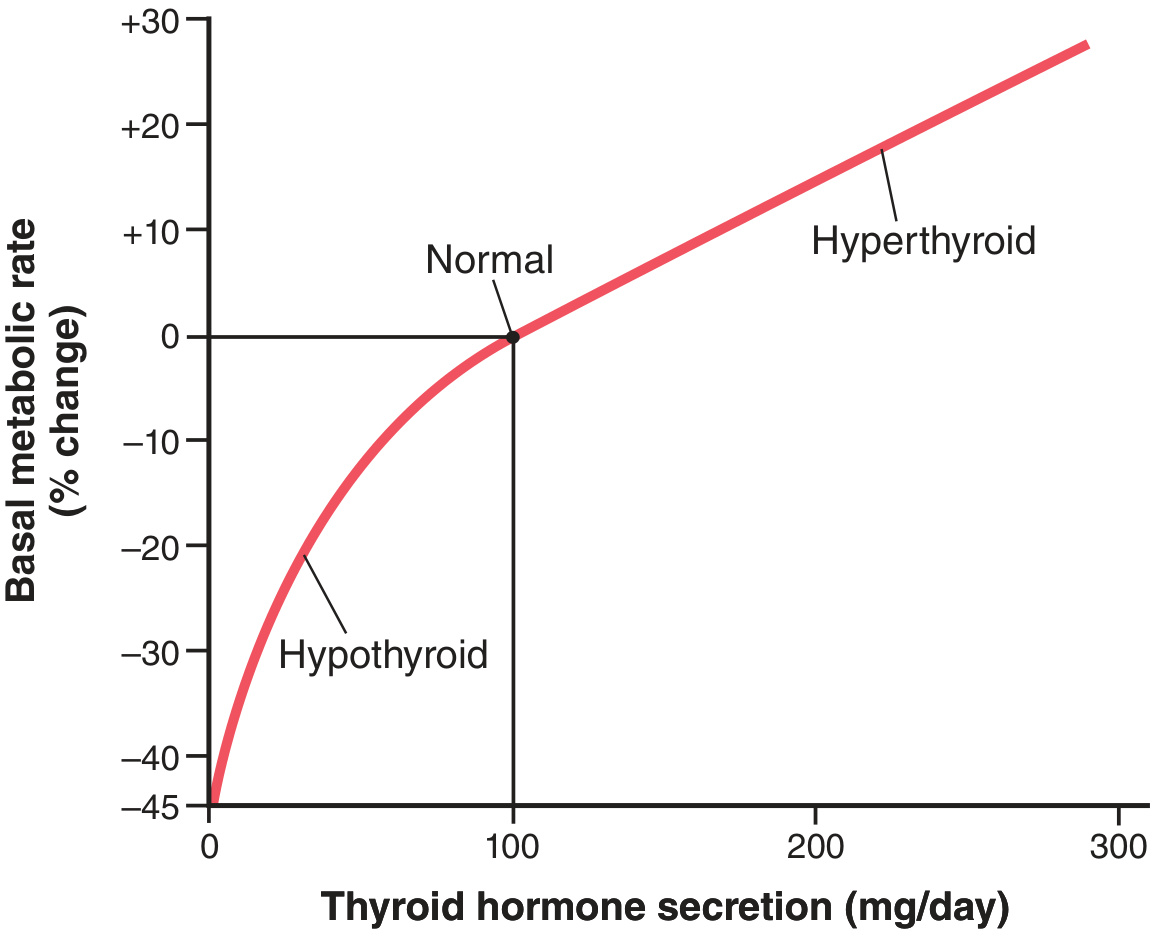
Figure 77.6 from Guyton & Hall: Approximate relation of daily thyroid hormone secretion to percent change in BMR
5. Vitamin Requirements
Because thyroid hormones increase enzyme quantities (and vitamins are essential parts of many enzymes/coenzymes), they increase the need for vitamins. Relative vitamin deficiency may occur with excess thyroid hormone secretion.
6. Body Weight
- Increased thyroid hormone -> decreased body weight (from increased metabolism)
- Decreased thyroid hormone -> increased body weight
- Note: appetite also increases with thyroid hormone, which may counterbalance weight loss
C. Cardiovascular Effects
- Increased blood flow and cardiac output: Increased metabolism causes vasodilation; cardiac output may rise 60% above normal in hyperthyroidism, fall to 50% of normal in severe hypothyroidism
- Heart rate: Increases considerably; thyroid hormone appears to have a direct effect on cardiac excitability, increasing the rate and force of contraction
- Blood pressure: Pulse pressure often increases (systolic rises, diastolic unchanged or slightly reduced)
D. Respiratory Effects
Increased metabolism increases oxygen consumption and CO₂ production, which stimulates the respiratory center, increasing depth and rate of respiration.
E. Gastrointestinal Effects
- Increases appetite and food intake
- Increases GI motility (hyperthyroidism causes diarrhea; hypothyroidism causes constipation)
F. Central Nervous System Effects
- Increased thyroid hormone -> excitability, anxiety, irritability, psychic disorders
- Deficiency -> mental sluggishness, slowed mentation, diminished cerebral blood flow
G. Muscular Effects
- Moderate increase: improves muscle vigor
- Excess: muscle weakness due to excess protein catabolism, tremor
H. Sleep
Thyroid hormone causes tiredness with inability to sleep (insomnia) due to excessive excitability of synapses
I. Effect on Growth
- Essential for normal growth and skeletal development in children
- Promotes growth and development of the brain during fetal life and early postnatal life
- Hypothyroidism in children -> greatly retarded growth rate
- Hyperthyroidism -> accelerated skeletal growth but early epiphyseal closure
J. Effect on Other Endocrine Glands
Thyroid hormones increase the metabolic activity and secretion of virtually all other endocrine glands; for example, they accelerate insulin degradation, requiring increased insulin secretion from the pancreas.
Part 4: Clinical Conditions Due to Thyroid Hormone Deficiency (3 marks)
A. Hypothyroidism in Adults
1. Myxedema (Adult Hypothyroidism)
- Caused most commonly by autoimmune destruction of the thyroid gland (Hashimoto's thyroiditis) - autoimmunity causes thyroid inflammation, progressive deterioration, and fibrosis, with diminished or absent hormone secretion
- Features: weight gain, cold intolerance, bradycardia, fatigue, constipation, dry skin, coarse hair, mental sluggishness, bradycardia, low BMR
- Plasma cholesterol and triglycerides are markedly elevated, predisposing to atherosclerosis
- A characteristic mucinous edema (myxedema) of skin and subcutaneous tissues, with "puffy" appearance
2. Endemic Colloid Goiter
- Caused by dietary iodine deficiency (50 mg/year required)
- Mechanism: Lack of iodine -> no T3/T4 synthesis -> no negative feedback on pituitary -> excessive TSH secretion -> overstimulation of thyroid -> thyroid enlargement (goiter) up to 10-20x normal size
- Patient is hypothyroid (insufficient hormone despite gland enlargement)
3. Idiopathic Nontoxic Colloid Goiter
- Similar enlargement without clear iodine deficiency
- Often due to mild thyroiditis with partial destruction, enzyme defects (e.g., deficient iodide trapping, deficient peroxidase system, deficient coupling enzymes, or deiodinase deficiency)
B. Hypothyroidism in Infants/Children
4. Cretinism (Congenital Hypothyroidism / Iodine Deficiency Syndrome)
- Extreme hypothyroidism during fetal life, infancy, or childhood
- Causes: congenital absence of thyroid gland, genetic defects in thyroid hormone synthesis, or severe iodine deficiency
- Features:
- Failure of body growth - disproportionate: skeletal growth more inhibited than soft tissue growth -> child appears obese, stocky, and short
- Irreversible intellectual disability (if not treated within weeks after birth) - due to retardation of neuronal growth, branching, and myelination during the critical period
- Enlarged tongue (may obstruct swallowing/breathing - guttural breathing)
- Sluggish movements
Key point: Treatment with thyroxine within days to weeks after birth can restore normal physical growth. However, mental development remains permanently impaired if treatment is delayed.
5. Juvenile Hypothyroidism
- Onset after the critical brain development period but during childhood
- Causes retarded physical growth (dwarfism) but mental impairment is less severe than in cretinism since brain development is largely complete
Summary Table
| Condition | Age | Key Features |
|---|---|---|
| Myxedema | Adult | Cold intolerance, weight gain, dry skin, bradycardia, hypercholesterolemia, myxedematous edema |
| Hashimoto's Thyroiditis | Adult | Autoimmune destruction of thyroid; commonest cause of adult hypothyroidism |
| Endemic Goiter | Any | Iodine deficiency, large goiter, hypothyroid state |
| Cretinism | Neonate/infant | Intellectual disability (irreversible if untreated), stunted growth, obese/stocky, guttural breathing |
| Juvenile Hypothyroidism | Child | Growth retardation (dwarfism), delayed puberty |
References: Guyton and Hall Textbook of Medical Physiology, 4th South Asia Edition (ISBN 9780443111013), Chapter 77 - Thyroid Metabolic Hormones, pp. 929-942.
This is a shared conversation. Sign in to Orris to start your own chat.