
Hbsag (positive) in detail
I'll start by reading the medical library skill, then search for comprehensive HBsAg information in parallel.
Reading File
Now I'll search the medical library and web in parallel for comprehensive HBsAg information.
Finding Sources
Finding Sources
Searching PubMed
"HBsAg" AND "hepatitis B" AND management
Good results. Now let me read the most relevant sections from Harrison's, Sleisenger, and Tietz for comprehensive HBsAg coverage.
Reading File
Reading File
Finding Sources
Searching Images
hepatitis B serology HBsAg markers timeline acute chronic infection
Let me get the key HBsAg sections from Harrison's and Tietz for serology interpretation.
Finding Sources
Finding Sources
Excellent finds. Let me read the key sections from Sabiston, Robbins, and Harrison's on HBV.
Reading File
Reading File
Finding Sources
Let me get more content from Sabiston and look for HBV serology table and HBsAg interpretation from Harrison's.
Reading File
Finding Sources
Finding Sources
Let me read the Goldman-Cecil treatment section and Red Book serology section for complete HBV information.
Reading File
Reading File
I now have excellent content. Let me also fetch the hepatitis B serology timeline image and read the Goldman-Cecil HBV treatment section.
Loading Image
Reading File
I now have comprehensive information from multiple authoritative textbooks and the serology timeline image. Let me now compose the detailed answer.
HBsAg (Hepatitis B Surface Antigen) - Positive: A Complete Overview
1. What is HBsAg?
HBsAg (Hepatitis B Surface Antigen) is a protein found on the surface envelope of the Hepatitis B virus (HBV). It is encoded by the pre-S/S gene of the HBV genome, which produces three surface proteins - small (S), middle (M), and large (L) - all of which express HBsAg. The blood of infected individuals contains not only infectious virions but also a large excess of empty, non-infectious HBV envelopes that are also HBsAg-positive.
HBsAg is the first detectable serologic marker of HBV infection and the cornerstone of HBV diagnosis.
- Goldman-Cecil Medicine, International Edition
2. Appearance After Infection (Timeline)
| Time After Exposure | Event |
|---|---|
| 1-10 weeks | HBsAg first appears in serum |
| ~4-6 weeks post-HBsAg | IgM anti-HBc becomes detectable |
| 4-6 months | HBsAg disappears in self-limited infection |
| After HBsAg clears | Anti-HBs (protective antibody) appears |
| Window period | Gap between HBsAg disappearance and anti-HBs appearance - only IgM anti-HBc is detectable |
| > 6 months | Persistence of HBsAg = chronic HBV infection |
- Sabiston Textbook of Surgery, The Biological Basis of Modern Surgical Practice
3. Serology Chart: Acute HBV Progressing to Chronic Infection
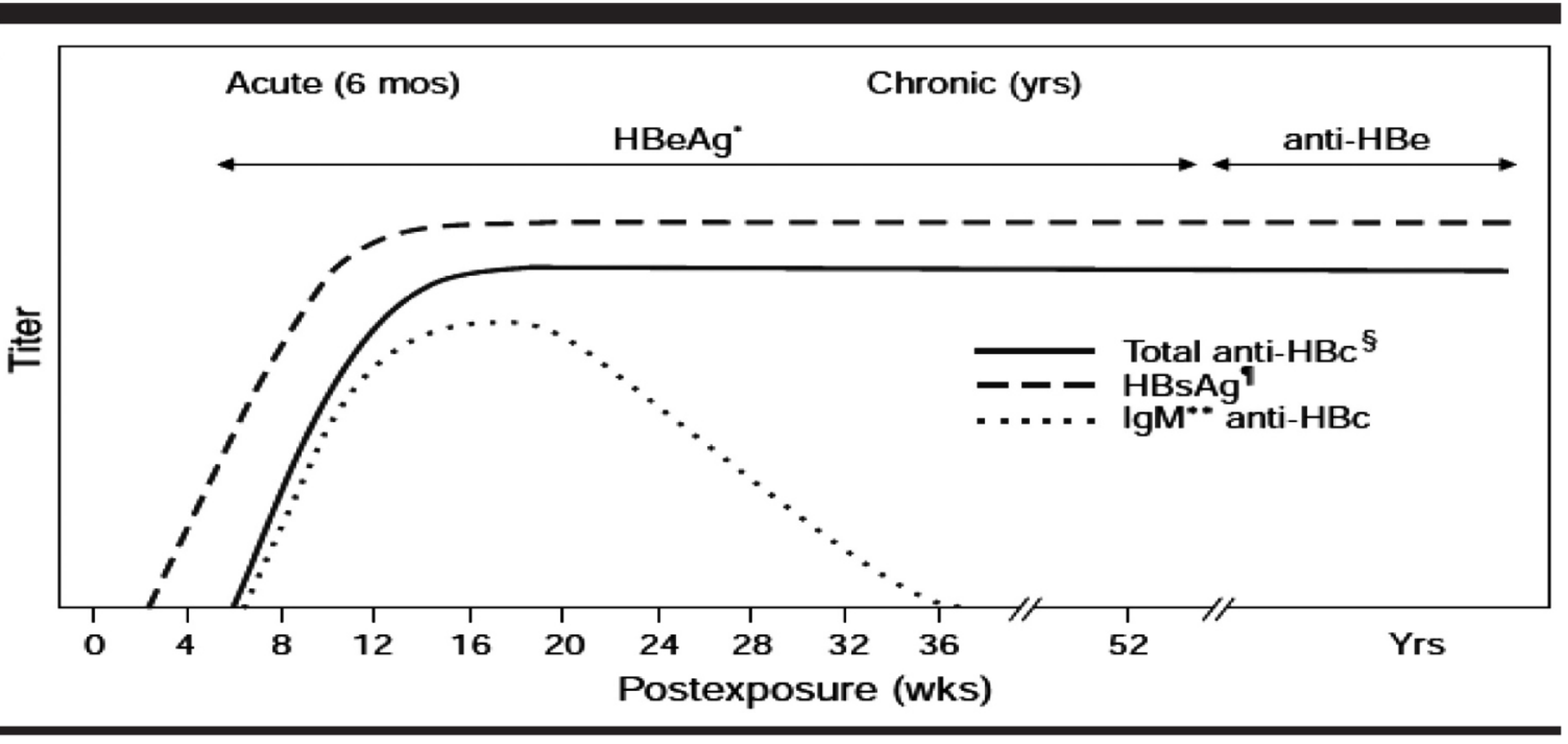
Fig: Typical serologic course of acute HBV infection with progression to chronic HBV. HBsAg (dashed line) remains persistently elevated in chronic infection. IgM anti-HBc (dotted line) peaks early and wanes. Total anti-HBc (solid line) persists indefinitely. - Red Book 2021
4. Interpretation of HBsAg Positive
HBsAg positive alone is not enough - you must interpret it alongside other markers:
| Pattern | Interpretation |
|---|---|
| HBsAg (+), IgM anti-HBc (+), Anti-HBs (-) | Acute HBV infection |
| HBsAg (+), Total anti-HBc (+), IgM anti-HBc (-) | Chronic HBV infection |
| HBsAg (+), Anti-HBs (+), Total anti-HBc (+) | Chronic infection (minority of chronic carriers have both) |
| HBsAg (-), IgM anti-HBc (+), Anti-HBs (-) | Window period of acute infection |
| HBsAg (-), Anti-HBs (+), Total anti-HBc (+) | Resolved past infection with immunity |
| HBsAg (-), Anti-HBs (+), Anti-HBc (-) | Vaccine-induced immunity |
Important: In acute HBV infection of unknown duration (e.g., incidental blood donor finding), testing for IgM anti-HBc helps distinguish acute from chronic infection.
- Harrison's Principles of Internal Medicine, 22E (2025)
5. HBsAg and Other Key Markers
HBeAg (Hepatitis B e Antigen)
- Derived from the pre-C/C gene as a secreted non-structural protein
- Its presence indicates active viral replication and high infectivity
- HBeAg positive = higher HBV DNA levels = greater transmissibility
- Seroconversion from HBeAg to anti-HBe signals reduction in replication
HBV DNA
- Most accurate measure of HBV activity
- Even patients thought to have "resolved" infection may have persistent low-level viremia (occult HBV)
- Used to select candidates for antiviral therapy and monitor treatment response
Anti-HBc (Core Antibody)
-
IgM anti-HBc: marker of acute or recent infection; the only marker during the window period
-
Total anti-HBc (IgG): persists lifelong; indicates past or present HBV exposure
-
Sabiston Textbook of Surgery; Red Book 2021
6. Chronic HBV Infection: Phases
Chronic HBV (defined as HBsAg persistence > 6 months) passes through recognized phases:
| Phase | HBsAg | HBeAg | HBV DNA | ALT | Liver Disease |
|---|---|---|---|---|---|
| Immune tolerant | + | + | Very high | Normal | Minimal |
| Immune active (HBeAg+) | + | + | High | Elevated | Active inflammation |
| Inactive carrier | + | - | Low/undetectable | Normal | Minimal |
| HBeAg-negative chronic hepatitis | + | - | Moderate-high | Elevated | Progressive |
| HBsAg loss (functional cure) | - | - | Undetectable | Normal | Regression |
7. Clinical Significance of HBsAg Positive
-
Infectivity: HBsAg-positive blood and body fluids are infectious. The primary routes of transmission are sexual contact, perinatal (mother-to-infant), horizontal child-to-child contact, and percutaneous/IV routes.
-
Perinatal transmission risk: Infants born to HBsAg-positive mothers must receive Hepatitis B vaccine + HBIG within 12 hours of birth. Without prophylaxis, perinatal transmission carries a >90% rate of chronic infection.
- Creasy & Resnik's Maternal-Fetal Medicine
-
Post-exposure management: Exposure to HBsAg-positive blood or body fluids requires immediate administration of the hepatitis B vaccine series and HBIG.
- Red Book 2021
-
Transient false positive: HBsAg can be transiently detected 24 hours to 3 weeks after HBV vaccine administration - this is a non-infectious, vaccine-induced finding and NOT a sign of true infection.
- Red Book 2021
-
Complications of chronic HBsAg positivity: 25% of chronic HBV infections can progress to liver cancer (hepatocellular carcinoma). Chronic HBsAg positivity is associated with cirrhosis, portal hypertension, and HCC risk.
- Sabiston Textbook of Surgery
-
HBsAg levels as biomarker: Quantitative HBsAg levels (measured in IU/mL) correlate with long-term outcomes. Higher HBsAg levels are associated with increased risk of HCC and cirrhosis, and declining HBsAg levels predict favorable response to therapy. A 2024 systematic review (PMID: 39150061) confirmed that HBsAg levels associate with long-term complications including HCC and cirrhosis.
8. HBV and HDV Co-infection
HDV (Hepatitis Delta Virus) is a satellite virus that requires HBsAg on its outer envelope to be infectious. It can only infect individuals who are already HBsAg positive. HDV uses the pre-S1 domain of large HBsAg to enter hepatocytes via the NTCP (sodium taurocholate cotransporting polypeptide) receptor. Co-infection with HDV worsens the clinical course of HBV significantly.
- Sleisenger and Fordtran's Gastrointestinal and Liver Disease
9. Treatment Indications When HBsAg is Positive
Acute HBV
- No antiviral treatment is needed for uncomplicated acute HBV
- Antiviral therapy (entecavir or tenofovir) is indicated only if there is acute liver failure
Chronic HBV (HBsAg positive > 6 months)
Treatment is indicated based on HBV DNA, ALT, and HBeAg status. Preferred first-line antivirals:
| Drug | Route | Notes |
|---|---|---|
| Tenofovir disoproxil fumarate (TDF) | Oral | Preferred; low resistance |
| Tenofovir alafenamide (TAF) | Oral | Preferred; renal-safer form |
| Entecavir | Oral | Preferred; low resistance |
| PEG-Interferon alfa-2a | SC injection | Finite duration; immunomodulator |
Lamivudine and adefovir are no longer preferred due to high resistance rates.
- Goldman-Cecil Medicine; Red Book 2021
10. Screening and Prevention
- Universal vaccination (3-dose series) is recommended for all infants; confers anti-HBs immunity
- Screening for HBsAg is recommended in: pregnant women, persons from endemic areas, household contacts of HBsAg+ individuals, healthcare workers, persons with HIV/HCV, IV drug users, and men who have sex with men
- Post-exposure prophylaxis: HBIG + HBV vaccine within 24 hours (ideally) of exposure to HBsAg-positive source
11. Occult HBV Infection
A clinically important concept: patients who are HBsAg negative but have detectable HBV DNA. This occurs because:
- Serum HBsAg may have cleared, but covalently closed circular DNA (cccDNA) persists in hepatocyte nuclei
- These individuals remain at risk for HBV reactivation, particularly with immunosuppressive therapy (e.g., chemotherapy, biologics)
- The 2025 AGA Clinical Practice Guideline (PMID: 39863345) specifically addresses prevention and treatment of HBV reactivation in at-risk individuals
Summary Table: HBsAg at a Glance
| Feature | Detail |
|---|---|
| Nature | Viral envelope glycoprotein |
| Gene | Pre-S/S gene |
| First appears | 1-10 weeks post-exposure |
| Positive result means | Active HBV infection (acute or chronic) |
| Chronic = | HBsAg positive > 6 months |
| Window period marker | IgM anti-HBc only |
| Treatment target | HBV DNA suppression to undetectable |
| Functional cure | HBsAg loss (rare with current treatments) |
| Vaccine response | Anti-HBs positive, HBsAg negative, Anti-HBc negative |
Sources: Harrison's Principles of Internal Medicine 22E (2025), Goldman-Cecil Medicine International Edition, Sabiston Textbook of Surgery, Red Book 2021 (AAP), Creasy & Resnik's Maternal-Fetal Medicine, Sleisenger & Fordtran's Gastrointestinal and Liver Disease, Robbins & Kumar Basic Pathology
This is a shared conversation. Sign in to Orris to start your own chat.