Excellent - I have all the data needed. Now compiling the complete, structured answer:
Risk Assessment Scores in Antithrombotic Therapy
Complete PG Guide with Mnemonics | Sources: Harrison's 22E, Braunwald's, Fuster & Hurst, Rosen's EM, Bradley & Daroff's Neurology | 2025 ACC/AHA, 2024 ESC Guidelines
THE BIG PICTURE - ORGANIZING FRAMEWORK
Think of risk scores in antithrombotic therapy as falling into 4 functional categories:
Mnemonic: "BIDE your time before prescribing"
| Letter | Category | Purpose | Examples |
|---|
| B | Bleeding risk | Should I give antithrombotic? How long? | HAS-BLED, CRUSADE, ARC-HBR, PRECISE-DAPT, ATRIA, HEMORR²HAGES |
| I | Ischemic/Thrombotic risk | Who benefits most? Anticoagulate or not? | CHA₂DS₂-VASc, GRACE, TIMI, DAPT Score |
| D | Diagnostic risk (chest pain) | Is this ACS at all? | HEART Score, EDACS |
| E | Event-after-event (stroke/TIA) | Recurrence risk? | ABCD2, ABCD3-I, PCE (Primary CVD) |
SECTION 1: ACS RISK SCORES
1A. TIMI Risk Score for UA/NSTEMI
Purpose: Predicts 14-day risk of all-cause mortality, new MI, or urgent revascularization
The score has 7 variables, each = 1 point (max score 7)
Mnemonic: "AMERICA" (Developed in the USA - easy to remember)
| Letter | Variable | Detail |
|---|
| A | Age ≥65 years | 1 point |
| M | Markers (elevated cardiac biomarkers) | Elevated troponin or CK-MB = 1 point |
| E | ECG changes (ST deviation ≥0.5mm) | 1 point |
| R | Risk factors ≥3 (HTN, DM, hyperlipidemia, smoking, family hx CAD) | 1 point |
| I | Ischemic events ≥2 in past 24h | Anginal episodes ≥2 in 24h = 1 point |
| C | Coronary stenosis known ≥50% | Prior cath or documented CAD = 1 point |
| A | Aspirin use in past 7 days | Aspirin use despite optimal Rx = 1 point |
Score Interpretation:
| Score | 14-day Risk | Action |
|---|
| 0-1 | 5% | Low - may consider early discharge |
| 2 | 8% | Low-intermediate |
| 3 | 13% | Intermediate - observe |
| 4 | 20% | Intermediate-high - early invasive |
| 5 | 26% | High - early invasive |
| 6-7 | 41% | Very high - urgent invasive |
Clinical tip: TIMI ≥3 = consider early invasive strategy (PCI within 24h)
1B. GRACE Score (Global Registry of Acute Coronary Events)
Purpose: Predicts in-hospital, 6-month, 1-year, and 3-year mortality/death+MI in ACS
Variables (continuous, calculated online/app - 8 parameters):
Mnemonic: "GRACE Has 8 - SHARKCB"
| Letter | Variable |
|---|
| S | Systolic blood pressure (lower = worse) |
| H | Heart rate (higher = worse) |
| A | Age |
| R | Renal function (serum creatinine) |
| K | Killip class (heart failure severity) |
| C | Cardiac arrest at admission |
| B | Biomarker (elevated troponin) |
| + | ST deviation |
Score Interpretation (in-hospital mortality for NSTEMI):
| Category | Score | In-hospital Mortality |
|---|
| Low | <109 | <1% |
| Intermediate | 109-140 | 1-3% |
| High | >140 | >3% |
GRACE vs TIMI - Which to use?
| Feature | TIMI | GRACE |
|---|
| Simplicity | Simple, bedside | Requires calculator |
| Variables | 7 binary (yes/no) | 8 continuous |
| Best for | Quick risk triage | More precise mortality prediction |
| Superior for | NSTEMI triage | STEMI + NSTEMI mortality |
| 2025 ACC/AHA position | Both acceptable | GRACE superior for objective mortality prediction |
Key 2025 ACC/AHA Guideline statement: "GRACE Risk Score has been found to be superior to subjective physician assessment for the prediction of death or MI in patients with STEMI or intermediate-risk NSTE-ACS." - Neither score should be used as a diagnostic tool; only for risk stratification in confirmed/suspected ACS.
1C. HEART Score
Purpose: Diagnose and risk-stratify chest pain in the ED - "Is this ACS or can I safely discharge?"
The name IS the mnemonic: H-E-A-R-T (each component scored 0-2, total 0-10)
| Letter | Component | 0 points | 1 point | 2 points |
|---|
| H | History | Non-specific | Mixed features | Highly suspicious for ACS |
| E | ECG | Normal | Non-specific repolarization changes | Significant ST deviation |
| A | Age | <45 years | 45-64 years | ≥65 years |
| R | Risk factors | None | 1-2 risk factors | ≥3 risk factors OR known ASCVD |
| T | Troponin | ≤ normal limit | 1-3x normal | >3x normal |
Score Interpretation:
| Score | Risk | Action |
|---|
| 0-3 | Low (~2% MACE) | Discharge safe - consider early discharge |
| 4-6 | Moderate (~12% MACE) | Admit - observe and further workup |
| 7-10 | High (~65% MACE) | Aggressive workup, likely ACS - activate pathway |
HEART vs TIMI vs GRACE - The Quick Comparison:
HEART = ED diagnostic triage (is this ACS?)
TIMI = Treatment decisions in confirmed ACS (how aggressive?)
GRACE = Mortality prediction in confirmed ACS (how bad is it?)
SECTION 2: BLEEDING RISK SCORES
2A. HAS-BLED Score (Most widely used bleeding score in AF)
Purpose: Estimates major bleeding risk with anticoagulation in AF patients
The name IS the mnemonic:
| Letter | Component | Points |
|---|
| H | Hypertension (uncontrolled SBP >160 mmHg) | 1 |
| A | Abnormal renal OR liver function (1 each) | 1 or 2 |
| S | Stroke history | 1 |
| B | Bleeding (prior bleeding history or predisposition) | 1 |
| L | Labile INR (on warfarin; TTR <60%) | 1 |
| E | Elderly (age ≥65 years) | 1 |
| D | Drugs (antiplatelets, NSAIDs) or Alcohol (1 each) | 1 or 2 |
Max score = 9
Score Interpretation:
| Score | Bleeding Risk | Annual Bleed Rate | Action |
|---|
| 0-1 | Low | 1-2% | Anticoagulate if stroke risk warrants |
| 2 | Moderate | ~2% | Consider anticoagulation |
| ≥3 | High | ≥3.7% | Caution; address modifiable factors; do NOT withhold OAC if stroke risk outweighs |
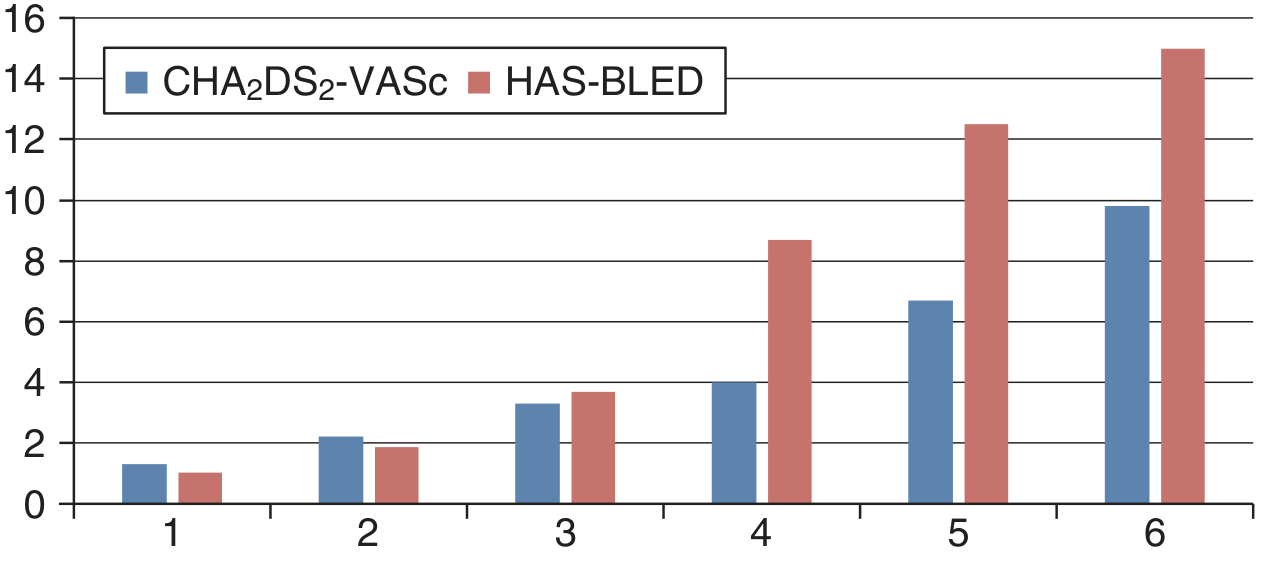
KEY POINT (2024 ESC, Harrison's 22E): A high HAS-BLED score should NEVER be used alone to withhold anticoagulation - it should prompt CORRECTION of modifiable factors (BP control, stop NSAIDs, optimize INR). The score identifies correctable risks, not a contraindication.
Figure: Annual stroke % (blue, CHA₂DS₂-VASc) vs major bleed % (red, HAS-BLED) as a function of score. Note the steeper acceleration of bleeding at scores ≥4. Source: Harrison's Principles of Internal Medicine 22E
2B. CRUSADE Score (Bleeding in ACS/PCI)
Purpose: In-hospital major bleeding risk in NSTEMI patients - guides anticoagulant/antiplatelet intensity
Mnemonic: "CRUSADE = 8 variables = CHADS GEH" (overlapping but distinct from cardiac scores)
| Variable | Detail |
|---|
| C | Creatinine clearance (↓CrCl = ↑bleeding) |
| H | Hematocrit (↓Hct = ↑bleeding) |
| A | Admission heart rate (↑HR = ↑risk) |
| D | Diabetes mellitus |
| S | Systolic BP (<90 = ↑risk, but also very high SBP) |
| + | Gender (female = ↑risk) |
| + | History of vascular disease |
| + | Signs of CHF at presentation |
Score Interpretation:
| Score | Risk Category | Major Bleed Rate |
|---|
| ≤20 | Very Low | 3.1% |
| 21-30 | Low | 5.5% |
| 31-40 | Moderate | 8.6% |
| 41-50 | High | 11.9% |
| >50 | Very High | 19.5% |
CRUSADE vs HAS-BLED: CRUSADE is for ACS/PCI in-hospital bleeding risk; HAS-BLED is for long-term OAC bleeding risk in AF
2C. ARC-HBR Criteria (Academic Research Consortium - High Bleeding Risk)
Purpose: Standardized definition of High Bleeding Risk (HBR) before PCI/DAPT decisions (2020, validated through 2024)
Definition: ≥1 MAJOR criterion OR ≥2 MINOR criteria = High Bleeding Risk
Mnemonic for MAJOR criteria: "CHAOS A Major Bleed"
| Major Criteria | Detail |
|---|
| C | Chronic anticoagulation use (OAC long-term) |
| H | Hemoglobin <11 g/dL (severe anemia) |
| A | Active malignancy (within 12 months) |
| O | OAC required - anticipated long-term |
| S | Severe CKD (eGFR/CrCl <30 mL/min) |
| + | Prior ICH or ischemic stroke |
| + | Non-deferrable major surgery on DAPT |
| + | Spontaneous bleeding requiring hospitalization/transfusion in past 6 months |
| + | Thrombocytopenia (<100,000/µL) |
| + | Liver cirrhosis with portal hypertension |
Minor Criteria (need 2 for HBR classification):
| Minor Criteria |
|---|
| Age ≥75 years |
| Moderate CKD (CrCl 30-59 mL/min) |
| Mild anemia (Hgb 11-12.9g/dL male; 11-11.9g/dL female) |
| Prior ischemic stroke (not meeting major) |
| Spontaneous bleeding requiring hospitalization in past 12m (not major) |
| Long-term NSAID or steroid use |
Clinical implication: ARC-HBR = consider shortening DAPT to 1-3 months post-PCI (2024 ESC, 2025 ACC/AHA)
2D. PRECISE-DAPT Score (Newer - Bleeding with DAPT duration)
Purpose: Predicts 1-year out-of-hospital bleeding risk post-PCI; guides DAPT duration choice
Only 5 variables (scored 0-100):
Mnemonic: "ACHeW" - Age, CrCl, Hgb, WBC, prior bleeding
| Variable | Component |
|---|
| A | Age |
| C | Creatinine clearance |
| H | Hemoglobin |
| W | White blood cell count |
| + | Prior Bleeding history |
Cutoff: Score ≥25 = High Bleeding Risk → favor short DAPT (3-6 months)
Score <25 = Standard/Low Risk → standard 12-month DAPT acceptable
2E. DAPT Score (Balances BOTH bleeding AND ischemic risk for extended DAPT)
Purpose: Predicts NET benefit of extending DAPT beyond 12 months post-PCI
9 variables (the only score that BALANCES both risks):
Mnemonic: "DAPT Score 9 - SAVE DAMS"
| Letter | Variable | Points |
|---|
| S | Smoking (active) | +1 |
| A | Age <65 | +2; 65-74 = +1; ≥75 = -2 |
| V | Vein graft stenting | -1 |
| E | EF ↓ / CHF at presentation | +2 |
| D | Diabetes mellitus | +1 |
| A | Admission: MI at presentation | +1 |
| M | MI previously (or prior PCI) | +1 |
| S | Stent diameter <3 mm | +1 |
| + | Paclitaxel-eluting stent | +1 |
Interpretation:
| DAPT Score | Action |
|---|
| ≥2 | Extended DAPT BENEFICIAL (↓ischemic events > ↑bleeding) |
| <2 | Extended DAPT causes more harm (↑bleeding > ↓ischemic events) - do NOT extend |
Note: Negative points for age ≥75 and vein grafts reflect the dominant bleeding risk at older age.
SECTION 3: STROKE/AF RISK SCORES
3A. CHA₂DS₂-VASc Score
Purpose: Stroke risk in non-valvular AF - guides OAC decision
The name is the mnemonic (previously shared - now adding the KEY 2024 UPDATE):
⚠️ MAJOR 2024 UPDATE: CHA₂DS₂-VA (ESC 2024 - Sex removed!)
| Old Score (ACC/AHA still uses) | New Score (ESC 2024) |
|---|
| CHA₂DS₂-VASc (max 9) | CHA₂DS₂-VA (max 8) |
| Sex (female) = 1 point | Sex REMOVED |
| OAC threshold: ≥2 men, ≥3 women | OAC threshold: ≥2 for all (unified) |
| Anticoagulate ≥2 (men), ≥3 (women) | Anticoagulate ≥2 (everyone) |
Why removed? Multiple studies showed sex alone (female) does not independently predict stroke; removing it gives superior or non-inferior discrimination and creates a unified threshold across sexes.
For PG exams: Know BOTH - old CHA₂DS₂-VASc (max 9, sex included) for ACC/AHA; CHA₂DS₂-VA (max 8, no sex) for ESC 2024
Score to Risk conversion (CHA₂DS₂-VASc):
| Score | Approx. Annual Stroke Risk (no OAC) |
|---|
| 0 | ~0% |
| 1 | ~1.3% |
| 2 | ~2.2% |
| 3 | ~3.2% |
| 4 | ~4.0% |
| 5 | ~6.7% |
| 6 | ~9.8% |
| 7-9 | 10-15%+ |
3B. ABCD2 Score (TIA - predicts short-term stroke risk)
Purpose: Estimates 2-day, 7-day, and 90-day stroke risk after TIA. Used to decide admit vs. discharge.
The name IS the mnemonic: A-B-C-D-2
| Letter | Variable | Points |
|---|
| A | Age ≥60 years | 1 |
| B | Blood pressure ≥140/90 mmHg | 1 |
| C | Clinical features: unilateral weakness = 2; speech disturbance only = 1; other = 0 | 0-2 |
| D | Duration: ≥60 min = 2; 10-59 min = 1; <10 min = 0 | 0-2 |
| 2 | Diabetes mellitus (the "2" in ABCD2 = Diabetes) | 1 |
Total: 0-7 points
Risk Stratification:
| Score | Risk | 2-day Stroke Risk | Action |
|---|
| 0-3 | Low | ~1% | May consider outpatient workup |
| 4-5 | Moderate | ~4% | Admit or urgent neurology review |
| 6-7 | High | ~8% | Immediate admission |
AHA/ASA 2026 uses ABCD2 ≥4 to define "high-risk TIA" - this is the threshold for initiating DAPT (ASA + Clopidogrel x 21 days)
IMPORTANT LIMITATION (per Tintinalli's EM, Bradley & Daroff's Neurology): ABCD2 should NOT be used IN ISOLATION to discharge a TIA patient. All TIA patients warrant urgent neuroimaging (MRI DWI) and vascular imaging regardless of ABCD2 score.
Extended versions:
- ABCD3: adds dual TIA within 7 days (+2) - max 9
- ABCD3-I: adds DWI lesion (+2) and ipsilateral carotid stenosis ≥50% (+2) - max 13. Better predictive accuracy but requires imaging.
SECTION 4: PRIMARY PREVENTION RISK SCORE
4A. Pooled Cohort Equations (PCE) - ASCVD 10-year Risk
Purpose: Primary prevention - should I start aspirin/statin? (the foundational 1° prevention tool)
Variables (calculated online/app - not a simple bedside score):
Mnemonic: "CRASH the Primary Prevention Plan"
| Letter | Variable |
|---|
| C | Cholesterol (Total + HDL) |
| R | Race/ethnicity (African American vs White - different equations) |
| A | Age and sex |
| S | Systolic blood pressure (treated vs untreated) |
| H | History of diabetes + Smoking status |
Risk Thresholds for Antithrombotic Decisions:
| 10-year ASCVD Risk | Aspirin 1° Prevention | Statin |
|---|
| <7.5% | Not recommended | Consider statin if ≥40y + risk factors |
| 7.5-10% | Borderline - discuss with patient | Statin recommended |
| ≥10% (AND age 40-59) | May consider ASA 81mg (Class IIb) | Statin recommended |
| ≥10% (AND age ≥60-70) | NOT recommended - bleeding risk | Statin recommended |
SECTION 5: PAD RISK SCORES
5A. Ankle-Brachial Index (ABI) - Not a "score" but a diagnostic/prognostic measure
The fundamental PAD risk number:
| ABI Value | Interpretation | Action |
|---|
| >1.4 | Non-compressible (calcified) arteries - falsely elevated | Toe-brachial index instead |
| 1.0-1.4 | Normal | No PAD |
| 0.9-1.0 | Borderline | Repeat with exercise |
| <0.9 | PAD confirmed | Antiplatelet therapy (Class I, 2024 ACC/AHA PAD) |
| <0.5 | Severe PAD / CLTI | Consider rivaroxaban 2.5mg + ASA |
Mnemonic: "ABI <0.9 = Anti-platelet you Own" (below 0.9, you own the responsibility to antiplatelet)
SECTION 6: QUICK MASTER TABLE - ALL SCORES AT A GLANCE
Mnemonic to remember ALL score categories: "GAP in BHC Makes Clinical Decisions"
| Mnemonic | Score | Condition | What it Decides |
|---|
| G | GRACE | ACS | Mortality risk / invasive urgency |
| A | AMERICA (TIMI) | NSTEMI/UA | 14-day event risk / management |
| P | PCE (Pooled Cohort) | General population | Start statin/ASA for 1° prevention? |
| B | BLEEDING: HAS-BLED | AF on OAC | Safe to anticoagulate? How long? |
| H | HEART Score | ED chest pain | Is this ACS? Safe discharge? |
| C | CHA₂DS₂-VASc / VA | AF | Start OAC? |
| + | CRUSADE | NSTEMI/PCI | In-hospital bleeding risk |
| + | ARC-HBR | Pre-PCI | Shorten DAPT to 1-3 months? |
| + | PRECISE-DAPT | Post-PCI | DAPT duration (short vs standard) |
| + | DAPT Score | 12 months post-PCI | Extend DAPT beyond 12 months? |
| + | ABCD2 | TIA | Admit or discharge? Start DAPT? |
| + | ABI | PAD | PAD severity / antiplatelet needed? |
SECTION 7: HOW TO RETAIN THESE FOR PG & CLINICAL PRACTICE
7A. Cluster by Purpose ("What question am I answering?")
Think of a patient in front of you - ask these 4 questions in order:
Q1. IS THIS ACS? → HEART Score (ED)
Q2. HOW BAD IS THE ACS? → TIMI (quick) or GRACE (precise mortality)
Q3. SHOULD I ANTICOAGULATE (AF)? → CHA₂DS₂-VASc/VA (stroke) vs HAS-BLED (bleeding)
Q4. HOW LONG SHOULD I GIVE DAPT? → PRECISE-DAPT (before) → DAPT Score (after 12m)
Q5. IS THIS TIA? WILL THEY STROKE? → ABCD2
Q6. IS THIS 1° PREVENTION? → PCE (10-yr ASCVD risk)
7B. "The Patient Journey" Memory Framework
POPULATION → PCE (10-yr risk) → Start 1° prevention?
     ↓
CHEST PAIN IN ED → HEART Score → Low: discharge / High: admit
     ↓
CONFIRMED ACS → TIMI / GRACE → Risk-stratify → Early invasive?
     ↓ (after PCI)
DAPT DURATION: PRECISE-DAPT (<25 vs ≥25) → Short or Standard DAPT?
     ↓ (at 12 months)
EXTEND DAPT? → DAPT Score (<2 vs ≥2) → Stop or extend?
     ↓
PARALLEL TRACK: AF → CHA₂DS₂-VASc + HAS-BLED → Anticoagulate?
     ↓
TIA DETECTED → ABCD2 → Admit + DAPT 21 days?
     ↓
PAD FOUND → ABI → Clopidogrel/ASA ± rivaroxaban 2.5mg
7C. Score-Specific Recall Tricks
| Score | Best Memory Hook |
|---|
| TIMI | "AMERICA" - 7 letters, 7 variables, 1 point each |
| GRACE | "SHARKCB" - 8 variables, needs calculator, beats TIMI for mortality |
| HEART | The name = The score (H-E-A-R-T, 0-2 each) |
| CHA₂DS₂-VASc | "CHF-H-A²-D-S²-VA-Sex" - doubles for Age≥75 and Stroke |
| CHA₂DS₂-VA | 2024 ESC = "drop the sex" from VASc |
| HAS-BLED | The name = The score - modifiable factors = fix them, not a stop sign |
| ABCD2 | "ABCD + diabetes" - the "2" in ABCD2 = Diabetes (D was already used for duration) |
| ARC-HBR | "1 major OR 2 minor = High Bleed Risk" - major criteria = CHAOS A |
| PRECISE-DAPT | "ACHeW" - 5 lab/clinical variables only |
| DAPT Score | "≥2 = extend; <2 = stop" - balances both ischemic AND bleeding |
| PCE | "CRASH" - 10-yr ASCVD risk calculator |
7D. The Critical Cutoffs Table - "Numbers to Tattoo"
| Score | Critical Number | Meaning |
|---|
| TIMI NSTEMI | ≥3 | Early invasive strategy |
| GRACE | >140 | High risk; early catheterization |
| HEART | ≥7 | High risk - almost certainly ACS pathway |
| CHA₂DS₂-VASc | ≥2 (men), ≥3 (women) | Start OAC (ACC/AHA) |
| CHA₂DS₂-VA | ≥2 (everyone) | Start OAC (ESC 2024) |
| HAS-BLED | ≥3 | High bleeding - fix modifiable factors |
| ABCD2 | ≥4 | High-risk TIA - DAPT x 21 days |
| PRECISE-DAPT | ≥25 | Shorten DAPT to 3-6 months |
| DAPT Score | ≥2 | Extend DAPT beyond 12 months |
| ARC-HBR | 1 major or 2 minor | HBR - shorten DAPT |
| ABI | <0.9 | PAD - start antiplatelet |
| PCE (10-yr ASCVD) | ≥10% (age 40-59) | Consider ASA for 1° prevention |
SECTION 8: WHAT CHANGED IN SCORING WITH LATEST GUIDELINES
| Score | Previous Status | Current Status (2024-2026) |
|---|
| CHA₂DS₂-VASc | Gold standard; sex included; thresholds differ by sex | ESC 2024: Replaced by CHA₂DS₂-VA (sex removed); unified threshold ≥2 for all |
| ABCD2 alone | Used to decide admission vs discharge in TIA | No longer sufficient alone (Tintinalli's, AHA/ASA 2026); must get DWI MRI regardless of score |
| TIMI for chest pain (undifferentiated) | Sometimes used in ED | NOT appropriate for undifferentiated chest pain - use HEART Score; TIMI was designed for confirmed/suspected ACS only |
| HAS-BLED ≥3 = stop OAC | Misapplied - OAC withheld | Corrected: ≥3 = fix modifiable factors; do NOT withhold OAC if stroke risk > bleeding risk |
| GRACE score | Recommended | 2025 ACC/AHA affirms GRACE as superior to physician judgment; but notes insufficient evidence that routine use changes outcomes - use as adjunct not replacement for judgment |
| CRUSADE | AF bleeding | Still used for NSTEMI in-hospital bleeding; ARC-HBR now preferred for PCI/DAPT decisions |
| PCE | Standard | Still used; consider adding coronary calcium score (CAC) as a "tie-breaker" for intermediate risk (7.5-20%) - 2023 ACC/AHA prevention guidelines |
FINAL STUDY CARD - "7 Scores Every Cardiologist Must Know Cold"
1. CHA₂DS₂-VA(Sc)  →  Stroke risk in AF → Anticoagulate?
2. HAS-BLED        →  Bleeding with OAC → Fix modifiable factors
3. HEART Score     →  ED: Is this ACS?
4. TIMI (AMERICA)  →  ACS: How urgent is intervention? (7 variables)
5. GRACE (SHARKCB) →  ACS: What's the mortality? (8 variables)
6. ABCD2           →  TIA: Admit? Start DAPT?
7. DAPT/ARC-HBR    →  PCI: How long should DAPT last?
Sources:
- Harrison's Principles of Internal Medicine 22E (2025) - Stroke Prevention in AF (Fig. 258-3)
- Braunwald's Heart Disease - Risk Stratification chapter
- Fuster & Hurst's The Heart 15E - AF Classification, Bleeding Risk Scores
- Rosen's Emergency Medicine - HEART Score table (Table 64.7)
- Bradley & Daroff's Neurology - ABCD2 Score (Table 65.4)
- 2025 ACC/AHA ACS Guideline - GRACE/TIMI use
- ESC 2024 AF Guidelines - CHA₂DS₂-VA adoption
- ARC-HBR 2024 Validation - JACC Interventions 2024