
Basal ganglia 5 marks physiology. 1 year mbbs
Reading File
Finding Sources
Finding Sources
Reading File
Reading File
Reading File
Reading File
Reading File
Reading File
Now I have comprehensive content. Let me fetch the key diagram showing the direct and indirect pathways.
Loading Image
Here is a complete, exam-ready 5-mark answer on the Basal Ganglia for 1st year MBBS physiology:
Basal Ganglia - Physiology (5 Marks)
Definition / Introduction
The basal ganglia are a group of deep nuclei of the telencephalon that play a key role in the planning and execution of smooth, voluntary movements. They form part of the highest level of the motor control hierarchy - concerned with strategy (choosing the type of movement).
Components (Nuclei)
Core nuclei:
- Caudate nucleus
- Putamen (caudate + putamen = Striatum - the main input station)
- Globus pallidus - internal segment (GPi) and external segment (GPe) - the main output station
Associated nuclei:
- Subthalamic nucleus (diencephalon)
- Substantia nigra - pars compacta (SNc) and pars reticulata (SNr) (midbrain)
- Ventral anterior (VA) and Ventral lateral (VL) nuclei of thalamus
Functions of Basal Ganglia
- Aid in planning and execution of smooth voluntary movements
- Suppress unwanted competing motor programs
- Facilitate initiation of willed movements
- Contribute to affective, cognitive, and motivational functions
- Working memory and decision-making
Circuits / Pathways
Almost all areas of the cerebral cortex send excitatory (glutamatergic) input topographically to the striatum. Information then flows via two major parallel pathways:
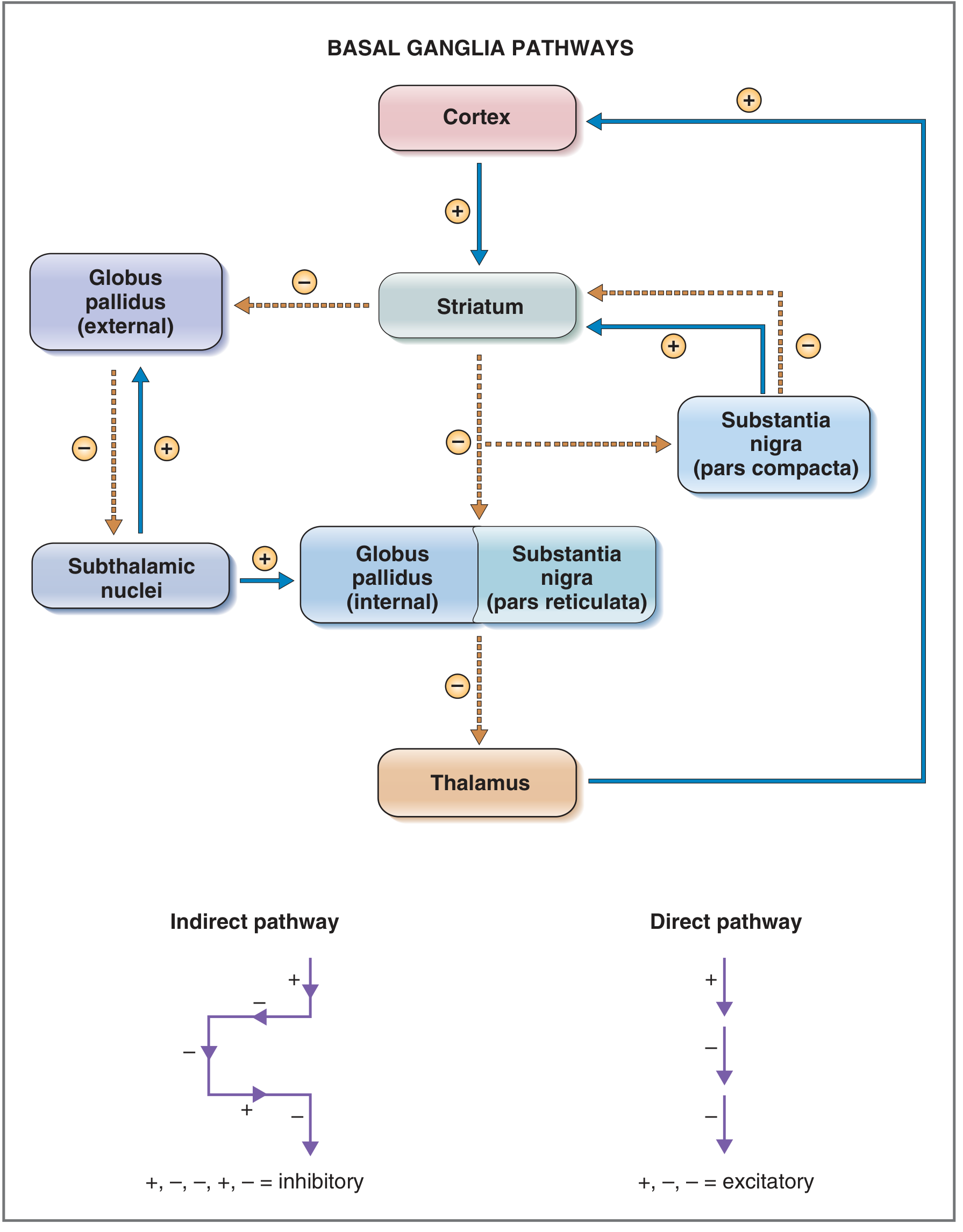
1. Direct Pathway (Overall EXCITATORY to cortex)
Cortex (+) → Striatum → GPi/SNr (-) → Thalamus → Cortex (+)
Step by step:
- Cortex sends excitatory input to striatum (putamen)
- Striatum sends inhibitory (GABA) input to GPi/SNr
- GPi/SNr is therefore inhibited (disinhibited thalamus)
- Thalamus sends excitatory input back to motor cortex
- Net result: EXCITATION of motor cortex → facilitates movement initiation ("Go signal")
- Sign chain: (+)(-)(-) = excitatory
2. Indirect Pathway (Overall INHIBITORY to cortex)
Cortex (+) → Striatum → GPe (-) → Subthalamic nucleus (+) → GPi/SNr (-) → Thalamus → Cortex (+)
Step by step:
- Cortex sends excitatory input to striatum
- Striatum sends inhibitory (GABA) input to GPe
- GPe (now less inhibited) ... actually GPe disinhibits STN - STN is released
- Subthalamic nucleus sends excitatory (glutamate) input to GPi/SNr
- GPi/SNr is MORE active, sending MORE inhibitory (GABA) to thalamus
- Thalamus is inhibited → cortex is less activated
- Net result: INHIBITION of motor cortex → suppresses unwanted competing movements
- Sign chain: (+)(-)(-)(+)(-) = inhibitory
Key principle: The direct and indirect pathways are equal and opposite - their balance determines smooth motor control. Disruption causes disease.
Role of Dopamine (Nigrostriatal Connection)
- Substantia nigra pars compacta (SNc) sends dopaminergic projections back to the striatum
- Dopamine acts on:
- D1 receptors on direct pathway neurons → excites (facilitates direct pathway)
- D2 receptors on indirect pathway neurons → inhibits (suppresses indirect pathway)
- Net effect: dopamine promotes movement by boosting direct and dampening indirect pathway
Diseases of the Basal Ganglia
| Disease | Lesion | Pathway Effect | Clinical Features |
|---|---|---|---|
| Parkinson's disease | Degeneration of SNc (dopaminergic neurons lost) | Indirect pathway overactive; Direct pathway underactive | Hypokinesia, bradykinesia, resting tremor ("pill-rolling"), rigidity, shuffling gait |
| Huntington's disease | Degeneration of striatal (caudate + putamen) GABAergic and cholinergic neurons | Indirect pathway underactive | Hyperkinesia, choreiform (writhing) movements, dementia |
- Increased basal ganglia output (inhibition of thalamus) → Hypokinesia (Parkinson's)
- Decreased basal ganglia output → Hyperkinesia (Huntington's, hemiballismus)
Treatment Note (For Parkinson's)
- L-Dopa (precursor to dopamine) - crosses blood-brain barrier, boosts dopamine synthesis
- Dopamine agonists (e.g., bromocriptine)
- Deep brain stimulation (DBS) of subthalamic nucleus
Summary Mnemonics
- Striatum = INPUT | Globus pallidus (GPi) = OUTPUT
- Direct = Disinhibition = movement facilitation ("Do it")
- Indirect = Inhibition = movement suppression ("Don't do it")
- Dopamine = "Do move" (facilitates movement via D1/D2)
Sources: Costanzo Physiology 7th Ed., p. 115-116 | Neuroscience: Exploring the Brain 5th Ed., p. 1351-1356
This is a shared conversation. Sign in to Orris to start your own chat.