
Primordial prevention in flow chart
primordial prevention definition levels of prevention public health
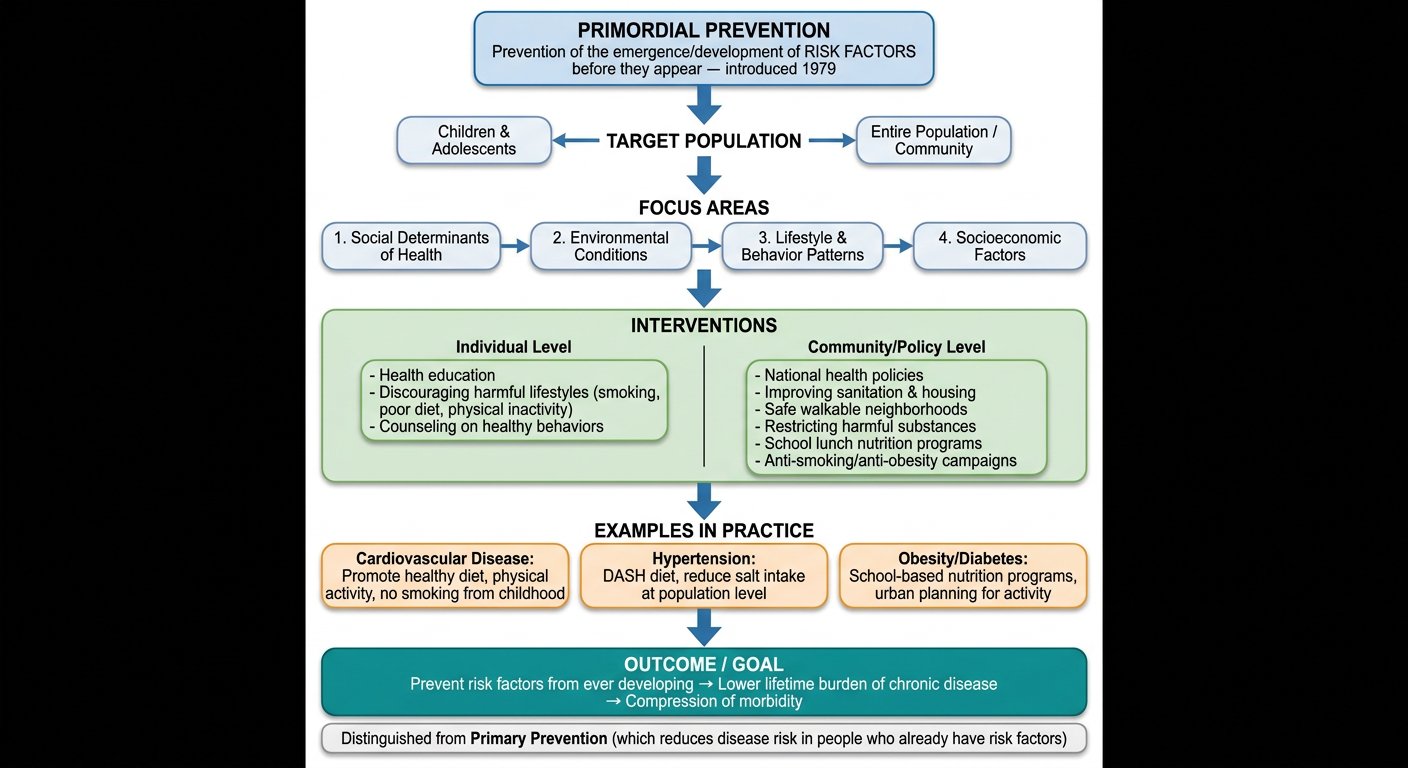
A clean medical education flowchart titled "Primordial Prevention" showing the following hierarchy and flow: Top box: "PRIMORDIAL PREVENTION" (definition: Prevention of the emergence/development of RISK FACTORS before they appear — introduced 1979) Arrow down to: "TARGET POPULATION" with two branches: - Children & Adolescents - Entire Population / Community Arrow down to: "FOCUS AREAS" (4 boxes in a row): 1. Social Determinants of Health 2. Environmental Conditions 3. Lifestyle & Behavior Patterns 4. Socioeconomic Factors Arrow down to: "INTERVENTIONS" (two columns): Left column — Individual Level: - Health education - Discouraging harmful lifestyles (smoking, poor diet, physical inactivity) - Counseling on healthy behaviors Right column — Community/Policy Level: - National health policies - Improving sanitation & housing - Safe walkable neighborhoods - Restricting harmful substances - School lunch nutrition programs - Anti-smoking/anti-obesity campaigns Arrow down to: "EXAMPLES IN PRACTICE" (3 boxes): - Cardiovascular Disease: Promote healthy diet, physical activity, no smoking from childhood - Hypertension: DASH diet, reduce salt intake at population level - Obesity/Diabetes: School-based nutrition programs, urban planning for activity Arrow down to: "OUTCOME / GOAL" box: "Prevent risk factors from ever developing → Lower lifetime burden of chronic disease → Compression of morbidity" Bottom note: "Distinguished from Primary Prevention (which reduces disease risk in people who already have risk factors)" Use color coding: blue header, green for interventions, orange for examples, teal for outcome. Clean, professional medical flowchart style with arrows and rounded boxes.
Primordial Prevention - Key Concepts
How it differs from other levels of prevention
| Level | Target | Example |
|---|---|---|
| Primordial | Risk factors (before they develop) | Stop children from ever starting to smoke |
| Primary | Disease onset (risk factors already present) | Antihypertensive therapy before CVD |
| Secondary | Early disease detection | Screening for hypertension |
| Tertiary | Complication/disability management | Cardiac rehab post-MI |
Why it matters
Main interventions
- Discouraging harmful childhood lifestyle habits (diet, sedentary behavior, smoking)
- Promoting physical activity, healthy eating patterns
- Health literacy campaigns
- National/government-level health policies
- Urban planning (walkable neighborhoods, safe parks)
- Food labeling and school nutrition programs
- Restricting access to tobacco/alcohol
- Improving sanitation, housing, and socioeconomic conditions
Applied examples
- CVD & Hypertension: DASH diet promotion, anti-smoking policy, reducing sodium in food supply at population level
- Obesity/Type 2 Diabetes: School lunch policies limiting processed food
- Rheumatic fever/RHD: Improving social conditions and access to primary care - Braunwald's Heart Disease
Primary prevention flow chart
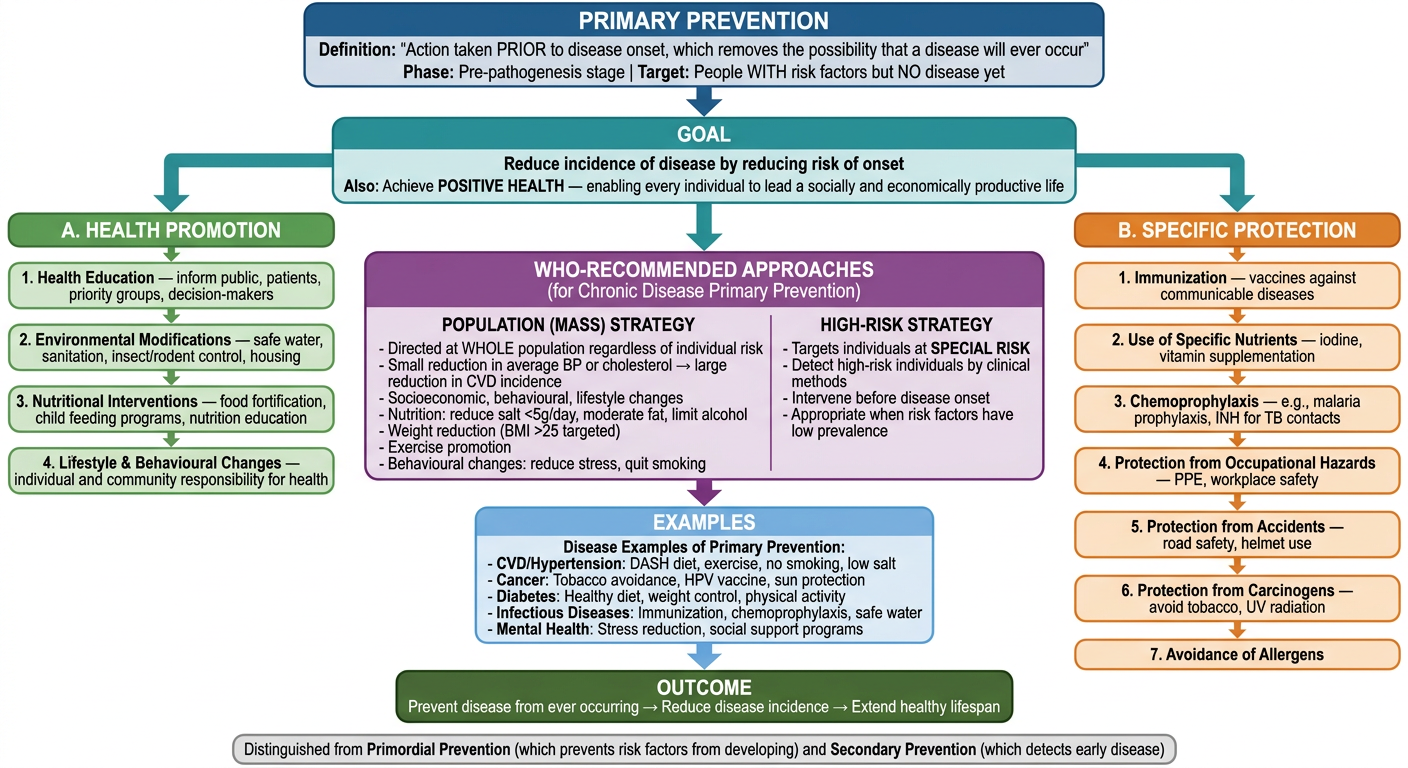
A detailed, clean medical education flowchart titled "PRIMARY PREVENTION" for a medical/public health textbook. Use a white background with professional color coding. TOP HEADER BOX (dark blue): "PRIMARY PREVENTION" Definition: "Action taken PRIOR to disease onset, which removes the possibility that a disease will ever occur" Phase: Pre-pathogenesis stage | Target: People WITH risk factors but NO disease yet Arrow down to: GOAL BOX (teal): "Reduce incidence of disease by reducing risk of onset" Also: Achieve POSITIVE HEALTH — enabling every individual to lead a socially and economically productive life Arrow down splits into TWO BRANCHES side by side: LEFT BRANCH (green header): "A. HEALTH PROMOTION" Sub-boxes stacked: 1. Health Education — inform public, patients, priority groups, decision-makers 2. Environmental Modifications — safe water, sanitation, insect/rodent control, housing 3. Nutritional Interventions — food fortification, child feeding programs, nutrition education 4. Lifestyle & Behavioural Changes — individual and community responsibility for health RIGHT BRANCH (orange header): "B. SPECIFIC PROTECTION" Sub-boxes stacked: 1. Immunization — vaccines against communicable diseases 2. Use of Specific Nutrients — iodine, vitamin supplementation 3. Chemoprophylaxis — e.g., malaria prophylaxis, INH for TB contacts 4. Protection from Occupational Hazards — PPE, workplace safety 5. Protection from Accidents — road safety, helmet use 6. Protection from Carcinogens — avoid tobacco, UV radiation 7. Avoidance of Allergens Both branches merge with arrow down to: WHO STRATEGIES BOX (purple header): "WHO-RECOMMENDED APPROACHES (for Chronic Disease Primary Prevention)" Two columns inside: Left: "POPULATION (MASS) STRATEGY" - Directed at WHOLE population regardless of individual risk - Small reduction in average BP or cholesterol → large reduction in CVD incidence - Socioeconomic, behavioural, lifestyle changes - Nutrition: reduce salt <5g/day, moderate fat, limit alcohol - Weight reduction (BMI >25 targeted) - Exercise promotion - Behavioural changes: reduce stress, quit smoking Right: "HIGH-RISK STRATEGY" - Targets individuals at SPECIAL RISK - Detect high-risk individuals by clinical methods - Intervene before disease onset - Appropriate when risk factors have low prevalence Arrow down to: EXAMPLES BOX (light blue): Disease Examples of Primary Prevention: - CVD/Hypertension: DASH diet, exercise, no smoking, low salt - Cancer: Tobacco avoidance, HPV vaccine, sun protection - Diabetes: Healthy diet, weight control, physical activity - Infectious Diseases: Immunization, chemoprophylaxis, safe water - Mental Health: Stress reduction, social support programs Arrow down to: OUTCOME BOX (dark green): "Prevent disease from ever occurring → Reduce disease incidence → Extend healthy lifespan" Bottom note in grey: "Distinguished from Primordial Prevention (which prevents risk factors from developing) and Secondary Prevention (which detects early disease)" Use rounded rectangles, clear arrows, readable font sizes, and professional medical education styling.
Primary Prevention - Key Concepts
Two Main Arms
| Arm | What it does | Examples |
|---|---|---|
| Health Promotion | Strengthens the host non-specifically | Health education, safe water, nutrition programs, lifestyle changes |
| Specific Protection | Targets a specific agent or risk factor | Immunization, chemoprophylaxis, PPE, tobacco avoidance |
WHO-Recommended Strategies for Chronic Disease (CHD, Hypertension, Cancer)
- Even a small reduction in average blood pressure or serum cholesterol across a population produces a large reduction in CVD incidence
- Dietary changes: salt <5 g/day, moderate fat, limit alcohol
- Weight reduction (BMI target <25)
- Regular physical activity
- Behavioural change: stress reduction, smoking cessation
- Health education and self-care (BP self-monitoring)
- Detect high-risk individuals using clinical methods
- Intervene before disease becomes established
- Most appropriate when risk factors have low community prevalence
- Complementary to the population strategy, not a replacement
Key Point: All three approaches work together
Comparison with Adjacent Levels
| Level | Target | Phase |
|---|---|---|
| Primordial | Social/environmental conditions | Before risk factors develop |
| Primary | Risk factors present, no disease yet | Pre-pathogenesis |
| Secondary | Early/silent disease | Pathogenesis (early) |
| Tertiary | Established disease | Advanced pathogenesis |
Flow chart of secondary prevention
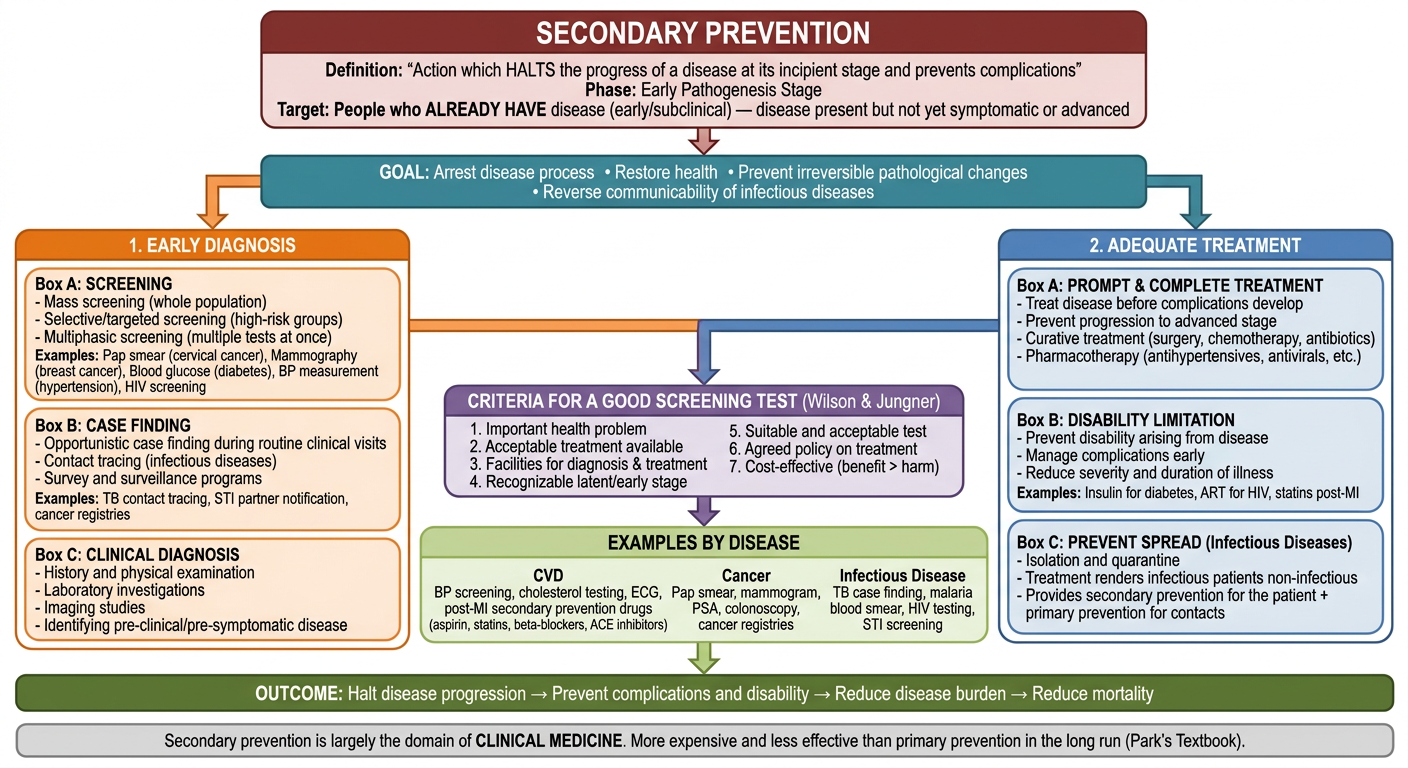
A detailed, clean medical education flowchart titled "SECONDARY PREVENTION" for a public health/preventive medicine textbook. White background, professional color coding, rounded rectangles, clear arrows. TOP HEADER BOX (dark red/maroon): "SECONDARY PREVENTION" Definition: "Action which HALTS the progress of a disease at its incipient stage and prevents complications" Phase: Early Pathogenesis Stage Target: People who ALREADY HAVE disease (early/subclinical) — disease present but not yet symptomatic or advanced Arrow down to: GOAL BOX (teal): "Arrest disease process • Restore health • Prevent irreversible pathological changes • Reverse communicability of infectious diseases" Arrow down splits into TWO MAIN BRANCHES: LEFT BRANCH (orange header): "1. EARLY DIAGNOSIS" Three sub-boxes stacked: Box A: "SCREENING" - Mass screening (whole population) - Selective/targeted screening (high-risk groups) - Multiphasic screening (multiple tests at once) Examples: Pap smear (cervical cancer), Mammography (breast cancer), Blood glucose (diabetes), BP measurement (hypertension), HIV screening Box B: "CASE FINDING" - Opportunistic case finding during routine clinical visits - Contact tracing (infectious diseases) - Survey and surveillance programs Examples: TB contact tracing, STI partner notification, cancer registries Box C: "CLINICAL DIAGNOSIS" - History and physical examination - Laboratory investigations - Imaging studies - Identifying pre-clinical/pre-symptomatic disease RIGHT BRANCH (blue header): "2. ADEQUATE TREATMENT" Three sub-boxes stacked: Box A: "PROMPT & COMPLETE TREATMENT" - Treat disease before complications develop - Prevent progression to advanced stage - Curative treatment (surgery, chemotherapy, antibiotics) - Pharmacotherapy (antihypertensives, antivirals, etc.) Box B: "DISABILITY LIMITATION" - Prevent disability arising from disease - Manage complications early - Reduce severity and duration of illness Examples: Insulin for diabetes, ART for HIV, statins post-MI Box C: "PREVENT SPREAD (Infectious Diseases)" - Isolation and quarantine - Treatment renders infectious patients non-infectious - Provides secondary prevention for the patient + primary prevention for contacts Both branches merge with arrow down to: SCREENING CRITERIA BOX (purple header): "CRITERIA FOR A GOOD SCREENING TEST (Wilson & Jungner)" Seven criteria in two columns: Left: 1. Important health problem | 2. Acceptable treatment available | 3. Facilities for diagnosis & treatment | 4. Recognizable latent/early stage Right: 5. Suitable and acceptable test | 6. Agreed policy on treatment | 7. Cost-effective (benefit > harm) Arrow down to: EXAMPLES BY DISEASE BOX (light green): Three columns: - CVD: BP screening, cholesterol testing, ECG, post-MI secondary prevention drugs (aspirin, statins, beta-blockers, ACE inhibitors) - Cancer: Pap smear, mammogram, PSA, colonoscopy, cancer registries - Infectious Disease: TB case finding, malaria blood smear, HIV testing, STI screening Arrow down to: OUTCOME BOX (dark green): "Halt disease progression → Prevent complications and disability → Reduce disease burden → Reduce mortality" Bottom note (grey): "Secondary prevention is largely the domain of CLINICAL MEDICINE. More expensive and less effective than primary prevention in the long run (Park's Textbook)." Professional medical education style, clear readable font, color-coded sections.
Secondary Prevention - Key Concepts
Two Pillars
| Pillar | Methods | Purpose |
|---|---|---|
| Early Diagnosis | Screening, case finding, clinical diagnosis | Detect disease before symptoms/complications arise |
| Adequate Treatment | Prompt curative/suppressive therapy | Arrest disease, prevent progression, reverse communicability |
Types of Screening
- Mass screening - applied to entire population (e.g., neonatal heel-prick)
- Selective/Targeted screening - focused on high-risk groups (e.g., diabetic eye screening)
- Multiphasic screening - multiple tests applied simultaneously
- Opportunistic screening - case finding during routine clinical visits
Wilson & Jungner Criteria for Screening
- It is an important health problem
- An accepted treatment exists
- Facilities for diagnosis and treatment are available
- There is a recognizable latent or early symptomatic stage
- A suitable, acceptable test exists
- The natural history is adequately understood
- The cost is proportionate to the benefit
Disease Examples
| Disease | Secondary Prevention Measure |
|---|---|
| Hypertension/CVD | BP screening; post-MI drugs (aspirin, statins, beta-blockers, ACE inhibitors) |
| Cancer | Pap smear, mammography, PSA, colonoscopy, cancer registries |
| Tuberculosis | Contact tracing, sputum smear, IGRA testing |
| Diabetes | Fasting glucose, HbA1c screening in at-risk populations |
| HIV | HIV testing and early ART initiation |