
Malaria intro definition epidemiology incubation period symptoms screening and diagnosis prevention and control treatment Ache de ans de exam ke liye aur English me bata
Reading File
Now let me search the medical library for comprehensive malaria content across all required topics simultaneously.
Finding Sources
Finding Sources
Good - I found several key sources. Let me now read the most comprehensive malaria sections in parallel - Robbins Pathology, Goldman-Cecil Medicine, and Rosen's Emergency Medicine.
Reading File
Finding Sources
Finding Sources
Excellent - Harrison's has a dedicated malaria chapter and Park's has diagnosis/treatment. Let me read these key sections now in parallel.
Reading File
Reading File
Excellent - I have very comprehensive Harrison's content. Let me now read the Park's textbook malaria section for epidemiology (Indian exam focus) and the treatment/diagnosis sections from Harrison's.
Reading File
Reading File
I now have very comprehensive content from Harrison's and Park's. Let me also get the Harrison's malaria section on clinical features, diagnosis, and prevention.
Reading File
Reading File
I now have very comprehensive data from Harrison's (2025 edition) and Park's Preventive Medicine. Let me also fetch the malaria life cycle diagram image and read the Harrison's treatment table.
Loading Image
Reading File
I now have all the content I need for a comprehensive malaria answer. Let me compile everything into a well-structured exam-oriented response.
MALARIA - Complete Study Notes (Exam Edition)
Sources: Harrison's Principles of Internal Medicine 22E (2025), Park's Textbook of Preventive & Social Medicine, Robbins & Kumar Basic Pathology
1. INTRODUCTION & DEFINITION
Malaria is a protozoan disease caused by parasites of the genus Plasmodium, transmitted by the bite of an infected female Anopheles mosquito. It is the most important parasitic disease of humans and a leading cause of morbidity and mortality worldwide.
"Humanity has but three great enemies: Fever, famine, and war; of these by far the greatest, by far the most terrible, is fever." - William Osler, 1896
Six species of Plasmodium cause human malaria:
| Species | Type of Malaria | Cycle |
|---|---|---|
| P. falciparum | Malignant tertian (most dangerous) | 48 h |
| P. vivax | Benign tertian | 48 h |
| P. ovale | Benign tertian | 48 h |
| P. malariae | Quartan | 72 h |
| P. knowlesi | Quotidian (Southeast Asia) | 24 h |
| P. ovale curtisi & wallikeri | Benign tertian | 48 h |
- Nearly all deaths are caused by P. falciparum
- P. knowlesi and P. vivax can also occasionally cause severe illness
- Humans are the only natural reservoir
2. LIFE CYCLE (Pathogenesis)
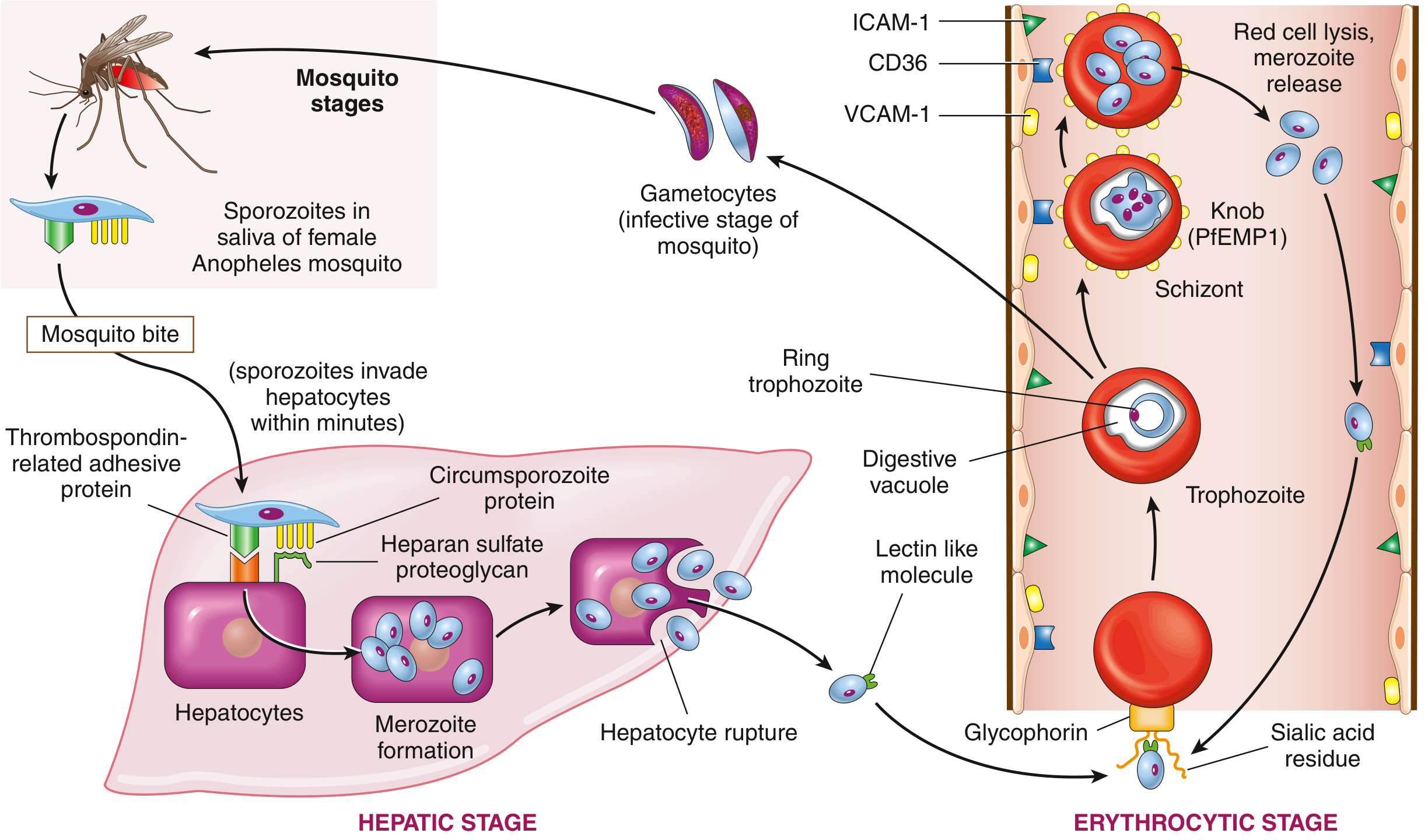
Two phases:
A. Hepatic (Pre-erythrocytic) Stage
- Female Anopheles mosquito bites → injects sporozoites into bloodstream
- Sporozoites travel to liver within minutes (bind via thrombospondin-related adhesive protein and circumsporozoite protein to hepatocyte proteoglycans)
- Inside hepatocytes: differentiate into merozoites (one sporozoite produces 10,000-30,000 merozoites)
- Infected hepatocytes rupture → merozoites released into bloodstream
Important: In P. vivax and P. ovale, some forms remain dormant as hypnozoites in the liver - causing relapses months to years later.
B. Erythrocytic Stage
- Merozoites invade RBCs (bind via lectin-like molecule to sialidated glycophorin)
- Inside RBCs: Merozoite → Ring form → Trophozoite → Schizont
- P. falciparum schizonts express PfEMP1 (knob protein) - binds ICAM-1, VCAM-1, CD36 on endothelium → cytoadherence → microvascular obstruction
- Some trophozoites → gametocytes (infective stage for mosquito)
- Schizonts rupture → merozoites released → new cycle
- Symptoms appear when parasitemia reaches ~50/μL (100 million parasites total)
3. EPIDEMIOLOGY
Global:
- In 2022: 249 million cases in 85 malaria-endemic countries; 608,000 deaths (~1,660 deaths/day) - Harrison's 22E
- Two countries account for ~43% of deaths (DRC and Nigeria)
- Endemic in sub-Saharan Africa, South/Southeast Asia, Central & South America
- P. falciparum dominates Africa; P. vivax dominates South Asia and Latin America
India-specific (Park's):
- India has ~45 species of anopheline mosquitoes; major vectors:
- Rural areas: Anopheles culicifacies (most important)
- Urban areas: Anopheles stephensi
- Others: An. fluviatilis, An. minimus, An. philippinensis, An. sundaicus, An. maculatus
- ~100 million fever cases screened annually in India
Key Epidemiological Indices (very important for Indian exams):
| Index | Formula | Significance |
|---|---|---|
| API (Annual Parasite Incidence) | (Confirmed cases/year ÷ Population) × 1000 | API ≥ 2/1000 = High risk area (eligible for vector control) |
| ABER (Annual Blood Examination Rate) | (Slides examined ÷ Population) × 100 | Target: screen 10% of population |
| AFI (Annual Falciparum Incidence) | Falciparum cases separately tracked | Monitors drug-resistant strain |
| SPR (Slide Positivity Rate) | % slides positive for any Plasmodium | Trend of transmission |
| SFR (Slide Falciparum Rate) | % slides positive for P. falciparum | Tracks dangerous strain |
Vector Indices:
- Human Blood Index - proportion of female Anopheles with human blood in stomach
- Sporozoite Rate - % female anophelines with sporozoites in salivary glands
- Man-Biting Rate - average anopheline bites per person per day
- Inoculation Rate = Man-biting rate × Sporozoite rate
4. INCUBATION PERIOD
| Species | Incubation Period |
|---|---|
| P. falciparum | 7-14 days (average ~12 days) |
| P. vivax | 12-17 days (can be up to 6-12 months with hypnozoites) |
| P. ovale | 15-18 days |
| P. malariae | 18-40 days |
| P. knowlesi | 9-12 days |
- Short incubation (<21 days) rules out malaria in travelers with appropriate chemoprophylaxis
- Most travel-related cases present within 1 month of return
5. CLINICAL FEATURES (Symptoms)
Classic Malarial Paroxysm (3 stages):
- Cold Stage (Rigor): Sudden chills, shivering, goosebumps - lasts 15-60 min
- Hot Stage (Fever): High fever 39-41°C, headache, vomiting, flushing - lasts 2-6 hours
- Sweating Stage (Defervescence): Profuse sweating, temperature falls, patient exhausted
Periodicity of fever:
- Tertian (every 48 h): P. vivax, P. ovale, P. falciparum
- Quartan (every 72 h): P. malariae
- Daily (quotidian): P. knowlesi
Other Common Features:
- Headache, myalgia, malaise, fatigue
- Nausea, vomiting, abdominal pain
- Splenomegaly (chronic - "Bignami's spleen" or "tropical splenomegaly")
- Hepatomegaly (mild)
- Anemia (hemolytic)
- Jaundice
Severe Falciparum Malaria (WHO criteria - exam important!)
Major manifestations:
| Feature | Definition/Threshold |
|---|---|
| Cerebral malaria (coma) | Glasgow Coma Score <11; unresponsive >30 min post-seizure; Blantyre Score <3 in children |
| Metabolic acidosis | Arterial pH <7.25; plasma bicarbonate <15 mmol/L; lactate ≥5 mmol/L |
| Severe anemia | Hematocrit <15% or Hb <5 g/dL in children; Hb <7 g/dL in adults with parasitemia |
| Hypoglycemia | Blood glucose <2.2 mmol/L (<40 mg/dL) |
| Renal failure | Creatinine >265 μmol/L (>3 mg/dL) |
| Pulmonary edema / ARDS | Non-cardiogenic |
| Abnormal bleeding / DIC | |
| Hemoglobinuria ("Blackwater fever") | Gross hemoglobinuria |
| Hyperparasitemia | >2% infected RBCs |
| Circulatory collapse | Systolic BP <80 mmHg |
"Blackwater fever" = massive intravascular hemolysis + hemoglobinuria; historically associated with quinine use in P. falciparum infection.
Cerebral malaria features: diffuse symmetric encephalopathy, retinal hemorrhages (15% on routine fundoscopy, 30-40% with dilation), convulsions in ~50% of children, papilledema (8% children).
6. SCREENING & DIAGNOSIS
A. Microscopy (Gold Standard)
- Thick blood smear - screening (more sensitive, detects parasites at low density)
- Thin blood smear - species identification (morphology preserved)
- Stain: Leishman's, Giemsa, or Field's stain
- Examined at intervals of 6-12 hours (parasites may not be detectable in early infection)
Morphological clues for identification:
| Feature | P. falciparum | P. vivax |
|---|---|---|
| RBC size | Normal | Enlarged (Schüffner's dots) |
| Rings | Multiple rings/cell; appliqué (accolé) form | Single ring |
| Schüffner's dots | Absent (Maurer's clefts instead) | Present |
| Banana-shaped gametocytes | Yes (pathognomonic) | No (round) |
B. Rapid Diagnostic Tests (RDTs)
- Detect parasite antigens (HRP-2 for P. falciparum; pLDH, aldolase for all species)
- Sensitivity ~90-95% for P. falciparum, lower for non-falciparum
- Advantage: results in 15-20 min; no microscope needed; field use
C. PCR (Molecular Methods)
- Most sensitive and specific
- Detects all species; identifies mixed infections and drug resistance markers
- Used in reference labs; not routine in field settings
D. Serology
- ELISA, IFAT - detect antibodies; useful for epidemiological surveys, blood bank screening
- Not useful for diagnosing acute infection (antibodies persist long after infection)
E. Other Lab Findings
- Thrombocytopenia (very common, almost universal)
- Normochromic normocytic anemia
- Elevated LDH, bilirubin (hemolysis)
- Elevated creatinine (severe disease)
- Hypoglycemia (especially in pregnancy, severe disease, quinine treatment)
- Blood cultures to rule out bacteremia (common co-infection)
7. PREVENTION AND CONTROL
A. Personal Protection (Individual Level)
- Insecticide-treated bed nets (ITNs) / Long-lasting insecticidal nets (LLINs) - single most effective measure
- Repellents: DEET (20-50%) on exposed skin; permethrin on clothing
- Protective clothing: long-sleeved shirts, long trousers (especially dusk to dawn)
- Screened windows and doors
- Indoor Residual Spraying (IRS): DDT, malathion, pyrethroid insecticides sprayed on indoor walls
B. Chemoprophylaxis (for Travelers)
| Drug | Regimen | Area |
|---|---|---|
| Atovaquone-proguanil (Malarone) | 1 tablet/day (start 1-2 days before, continue 7 days after) | All areas including chloroquine-resistant |
| Doxycycline | 100 mg/day | Chloroquine-resistant areas |
| Mefloquine | 250 mg weekly (start 2 weeks before) | Most malaria areas |
| Chloroquine | 500 mg weekly | Chloroquine-sensitive areas only |
| Primaquine | For terminal prophylaxis in P. vivax/P. ovale - eliminates hypnozoites |
No chemoprophylactic regimen is 100% protective - mosquito avoidance is always essential.
C. Vector Control Strategies (India - National Programme)
Strategic Action Plan (NVBDCP - National Vector Borne Disease Control Programme):
(a) Surveillance and Case Management:
- Case detection (passive + active surveillance)
- Early diagnosis and complete treatment
- Sentinel surveillance
(b) Integrated Vector Management:
- Indoor Residual Spraying (IRS)
- ITNs and LLINs
- Anti-larval measures (source reduction, larviciding)
- Biological control (Gambusia fish, Bacillus thuringiensis israelensis)
(c) Epidemic Preparedness and Early Response
(d) Supportive Interventions:
- Capacity building
- Behavioral change communication (BCC)
- Intersectoral collaboration
- Monitoring and Evaluation
D. Vaccine
- RTS,S/AS01 (Mosquirix) - first licensed malaria vaccine; WHO recommended for children in sub-Saharan Africa (2021); targets P. falciparum circumsporozoite protein; ~30-40% efficacy
- R21/Matrix-M - newer vaccine showing ~75% efficacy in trials; recommended by WHO in 2023
- No vaccine currently approved/available for travelers
8. TREATMENT
A. Uncomplicated Malaria
Non-Falciparum Malaria (P. vivax, P. ovale, P. malariae):
- Chloroquine (first-line, where sensitive): 600 mg base stat, then 300 mg at 6h, then 300 mg daily × 2 days
- For P. vivax/ovale: add Primaquine 15 mg/day × 14 days (to eliminate hypnozoites/prevent relapse)
- Check G6PD status before primaquine (causes hemolysis in G6PD deficiency)
- Note: Chloroquine resistance in P. vivax reported in parts of Indonesia and Papua New Guinea
Uncomplicated P. falciparum Malaria:
- Artemisinin-Based Combination Therapy (ACT) - WHO recommended first-line in ALL endemic countries
| ACT Regimen | Composition |
|---|---|
| AL (Artemether-Lumefantrine) | Most widely used globally |
| AS+AQ (Artesunate + Amodiaquine) | Sub-Saharan Africa |
| AS+SP (Artesunate + Sulfadoxine-Pyrimethamine) | India: ACT-SP |
| DHA+PPQ (Dihydroartemisinin + Piperaquine) | Southeast Asia |
| AS+MQ (Artesunate + Mefloquine) | Southeast Asia |
| Atovaquone-proguanil | 20/8 mg/kg/day × 3 days (travelers) |
India's National Programme: ACT-AL (Artemether-Lumefantrine) or ACT-SP (Artesunate + SP) depending on region.
Add single-dose Primaquine (0.25 mg base/kg) to all falciparum treatments as gametocytocide (safe even in G6PD deficiency at this single dose).
B. Severe Falciparum Malaria
Drug of choice: IV Artesunate (35% lower mortality vs quinine in SE Asia; 22.5% lower in Africa)
| Drug | Dose |
|---|---|
| IV Artesunate (1st choice) | 2.4 mg/kg IV stat, then at 12h, 24h, then daily; children <20 kg: 3 mg/kg/dose |
| IM Artemether (if IV artesunate unavailable) | 3.2 mg/kg IM stat, then 1.6 mg/kg/day |
| IV Quinine (if artemisinin unavailable) | 20 mg salt/kg over 4h, then 10 mg salt/kg over 2-8h every 8h |
- Switch to oral ACT as soon as patient can swallow
- If acquired from artemisinin-resistant area: give IV artesunate + quinine together
C. Supportive Treatment in Severe Malaria
- ICU care, frequent monitoring
- Treat hypoglycemia: IV dextrose
- Treat seizures: benzodiazepines
- Blood transfusion for severe anemia (Hb <7 g/dL)
- Renal dialysis for renal failure
- Antipyretics: paracetamol (avoid aspirin - risk of Reye's syndrome in children)
- Do NOT use steroids (harmful in cerebral malaria)
- Dexamethasone is contraindicated in cerebral malaria
D. Drug Resistance (Important for Exams)
- Chloroquine resistance in P. falciparum: mediated by Pfcrt gene mutation
- Artemisinin resistance: mediated by Pfkelch13 mutations (confirmed in SE Asia - Mekong region)
- Mefloquine resistance: Pfmdr1 gene amplification
- Piperaquine resistance: Pfpm1/Pfpm2 gene amplification
9. QUICK EXAM MNEMONICS
Malaria Species "FVOMK":
- Falciparum (worst)
- Vivax (relapse - hypnozoites)
- Ovale (relapse - hypnozoites)
- Malariae (nephrotic syndrome)
- Knowlesi (daily fever, SE Asia)
"3 Cs of Severe Malaria" = Coma, Convulsions, Complications
Primaquine indications: "VOMIT" = Vivax, Ovale, Malaria (terminal prophylaxis), Individual G6PD check first, Terminal prophylaxis
ACT = Artemisinin + Companion drug (never use artemisinin alone - prevents resistance)
10. KEY EXAM FACTS (High-Yield Summary)
| Fact | Answer |
|---|---|
| Most dangerous species | P. falciparum |
| Causes relapse (hypnozoites) | P. vivax and P. ovale |
| Causes nephrotic syndrome | P. malariae |
| Banana-shaped gametocytes | P. falciparum (pathognomonic) |
| Schüffner's dots (stippling) | P. vivax and P. ovale |
| Shortest RBC cycle | P. knowlesi (24 h) |
| Longest incubation | P. malariae (18-40 days) |
| Vector in rural India | An. culicifacies |
| Vector in urban India | An. stephensi |
| Gold standard diagnosis | Peripheral blood smear (Giemsa stain) |
| HRP-2 antigen detected by | RDT (for P. falciparum) |
| First-line for uncomplicated falciparum | ACT (Artemisinin-Based Combination Therapy) |
| Drug for severe malaria | IV Artesunate (DOC) |
| Drug to prevent relapse in vivax | Primaquine (14 days) |
| Contraindication with primaquine | G6PD deficiency |
| Cerebral malaria: steroid use | Contraindicated |
| Vaccine approved by WHO | RTS,S (Mosquirix) + R21/Matrix-M |
| API high-risk threshold | ≥2 per 1000 population/year |
| "Blackwater fever" | Hemoglobinuria in severe P. falciparum |
Sources: Harrison's Principles of Internal Medicine 22E (2025), p. 1804-1876 | Park's Textbook of Preventive and Social Medicine | Robbins & Kumar Basic Pathology, p. 392
This is a shared conversation. Sign in to Orris to start your own chat.