
Good morning bsc nursing students please read following procedure for the exams - Conversion of temperature (Celcius to Fahrenheit and Vise Verse) - Hand washing - BMI - vital sign - Bandaging - Biomedical Waste Management - Hair care - Positioning - Physical Examination Read for pratical exam
Reading File
Now let me search the medical library for all these nursing procedures in parallel.
Finding Sources
Finding Sources
Finding Sources
Finding Sources
Finding Sources
Finding Sources
Finding Sources
Finding Sources
Finding Sources
Now let me read the most relevant sections - especially from Park's Preventive Medicine for hand washing, and key nursing procedure sources.
Reading File
Reading File
Reading File
Good morning, BSc Nursing students! Here is your complete practical exam revision guide covering all 9 procedures. Study carefully!
🩺 BSc Nursing Practical Exam Revision Guide
1. CONVERSION OF TEMPERATURE (Celsius ↔ Fahrenheit)
Formulas (must memorize):
| Conversion | Formula |
|---|---|
| Celsius to Fahrenheit | °F = (°C × 9/5) + 32 |
| Fahrenheit to Celsius | °C = (°F - 32) × 5/9 |
Key reference values:
| Celsius (°C) | Fahrenheit (°F) | Clinical Significance |
|---|---|---|
| 36.1 - 37.2 | 97 - 99 | Normal body temperature |
| 37.5 | 99.5 | Low-grade fever |
| 38.0 | 100.4 | Fever (pyrexia) |
| 39.0 | 102.2 | High fever |
| 40.0 | 104.0 | Very high fever |
| 41.0 | 105.8 | Hyperpyrexia |
| 35.0 | 95.0 | Hypothermia |
| 100 | 212 | Boiling point of water |
| 0 | 32 | Freezing point of water |
Quick trick: To convert 37°C → °F: (37 × 9/5) + 32 = 66.6 + 32 = 98.6°F
2. HAND WASHING (WHO 6-Step Technique)
As described in Park's Textbook of Preventive and Social Medicine
Purpose: Remove transient microorganisms, prevent hospital-acquired infections (HAIs), break the chain of infection.
When to wash hands (5 Moments - WHO):
- Before touching a patient
- Before a clean/aseptic procedure
- After body fluid exposure risk
- After touching a patient
- After touching patient surroundings
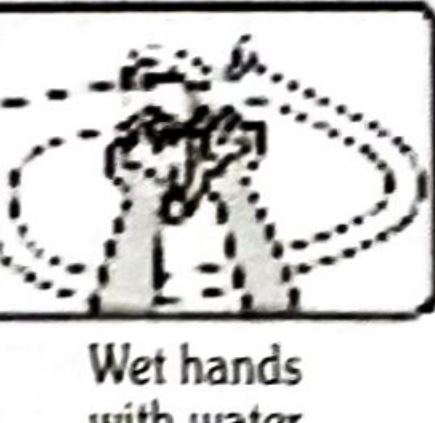
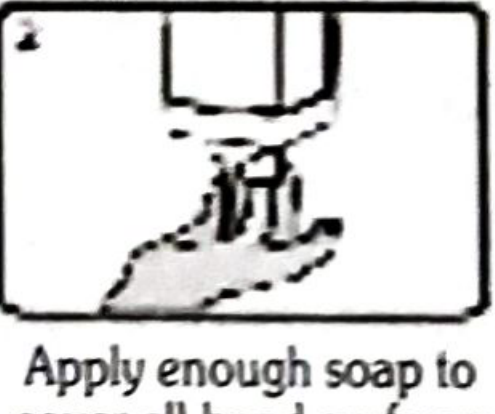
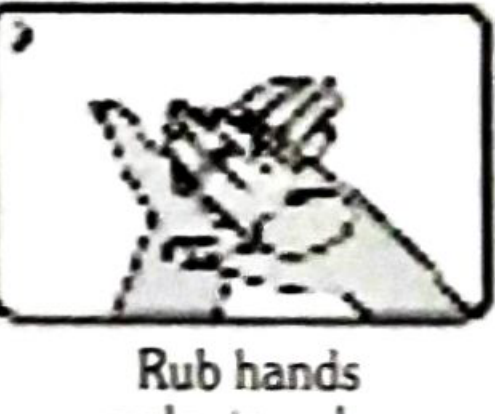
Steps of Hand Washing Technique (Soap & Water - minimum 40-60 seconds):
| Step | Action |
|---|---|
| 1 | Wet hands with water |
| 2 | Apply enough soap to cover all hand surfaces |
| 3 | Rub palms together (palm to palm) |
| 4 | Rub back of each hand with palm of other hand, fingers interlocked |
| 5 | Rub palm to palm with fingers interlocked |
| 6 | Rub backs of fingers to opposing palms with fingers interlocked |
| 7 | Rotational rubbing of left thumb clasped in right palm and vice versa |
| 8 | Rub tips of fingers in opposite hand with rotational movement |
| 9 | Rinse hands with water |
| 10 | Dry thoroughly with a single-use towel |
| 11 | Use the towel to turn off the tap |
Alcohol-based handrub: Use when hands are not visibly soiled - 20-30 seconds, same 6 steps.
3. BMI (Body Mass Index)
Formula:
BMI = Weight (kg) / Height² (m²)
Example: Weight = 70 kg, Height = 1.70 m → BMI = 70 / (1.70)² = 70 / 2.89 = 24.2 kg/m²
WHO BMI Classification:
| BMI (kg/m²) | Classification |
|---|---|
| < 18.5 | Underweight |
| 18.5 - 24.9 | Normal weight |
| 25.0 - 29.9 | Overweight (Pre-obese) |
| 30.0 - 34.9 | Obese Class I |
| 35.0 - 39.9 | Obese Class II |
| ≥ 40.0 | Obese Class III (Morbid obesity) |
Nursing implications: BMI guides nutritional assessment, risk screening for diabetes, hypertension, CVD. Document and report abnormal BMI. - Goldman-Cecil Medicine
4. VITAL SIGNS
The 4 Primary Vital Signs:
A. Temperature
- Normal: 36.1 - 37.2°C (97 - 99°F)
- Sites: Oral, Axillary (subtract 0.5°C), Rectal (add 0.5°C), Tympanic
- Axillary temperature is lowest; rectal is highest and most accurate
B. Pulse (Heart Rate)
- Normal adults: 60 - 100 bpm
- Bradycardia: < 60 bpm | Tachycardia: > 100 bpm
- Assess: rate, rhythm, volume (strength), equality
- Best sites: Radial (routine), Carotid (emergency), Apical (1 full minute)
C. Respiration
- Normal adults: 12 - 20 breaths/min
- Bradypnoea: < 12 | Tachypnoea: > 20
- Count for 1 full minute; observe rise and fall of chest
- Never tell patient you are counting (they will alter breathing)
D. Blood Pressure
- Normal: < 120/80 mmHg
- Hypertension: ≥ 130/80 mmHg (AHA) or ≥ 140/90 mmHg (WHO)
- Hypotension: < 90/60 mmHg
- Measure in sitting position, after 5 min rest, arm at heart level
Additional: Oxygen Saturation (SpO₂)
- Normal: 95 - 100%
- Concern: < 92% requires intervention
Vital Signs - Normal Adult Reference Table:
| Parameter | Normal Range | Tool Used |
|---|---|---|
| Temperature | 36.1 - 37.2°C | Thermometer |
| Pulse | 60 - 100 bpm | Watch + fingers |
| Respiration | 12 - 20/min | Observation |
| Blood Pressure | 120/80 mmHg | Sphygmomanometer |
| SpO₂ | 95 - 100% | Pulse oximeter |
5. BANDAGING
From Pye's Surgical Handicraft, 22nd Edition
Types of Bandages:
| Type | Use |
|---|---|
| Roller bandage | Most common - limbs, head |
| Triangular bandage | Sling, first aid |
| T-bandage | Perineal/groin dressings |
| Tubular bandage | Fingers, toes |
| Elastic/Crepe bandage | Compression, stump |
Basic Turns in Bandaging:
| Turn | Technique | Area Used |
|---|---|---|
| Circular | Each layer directly over the previous | Wrist, ankle |
| Spiral | Each layer overlaps 1/2 to 2/3 of previous | Cylindrical limbs |
| Reverse spiral (Spica) | Bandage reversed at each turn | Conical limbs |
| Figure-of-eight | Alternating oblique turns above & below joint | Joints (knee, elbow, ankle) |
| Recurrent (Capeline) | Back-and-forth turns over terminal end | Stump, fingertip, head |
Principles of Good Bandaging:
- Begin from the distal end and proceed proximally
- Overlap each turn by 1/2 to 2/3 of the width
- Apply uniform, firm pressure - not too tight (check circulation) or too loose (slips off)
- Always leave fingertips/toe tips exposed to check circulation
- Check for: pallor, cyanosis, swelling, numbness, coldness (signs of impaired circulation)
- Secure the end with a safety pin or tape - never a metal clip near a wound
Stump Bandaging: Figure-of-eight turns applied to condition stump post-amputation - prevents oedema, encourages venous return, tones tissue. Must be applied from time of amputation. - Pye's Surgical Handicraft
T-bandage (Perineal): Belt passed around waist; single or double tails passed between legs and secured. Used for perineal and groin dressings.
6. BIOMEDICAL WASTE MANAGEMENT
Governed by: Bio-Medical Waste (Management & Handling) Rules, 1998 (India) - amended 2016/2018
Color-Coded Segregation (MUST memorize):
| Bag/Container Color | Waste Type | Disposal Method |
|---|---|---|
| 🟡 Yellow | Human anatomical waste, animal waste, soiled waste (blood-soaked), expired medicines | Incineration / deep burial |
| 🔴 Red | Contaminated plastic waste (syringes without needles, IV sets, catheters, urine bags) | Autoclaving → recycling |
| 🔵 Blue / White Translucent | Glass waste, metallic implants, sharps | Autoclaving / microwaving → landfill |
| ⬛ Black | General solid waste (non-biomedical) | Municipal solid waste disposal |
Sharps Management:
- Never recap needles with two hands (one-hand scoop technique only)
- Dispose directly into puncture-proof sharps container (never overfill beyond 3/4)
- Sharps containers: white/blue translucent, labeled
Key Principle - Segregation at source: Waste must be segregated at the point of generation (bedside). Never mix categories.
Chain of Waste Management:
Segregation → Collection → Transportation → Treatment → Disposal
7. HAIR CARE
Purpose: Maintain cleanliness, prevent infection (pediculosis/lice), promote comfort, assess scalp condition, maintain patient dignity.
Procedure - Hair Combing:
- Position: Sitting if possible; for bedridden - Fowler's or lateral position with towel under head
- Drape towel around shoulders
- Divide hair into sections
- Start combing from ends to roots to prevent pulling and breakage
- Use wide-toothed comb for tangled hair
- Assess for: dandruff, pediculosis (lice/nits), scalp lesions, alopecia
Bed Shampoo (for bedridden patients):
- Gather: shampoo, basin, jug of warm water, waterproof sheet, towels, trough/Kelly pad
- Position patient at edge of bed; protect mattress with waterproof sheet
- Place trough/Kelly pad under head to channel water into basin
- Wet hair, apply shampoo, massage gently with fingertips (not nails)
- Rinse thoroughly (no residue left - causes dandruff)
- Dry with towel, then dryer if available
- Comb and style
Pediculosis Treatment:
- Apply prescribed pediculicide lotion, leave for prescribed time
- Use fine-toothed nit comb to remove nits
- Wash all bedding/clothing
8. POSITIONING
Purpose: Prevent pressure ulcers, facilitate breathing, aid drainage, post-operative positioning, comfort, diagnostic/therapeutic purposes.
Standard Nursing Positions:
| Position | Description | Uses |
|---|---|---|
| Supine (Dorsal recumbent) | Lying flat on back, arms at sides | General examination, post-anaesthesia |
| Prone | Lying face down | Back surgery, prevent pressure on sacrum, improve oxygenation (ARDS) |
| Lateral (Side-lying) | Lying on either side, pillow between knees | Preventing pressure ulcers, enema, unconscious patient |
| Fowler's | Head of bed 45-60° elevated | Respiratory difficulty, NG feeding, cardiac patients |
| Semi-Fowler's | 30-45° elevation | Comfort, post-abdominal surgery |
| High Fowler's | 60-90° (near sitting) | Severe respiratory distress, eating |
| Trendelenburg | Foot end raised 15-30° above head | Shock (controversial), perineal surgery, postural drainage |
| Modified Trendelenburg | Only legs elevated, body flat | Hypovolemic shock |
| Reverse Trendelenburg | Head end raised, body straight | Head/neck surgery, GERD |
| Lithotomy | On back, thighs flexed on abdomen, legs on stirrups | Gynaecological procedures, catheterization |
| Sims' (Semi-prone) | On left side, upper knee drawn up | Enema, rectal examination, unconscious patient |
| Knee-Chest (Genupectoral) | On knees and chest, head down | Rectal/sigmoid examination, posterior vaginal prolapse |
Repositioning Schedule: Reposition every 2 hours to prevent pressure ulcers in bedridden patients.
9. PHYSICAL EXAMINATION
Purpose: Systematic assessment to determine health status, plan and evaluate care.
Techniques (IPPA - in order):
| Technique | Method | Notes |
|---|---|---|
| I - Inspection | Visual observation | First step - never skip |
| P - Palpation | Touch/feel | Light before deep palpation |
| P - Percussion | Tapping to assess resonance | Distinguish solid vs. hollow organs |
| A - Auscultation | Listening with stethoscope | Always LAST (except for abdomen: IPAP) |
Note for Abdomen: Order is Inspection → Auscultation → Palpation → Percussion (auscultate before palpating to avoid altering bowel sounds)
Systematic Head-to-Toe Assessment Sequence:
- General appearance - level of consciousness, hygiene, distress
- Head & Hair - symmetry, lesions, hair texture
- Eyes - PERRLA (Pupils Equal, Round, Reactive to Light and Accommodation)
- Ears - hearing, discharge
- Nose & Mouth - mucous membranes, teeth, throat
- Neck - lymph nodes, thyroid, JVD
- Chest/Respiratory - breath sounds (vesicular, bronchial, bronchovesicular)
- Cardiovascular - heart sounds S1 (mitral/tricuspid closure), S2 (aortic/pulmonic closure)
- Abdomen - bowel sounds (normal 5-30/min), tenderness
- Extremities - pulses, oedema, reflexes
- Neurological - GCS, cranial nerves, motor/sensory
Breath Sounds:
| Sound | Location | Character |
|---|---|---|
| Vesicular | Peripheral lung fields | Soft, low-pitched, inspiration > expiration |
| Bronchovesicular | Main bronchi area | Medium pitch, equal I:E ratio |
| Bronchial (Tubular) | Over trachea | Loud, high-pitched, expiration > inspiration |
Abnormal Breath Sounds:
- Crackles (Crepitations): Fluid in airways - pneumonia, pulmonary oedema
- Wheeze: Bronchospasm - asthma, COPD
- Stridor: Upper airway obstruction - emergency
- Pleural friction rub: Pleuritis
QUICK EXAM CHEAT SHEET
| Topic | Key Number/Formula |
|---|---|
| Temp conversion | °F = (°C × 9/5) + 32 |
| Normal temp | 36.1 - 37.2°C / 98.6°F |
| BMI formula | Weight(kg) / Height²(m) |
| Normal BMI | 18.5 - 24.9 |
| Normal pulse | 60 - 100 bpm |
| Normal RR | 12 - 20/min |
| Normal BP | 120/80 mmHg |
| Normal SpO₂ | 95 - 100% |
| Reposition frequency | Every 2 hours |
| Hand wash duration | 40 - 60 seconds |
| Sharps container fill | Never beyond 3/4 |
| Yellow bag | Anatomical waste → Incinerate |
| Red bag | Contaminated plastics → Autoclave |
Good luck in your practical exams! Master the rationale behind each procedure - examiners often ask WHY you perform each step. 💪
This is a shared conversation. Sign in to Orris to start your own chat.