
chromosomes
Reading File
The query "chromosomes" is quite broad. Let me clarify what you're looking for before diving into research.
Asking for Preferences
What aspect of chromosomes are you interested in?
Finding Sources
Searching the Web
chromosomes structure function overview genetics
Reading File
Reading File
Reading File
Reading File
Reading File
Reading File
Finding Sources
Loading Image
Loading Image
Reading File
Here is a thorough overview of chromosomes, drawing from Emery's Elements of Medical Genetics and Genomics and Thompson & Thompson Genetics and Genomics in Medicine.
Chromosomes: A Complete Overview
1. What Are Chromosomes?
Chromosomes are organized packages of DNA and protein found in the nucleus of every eukaryotic cell. Humans have 46 chromosomes arranged in 23 pairs:
- 22 pairs of autosomes (chromosomes 1-22, numbered in order of decreasing length)
- 1 pair of sex chromosomes (XX in females, XY in males)
Each chromosome consists of a single continuous DNA double helix - though it is far wider than the helix itself due to multiple levels of protein packaging.
2. Structure and Packaging
The total DNA in a human cell, if fully extended, would be several meters long - yet it fits into a nucleus less than a tenth of a millimeter across. This is achieved through successive levels of coiling (the "solenoid model"):
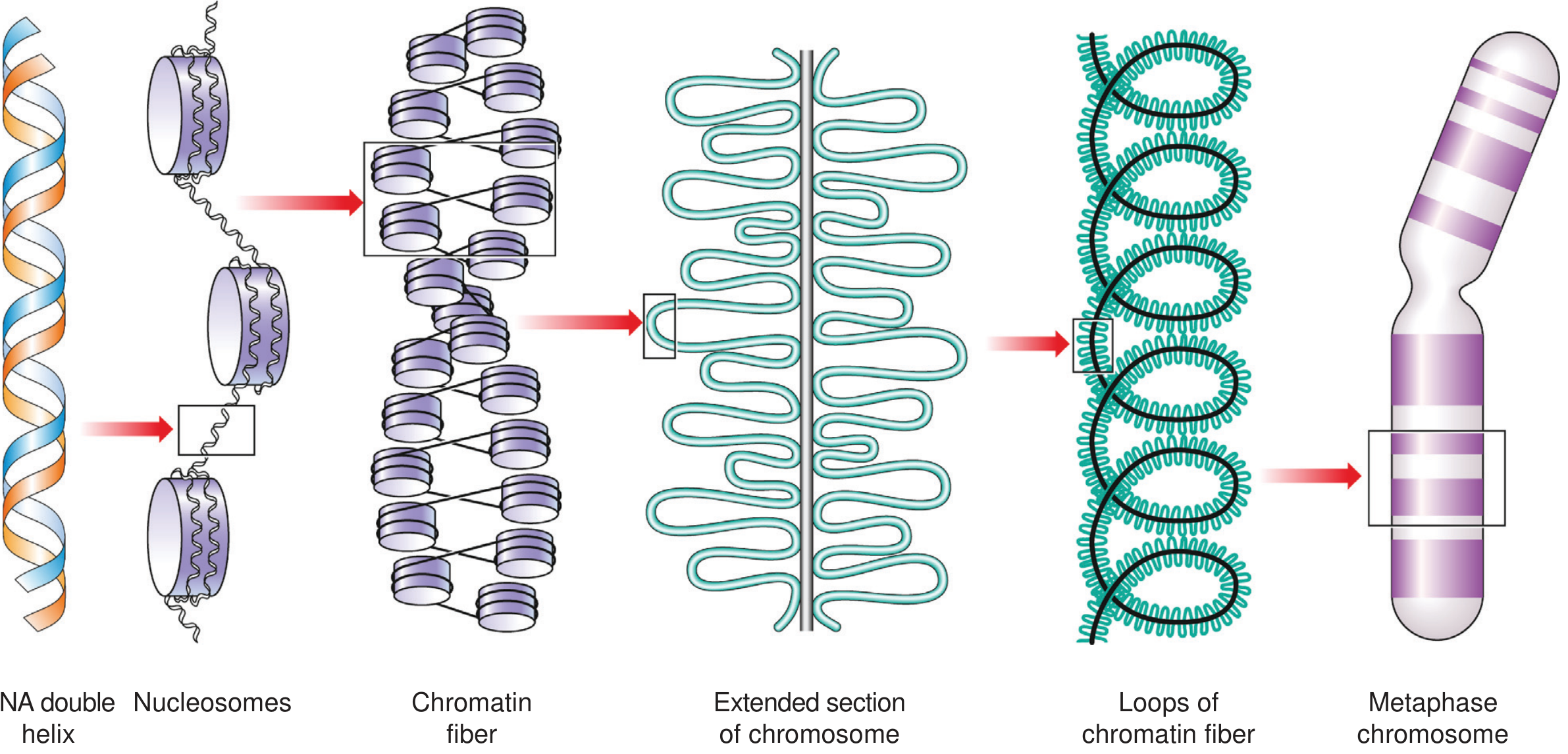
Levels of DNA packaging: DNA double helix → nucleosomes → chromatin fiber → looped domains → metaphase chromosome
| Level | Description |
|---|---|
| Primary | DNA double helix |
| Secondary | DNA wraps around histone proteins forming nucleosomes ("beads on a string") |
| Tertiary | Nucleosomes coil into chromatin fibers (30 nm fiber) |
| Quaternary | Chromatin loops anchor to a non-histone protein scaffold, then coil further into the visible metaphase chromosome |
Key Structural Landmarks
- Centromere - constricted region; where spindle fibers attach during cell division; divides chromosome into short arm (p) and long arm (q)
- Telomeres - protective caps at both ends; consist of repetitive DNA sequences; shorten with each division
- Chromatids - after DNA replication, each chromosome consists of two identical sister chromatids joined at the centromere
3. The Human Genome Content
- ~21,000 protein-coding genes in the nuclear genome
- 60-70% of the genome is single- or low-copy DNA; 30-40% is repetitive (satellite DNA, interspersed sequences - not transcribed)
- Gene density varies greatly: chromosomes 19 and 22 are gene-rich; chromosomes 4 and 18 are gene-poor
- The largest known human gene is TTN (titin), with 363 exons
4. Chromosome Identification: Karyotyping & Banding
Chromosomes are analyzed in a karyotype - an arrangement of all chromosome pairs from a dividing cell. The standard technique is G (Giemsa) banding:
- Cells (usually white blood cells) are cultured and arrested in mitosis
- Chromosomes are spread on a slide
- Treatment with trypsin denatures chromosome proteins
- Giemsa stain produces a characteristic pattern of light and dark bands unique to each chromosome
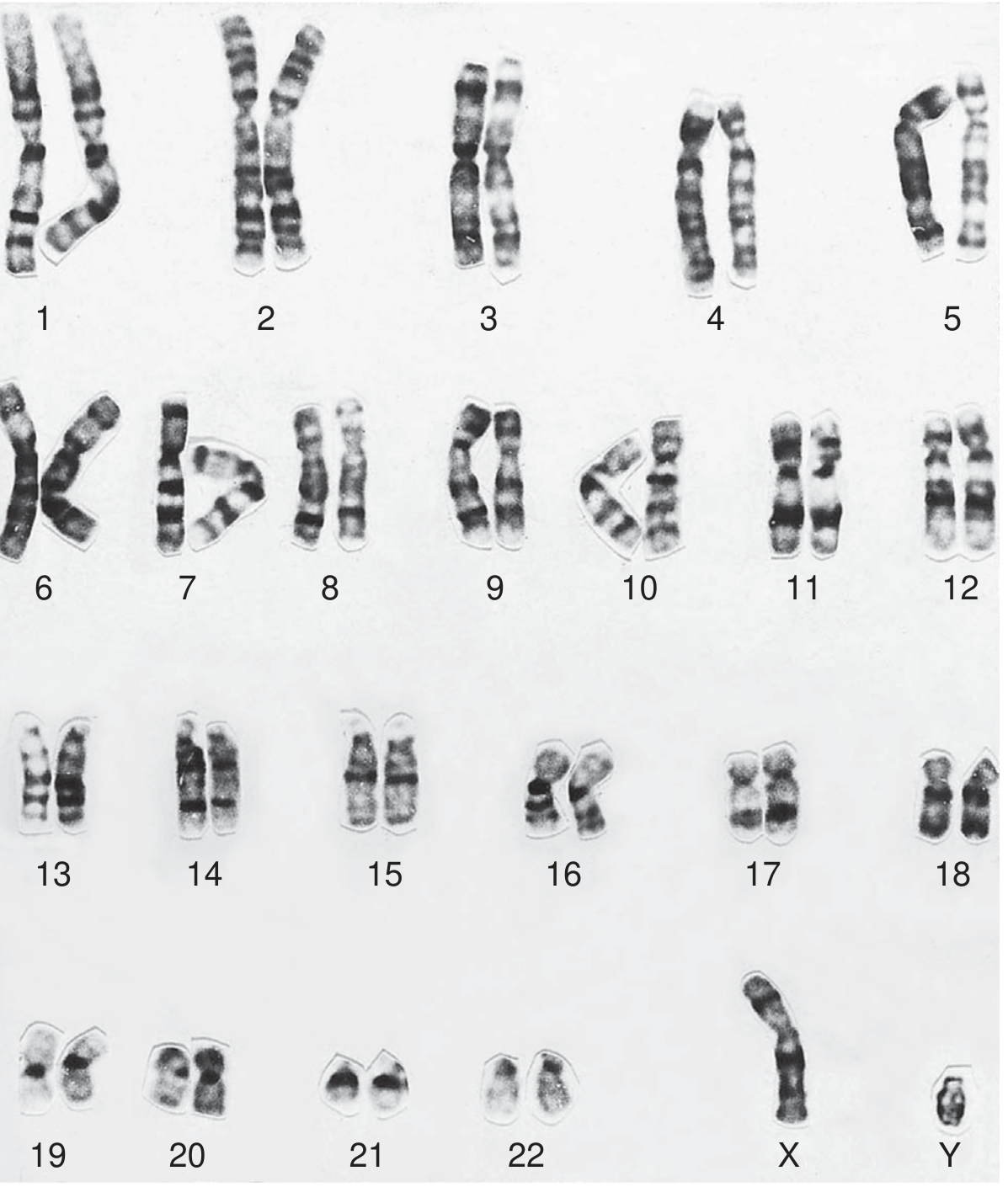
A normal G-banded male karyotype (46,XY)
G-banding gives approximately 400-500 bands per haploid set, each band representing ~6,000-8,000 kb of DNA. The banding pattern of each chromosome is specific and reproducible, displayed as a stylized diagram called an idiogram.
Molecular cytogenetics (FISH - Fluorescence In Situ Hybridization) extends this by using fluorescent DNA probes to detect specific sequences, enabling detection of microdeletions and microduplications too small to see under the light microscope.
5. Cell Division: Mitosis vs. Meiosis
Mitosis (somatic cells)
- Produces 2 identical diploid daughter cells (46 chromosomes each)
- After DNA replication, sister chromatids of each chromosome separate
- Purpose: growth, tissue repair, replacement of cells
Meiosis (germ cells only)
- Produces 4 haploid gametes (23 chromosomes each)
- Consists of one round of DNA replication followed by two rounds of cell division (meiosis I and II)
Meiosis I (reduction division):
- Homologous chromosomes pair up (synapsis) forming bivalents, held together by the synaptonemal complex
- Genetic recombination (crossing over) occurs at pachytene - homologous segments of DNA are exchanged between non-sister chromatids, ensuring genetic diversity
- Homologous chromosomes (not sister chromatids) separate to opposite poles - this halves the chromosome number
Meiosis II:
- Sister chromatids separate, similar to mitosis
- Result: 4 genetically unique haploid cells
6. Chromosome Abnormalities
Chromosome abnormalities fall into two main categories:
Numerical Abnormalities (Aneuploidy/Polyploidy)
| Term | Meaning |
|---|---|
| Monosomy | Loss of one chromosome (45 total) |
| Trisomy | Gain of one chromosome (47 total) |
| Polyploidy | Gain of one or more complete haploid sets (triploidy = 69, tetraploidy = 92) |
Cause: Nondisjunction - failure of chromosomes to separate properly during meiosis I or II
- Meiosis I error: gamete receives both homologs of a chromosome pair
- Meiosis II error: gamete receives two copies of one homolog
Most autosomal trisomies are of maternal origin and increase with maternal age (due to aging effects on primary oocytes, which can remain in suspended meiosis I for up to 50 years):
| Disorder | Extra Chromosome | Maternal Origin |
|---|---|---|
| Down syndrome | Trisomy 21 | ~95% |
| Edwards syndrome | Trisomy 18 | ~90% |
| Patau syndrome | Trisomy 13 | ~85% |
| Klinefelter (47,XXY) | Extra X | ~55% |
| Turner (45,X) | Missing X | 80% paternal origin |
| 47,XYY | Extra Y | 100% paternal |
Only trisomies 13, 18, and 21 are compatible with survival to term among autosomal trisomies; most others cause early miscarriage (trisomy 16 is especially common in first-trimester losses).
Monosomy for any autosome is almost always lethal before birth; monosomy X (45,X = Turner syndrome) is the exception.
Structural Abnormalities
These arise from chromosome breaks and abnormal rejoining:
| Type | Description |
|---|---|
| Translocation (reciprocal) | Segments exchanged between two non-homologous chromosomes |
| Translocation (Robertsonian) | Two acrocentric chromosomes fuse at centromeres |
| Deletion | Loss of a chromosome segment |
| Insertion | A segment inserted into a non-homologous chromosome |
| Inversion | A segment is reversed (paracentric = doesn't include centromere; pericentric = includes centromere) |
| Ring chromosome | Both ends of a chromosome fuse |
| Isochromosome | A chromosome with two identical arms (both p or both q) |
Balanced rearrangements (no net gain or loss of material) - carriers are usually normal but at risk of having unbalanced offspring who are often severely affected.
Mosaicism
When nondisjunction occurs during early mitosis of the developing zygote, the result is two or more cell populations with different chromosome constitutions in the same individual - called mosaicism. Effects are typically milder than full aneuploidy.
7. Clinical Significance
Chromosome abnormalities are a major cause of:
- Spontaneous miscarriage (~50% of first-trimester losses have a chromosomal cause)
- Congenital malformations and intellectual disability (Down, Patau, Edwards syndromes)
- Infertility and gonadal dysgenesis (Turner, Klinefelter syndromes)
- Cancer - somatic chromosome abnormalities accumulate with age and drive malignant transformation
Microdeletion syndromes (e.g., DiGeorge/22q11.2, Prader-Willi, Angelman) result from deletions too small to detect by standard karyotyping - diagnosed by FISH or microarray comparative genomic hybridization (array-CGH), which is now the first-line investigation for unexplained intellectual disability.
Sources: Emery's Elements of Medical Genetics and Genomics; Thompson & Thompson Genetics and Genomics in Medicine, 9th ed.
harrison reference
Finding Sources
Finding Sources
Reading File
Reading File
Reading File
Here is the chromosome content specifically from Harrison's Principles of Internal Medicine, 22nd Edition (2025) - Chapter 479 (Human Genetics and Genomics):
Chromosomes - Harrison's Reference (22nd Ed., 2025)
The Human Genome
Harrison's frames chromosomes in the context of genomics and precision medicine. Key figures:
- ~20,000 protein-coding genes in the human genome
- The exome (all exons) constitutes only 1.14% of the genome
- ~200,000 total transcripts, including thousands of noncoding RNAs (miRNA, lncRNA)
- Only ~1% of DNA codes for protein; the rest includes introns, regulatory elements, centromeres, telomeres, repetitive sequences, and pseudogenes
Noncoding DNA roles (Harrison's enumeration):
- Intron sequences
- Regulatory elements (promoters, enhancers, silencers, insulators)
- Non-protein-coding RNA generators
- Centromeres and telomeres
- Chromatin structure / histone modification regions
- Repetitive sequences of variable length
- Pseudogenes and regions without discernible function
Genetic Variation
- A typical genome differs from the reference human genome at 4-5 million sites
- Human-to-human DNA sequence similarity: ~99.9%
- SNPs (single nucleotide polymorphisms) - the most common variant type; >1 billion validated across populations; occur every 100-300 bases on average; account for >90% of all sequence variation
- Copy number variations (CNVs) - duplications or deletions of 1 kb to several Mb; ~5-10% of the genome can display CNVs; comparing any two individuals, ~0.4-0.8% of their genomes differ in CNVs
Mitosis
Harrison describes the cell cycle pathway:
"Prior to mitosis, cells exit the resting, or G0 state, and enter the cell cycle. After traversing a critical checkpoint in G1, cells undergo DNA synthesis (S phase), during which the DNA in each chromosome is replicated, yielding two pairs of sister chromatids (2n → 4n)."
Key checkpoints: G1 checkpoint (before S phase) and G2 checkpoint (before mitosis). At metaphase, chromosomes condense and align at the equatorial plate; sister chromatids separate at the centromere and migrate to opposite poles, restoring the diploid state.
Clinical relevance of DNA repair: Genetic defects in DNA mismatch/repair lead to rapid mutation accumulation and cancer predisposition - examples include:
- Xeroderma pigmentosum
- Bloom's syndrome
- Ataxia telangiectasia
- Hereditary nonpolyposis colon cancer (HNPCC)
Meiosis and Genetic Diversity
"Meiosis occurs only in germ cells of the gonads. It shares certain features with mitosis but involves two distinct steps of cell division that reduce the chromosome number to the haploid state. In addition, there is active recombination that generates genetic diversity."
Key points from Harrison's:
- During meiosis I: sister chromatids form (2n → 4n), then chiasmata form where DNA crosses over between maternal and paternal homologs
- Recombination occurs more frequently in female meiosis than in male meiosis
- After random segregation of 23 chromosome pairs: 2²³ > 8 million possible chromosome combinations per gamete
- Combined with recombination, "each gamete is genetically unique"
This genetic diversity forms the foundation for linkage analysis in disease gene mapping.
Clinical Genetics Scope (Harrison's Perspective)
Harrison's emphasizes the clinical breadth of chromosomal and genomic medicine:
| Category | Examples |
|---|---|
| Chromosomal/cytogenetic disorders | Trisomy 21 (Down syndrome), Monosomy X (Turner syndrome) |
| Metabolic/single-gene | PKU, familial hypercholesterolemia |
| Multifactorial / polygenic | Hypertension, diabetes, heart disease, asthma, mental illness |
| Cancer genomics | Somatic mutations; mutational profile guides targeted therapy (TCGA) |
Precision medicine aims to use a patient's genotype to:
- Optimize drug therapy and predict efficacy (pharmacogenomics)
- Predict adverse events and drug dosing
- Identify driver mutations in cancer for targeted therapy selection
- Apply genome-wide polygenic risk scores (PRS) for disease prevention
Source: Harrison's Principles of Internal Medicine, 22nd Edition (2025, McGraw Hill Medical) - Chapter 479: Human Genetics and Genomics
This is a shared conversation. Sign in to Orris to start your own chat.