
Sex determination from femur. short note’s 5 marks
Reading File
Now let me search the medical library for sex determination from femur.
Finding Sources
Finding Sources
Good - found relevant sections. Let me read the key blocks from both the Forensic Medicine textbook and the Forensic Anthropology textbook.
Reading File
Reading File
Now let me get the femur-specific section from the Forensic Medicine textbook (Essentials of Forensic Medicine):
Reading File
Finding Sources
Excellent! Let me now read the detailed femur table from PC Dikshit and Parikh's textbooks, and the full femur section from Essentials:
Reading File
Reading File
Reading File
Now let me read the full femur table from PC Dikshit and fetch the femur image:
Reading File
Loading Image
I now have all the information needed for a comprehensive short note. Let me compile the answer.
Sex Determination from Femur
The femur is one of the most reliable long bones for sex determination from skeletal remains. Sexual differences become apparent only after puberty. Sex determination from the femur alone carries about 80% accuracy (Krogman).
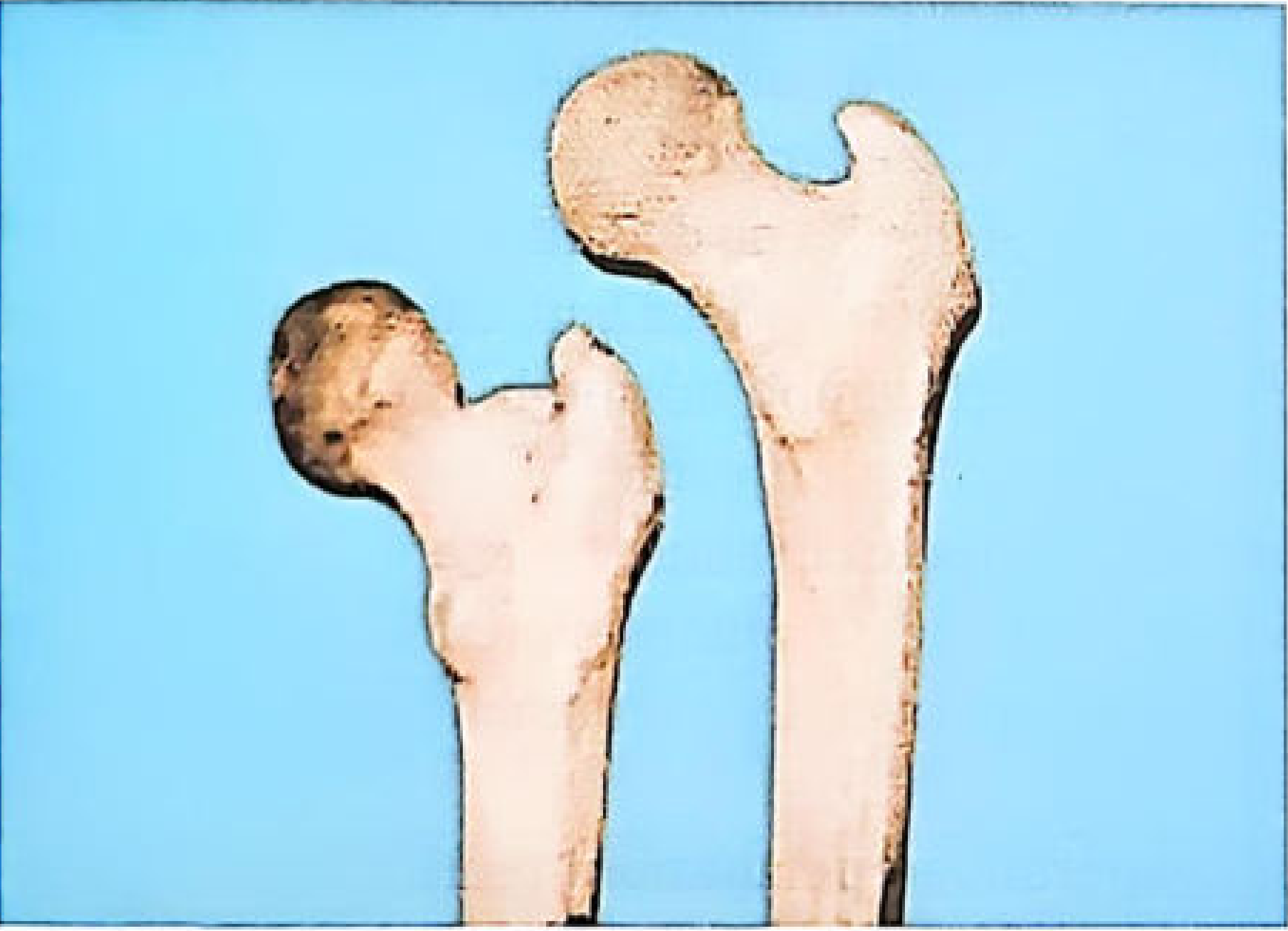
Morphological Differences
| Feature | Male Femur | Female Femur |
|---|---|---|
| Head | Larger; forms about 2/3rd of a sphere | Smaller; forms less than 2/3rd of a sphere |
| Neck angle | Obtuse angle (~125° with the shaft) | Almost a right angle with the shaft |
| General size | Larger, heavier, rougher | Smaller, slender, smoother |
| Shaft | Rougher, with prominent ridges and muscle attachments | Smoother, thinner |
| Condyles | Larger articular surfaces | Smaller articular surfaces |
Metric (Measurement-Based) Criteria
These are more objective and are preferred in forensic practice:
1. Vertical Diameter of the Femoral Head
The single most important metric for sex determination from the femur.
| Measurement | Sex |
|---|---|
| > 47 mm | Male |
| 45-47 mm | Indeterminate |
| < 45 mm | Female |
- PC Dikshit values: Male = 47-49 mm; Female = 43-45 mm
- Stewart's sectioning system: <43 mm = Female; 44-46 mm = Indeterminate; >47 mm = Male
2. Bicondylar Width (Distal End)
| Measurement | Sex |
|---|---|
| > 78 mm (or 74-89 mm range) | Almost certainly Male |
| < 74 mm (or 67-76 mm range) | Almost certainly Female |
3. Total Length
Males have longer femurs (arm and leg bones are ~8% longer in males), but length alone has >10% overlap and cannot be used as a sole determinant.
4. Trochanteric Oblique Length
- Male: ~390 mm
- Female: ~450 mm (female pelvis is wider, altering this measurement)
Accuracy of Sex Determination
According to Krogman's accuracy estimates:
| Method | Accuracy |
|---|---|
| Entire skeleton | 100% |
| Pelvis alone | 95% |
| Long bones (including femur) | ~80% |
| Long bones without pelvis/skull | ~50-60% |
Key Points to Remember
- Sexual differences in the skeleton appear only after puberty - cannot sex pre-pubertal bones reliably.
- The femur is not used alone - it is assessed with the pelvis, skull, and other bones for better accuracy.
- The vertical diameter of the femoral head is the single most useful metric parameter.
- There is always a zone of overlap (indeterminate range), especially in the 44-46 mm range for femoral head diameter.
- Discriminant function analysis using multiple femoral measurements (introduced by Fischer in the 1940s) greatly improves accuracy over single-variable methods.
- Racial variation must be considered - reference values may differ across populations.
Sources: The Essentials of Forensic Medicine and Toxicology (36th ed., 2026); PC Dikshit Textbook of Forensic Medicine and Toxicology; Parikh's Textbook of Medical Jurisprudence; Forensic Anthropology: A Comprehensive Introduction (2nd ed.)
This is a shared conversation. Sign in to Orris to start your own chat.