
Content of femoral sheath
Reading File
The femoral sheath is a funnel-shaped fascial tunnel in the upper thigh containing the femoral vessels and lymphatics (but NOT the femoral nerve). It has 3 compartments: lateral (femoral artery), middle (femoral vein), and medial (femoral canal with lymphatics).
Searching sources...
Finding Sources
Finding Sources
Reading File
Reading File
Loading Image
Content of the Femoral Sheath
The femoral sheath is a funnel-shaped (cone-shaped) sleeve of fascia that surrounds the femoral vessels as they pass beneath the inguinal ligament into the thigh. It is formed by an extension of the transversalis fascia (anterior wall) and the iliac fascia (posterior wall) from the abdomen.
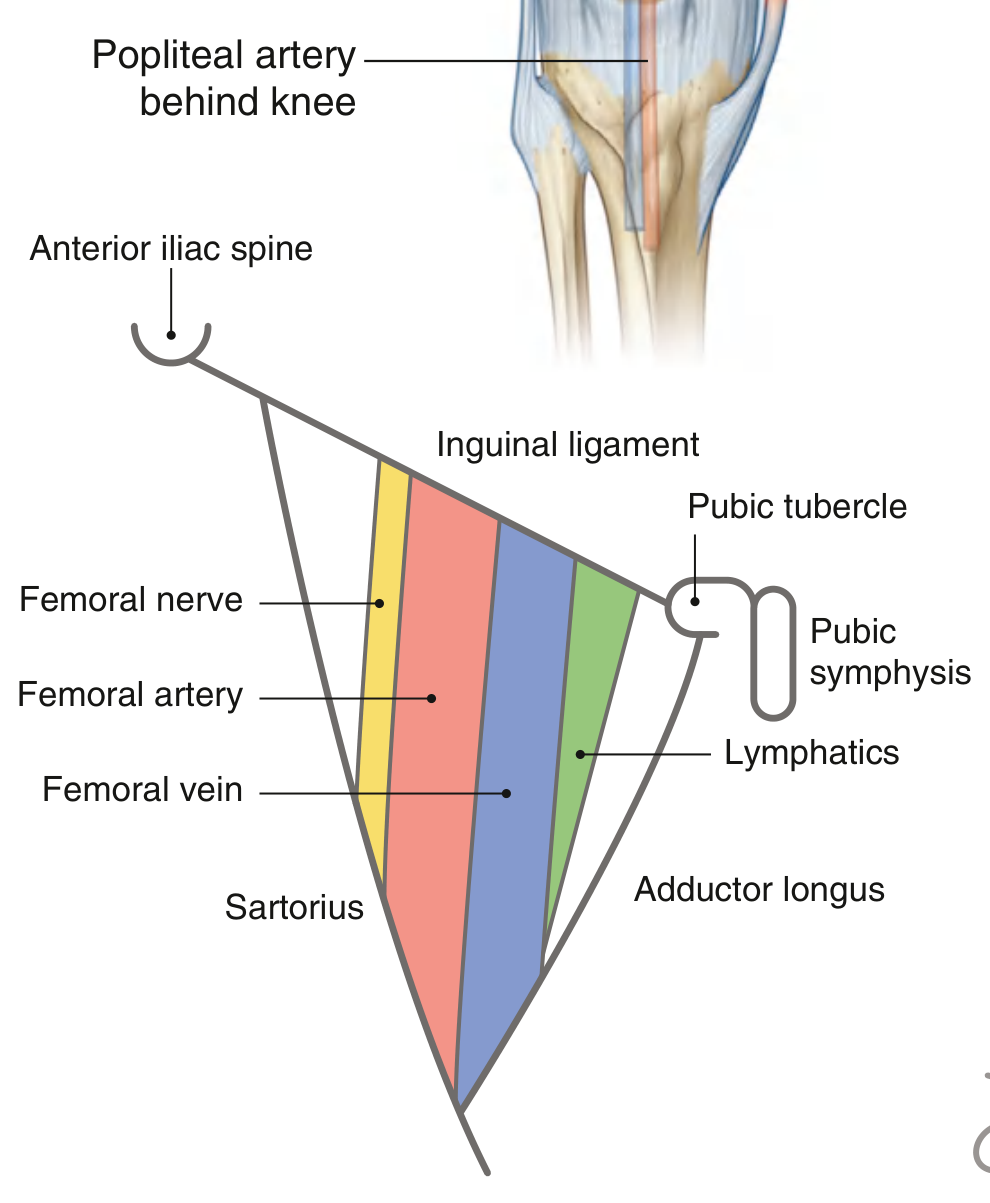
Three Compartments (lateral to medial)
| Compartment | Contents |
|---|---|
| Lateral | Femoral artery |
| Middle | Femoral vein |
| Medial (Femoral canal) | Lymphatic vessels + areolar connective tissue; Cloquet's node at its upper end (femoral ring) |
The compartments are separated from each other by thin vertical septa of the fascia.
What is NOT in the femoral sheath
- Femoral nerve - it lies lateral to the sheath, outside it, within the muscular lacuna (lacuna musculorum) separated by the iliopectineal arch
- The iliopsoas muscle and lateral femoral cutaneous nerve are also outside, in the lacuna musculorum
Key Anatomical Points
Formation:
- The iliopectineal arch divides the space beneath the inguinal ligament into:
- Lacuna vasorum (medial) - contains the femoral sheath and its contents
- Lacuna musculorum (lateral) - contains iliopsoas, femoral nerve, and lateral femoral cutaneous nerve
- The femoral branch of the genitofemoral nerve passes within the lateral part of the vascular lacuna and may enter the lateral compartment of the femoral sheath
The Femoral Canal (medial compartment):
- Cone-shaped, normally contains only loose connective tissue, fat, and lymphatics
- Its proximal opening = femoral ring, bounded by:
- Anteriorly: inguinal ligament
- Posteriorly: iliopubic tract / pectineal ligament (Cooper's ligament)
- Medially: lacunar ligament (Gimbernat's ligament)
- Laterally: femoral vein
- The femoral ring is sealed by the septum crurale (a plug of extraperitoneal fat)
- Cloquet's node (also called Rosenmüller's node) sits at the femoral ring
- The canal allows the femoral vein to expand during increased venous return
Clinical relevance:
- The femoral canal is the site of femoral hernias - abdominal contents can protrude through the femoral ring down the femoral canal, appearing as a swelling below and lateral to the pubic tubercle
- Femoral hernias are more common in women (due to wider pelvis and thus wider femoral ring)
- The rigid boundaries of the femoral ring (especially the sharp lacunar ligament medially) make femoral hernias prone to strangulation
Inferior extent:
- The sheath merges with the adventitia of the vessels approximately 4 cm below the inguinal ligament
Sources: Gray's Anatomy for Students; Mulholland and Greenfield's Surgery, Scientific Principles and Practice - 7e
Only content
Contents of the Femoral Sheath
The femoral sheath has 3 compartments (lateral to medial):
| Compartment | Content |
|---|---|
| Lateral | Femoral artery |
| Middle | Femoral vein |
| Medial (Femoral canal) | Lymphatics + areolar tissue (Cloquet's node at femoral ring) |
Femoral nerve is NOT inside the sheath - it lies lateral to it, outside the sheath.
This is a shared conversation. Sign in to Orris to start your own chat.