
Hey
Are you only usable for medical related content or do you work for fun too ?
- General knowledge - history, science, geography, culture
- Math & logic - calculations, puzzles, problem solving
- Writing - essays, stories, emails, proofreading
- Coding - writing, debugging, explaining code in any language
- Research - summarizing topics, finding information, literature reviews
- Creative stuff - brainstorming ideas, worldbuilding, jokes
- Files & documents - creating Word docs, spreadsheets, PDFs, PowerPoint slides
- Images - generating visuals, analyzing photos
- Medical & clinical - yes, that too, with access to medical textbooks and research
University of Texas classification for Diabetic foot ulcer Give me an image
University of Texas classification diabetic foot ulcer table
A clear medical classification table showing the University of Texas (UT) Classification System for Diabetic Foot Ulcers. The table has 5 columns: Stage (A, B, C, D) and 4 Grade columns (Grade 0, Grade I, Grade II, Grade III). Grade 0: Pre/post-ulcerative lesion, completely epithelialized. Grade I: Superficial ulcer, not involving tendon, capsule, or bone. Grade II: Ulcer penetrating to tendon or capsule. Grade III: Ulcer penetrating to bone or joint. Stage A: No infection, no ischemia. Stage B: With infection. Stage C: With ischemia. Stage D: With infection AND ischemia. Clean white background, professional medical style, color-coded rows with light blue for Stage A, light yellow for Stage B, light orange for Stage C, light red for Stage D.
429 RESOURCE_EXHAUSTED. {'error': {'code': 429, 'message': 'Resource exhausted. Please try again later. Please refer to https://cloud.google.com/vertex-ai/generative-ai/docs/error-code-429 for more details.', 'status': 'RESOURCE_EXHAUSTED'}}
We encountered an error while processing your request. Please try again or reach out to us for help.
Try again
A clear medical classification table titled "University of Texas (UT) Classification System for Diabetic Foot Ulcers". The table has 5 columns: Stage and 4 Grade columns (Grade 0, Grade I, Grade II, Grade III). Rows are the 4 stages A B C D. Grade 0: Pre or post-ulcerative lesion, completely epithelialized. Grade I: Superficial ulcer, not involving tendon, capsule, or bone. Grade II: Ulcer penetrating to tendon or capsule. Grade III: Ulcer penetrating to bone or joint. Stage A: No infection, no ischemia. Stage B: With infection. Stage C: With ischemia. Stage D: With infection AND ischemia. Clean white background, professional medical diagram style, color-coded rows with light blue for Stage A, light yellow for Stage B, light orange for Stage C, light red for Stage D. Each cell shows the wound description clearly.
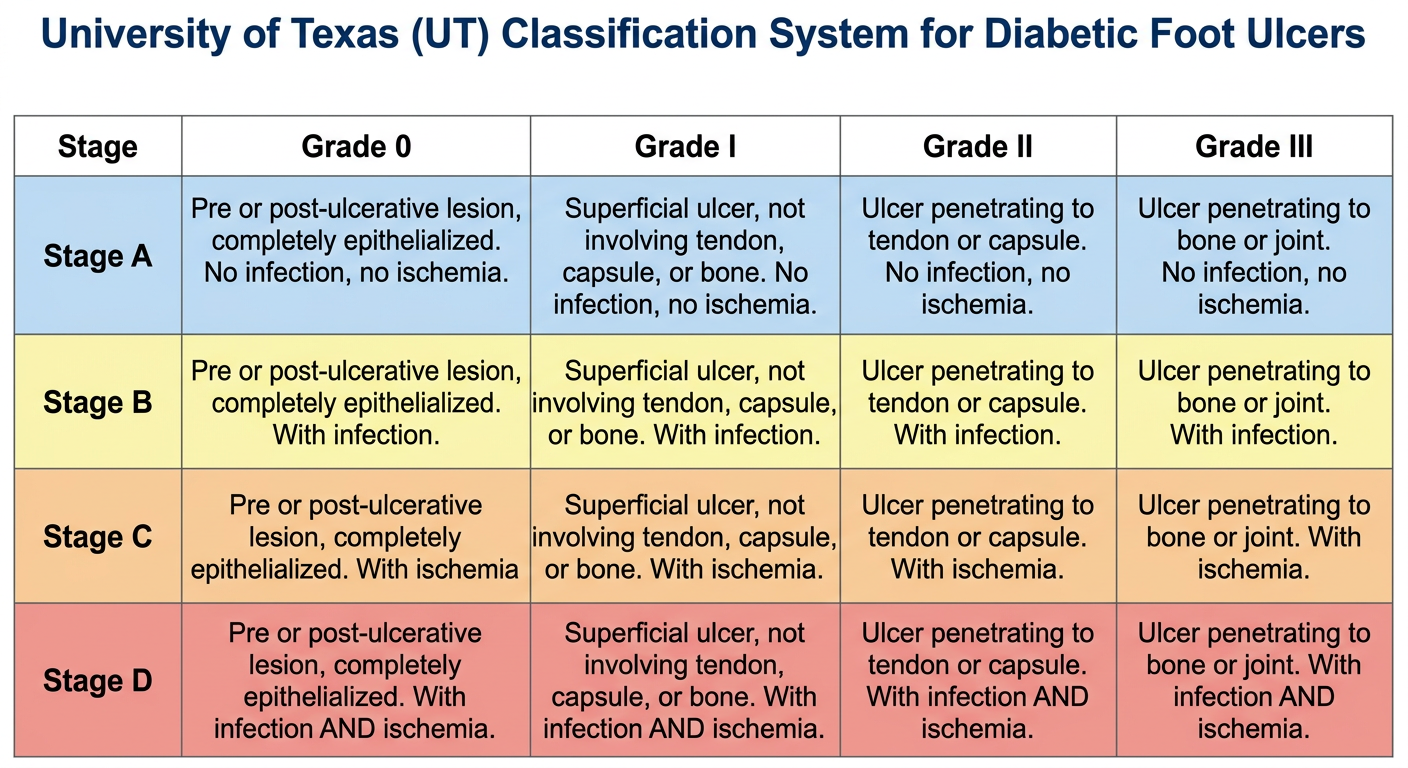
- Grades (0-III) = wound depth, going from a pre/post-ulcerative lesion all the way down to bone/joint involvement
- Stages (A-D) = complicating factors:
- A - Clean wound (no infection, no ischemia) - best prognosis
- B - Infected
- C - Ischemic
- D - Both infected AND ischemic - worst prognosis