
Insulin unit distribution in diabetes.
Reading File
Insulin unit distribution in diabetes refers to how insulin doses are divided and timed across the day - typically with basal insulin covering background needs (~40-50% of total daily dose) and bolus/prandial insulin covering meals (~50-60%), with correction doses added as needed.
Searching sources...
Finding Sources
Finding Sources
Finding Sources
Finding Sources
Good hits. Let me read the most authoritative sections in parallel.
Reading File
Reading File
Reading File
Reading File
Reading File
Finding Sources
Reading File
Reading File
Loading Image
I now have excellent material from multiple authoritative textbooks plus the insulin regimen diagram. Here is the full answer:
Insulin Unit Distribution in Diabetes
1. Total Daily Dose (TDD) - Starting Point
The TDD is the foundation for all insulin distribution calculations.
| Patient Type | TDD (units/kg/day) |
|---|---|
| Average non-obese adult (Type 1) | 0.4 - 0.7 units/kg/day |
| Obese, Type 2, or pubertal adolescents | 1 - 2 units/kg/day (due to insulin resistance) |
| Conservative starting estimate | 0.4 units/kg/day |
| Practical clinical formula | Weight (kg) × 0.7 |
Example: A 70-kg patient → TDD = 70 × 0.7 = 49 units/day
- Goodman & Gilman's Pharmacological Basis of Therapeutics, p. 1052
- Textbook of Family Medicine 9e, p. 989
2. Basal : Bolus Split
The TDD is divided between basal (background) and bolus (prandial) insulin:
| Component | Proportion of TDD | Purpose |
|---|---|---|
| Basal insulin | 40% - 50% | Suppresses hepatic glucose output; maintains fasting glucose |
| Bolus/Prandial insulin | 50% - 60% | Covers postprandial glucose excursions |
"The basal dose is usually 40% to 50% of the total daily dose, with the remainder as prandial or premeal insulin." - Goodman & Gilman's
Some individuals may need a 40/60 split favoring bolus insulin, depending on carbohydrate intake pattern. - Textbook of Family Medicine 9e
Using the 49-unit TDD example:
- Basal (glargine/detemir/degludec): ~25 units once daily
- Total bolus: ~24 units → divided as ~8 units per meal (3 meals)
3. Prandial (Bolus) Dose Per Meal
Each meal receives an equal share of the bolus component, with adjustments for meal size:
Baseline formula:
Prandial insulin = 0.1 units/kg/meal
For a 70-kg patient: 0.1 × 70 = 7 units/meal
Meal size adjustments (Textbook of Family Medicine 9e):
| Meal Size | Dose Adjustment |
|---|---|
| Standard meal | No change |
| Large meal without dessert | +1 to 2 units |
| Very large meal with dessert | +3 units |
| Smaller than usual meal | -1 to 2 units |
Inject rapid-acting insulin 15 minutes before the meal (unless pre-meal glucose <80 mg/dL - then inject at meal onset).
4. Insulin-to-Carbohydrate Ratio (ICR)
Used for carbohydrate-counting patients, especially Type 1:
| Insulin Type | ICR Formula | Notes |
|---|---|---|
| Rapid-acting analogue (lispro, aspart) | 500 ÷ TDD | 1 unit covers X grams of carbohydrate |
| Regular insulin | 450 ÷ TDD | Slightly more carb per unit |
Example (TDD = 18 units in a child):
- Rapid-acting: 500 ÷ 18 = 1 unit per 28 g carbohydrate
- Regular: 450 ÷ 18 = 1 unit per 25 g carbohydrate
A common ratio for Type 1 adults is 1 unit per 10-15 g carbohydrate (Harrison's Principles, 22e).
- The Harriet Lane Handbook (23rd ed.), Table 10.2
5. Correction (Sensitivity) Factor
Used to correct pre-meal hyperglycemia:
| Insulin Type | Formula | Result |
|---|---|---|
| Rapid-acting analogue | 1800 ÷ TDD | Drop in BG (mg/dL) per unit |
| Regular insulin | 1500 ÷ TDD | Drop in BG (mg/dL) per unit |
Example (TDD = 18 units):
- Rapid-acting: 1800 ÷ 18 = 1 unit drops BG by 100 mg/dL
- Regular: 1500 ÷ 18 = 1 unit drops BG by ~83 mg/dL
When to correct: Pre-meal glucose >180 mg/dL. Target post-correction glucose: 150 mg/dL (a conservative target to avoid overshooting into hypoglycemia).
6. Classical "Rule of Two-Thirds" Regimen (Type 1, MDI with NPH/Regular)
For the older twice-daily NPH + Regular regimen:
| Timing | Fraction of TDD | Insulin Mix |
|---|---|---|
| Morning (2/3 of TDD) | 2/3 total → split 2:1 Regular:NPH | 2 parts Regular, 1 part NPH |
| Evening (1/3 of TDD) | 1/3 total → split 2:1 Regular:NPH | 2 parts Regular, 1 part NPH |
Initial TDD starting point: 15-20 units for this regimen. - Swanson's Family Medicine Review
7. Insulin Regimen Diagrams
The figure below (from Goodman & Gilman's) illustrates three major regimens and a continuous glucose monitoring (CGM) time-in-range profile:
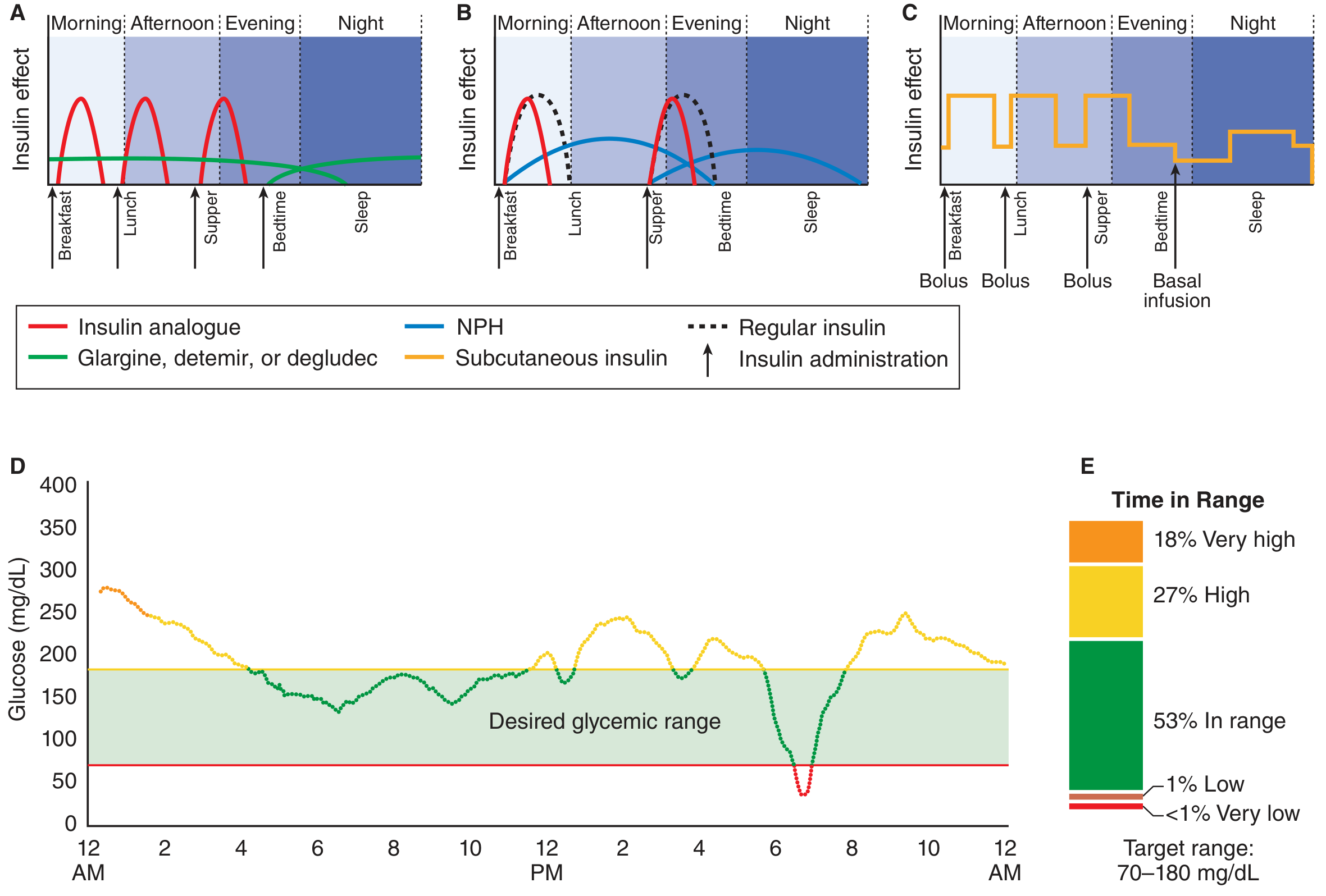
- Panel A: Basal-bolus (once-daily glargine/detemir/degludec + rapid-acting analogue at each meal) - the modern gold standard
- Panel B: Twice-daily NPH + Regular (less intensive, more hypoglycemia risk overnight)
- Panel C: Insulin pump (CSII) - programmable variable basal rates with boluses at meals
- Panel D + E: CGM glucose trace and time-in-range breakdown (target: 70-180 mg/dL)
8. Pediatric Dosing Summary (Harriet Lane, Table 10.2)
| Component | Formula | Example (24-kg child) |
|---|---|---|
| TDD | 0.5-1 unit/kg/day | 0.75 × 24 = 18 units/day |
| Basal (Glargine) | ½ TDD once daily | 9 units/day |
| Basal (Detemir) | ½ TDD divided BID | 4.5 units BID |
| ICR (rapid-acting) | 500 ÷ TDD | 1 unit : 28 g carb |
| ICR (Regular) | 450 ÷ TDD | 1 unit : 25 g carb |
| Correction (rapid-acting) | 1800 ÷ TDD | 1 unit drops BG by 100 mg/dL |
| Correction (Regular) | 1500 ÷ TDD | 1 unit drops BG by 83 mg/dL |
Summary Table
| Component | % of TDD | Formula |
|---|---|---|
| Basal | 40-50% | Long-acting insulin once daily |
| Bolus total | 50-60% | Divided equally across meals |
| Per meal bolus | ~16-20% each (3 meals) | 0.1 units/kg/meal baseline |
| Correction | Variable | 1800/TDD (rapid) or 1500/TDD (Regular) |
| ICR | - | 500/TDD (rapid) or 450/TDD (Regular) |
Insulin doses must always be individualized based on self-monitoring of blood glucose (SMBG) or CGM, titrated upward by 1-2 units at a time until targets are reached. The key target: fasting BG 90-130 mg/dL, 2-hour postprandial BG <180 mg/dL, HbA1c <7%.
Carbohydrate counting according to this
Carbohydrate counting in diabetes uses the Insulin-to-Carbohydrate Ratio (ICR) established from the previous insulin unit distribution framework to calculate meal doses precisely.
Searching sources...
Finding Sources
Finding Sources
Reading File
Reading File
Reading File
Finding Sources
Finding Sources
Finding Sources
Reading File
Reading File
Excellent - I now have rich content from multiple authoritative sources. Here is the full, integrated answer:
Carbohydrate Counting in Diabetes - Integrated with Insulin Unit Distribution
Carbohydrate counting is the method of calculating the prandial (bolus) insulin dose based on the carbohydrate content of each meal. It directly applies the ICR and correction factor formulas established from the TDD framework covered previously.
Step 1 - Recall Your TDD and ICR
From the previous unit distribution framework:
| Formula | Rapid-Acting Analogue | Regular Insulin |
|---|---|---|
| ICR (Insulin-to-Carb Ratio) | 500 ÷ TDD | 450 ÷ TDD |
| Correction Factor | 1800 ÷ TDD | 1500 ÷ TDD |
Example (TDD = 50 units):
- ICR (rapid-acting) = 500 ÷ 50 = 1 unit per 10 g carbohydrate
- Correction factor = 1800 ÷ 50 = 1 unit drops BG by 36 mg/dL
A common real-world ICR for Type 1 adults: 1 unit per 10-15 g of carbohydrate (must be individualized). - Harrison's Principles of Internal Medicine 22e
Step 2 - Count Grams of Carbohydrate in the Meal
The patient identifies and totals the carbohydrate content of everything they plan to eat:
- Read nutrition labels (total carbohydrate per serving)
- Use food databases or dietitian-provided exchange lists
- Account for all sources: bread, rice, fruit, milk, starchy vegetables, sweets
Example meal:
| Food | Carbohydrate |
|---|---|
| 2 slices of bread | 30 g |
| 1 medium apple | 25 g |
| 1 cup milk | 12 g |
| Total | 67 g |
Step 3 - Calculate the Meal Insulin Dose
Formula:
Meal Dose = Total Carbohydrate (g) ÷ ICR
Using the above example (ICR = 1:10):
67 g ÷ 10 = ~7 units of rapid-acting insulin
If ICR = 1:15:
67 g ÷ 15 = ~4.5 units (round to 4 or 5)
Note: The ICR can vary by time of day - many patients need a lower ratio (more insulin per gram) at breakfast due to the dawn phenomenon. - Goldman-Cecil Medicine
Step 4 - Add the Correction Dose for Pre-Meal Hyperglycemia
If the pre-meal blood glucose is above target, add a correction on top of the carb-based dose:
Formula:
Correction Dose = (Current BG - Target BG) ÷ Correction Factor
| Target | Typical value |
|---|---|
| Pre-meal BG target | ~100 mg/dL (fasting) or 80-130 mg/dL |
| Correction threshold | Only correct if BG >180 mg/dL |
| Post-correction target | 150 mg/dL (conservative - avoids hypoglycemia overshoot) |
Example:
- Pre-meal BG = 220 mg/dL; target = 100 mg/dL; correction factor = 50 mg/dL per unit
- Correction = (220 - 100) ÷ 50 = 2.4 units → round to 2 units
Total dose = Meal dose + Correction dose = 7 + 2 = 9 units
- Textbook of Family Medicine 9e, p. 989
Step 5 - Complete Preprandial Dose Formula
Total Preprandial Dose = (Carbs ÷ ICR) + [(Pre-meal BG - Target BG) ÷ Correction Factor]
Harrison's 22e states the supplemental correction formula as:
"1 unit for every 30-60 mg/dL above the preprandial glucose target" - or estimated as 1500 ÷ TDD for regular insulin.
ICR Varies with Context
The ratio is NOT fixed - it must be adjusted for:
| Situation | Effect on ICR | Action |
|---|---|---|
| Dawn phenomenon (breakfast) | More insulin needed | Lower ICR (e.g., 1:8 instead of 1:12) |
| Physical activity after meal | Less insulin needed | Higher ICR (reduce dose) |
| Illness / stress / steroids | More insulin needed | Lower ICR |
| Pregnancy - 1st trimester | ~1 unit : 12 g carb | Typical |
| Pregnancy - 2nd trimester | ~1 unit : 10-6 g carb | Increasing resistance |
| Pregnancy - 3rd trimester | ~1 unit : 6-2 g carb | Marked resistance |
- Creasy & Resnik's Maternal-Fetal Medicine
Carbohydrate Counting Approach - Two Levels
Basic Level (Fixed-dose adjustment)
- Patient eats a consistent amount of carbohydrate at each meal
- Uses a fixed prandial dose adjusted for meal size (±1-3 units as shown in the previous session's table)
- Suitable for Type 2 or patients new to insulin
Advanced Level (Full carb counting + ICR)
- Patient counts exact grams of carbohydrate per meal
- Calculates dose using ICR formula
- Adds correction dose for BG excursions
- Requires education on nutrition labels, food databases, and SMBG/CGM
- Preferred for Type 1 DM and insulin pump (CSII) users
"Carbohydrate counting is a useful skill for patients on intensified insulin therapy who adjust insulin doses based on the carbohydrate content of meals and snacks." - Washington Manual of Medical Therapeutics
"This approach requires substantial education, including how to read and understand nutritional information on food packaging, experience, and health literacy." - Goldman-Cecil Medicine
Practical Worked Example (Tying It All Together)
Patient: 70 kg, Type 1 DM, TDD = 49 units
| Parameter | Calculation | Value |
|---|---|---|
| ICR (rapid-acting) | 500 ÷ 49 | ~1 unit : 10 g carb |
| Correction factor | 1800 ÷ 49 | ~1 unit : 37 mg/dL |
| Meal carbs (lunch) | Measured | 75 g |
| Meal insulin | 75 ÷ 10 | 7.5 → 8 units |
| Pre-meal BG | Measured | 190 mg/dL |
| Target BG | 100 mg/dL | |
| Correction | (190-100) ÷ 37 | 2.4 → 2 units |
| Total dose | 8 + 2 | 10 units lispro/aspart |
Inject 15 minutes before the meal (or at meal onset if pre-meal BG <80 mg/dL).
Key Quality Checks After Dosing
- Check BG 2 hours post-meal - target: <180 mg/dL, and rise from baseline ≤50 mg/dL
- If 2-hr post-meal BG is consistently >50 mg/dL above pre-meal: increase dose by 1-2 units
- If BG drops (negative delta from baseline): reduce dose by 1-2 units - risk of hypoglycemia
Provide me book or resources to study
Based on our discussion (insulin unit distribution + carbohydrate counting in diabetes), here are the exact textbooks from the medical library that were directly cited in the answers above, plus their best use cases:
📚 Primary Sources Used in This Session
1. Goodman & Gilman's - The Pharmacological Basis of Therapeutics
- Best for: Insulin pharmacology, drug mechanisms, dosing regimens, adverse effects, insulin types and absorption
- What we used: Basal:bolus split (40-50%/50-60%), insulin regimen diagrams (Figure 51-8), TDD formulas, factors affecting absorption
- Audience: Pharmacology students, medical students, clinicians
2. Harrison's Principles of Internal Medicine, 22nd Edition (2025)
- Best for: Comprehensive Type 1 and Type 2 DM management, MDI regimens, ICR in clinical practice, insulin preparations
- What we used: ICR (1 unit/10-15 g carb for Type 1), correction formula (1500/TDD), basal 30-50% of TDD
- Audience: Medical students (especially clinical years), residents, internists
3. Textbook of Family Medicine, 9th Edition
- Best for: Step-by-step basal-bolus initiation, prandial dose titration, structured SMBG, correction dosing protocol
- What we used: The 5-step insulin initiation protocol, meal size adjustment table, correction dose threshold (BG >180), ISF formula
- Audience: Family medicine residents, GPs, primary care practitioners
4. Goldman-Cecil Medicine (International Edition)
- Best for: Type 1 DM dietary planning, carbohydrate counting rationale, meal-to-meal consistency vs. flexible dosing
- What we used: ICR concept, time-of-day variation, nutrition label reading requirement
- Audience: Internal medicine students and residents
5. Washington Manual of Medical Therapeutics
- Best for: Quick clinical reference for TDD calculation, carbohydrate counting definition, hospitalized diabetes management
- What we used: TDD = 0.5-0.8 units/kg/day, conservative starting TDD of 0.4 units/kg, carb counting for intensified therapy
- Audience: Medical students on wards, interns, residents needing rapid reference
6. The Harriet Lane Handbook, 23rd Edition (Johns Hopkins)
- Best for: Pediatric insulin dosing - TDD, ICR, and correction factor tables in one place
- What we used: Table 10.2 - full pediatric subcutaneous insulin dosing formula set (500 rule, 1800 rule)
- Audience: Pediatrics students and residents
7. Swanson's Family Medicine Review
- Best for: Board-style review of Type 1 DM insulin regimens, rule of two-thirds, exam preparation
- What we used: Classical 2/3 morning + 1/3 evening NPH/Regular regimen, total initial dose 15-20 units
- Audience: USMLE/board exam candidates, family medicine board review
8. Creasy & Resnik's Maternal-Fetal Medicine
- Best for: Carbohydrate counting and insulin corrections specifically in pregnancy - how ICR changes trimester by trimester
- What we used: ICR progression (1:15 → 1:12 → 1:10 → 1:6 → 1:2 across trimesters), correction caps in pregnancy
- Audience: OB/GYN residents, maternal-fetal medicine fellows, midwives
Suggested Study Order
| Goal | Start With |
|---|---|
| Understand insulin pharmacology first | Goodman & Gilman's |
| Clinical management + MDI protocols | Harrison's → Textbook of Family Medicine |
| Quick ward/bedside reference | Washington Manual |
| Pediatric dosing | Harriet Lane Handbook |
| Exam/board prep | Swanson's Family Medicine Review |
| Obstetric diabetes | Creasy & Resnik's |
All of these books are available in the medical library integrated into this assistant - you can ask about any topic from them directly and get cited, page-referenced answers.
This is a shared conversation. Sign in to Orris to start your own chat.