
Body fluids components and it's function
Reading File
Now let me search the medical library for body fluids content.
Finding Sources
Finding Sources
Reading File
Reading File
Reading File
Finding Sources
Reading File
Reading File
Finding Sources
Loading Image
Loading Image
Finding Sources
I now have comprehensive information from the textbooks to provide a thorough answer. Let me compile everything.
Body Fluids: Components and Functions
Overview
Water is the medium of the body's internal environment. In an average young adult male, water accounts for 60% of total body weight (50% in females, ~80% in newborns). The percentage varies inversely with body fat content.
The well-known 60-40-20 rule:
- 60% of body weight = Total Body Water (TBW)
- 40% of body weight = Intracellular Fluid (ICF)
- 20% of body weight = Extracellular Fluid (ECF)
Fluid Compartments
TBW is divided into two major compartments, with a small third:
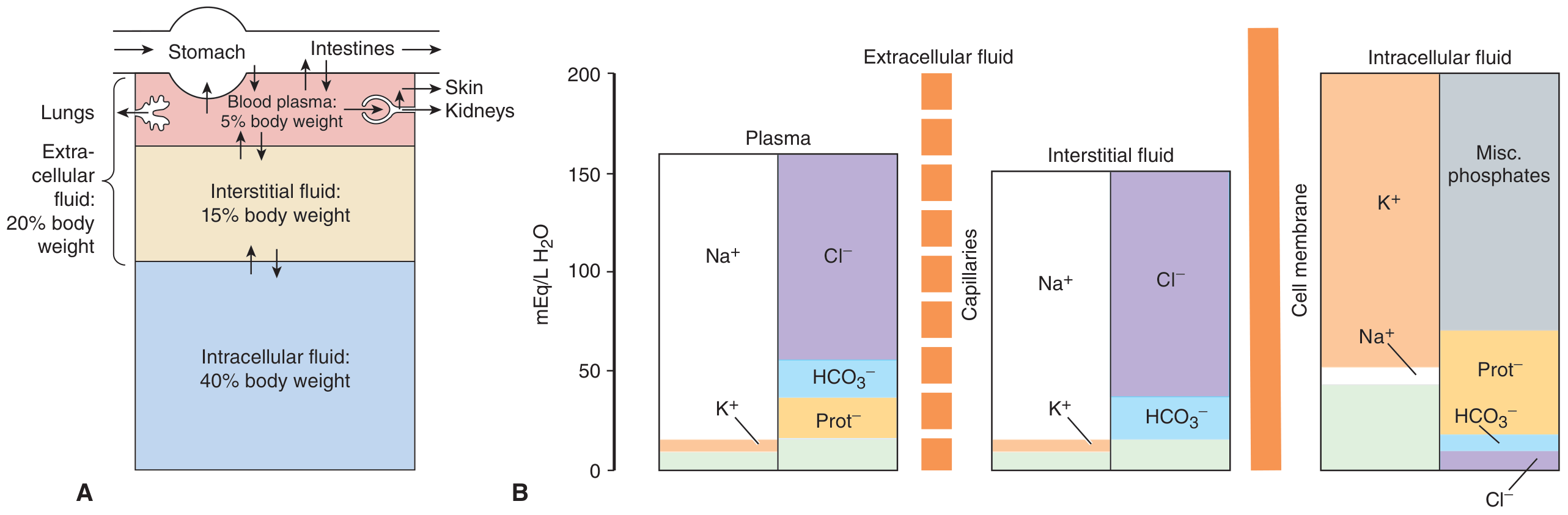
1. Intracellular Fluid (ICF)
- Volume: ~28 L (~40% of body weight) in a 70-kg person
- Located inside the trillions of cells; collectively treated as one large compartment due to remarkably similar composition across cell types
- Principal cations: K⁺ (140 mOsm/L), Mg²⁺ (20 mOsm/L)
- Principal anions: Phosphate/HPO₄²⁻, proteins, sulfate
- Low Na⁺ (14 mOsm/L), very low Ca²⁺ (0.0001 mOsm/L)
Functions of ICF:
- Site of cellular metabolism (energy production, protein synthesis)
- Contains enzymes, organelles, genetic material
- Maintains electrical potential difference across cell membranes (essential for nerve and muscle function)
- Intracellular K⁺ is critical for resting membrane potential
2. Extracellular Fluid (ECF)
- Volume: ~14 L (~20% of body weight)
- Divided into two major sub-compartments:
| Sub-compartment | Volume | % of Body Weight |
|---|---|---|
| Interstitial fluid | ~11 L (3/4 of ECF) | 15% |
| Plasma | ~3 L (1/4 of ECF) | 5% |
- Principal cation: Na⁺ (142 mOsm/L in plasma)
- Principal anions: Cl⁻ (106 mOsm/L), HCO₃⁻ (24 mOsm/L)
- Plasma has slightly higher protein content than interstitial fluid (Gibbs-Donnan equilibrium)
Functions of ECF:
- Delivers O₂ and nutrients to cells
- Removes metabolic waste products (CO₂, urea, etc.)
- Maintains blood pressure and cardiovascular dynamics (via plasma volume)
- Plasma proteins maintain oncotic pressure and proper fluid distribution between blood and tissues
- Serves as the medium for hormone transport and immune defense
3. Transcellular Fluid (Third Space)
- Volume: ~1-2 L (quantitatively small)
- Includes: cerebrospinal fluid (CSF), synovial fluid, pleural fluid, peritoneal fluid, pericardial fluid, digestive secretions, aqueous humor
Functions of specific transcellular fluids:
- CSF: Cushions the brain/spinal cord, removes waste, maintains CNS ion environment
- Synovial fluid: Lubricates joints, nourishes articular cartilage
- Pleural/pericardial fluid: Reduces friction during respiratory and cardiac movement
- Peritoneal fluid: Lubricates abdominal organs
- Digestive secretions: Aid digestion and absorption
Blood Volume (Special Compartment)
- Blood is considered a separate fluid compartment (contained within the circulatory system)
- Volume: ~5 L (~7-8% of body weight)
- Composition: ~60% plasma + ~40% red blood cells (hematocrit ~0.42 in men, ~0.38 in women)
Electrolyte Composition Compared
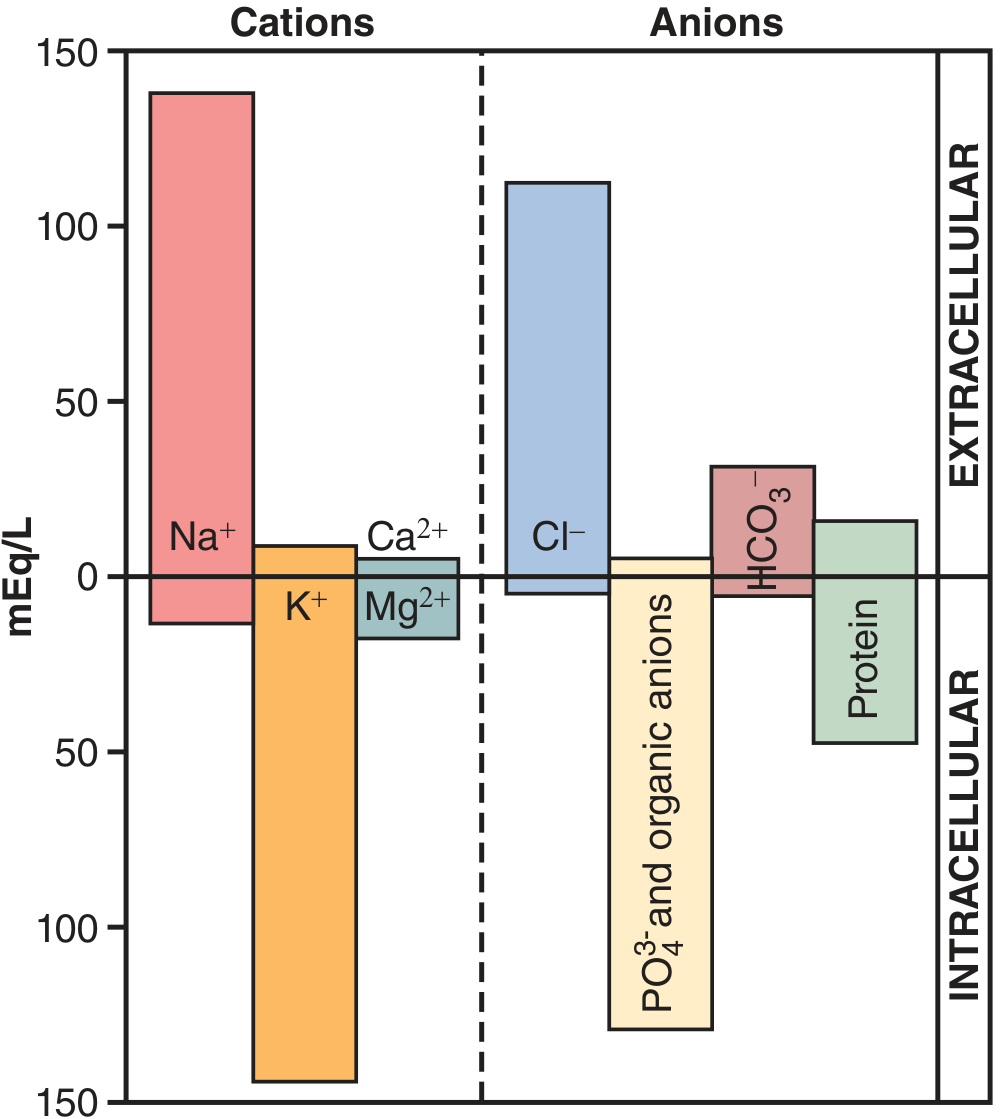
| Electrolyte | Plasma | Interstitial | Intracellular |
|---|---|---|---|
| Na⁺ | 142 mOsm/L | 139 | 14 |
| K⁺ | 4.2 | 4.0 | 140 |
| Ca²⁺ | 1.3 | 1.2 | 0.0001 |
| Mg²⁺ | 0.8 | 0.7 | 20 |
| Cl⁻ | 106 | 108 | 4 |
| HCO₃⁻ | 24 | 28.3 | 10 |
| Phosphate | 2 | 2 | 11 |
| Proteins | high | low | high |
The concentration gradient between ICF and ECF is maintained by the Na⁺/K⁺-ATPase pump in cell membranes.
Key Functions of Body Fluids (Summary)
| Function | Description |
|---|---|
| Transport | Carries O₂, nutrients, hormones, and waste products |
| Thermoregulation | Water's high specific heat buffers body temperature; sweat dissipates heat |
| Solvent | Dissolves gases, electrolytes, and organic molecules for metabolic reactions |
| Acid-base balance | Bicarbonate buffering system in plasma and ICF |
| Electrolyte balance | Maintains osmolarity (~285-295 mOsm/L) and cell volume |
| Lubrication | Transcellular fluids reduce friction in joints, pleura, pericardium |
| Protection | CSF cushions the CNS; amniotic fluid protects the fetus |
| Volume/Pressure | Plasma volume determines venous return and cardiac output |
Sources:
- Guyton and Hall Textbook of Medical Physiology
- Ganong's Review of Medical Physiology, 26th Edition
- Costanzo Physiology, 7th Edition
- Schwartz's Principles of Surgery, 11th Edition
This is a shared conversation. Sign in to Orris to start your own chat.