
What is the commonest reason for discharge from the eye in elderly?
Commonest Reason for Eye Discharge (Epiphora) in the Elderly
Why Drainage Fails in the Elderly
- Hypersecretion - excess tear production due to anterior segment disease, such as dry eye causing paradoxical reflex watering, or ocular surface inflammation.
- Defective drainage - a compromised lacrimal drainage system.
| Cause | Notes |
|---|---|
| Punctal stenosis | Reported in up to ~50% of the general population; most common cause of lacrimal drainage failure |
| Ectropion | Age-related lower lid laxity causes the punctum to fall away from the globe; often co-exists with punctal stenosis |
| Nasolacrimal duct obstruction (NLDO) | Produces mucopurulent discharge; may lead to dacryocystitis |
| Conjunctivochalasis | Redundant conjunctiva obstructs the punctal opening; common but underdiagnosed |
| Lacrimal pump failure | Due to lower lid laxity and weakened orbicularis muscle - both age-related |
| Dry eye with reflex watering | Very common in elderly; the dry ocular surface triggers paradoxical hypersecretion |
The Single Commonest Cause
"Punctal abnormality is the most common cause of lacrimal drainage failure."
- Kanski's Clinical Ophthalmology, 10th Edition
- The punctal orifice narrows with age (involutional changes)
- Chronic blepharitis and eyelid inflammation contribute to scarring
- Ectropion (also very common in the elderly due to lid laxity) frequently produces secondary punctal stenosis
Character of Discharge Helps Localise the Cause
- Watery discharge - hypersecretion (dry eye, allergic) or proximal drainage problem (punctal stenosis, ectropion)
- Mucopurulent discharge - nasolacrimal duct obstruction (NLDO) or dacryocystitis; compression of the lacrimal sac produces mucopurulent reflux through the punctum
- Purulent/sticky discharge - infective conjunctivitis (bacterial), blepharitis
- Mucoid/stringy discharge - allergic conjunctivitis, dry eye
Summary
Create a diagnostic flowchart for elderly eye discharge
A clean, professional medical diagnostic flowchart titled "Elderly Eye Discharge: Diagnostic Flowchart". The flowchart starts at the top with a box "Elderly Patient with Eye Discharge", then branches down based on discharge type into three main columns: Left column - "WATERY DISCHARGE (Epiphora)": branches into "Drainage Failure" and "Hypersecretion". Drainage Failure leads to boxes: Punctal Stenosis (most common), Ectropion, Nasolacrimal Duct Obstruction, Conjunctivochalasis, Lacrimal Pump Failure. Hypersecretion leads to: Dry Eye (paradoxical watering), Ocular Surface Inflammation. Middle column - "MUCOPURULENT DISCHARGE": leads to boxes: Nasolacrimal Duct Obstruction / Dacryocystitis, Chronic Bacterial Conjunctivitis, Blepharitis / Meibomian Gland Dysfunction. Right column - "PURULENT / STICKY DISCHARGE": leads to boxes: Acute Bacterial Conjunctivitis, Blepharitis (staph), Dacryocystitis (acute). Below each main column, add a "Key Features" box with clinical clues: - Watery: overflow onto cheek, worse in wind/cold, medial canthal swelling - Mucopurulent: reflux on sac pressure, NLDO confirmed by irrigation - Purulent: lid crusting, red eye, sticky lids on waking At the bottom, a single "Management" box with arrows from all three columns pointing to it, containing: Punctal dilation/surgery, DCR for NLDO, Lid surgery for ectropion, Artificial tears for dry eye, Topical antibiotics for infection, Lid hygiene for blepharitis. Use a white background, blue header boxes, light blue for branch boxes, green for management, red/orange for diagnosis boxes. Professional clinical style with clear arrows and readable font. No emoji.
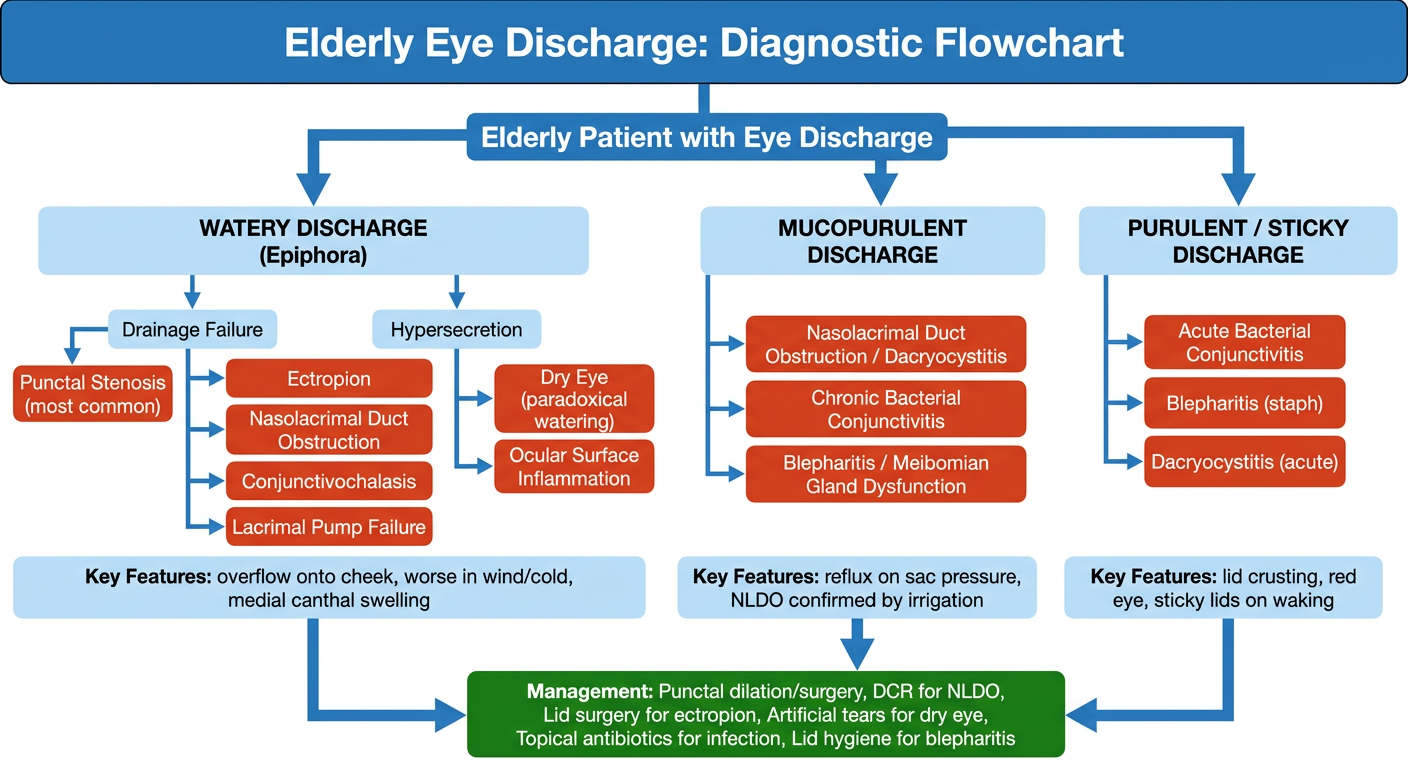
How to Use the Flowchart
- Watery - think drainage failure (punctal stenosis, ectropion) or paradoxical hypersecretion from dry eye
- Mucopurulent - think NLDO, chronic bacterial conjunctivitis, or blepharitis
- Purulent/sticky - think acute bacterial conjunctivitis, acute dacryocystitis, or staphylococcal blepharitis
| Discharge Type | Clinical Clues | Commonest Cause in Elderly |
|---|---|---|
| Watery | Overflow onto cheek, worse in cold/wind | Punctal stenosis / ectropion |
| Mucopurulent | Reflux on sac pressure, irrigation test | NLDO / dacryocystitis |
| Purulent/sticky | Lid crusting, red eye, morning gluing | Bacterial conjunctivitis / blepharitis |
- Punctal dilation or surgery for stenosis
- DCR (dacryocystorhinostomy) for NLDO
- Lid surgery (ectropion repair) for lid malposition
- Artificial tears + lid hygiene for dry eye + blepharitis
- Topical antibiotics for acute bacterial infection