
Explain about Taurine and Acetylcysteine
Reading File
Now let me search the medical library and PubMed in parallel for both compounds.
Finding Sources
Finding Sources
Searching PubMed
taurine supplementation clinical effects
Searching PubMed
N-acetylcysteine clinical applications
Finding Sources
Reading File
Reading File
Finding Sources
Finding Sources
Reading File
Finding Sources
Loading Image
I now have comprehensive information from the textbooks. Let me compile a thorough answer.
Taurine and N-Acetylcysteine (NAC)
TAURINE
Structure & Classification
Taurine (2-aminoethanesulfonic acid) is a β-amino acid — structurally distinct from α-amino acids in that its sulfonic acid group replaces the carboxyl group. Unlike most amino acids, it is not incorporated into proteins. It belongs to a group of β-amino acids alongside β-alanine and GABA.
- Plasma concentration: ~50 μM (significantly higher than GABA at ~0.1 μM)
- It is a non-essential (conditionally essential) nutrient synthesized endogenously from cysteine
— Brenner and Rector's The Kidney
Biosynthesis
Taurine is an end product of cysteine metabolism, synthesized via a three-step enzymatic pathway:
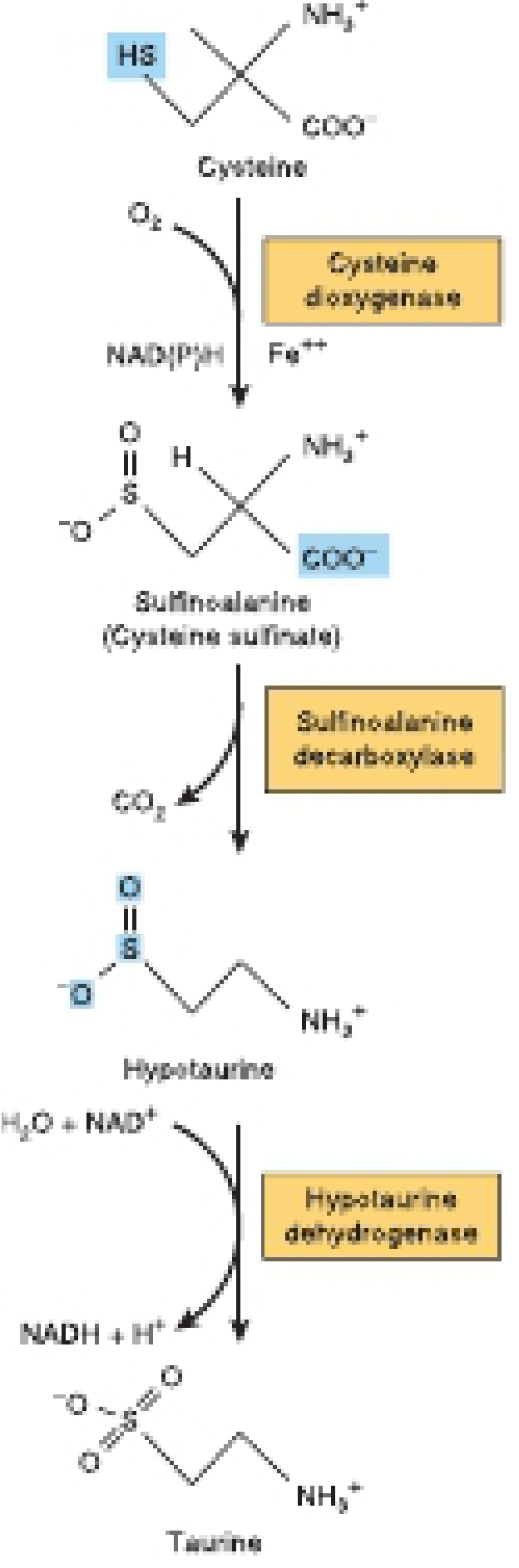
Figure: Conversion of cysteine to taurine (Harper's Illustrated Biochemistry, 32nd Ed)
| Step | Enzyme | Reaction |
|---|---|---|
| 1 | Cysteine dioxygenase (Fe²⁺-dependent) | Cysteine → Cysteine sulfinate (sulfinoalanine) |
| 2 | Sulfinoalanine (cysteine sulfinate) decarboxylase | Cysteine sulfinate → Hypotaurine + CO₂ |
| 3 | Hypotaurine dehydrogenase | Hypotaurine + NAD⁺ → Taurine + NADH |
— Harper's Illustrated Biochemistry, 32nd Ed, p. 319
Key Physiological Functions
1. Bile Acid Conjugation
The most well-established role of taurine is conjugation with bile acids in the liver. Taurine can displace the CoA moiety of cholyl-CoA to form taurocholic acid — a conjugated bile salt.
- Conjugated bile salts (with glycine or taurine) have greatly enhanced aqueous solubility and promote high intraluminal micellar concentrations that facilitate fat and fat-soluble vitamin absorption
- The major function of this conjugation is to decrease passive diffusion of bile acids across cell membranes, ensuring efficient enterohepatic recirculation
- In adults, the glycine:taurine conjugate ratio is approximately 3:1; in fetuses and infants, taurine conjugates predominate (80% of biliary bile acids)
— Sleisenger and Fordtran's GI and Liver Disease; Yamada's Textbook of Gastroenterology; Basic Medical Biochemistry, 6th ed
2. Renal Tubular Transport
Taurine is reabsorbed in the kidney via specific apical transporters for β-amino acids on the proximal tubule brush border. These transporters handle taurine, β-alanine, and GABA — an important mechanism in conserving these amino acids.
— Brenner and Rector's The Kidney
3. Antioxidant & Cytoprotective Effects
Taurine acts as a cellular antioxidant and osmoregulator, particularly in excitable tissues (heart, retina, skeletal muscle, brain). It has roles in:
- Membrane stabilization
- Calcium modulation
- Osmoregulation (intracellular taurine concentrations are very high in heart and retinal cells)
4. Neuromodulation
Taurine functions as an inhibitory neuromodulator and is highly concentrated in the central nervous system, where it modulates GABAergic and glycinergic signaling.
Clinical Relevance
- Infant nutrition: Taurine is added to infant formulas because neonates have limited synthetic capacity
- Cardiovascular disease: Emerging evidence suggests taurine supplementation may benefit heart failure patients (muscle cramp management in cirrhosis per recent systematic review, PMID: 39548657)
- Autoimmune disease: A 2026 systematic review (PMID: 41874670) examined taurine supplementation in SLE preclinical studies, showing potential anti-inflammatory benefits
- Retinal degeneration: Dietary taurine deficiency has been linked to retinal degeneration (especially in cats, though also relevant in humans on total parenteral nutrition)
N-ACETYLCYSTEINE (NAC)
Structure & Pharmacology
N-Acetylcysteine is the N-acetyl derivative of the amino acid L-cysteine. It contains a free thiol (-SH) group, which is the basis for nearly all of its pharmacological actions. Trade names: Acetadote (IV), Mucomyst (oral/inhaled).
Mechanisms of Action
NAC operates through several distinct mechanisms:
| Mechanism | Explanation |
|---|---|
| Glutathione precursor | NAC is deacetylated intracellularly to cysteine, the rate-limiting substrate for glutathione (GSH) synthesis |
| Direct antioxidant | The free -SH group directly scavenges reactive oxygen species (ROS) |
| NAPQI scavenging | Directly reduces NAPQI (the toxic acetaminophen metabolite) back to acetaminophen; also acts as a sulfate precursor |
| Mucolytic | Cleaves disulfide bonds in mucopolysaccharides, reducing sputum viscosity |
| Anti-inflammatory | Decreases neutrophil infiltration; improves microcirculatory blood flow |
— Tintinalli's Emergency Medicine; Katzung's Basic and Clinical Pharmacology, 16th ed; K.J. Lee's Essential Otolaryngology
Clinical Applications
1. Acetaminophen (Paracetamol) Overdose — PRIMARY INDICATION
This is the most critical and life-saving use of NAC.
Mechanism of toxicity: Acetaminophen is metabolized by CYP2E1 to NAPQI (N-acetyl-p-benzoquinone imine), a highly reactive electrophile. Normally, NAPQI is detoxified by conjugation with glutathione (GSH). In overdose, GSH stores are depleted → NAPQI binds hepatic macromolecules → fulminant hepatotoxicity.
NAC treatment efficacy:
- Given within 8 hours: nearly 100% effective in preventing hepatotoxicity
- Delayed 8–24 hours: still reduces risk vs. historical controls
- Established toxicity (>24 hours): still beneficial — acts as antioxidant, reduces neutrophil infiltration, improves tissue O₂ delivery
Standard IV Protocol (21-hour):
| Phase | Dose | Duration |
|---|---|---|
| Loading dose | 150 mg/kg | Over 1 hour |
| 1st maintenance | 50 mg/kg | Over 4 hours |
| 2nd maintenance | 100 mg/kg | Over 16 hours |
Note: IV route has supplanted oral due to greater ease of administration and patient acceptance. Key adverse effect: anaphylactoid reactions in 4–17% of patients (highest risk in asthmatics; highest risk during first 2 hours).
— Tintinalli's Emergency Medicine, p. 1297; Katzung's Basic and Clinical Pharmacology
2. Mucolytic Agent (Respiratory)
NAC cleaves disulfide bonds in mucoproteins, liquefying viscous secretions. Used in:
- Chronic obstructive pulmonary disease (COPD): Oral NAC 600 mg twice daily reduces exacerbations and may have antioxidant benefit (though it does not alter FEV₁ decline)
- Cystic fibrosis / meconium ileus: 10% NAC (Mucomyst) solution via NGT to dissolve inspissated meconium
- Asthma: Thinning of secretions
- Vernal keratoconjunctivitis (ophthalmology): Topical acetylcysteine dissolves mucus filaments and plaques
— Fishman's Pulmonary Diseases; Murray & Nadel's Textbook of Respiratory Medicine; Sabiston Textbook of Surgery; Kanski's Clinical Ophthalmology
3. Contrast-Induced Nephropathy (CIN) Prophylaxis
NAC (600 mg orally every 12 hours, four doses before and after contrast) was widely used to reduce contrast-induced AKI, particularly in patients with pre-existing renal disease.
Note: More recent evidence has called this benefit into question. Current Surgical Therapy 14e states: "there is no compelling data that any therapeutic agent [including NAC] influences" AKI risk in surgical patients. The benefit appears more established for oral prophylaxis in cardiac angiography than in surgical settings.
— Morgan and Mikhail's Clinical Anesthesiology, 7e; Current Surgical Therapy 14e
4. Psychiatric Uses
NAC has been investigated as an adjunct in schizophrenia (especially clozapine-resistant cases) and other psychiatric conditions, given its ability to replenish glutathione and modulate glutamate signaling.
— The Maudsley Prescribing Guidelines in Psychiatry, 15th ed
5. Laboratory Use
NAC is the agent of choice in creatine kinase (CK) assay reagents. It restores -SH groups on CK isoenzymes that may have become oxidized during specimen handling.
— Tietz Textbook of Laboratory Medicine, 7th ed
6. PCOS
A 2024 systematic review (PMID: 39039898) reviewed NAC as an antioxidant for polycystic ovary syndrome, noting its role in improving insulin sensitivity and ovarian function.
Relationship Between Taurine and NAC
Both compounds are metabolically linked through cysteine:
Cysteine
   ├──→ Taurine  (via cysteine dioxygenase pathway)
   └──→ Glutathione (via γ-glutamylcysteine synthetase)
          ↑
         NAC (provides cysteine as precursor for GSH synthesis)
- Taurine is the end product of cysteine sulfur oxidation
- NAC is the acetylated precursor that donates cysteine for glutathione synthesis
Both are sulfur-containing compounds with significant antioxidant and cytoprotective roles, reflecting the central importance of cysteine metabolism in redox homeostasis.
Key Sources: Harper's Illustrated Biochemistry 32nd Ed | Katzung's Basic and Clinical Pharmacology 16th Ed | Tintinalli's Emergency Medicine | Fishman's Pulmonary Diseases | Sleisenger & Fordtran's GI and Liver Disease | Yamada's Textbook of Gastroenterology | Recent PubMed: PMID 39548657, 41874670, 39039898
This is a shared conversation. Sign in to Orris to start your own chat.