
I have my university exam of 1 st year of subject biochemistry These are the important long answer give me answer of this question"Gluconeogenesis" and remeber it's a university examination
Reading File
Now let me search the medical library for comprehensive gluconeogenesis content.
Finding Sources
Searching the Web
gluconeogenesis biochemistry university exam answer pathway enzymes regulation
The Lippincott and Basic Medical Biochemistry books have dedicated gluconeogenesis sections. Let me read them in parallel.
Reading File
Reading File
Excellent data coming in. Let me read more from Lippincott for the unique enzymes, steps and regulation sections.
Reading File
Reading File
Let me get more content - specifically the regulation section and the unique enzyme reactions from Lippincott.
Reading File
I now have comprehensive content. Let me also fetch the key pathway diagram image and check regulation content.
Loading Image
Reading File
I now have everything needed for a comprehensive university exam answer. Let me compose the full detailed answer.
GLUCONEOGENESIS
[University Examination - Long Answer]
DEFINITION
Gluconeogenesis is the metabolic process by which glucose is synthesized de novo from non-carbohydrate precursors. The term literally means "new formation of glucose." It occurs primarily in the liver (about 90% during an overnight fast) and to a lesser extent in the kidney cortex (~10% normally, rising to ~40% during prolonged starvation of 48+ hours). The small intestine can also make small amounts of glucose.
- Lippincott Illustrated Reviews: Biochemistry, 8e, p. 353
PHYSIOLOGICAL SIGNIFICANCE / WHY IS IT NEEDED?
Certain tissues cannot survive without a constant supply of glucose:
- Brain and nervous tissue
- Red blood cells (RBCs) - lack mitochondria, rely entirely on glycolysis
- Kidney medulla, lens and cornea of the eye, testes
- Exercising skeletal muscle
Liver glycogen stores can only sustain blood glucose for less than 24 hours during fasting. Beyond that point, glucose must be synthesized from non-carbohydrate sources via gluconeogenesis to:
- Maintain blood glucose during prolonged fasting/starvation
- Recycle metabolic waste products (lactate, glycerol, amino acids)
- Respond to increased glucose demand (e.g., prolonged exercise)
SITES OF GLUCONEOGENESIS
| Site | Contribution |
|---|---|
| Liver (cytoplasm + mitochondria) | ~90% (short-term fast) |
| Kidney cortex | ~10% (short-term), ~40% (prolonged starvation) |
| Small intestine | Minor |
SUBSTRATES (GLUCONEOGENIC PRECURSORS)
Three major gluconeogenic precursors:
1. Lactate
- The most important substrate during exercise and anaerobic conditions
- Produced by RBCs, exercising skeletal muscle, skin
- Converted to pyruvate by lactate dehydrogenase (LDH) in the liver
- Forms the basis of the Cori cycle (see below)
2. Glycerol
- Released from hydrolysis of triacylglycerols (TAGs) in adipose tissue during fasting
- Converted to glycerol-3-phosphate by glycerol kinase
- Then oxidized to dihydroxyacetone phosphate (DHAP) by glycerol-3-phosphate dehydrogenase
- DHAP is a direct intermediate of both glycolysis and gluconeogenesis
3. Glucogenic Amino Acids
- All amino acids except leucine and lysine are glucogenic
- They are transaminated or deaminated to yield pyruvate, OAA, alpha-ketoglutarate, succinyl CoA, or fumarate - all of which can feed into the TCA cycle to form OAA and ultimately PEP
- Most important: Alanine → pyruvate (via alanine aminotransferase); forms the Glucose-Alanine Cycle
Note: Leucine and lysine are purely ketogenic (give rise only to acetyl CoA, which cannot make net glucose due to the irreversibility of pyruvate dehydrogenase). Fatty acids are also not gluconeogenic substrates for the same reason.
THE PATHWAY OF GLUCONEOGENESIS
Gluconeogenesis is NOT a simple reversal of glycolysis. 7 of the 10 glycolytic reactions are reversible and are shared. But 3 glycolytic steps are irreversible (catalyzed by hexokinase, PFK-1, and pyruvate kinase) and must be bypassed by 4 special gluconeogenic reactions.
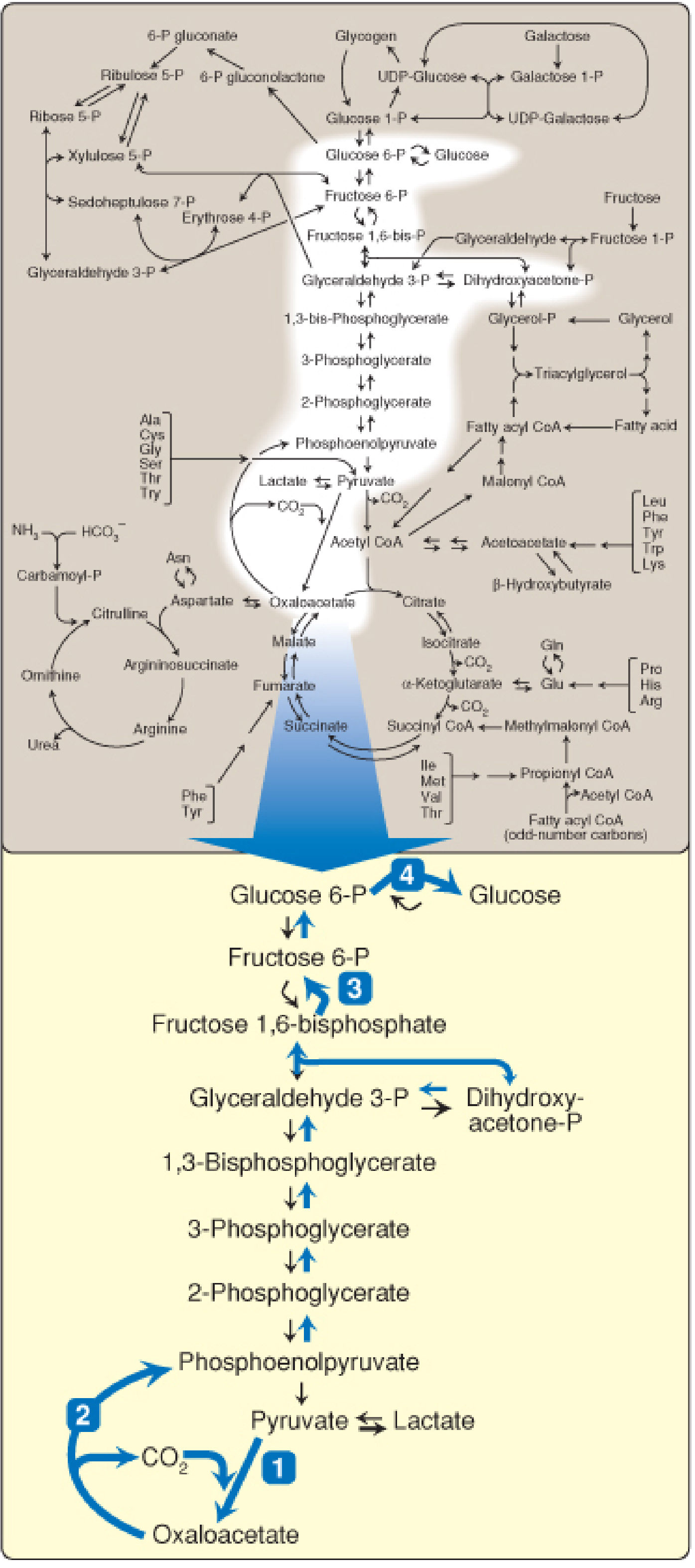
THE 4 UNIQUE REACTIONS OF GLUCONEOGENESIS
Bypass 1: Pyruvate → Phosphoenolpyruvate (PEP)
This bypasses the irreversible pyruvate kinase step (PEP → Pyruvate in glycolysis).
In gluconeogenesis, this requires TWO reactions in sequence:
Step 1 - Pyruvate Carboxylase (PC):
- Location: Mitochondrial matrix
- Pyruvate + CO₂ + ATP → Oxaloacetate (OAA) + ADP + Pi
- Requires coenzyme Biotin (covalently bound to lysine residue of the enzyme)
- Allosteric activator: Acetyl CoA (signals that TCA cycle needs replenishment)
- This reaction has an anaplerotic function (replenishes TCA cycle intermediates)
Step 2 - Phosphoenolpyruvate Carboxykinase (PEPCK):
- Location: Cytoplasm (and partly mitochondrial)
- OAA + GTP → PEP + CO₂ + GDP
- Requires GTP as energy source
- PEPCK is the key rate-limiting enzyme of gluconeogenesis
- Induced by glucagon and cortisol; inhibited by insulin
OAA cannot cross the inner mitochondrial membrane directly. It is first reduced to malate (by mitochondrial malate dehydrogenase), exits to cytoplasm, and is re-oxidized back to OAA (by cytoplasmic malate dehydrogenase). This transport also provides NADH to the cytoplasm for gluconeogenesis.
Bypass 2: Fructose-1,6-bisphosphate → Fructose-6-phosphate
This bypasses the irreversible Phosphofructokinase-1 (PFK-1) step in glycolysis.
Enzyme: Fructose-1,6-bisphosphatase (FBPase-1)
- Location: Cytoplasm
- Fructose-1,6-bisphosphate + H₂O → Fructose-6-phosphate + Pi (simple hydrolysis, no ATP generated)
- Inhibited by: AMP, Fructose-2,6-bisphosphate
- Activated by: Citrate
Bypass 3: Glucose-6-phosphate → Glucose
This bypasses the irreversible Hexokinase/Glucokinase step in glycolysis.
Enzyme: Glucose-6-phosphatase
- Location: Smooth ER (endoplasmic reticulum) membrane of liver and kidney cells
- Glucose-6-phosphate + H₂O → Glucose + Pi (hydrolysis)
- This enzyme is absent in muscle and brain - which is why these tissues CANNOT release free glucose
- Allows the liver to release free glucose into the bloodstream
ENERGY COST OF GLUCONEOGENESIS
Converting 2 pyruvate molecules → 1 glucose requires:
- 6 ATP equivalents (4 ATP + 2 GTP)
- 2 NADH (used in the glyceraldehyde-3-phosphate dehydrogenase reverse step)
Overall equation:
2 Pyruvate + 4ATP + 2GTP + 2NADH + 6H₂O → Glucose + 4ADP + 2GDP + 6Pi + 2NAD⁺
REGULATION OF GLUCONEOGENESIS
Gluconeogenesis is regulated at multiple levels to ensure it operates only when needed (fasting, stress) and is suppressed after a meal.
1. Hormonal Regulation
| Hormone | Effect on Gluconeogenesis | Mechanism |
|---|---|---|
| Glucagon | Stimulates ↑ | ↓ Fructose-2,6-bisphosphate → activates FBPase-1; phosphorylates & inactivates pyruvate kinase; induces PEPCK gene transcription |
| Cortisol | Stimulates ↑ | Induces PEPCK gene expression; provides amino acid substrates (from muscle proteolysis) |
| Epinephrine | Stimulates ↑ | Similar to glucagon via cAMP |
| Insulin | Inhibits ↓ | Decreases PEPCK expression; activates PFK-2 (raises Fructose-2,6-bisphosphate → inhibits FBPase-1) |
2. Allosteric Regulation
| Regulator | Effect |
|---|---|
| Acetyl CoA | Activates pyruvate carboxylase (PC) |
| AMP | Inhibits FBPase-1 (stimulates glycolysis instead) |
| Fructose-2,6-bisphosphate | Inhibits FBPase-1 (key reciprocal regulator with glycolysis) |
| Citrate | Activates FBPase-1 |
| ATP | Inhibits PFK-1, promotes gluconeogenesis indirectly |
3. Substrate Availability
Increased supply of lactate, glycerol, and amino acids during fasting directly drives the rate of gluconeogenesis.
4. Enzyme Induction (Long-term)
- PEPCK is transcriptionally induced by glucagon (via cAMP-CREB pathway) and cortisol
- Insulin suppresses PEPCK gene expression
- This slow mechanism adapts the liver's gluconeogenic capacity over hours/days
IMPORTANT CYCLES LINKED TO GLUCONEOGENESIS
1. The Cori Cycle (Glucose-Lactate Cycle)
- Muscle → anaerobic glycolysis → Lactate → released into blood
- Liver → lactate oxidized to pyruvate → gluconeogenesis → Glucose → released into blood → back to muscle
- Significance: recycles lactate, prevents lactic acidosis, sustains muscle activity
2. The Glucose-Alanine Cycle
- Muscle → amino acids → transamination → Alanine → released into blood
- Liver → alanine → pyruvate (by alanine aminotransferase) → gluconeogenesis → Glucose
- Also transfers amino groups from muscle to liver for urea synthesis
- Important during prolonged fasting and starvation
COMPARISON: GLUCONEOGENESIS vs. GLYCOLYSIS
| Feature | Glycolysis | Gluconeogenesis |
|---|---|---|
| Direction | Glucose → Pyruvate | Pyruvate → Glucose |
| Net ATP | Produces 2 ATP | Consumes 6 ATP equivalents |
| Site | Cytoplasm | Cytoplasm + Mitochondria |
| Condition | Fed state | Fasting/Starvation |
| Stimulated by | Insulin | Glucagon, Cortisol |
| Unique enzymes | Hexokinase, PFK-1, Pyruvate kinase | PC, PEPCK, FBPase-1, Glucose-6-phosphatase |
CLINICAL RELEVANCE
-
Hypoglycemia: Deficiency of gluconeogenic enzymes (PC, PEPCK, FBPase-1, Glucose-6-phosphatase) causes hypoglycemia, especially during fasting.
-
Type 2 Diabetes Mellitus: Uncontrolled gluconeogenesis in the liver contributes significantly to fasting hyperglycemia. Metformin acts partly by inhibiting hepatic gluconeogenesis (reduces PEPCK and G6Pase expression).
-
Alcohol and Gluconeogenesis: Alcohol metabolism generates excess NADH, which shifts OAA to malate, depletes OAA, and blocks gluconeogenesis → causes alcoholic hypoglycemia.
-
Gluconeogenesis in DKA (Diabetic Ketoacidosis): In insulin deficiency, glucagon rises, driving uncontrolled gluconeogenesis → severe hyperglycemia.
-
Von Gierke disease (GSD Type I): Deficiency of glucose-6-phosphatase → cannot release free glucose from liver → severe fasting hypoglycemia, hepatomegaly.
SUMMARY
| Key Point | Details |
|---|---|
| Definition | Synthesis of glucose from non-carbohydrate precursors |
| Main site | Liver; also kidney cortex |
| Substrates | Lactate, Glycerol, Glucogenic amino acids |
| Key unique enzymes | PC, PEPCK, FBPase-1, Glucose-6-phosphatase |
| Energy cost | 6 ATP equivalents per glucose |
| Stimulated by | Glucagon, Cortisol, Epinephrine, Acetyl CoA, AMP |
| Inhibited by | Insulin, AMP (on FBPase-1), Fructose-2,6-bisphosphate |
| Clinical relevance | Hypoglycemia disorders, Diabetes, Alcoholic hypoglycemia |
Sources: Lippincott Illustrated Reviews: Biochemistry 8e (Ch. 10, pp. 353-368); Basic Medical Biochemistry: A Clinical Approach 6e (Ch. 28, pp. 1007-1012)
I have my university exam of 1 st year of subject biochemistry These are the important long answer give me answer of this question"Galactose metabolism" and remeber it's a university examination
Your credits are exhausted. You can purchase a top-up or subscribe to a plan to continue using Orris. If you're already subscribed, your daily credits will reset tomorrow.
This is a shared conversation. Sign in to Orris to start your own chat.