
Respiratory cycle and volumes
Reading File
Reading File
Searching the Web
respiratory cycle lung volumes capacities physiology
Finding Sources
Finding Sources
Searching PubMed
"Lung Volume Measurements"[MeSH Terms]
Reading File
Respiratory cycle
One respiratory cycle consists of inspiration followed by expiration.
-
Quiet inspiration
- An active process.
- Diaphragm contracts and descends; external intercostal muscles elevate the ribs.
- Thoracic volume increases, intrapleural pressure becomes more negative, and alveolar pressure falls slightly below atmospheric pressure.
- Air flows into the lungs.
-
End-inspiration
- Alveolar pressure again equals atmospheric pressure.
- Airflow stops, although lung volume is at its highest during a normal breath.
-
Quiet expiration
- Usually passive.
- Diaphragm and external intercostals relax.
- Elastic recoil of the lungs and chest wall decreases thoracic volume.
- Alveolar pressure rises slightly above atmospheric pressure, so air flows out.
-
End-expiration
- Alveolar pressure equals atmospheric pressure again, so there is no airflow.
- The lung is not empty. The volume remaining is the functional residual capacity (FRC).
During forced breathing, inspiration may recruit accessory muscles, while forced expiration uses the abdominal muscles and internal intercostals.
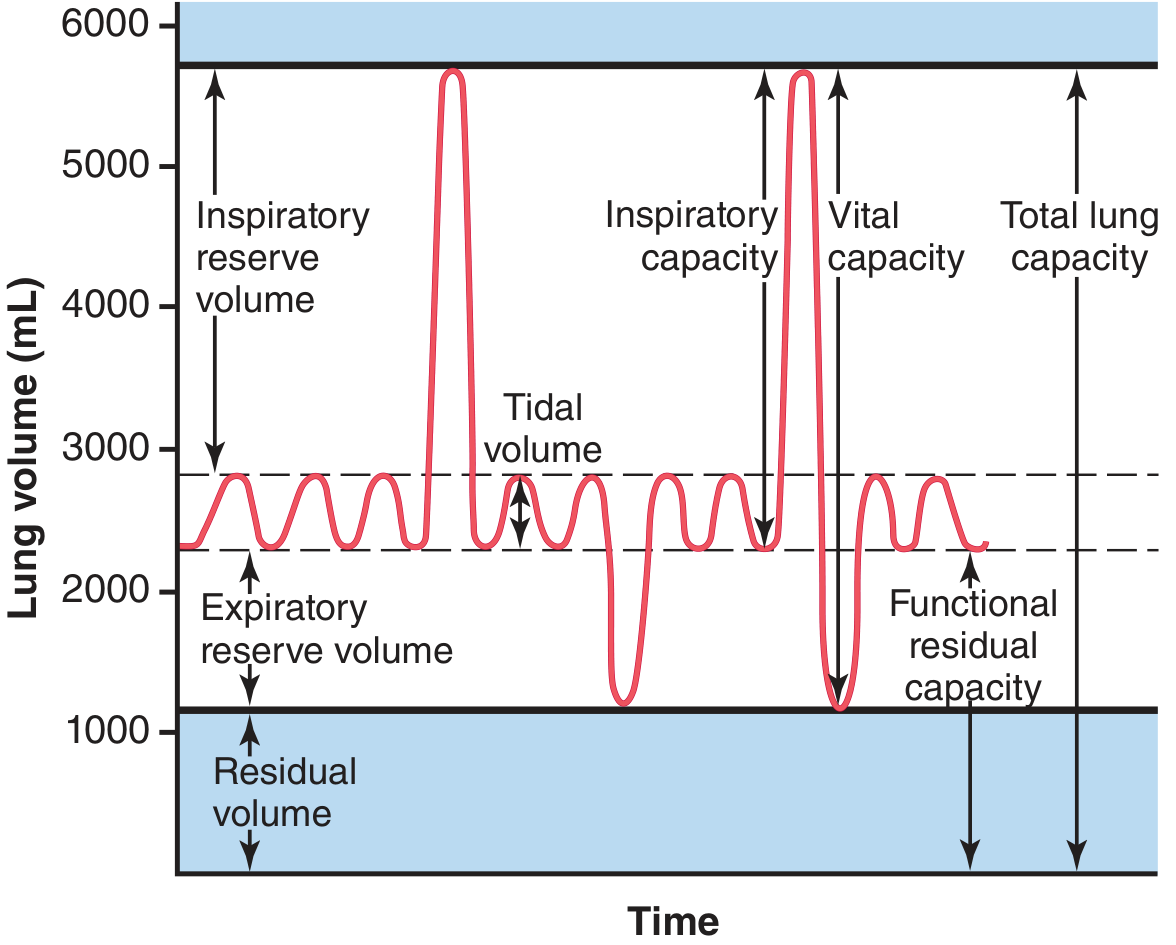
Lung volumes
| Volume | Meaning | Approximate adult male value |
|---|---|---|
| Tidal volume (TV) | Air inspired or expired in one quiet breath | 500 mL |
| Inspiratory reserve volume (IRV) | Extra air that can be inspired after a normal inspiration | 3000 mL |
| Expiratory reserve volume (ERV) | Extra air that can be expired after a normal expiration | 1100 mL |
| Residual volume (RV) | Air remaining after maximal forced expiration | 1200 mL |
Lung capacities
Capacities are combinations of two or more volumes.
| Capacity | Formula | Meaning | Approximate value |
|---|---|---|---|
| Inspiratory capacity (IC) | TV + IRV | Maximum air inspired after a normal expiration | 3500 mL |
| Functional residual capacity (FRC) | ERV + RV | Air remaining at the end of quiet expiration | 2300 mL |
| Vital capacity (VC) | IRV + TV + ERV | Maximum air expired after a maximal inspiration | 4600 mL |
| Total lung capacity (TLC) | VC + RV | Total air in lungs after maximal inspiration | 5800 mL |
Important points
- RV cannot be measured by simple spirometry, so FRC and TLC also cannot be directly measured by simple spirometry.
- Lung volumes vary with sex, height, age, body size, posture, fitness, pregnancy, and lung disease.
- Minute ventilation = TV × respiratory rate.
- Alveolar ventilation = (TV − anatomical dead space) × respiratory rate. This represents fresh air reaching gas-exchange areas.
The figures are approximate averages for healthy young adults. See the NCBI overview of lung capacity for clinical measurement context.
This is a shared conversation. Sign in to Orris to start your own chat.