
Topic is ultra violet radiation Give me its classification And high pressure mercury lamp production with diagram
ultraviolet radiation classification UV-A UV-B UV-C wavelength ranges
high pressure mercury lamp UV production construction diagram working principle
https://lamptech.co.uk/Documents/M1%20Introduction.htm
A detailed labeled cross-section diagram of a high pressure mercury vapor lamp showing: outer glass bulb (elliptical envelope), inner quartz arc tube, two main tungsten electrodes at each end of the arc tube, one auxiliary starting electrode near one main electrode connected via a resistor, mercury droplets inside arc tube, argon buffer gas filling, nitrogen-filled outer envelope, molybdenum foil seals at the ends of the arc tube, support frame/mount wires, and lamp base. Include arrows showing UV light emission from the arc tube. Clean scientific diagram on white background with clear labels and annotations.
Ultraviolet (UV) Radiation
1. Classification of UV Radiation
| Band | Wavelength | Also Called | Atmospheric Fate |
|---|---|---|---|
| UVA | 315 - 400 nm | Long-wave UV / "Black light" | NOT absorbed by ozone; ~90% reaches Earth's surface |
| UVB | 280 - 315 nm | Medium-wave UV | Mostly absorbed by ozone; ~10% reaches surface |
| UVC | 100 - 280 nm | Short-wave UV / Germicidal UV | Completely absorbed by ozone and atmosphere |
Further Sub-divisions
- UVA-I: 340-400 nm (less biologically damaging, used in phototherapy)
- UVA-II: 315-340 nm (more energetic, contributes to erythema)
- Far UV (FUV): 200-280 nm
- Vacuum UV (VUV): 100-200 nm (absorbed by air itself; only propagates in a vacuum)
Key Properties by Band
- Penetrates deep into the dermis
- Causes photoaging, indirect DNA damage via reactive oxygen species (ROS)
- Primary driver of tanning; used in PUVA phototherapy
- Source of ~90% of total UV reaching Earth's surface
- Absorbed mainly in the epidermis
- Causes direct DNA damage - characteristic C→T and CC→TT dipyrimidine mutations (UV signature mutations)
- Responsible for sunburn, vitamin D synthesis, and skin cancer induction
- Most carcinogenic band in terms of direct DNA mutagenesis
- Most energetic and most damaging type
- Completely filtered by the atmosphere - does NOT naturally reach Earth's surface
- Artificially produced by germicidal lamps (peak emission 254 nm)
- Disrupts DNA and microbial cell walls - used for disinfection
Sources: WHO UV Q&A | CDC UV Facts | EU Scientific Committee Glossary | Fitzpatrick's Dermatology, Vol. 1
2. High-Pressure Mercury Lamp - UV Production
What It Is
Construction
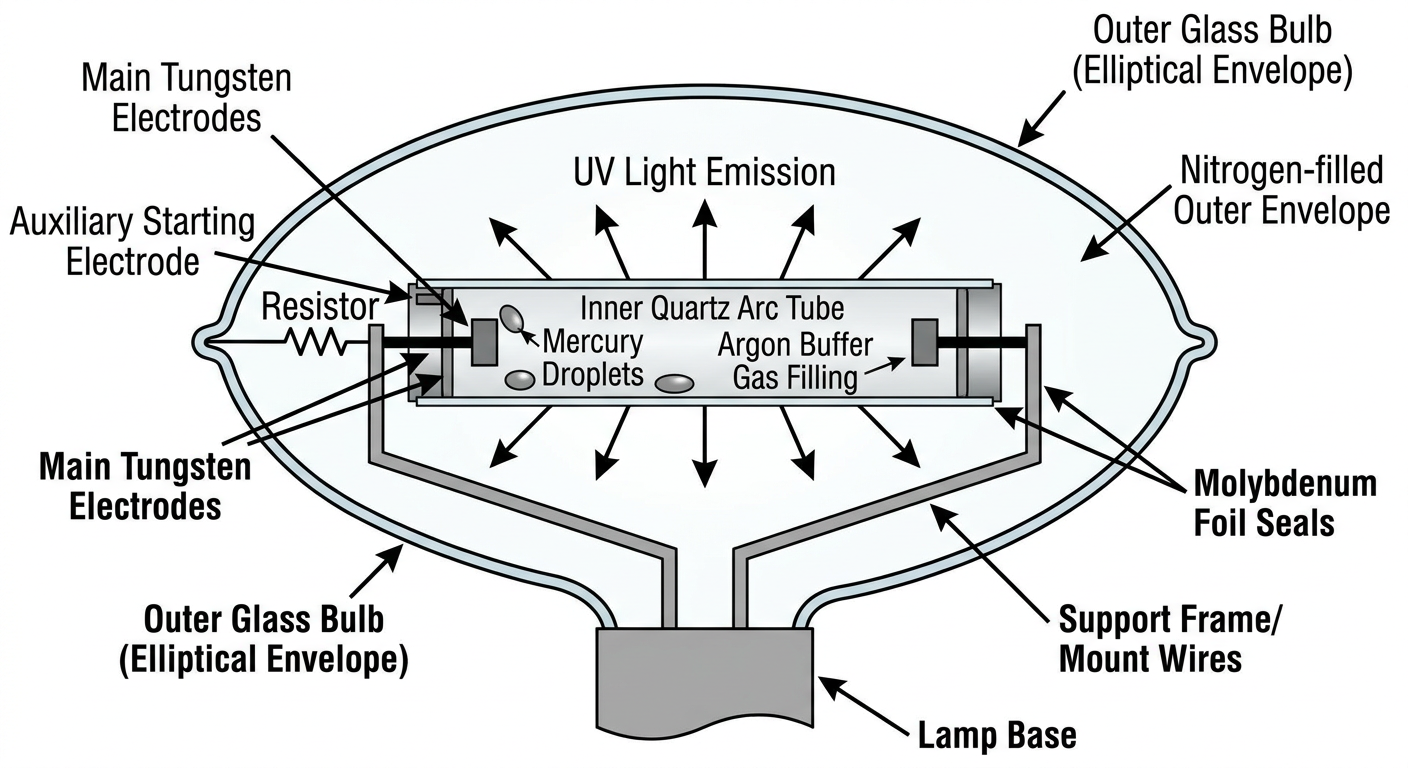
| Component | Material | Function |
|---|---|---|
| Arc tube (inner) | Fused quartz | Contains the discharge; quartz transmits UV (200-400 nm) |
| Main electrodes (x2) | Tungsten | One at each end of arc tube; sustain the main discharge |
| Auxiliary starting electrode | Tungsten | Placed beside one main electrode, connected via 10-30 kΩ resistor |
| Mercury | Elemental Hg | A few mg; primary radiation source when vaporised |
| Buffer gas | Argon (25-50 torr) | Carries discharge while mercury warms up |
| Outer envelope (bulb) | Hard glass / quartz | Protects arc tube; may carry phosphor coating |
| Outer gas fill | Nitrogen or Ar-N₂ | Prevents oxidation of seals; slows phosphor degradation |
| Seals | Molybdenum foil | Hermetic seal between quartz tube and metal leads |
Working Principle - Step by Step
- Full open-circuit voltage is applied across the arc tube
- The main electrode gap is too large for direct ionisation
- Voltage is also applied between the main electrode and the auxiliary electrode (small gap) via a resistor
- The small gap ionises the argon gas - a small discharge strikes
- Free electrons, ions and photons flood the arc tube
- The small argon discharge generates heat
- Heat vaporises mercury droplets into mercury vapour
- The discharge transitions from argon to mercury vapour
- Lamp colour shifts from dark blue (low-pressure Hg lines) to blue-green/white
- Pressure builds progressively inside the arc tube
- Mercury is fully vaporised; pressure reaches 2-18 bar depending on lamp power
- High-pressure arc emits a broad UV spectrum
- The high pressure causes spectral line broadening (pressure broadening)
- Characteristic emission lines: 254 nm (UVC), 313 nm, 365 nm (UVA), 404 nm, 436 nm, plus visible green/yellow/violet lines
- The strongest UV irradiance is typically around 365 nm
- Electric current accelerates electrons between electrodes
- Electrons collide with mercury atoms, exciting them to higher energy states
- Mercury atoms return to ground state, releasing energy as photons
- Photon wavelength = inversely proportional to the energy difference between states
- Quartz tube transmits UV wavelengths that glass would block
Emission Spectrum of High-Pressure Mercury Lamp
| Wavelength | Region | Intensity |
|---|---|---|
| 254 nm | UVC | Present (stronger in low-pressure) |
| 313 nm | UVB | Moderate |
| 365 nm | UVA-I | Strongest UV line |
| 404-436 nm | Violet (visible) | Strong |
| 546-578 nm | Green/Yellow | Strong |
Phosphor Coating (Fluorescent Versions)
- Absorbs the invisible UV (especially 365 nm)
- Re-emits it as visible red/white light
- Improves colour rendering by filling in the lamp's red deficiency
Applications
- UV phototherapy (PUVA, UVB narrowband therapy for psoriasis, vitiligo)
- UV curing (adhesives, printing inks, coatings)
- Germicidal/disinfection (especially medium-pressure variants)
- Molecular spectroscopy
- Street/industrial lighting (with phosphor coating)
- Forensic and fluorescence examination