
Can you make me an MCQ test of 50 MCQs with... E- enough question that I could mark the correct answer there in the question. Secondly, make me a lower limb MCQ test, which starts from the... Which covers the thigh, gluteal region till... The knee, but do not include the knee joint. Just think in a way that... Just think it in a way that I have studied the lower limb. Tell the knee joint, except the knee joint.
Reading File
Now let me search the medical library for lower limb anatomy content covering thigh and gluteal region:
Finding Sources
Finding Sources
Finding Sources
Finding Sources
I have enough context to create an excellent, medically accurate 50-MCQ test on the lower limb (thigh + gluteal region, excluding knee joint). Let me generate this now based on my deep anatomical knowledge of these regions.
Lower Limb Anatomy MCQ Test
Thigh & Gluteal Region (Excluding Knee Joint)
50 Multiple Choice Questions | Mark the correct answer
Instructions: Each question has one correct answer (A-E). Circle or mark the correct option.
Q1. Which muscle is the primary hip flexor and is formed by the union of two muscles?
- A) Gluteus maximus
- B) Iliopsoas ✅
- C) Rectus femoris
- D) Sartorius
- E) Tensor fasciae latae
Q2. The femoral triangle is bounded laterally by which structure?
- A) Inguinal ligament
- B) Adductor longus
- C) Sartorius ✅
- D) Pectineus
- E) Iliacus
Q3. Which nerve passes through the femoral triangle but NOT through the femoral sheath?
- A) Femoral branch of genitofemoral nerve
- B) Lateral cutaneous nerve of the thigh
- C) Femoral nerve ✅
- D) Obturator nerve
- E) Ilioinguinal nerve
Q4. The femoral sheath is a continuation of which fascia?
- A) Fascia lata only
- B) Transversalis fascia anteriorly and iliac fascia posteriorly ✅
- C) Iliac fascia only
- D) Fascia lata anteriorly and iliac fascia posteriorly
- E) Endopelvic fascia
Q5. The femoral canal (medial compartment of femoral sheath) contains:
- A) Femoral artery
- B) Femoral vein
- C) Femoral nerve
- D) Lymphatics and fat ✅
- E) Obturator nerve
Q6. Which is NOT a content of the femoral sheath?
- A) Femoral artery
- B) Femoral vein
- C) Femoral canal
- D) Femoral nerve ✅
- E) Lymph node of Cloquet
Q7. The adductor (subsartorial / Hunter's) canal transmits which nerve to the popliteal fossa?
- A) Common peroneal nerve
- B) Posterior cutaneous nerve of thigh
- C) Saphenous nerve ✅
- D) Tibial nerve
- E) Sural nerve
Q8. The adductor hiatus is a gap in which muscle?
- A) Adductor brevis
- B) Adductor longus
- C) Adductor magnus ✅
- D) Gracilis
- E) Pectineus
Q9. Which muscle occupies the floor of the adductor canal?
- A) Adductor brevis
- B) Adductor longus ✅
- C) Adductor magnus
- D) Pectineus
- E) Vastus medialis
Q10. Which of the following muscles does NOT belong to the anterior compartment of the thigh?
- A) Rectus femoris
- B) Vastus lateralis
- C) Vastus medialis
- D) Vastus intermedius
- E) Biceps femoris ✅
Q11. The quadriceps femoris inserts into:
- A) Ischial tuberosity
- B) Lesser trochanter
- C) Tibial tuberosity via the patellar ligament ✅
- D) Head of fibula
- E) Medial condyle of tibia
Q12. Which muscle of the quadriceps group is the only one that crosses the hip joint?
- A) Vastus lateralis
- B) Vastus medialis
- C) Vastus intermedius
- D) Rectus femoris ✅
- E) All four cross the hip
Q13. The sartorius muscle is supplied by which nerve?
- A) Obturator nerve
- B) Femoral nerve ✅
- C) Superior gluteal nerve
- D) Lateral cutaneous nerve of thigh
- E) Common peroneal nerve
Q14. Which muscle is sometimes called "the tailor's muscle" and crosses the thigh obliquely?
- A) Gracilis
- B) Tensor fasciae latae
- C) Sartorius ✅
- D) Rectus femoris
- E) Iliotibial band
Q15. The medial compartment of the thigh is supplied mainly by which nerve?
- A) Femoral nerve
- B) Sciatic nerve
- C) Obturator nerve ✅
- D) Superior gluteal nerve
- E) Pudendal nerve
Q16. Which muscle of the medial compartment is innervated partly by the sciatic nerve (tibial division)?
- A) Adductor longus
- B) Adductor brevis
- C) Gracilis
- D) Adductor magnus (adductor part by obturator; hamstring part by sciatic) ✅
- E) Pectineus
Q17. Gracilis inserts at which bony landmark on the tibia?
- A) Tibial tuberosity
- B) Medial surface of shaft of tibia (pes anserinus) ✅
- C) Head of fibula
- D) Lateral condyle of tibia
- E) Medial malleolus
Q18. The pes anserinus is formed by the combined insertions of sartorius, gracilis, and which third muscle?
- A) Rectus femoris
- B) Semimembranosus
- C) Semitendinosus ✅
- D) Biceps femoris
- E) Popliteus
Q19. Which of the following is a hamstring muscle?
- A) Sartorius
- B) Adductor magnus
- C) Rectus femoris
- D) Semitendinosus ✅
- E) Gracilis
Q20. The hamstring muscles are innervated by which nerve?
- A) Femoral nerve
- B) Obturator nerve
- C) Sciatic nerve (tibial division mainly) ✅
- D) Common peroneal nerve
- E) Inferior gluteal nerve
Q21. Which hamstring muscle has a long head and a short head, and its short head is NOT supplied by the tibial division of the sciatic nerve?
- A) Semitendinosus
- B) Semimembranosus
- C) Biceps femoris ✅
- D) Adductor magnus
- E) Gracilis
Q22. The short head of biceps femoris is supplied by which division of the sciatic nerve?
- A) Tibial division
- B) Common peroneal division ✅
- C) Pudendal nerve
- D) Femoral nerve
- E) Obturator nerve
Q23. Which is the largest nerve in the body?
- A) Femoral nerve
- B) Obturator nerve
- C) Sciatic nerve ✅
- D) Common peroneal nerve
- E) Posterior cutaneous nerve of thigh
Q24. The sciatic nerve exits the pelvis through:
- A) Obturator foramen
- B) Greater sciatic foramen below piriformis ✅
- C) Lesser sciatic foramen
- D) Femoral canal
- E) Adductor hiatus
Q25. At what level does the sciatic nerve typically divide into tibial and common peroneal nerves?
- A) Level of ischial spine
- B) Mid-thigh
- C) Apex of popliteal fossa ✅
- D) Head of fibula
- E) Inguinal ligament
Q26. Which muscle is the chief lateral rotator of the hip and is used as the landmark for sciatic nerve injection safety?
- A) Obturator internus
- B) Quadratus femoris
- C) Piriformis ✅
- D) Gemellus superior
- E) Obturator externus
Q27. The piriformis originates from which structure?
- A) Ilium
- B) Anterior surface of sacrum ✅
- C) Ischium
- D) Pubic ramus
- E) Posterior superior iliac spine
Q28. The piriformis inserts at:
- A) Lesser trochanter
- B) Greater trochanter ✅
- C) Intertrochanteric crest
- D) Ischial tuberosity
- E) Iliac crest
Q29. Which muscle passes through the lesser sciatic foramen to reach the gluteal region?
- A) Piriformis
- B) Obturator internus ✅
- C) Quadratus femoris
- D) Gemellus inferior
- E) Obturator externus
Q30. The superior gluteal nerve supplies all of the following EXCEPT:
- A) Gluteus medius
- B) Gluteus minimus
- C) Tensor fasciae latae
- D) Gluteus maximus ✅
- E) None -- all are correct exclusions
Q31. Gluteus maximus is innervated by which nerve?
- A) Superior gluteal nerve
- B) Inferior gluteal nerve ✅
- C) Sciatic nerve
- D) Posterior cutaneous nerve of thigh
- E) Pudendal nerve
Q32. The primary action of gluteus medius and minimus is:
- A) Extension of the hip
- B) Lateral rotation of the hip
- C) Abduction of the hip ✅
- D) Flexion of the hip
- E) Adduction of the hip
Q33. Trendelenburg's sign is positive when which muscle group is paralyzed or weak?
- A) Hip adductors (obturator nerve palsy)
- B) Hip extensors (gluteus maximus)
- C) Hip abductors - gluteus medius and minimus ✅
- D) Hip flexors - iliopsoas
- E) Hamstrings
Q34. The tensor fasciae latae inserts into the iliotibial tract, which in turn inserts at:
- A) Patella
- B) Head of fibula
- C) Gerdy's tubercle on lateral tibia ✅
- D) Lateral malleolus
- E) Greater trochanter
Q35. The profunda femoris (deep femoral artery) arises from which vessel?
- A) External iliac artery
- B) Internal iliac artery
- C) Femoral artery ✅
- D) Obturator artery
- E) Popliteal artery
Q36. Which artery is the major blood supply to the head of the femur in adults?
- A) Obturator artery
- B) Superior gluteal artery
- C) Medial circumflex femoral artery ✅
- D) Lateral circumflex femoral artery
- E) Inferior gluteal artery
Q37. The cruciate anastomosis around the hip involves all EXCEPT:
- A) Medial circumflex femoral artery
- B) Lateral circumflex femoral artery
- C) Inferior gluteal artery
- D) 1st perforating branch of profunda femoris
- E) Superior gluteal artery ✅
Q38. The great saphenous vein drains into which vessel at the saphenofemoral junction?
- A) Popliteal vein
- B) External iliac vein
- C) Femoral vein ✅
- D) Internal iliac vein
- E) Deep femoral vein
Q39. The saphenofemoral junction is located approximately:
- A) 4 cm below and lateral to the pubic tubercle
- B) 4 cm below and medial to the pubic tubercle ✅
- C) At the inguinal ligament midpoint
- D) 2 cm above the inguinal ligament
- E) At the femoral triangle apex
Q40. The lateral cutaneous nerve of the thigh (meralgia paraesthetica when compressed) passes through/under which structure?
- A) Femoral canal
- B) Adductor hiatus
- C) Inguinal ligament near ASIS ✅
- D) Greater sciatic foramen
- E) Obturator foramen
Q41. Meralgia paraesthetica causes sensory loss over which area?
- A) Medial thigh
- B) Posterior thigh
- C) Anterolateral thigh ✅
- D) Medial leg below knee
- E) Gluteal region
Q42. The obturator nerve (L2-L4) passes through the obturator foramen and divides into anterior and posterior divisions. Which muscle is supplied by the posterior division?
- A) Adductor longus
- B) Gracilis
- C) Pectineus
- D) Obturator externus ✅
- E) Adductor brevis (anterior division)
Q43. Which of the following is the nerve root value of the femoral nerve?
- A) L1, L2, L3
- B) L2, L3, L4 ✅
- C) L3, L4, L5
- D) L4, L5, S1
- E) L5, S1, S2
Q44. The femoral nerve lies which side of the femoral artery in the femoral triangle?
- A) Medial
- B) Lateral ✅
- C) Anterior
- D) Posterior
- E) In the femoral sheath alongside it
Q45. The "NAVEL" mnemonic describes the contents of the femoral triangle from lateral to medial. What does the "L" stand for?
- A) Lateral cutaneous nerve
- B) Lacunar ligament ✅
- C) Lymphatics
- D) Ligament of Poupart
- E) Lesser trochanter
Q46. Which of these structures passes through the obturator foramen?
- A) Sciatic nerve
- B) Femoral nerve
- C) Obturator nerve and vessels ✅
- D) Lateral cutaneous nerve of thigh
- E) Pudendal nerve
Q47. The posterior cutaneous nerve of the thigh arises from which sacral roots?
- A) L4, L5
- B) L5, S1
- C) S1, S2, S3 ✅
- D) S2, S3, S4
- E) L5, S1, S2
Q48. Which muscle forms the floor of the femoral triangle?
- A) Adductor longus laterally and iliopsoas medially
- B) Iliopsoas laterally and pectineus medially ✅
- C) Sartorius and rectus femoris
- D) Adductor longus and adductor brevis
- E) Pectineus and gracilis
Q49. A patient falls on an outstretched hand and fractures the neck of the femur. Avascular necrosis of the femoral head is most likely because of disruption to which artery?
- A) Superior gluteal artery
- B) Inferior gluteal artery
- C) Medial circumflex femoral artery ✅
- D) Lateral circumflex femoral artery
- E) Obturator artery
Q50. The "sciatic notch" - greater sciatic foramen transmits all of the following EXCEPT:
- A) Piriformis muscle
- B) Superior gluteal vessels and nerve
- C) Sciatic nerve
- D) Posterior cutaneous nerve of thigh
- E) Obturator nerve ✅
Answer Key
| Q | A | Q | A | Q | A | Q | A | Q | A |
|---|---|---|---|---|---|---|---|---|---|
| 1 | B | 11 | C | 21 | C | 31 | B | 41 | C |
| 2 | C | 12 | D | 22 | B | 32 | C | 42 | D |
| 3 | C | 13 | B | 23 | C | 33 | C | 43 | B |
| 4 | B | 14 | C | 24 | B | 34 | C | 44 | B |
| 5 | D | 15 | C | 25 | C | 35 | C | 45 | B |
| 6 | D | 16 | D | 26 | C | 36 | C | 46 | C |
| 7 | C | 17 | B | 27 | B | 37 | E | 47 | C |
| 8 | C | 18 | C | 28 | B | 38 | C | 48 | B |
| 9 | B | 19 | D | 29 | B | 39 | B | 49 | C |
| 10 | E | 20 | C | 30 | D | 40 | C | 50 | E |
Coverage breakdown:
- Femoral triangle & canal - Q1-6, 38, 39, 44, 45, 48
- Anterior compartment (quadriceps, sartorius) - Q10-14
- Medial compartment (adductors, gracilis, obturator nerve) - Q15-18, 42, 46
- Posterior compartment (hamstrings) - Q19-22
- Gluteal region (muscles, nerves, vessels) - Q26-34
- Sciatic nerve - Q23-25, 47, 50
- Blood supply (femoral, profunda, circumflex, cruciate anastomosis) - Q35-37, 49
- Cutaneous nerves & clinical - Q40-41, 43
- Adductor canal & hiatus - Q7-9
Can you tell me the course of the obturator nerve? Can you tell me the course of the obturator nerve? Can you tell me the course of the obturator nerve?
The obturator nerve arises from the lumbar plexus (L2, L3, L4), descends through the psoas major, emerges from its medial border, runs along the lateral wall of the pelvis, and exits through the obturator foramen to divide into anterior and posterior divisions in the thigh.
Searching sources...
Finding Sources
Reading File
Reading File
Loading Image
Reading File
Here is the complete course of the obturator nerve, straight from Gray's Anatomy for Students:
Course of the Obturator Nerve
Origin
- Arises from the lumbar plexus, spinal cord segments L2, L3, L4
- Formed on the posterior abdominal wall within the substance of the psoas major muscle
Abdominal / Retroperitoneal Part
- Descends within the psoas major muscle
- Emerges from the medial margin of psoas (unlike the femoral nerve which emerges from its lateral border)
- At this point it lies on the posterior abdominal wall, medial to the psoas
Pelvic Part
- Enters the pelvic cavity
- Runs along the lateral wall of the pelvis - this is where it is vulnerable to damage, particularly during childbirth (the fetal head or forceps can compress it against the lateral pelvic wall)
- Travels toward the obturator foramen
- Passes through the obturator canal (the upper part of the obturator foramen, formed between the obturator membrane and the superior ramus of the pubis)
In the Thigh - Division
As soon as it exits the obturator canal and enters the medial compartment of the thigh, it divides into two branches separated by the adductor brevis muscle:
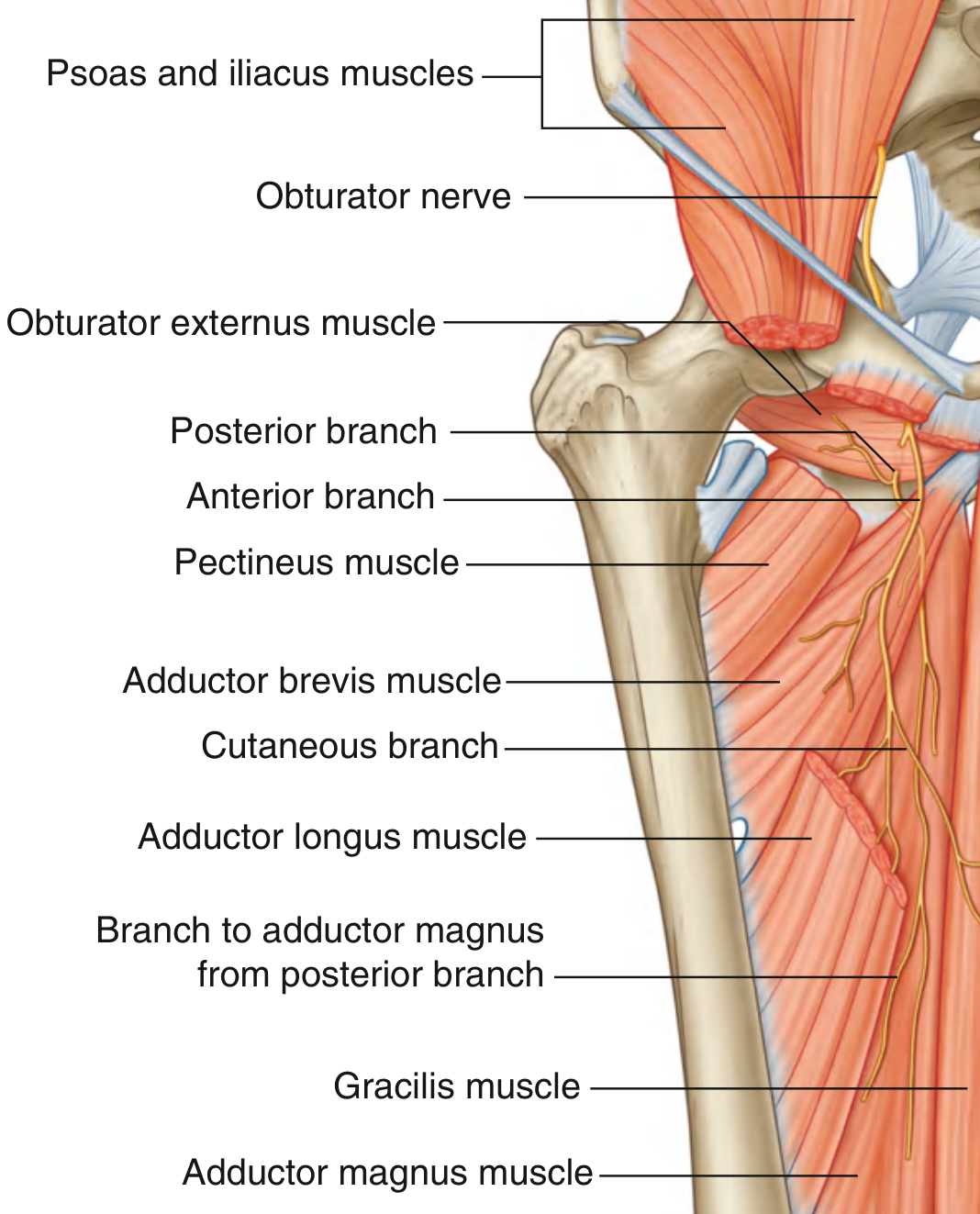
Anterior Branch (in front of adductor brevis)
- Descends on the anterior surface of adductor brevis
- Lies behind pectineus and adductor longus
- Supplies:
- Adductor longus
- Adductor brevis
- Gracilis
- Pectineus (inconstant - often also supplied by femoral nerve)
- Gives cutaneous branches to the skin on the medial side of the thigh
Posterior Branch (behind adductor brevis)
- Descends behind adductor brevis and on the anterior surface of adductor magnus
- Supplies:
- Obturator externus (just as it exits the obturator canal)
- Adductor brevis (sometimes)
- The adductor part of adductor magnus (the part that attaches to the linea aspera) - the hamstring part of adductor magnus goes to the sciatic nerve
- Note: the posterior branch does NOT have a cutaneous branch
Summary Table
| Part | Location | Key Relations |
|---|---|---|
| Origin | Lumbar plexus (L2-L4) | Inside psoas major |
| Abdominal | Behind psoas, medial margin | Medial to femoral nerve |
| Pelvic | Lateral pelvic wall | Vulnerable in childbirth |
| Canal | Obturator canal | Above obturator vessels |
| Thigh - Anterior branch | Anterior to adductor brevis | Behind pectineus & adductor longus |
| Thigh - Posterior branch | Posterior to adductor brevis | On adductor magnus |
What it Supplies (Summary)
- Motor: Most medial compartment muscles - adductor longus, adductor brevis, gracilis, part of adductor magnus, obturator externus. (NOT the hamstring part of adductor magnus = sciatic; NOT pectineus = mainly femoral)
- Sensory: Skin on the medial side of the upper thigh
Clinical Point - Obturator Nerve Damage
Damage (e.g., during assisted childbirth) causes:
-
Weakness of hip adduction - the patient cannot bring the thighs together
-
Sensory loss on the medial aspect of the thigh
-
In obturator hernia - the nerve can be compressed, causing pain referred down the medial thigh to the knee (Howship-Romberg sign)
-
Gray's Anatomy for Students, p. 668 & 707
This is a shared conversation. Sign in to Orris to start your own chat.