
H pylori treatment
I'll look up current H. pylori treatment guidelines from the medical library and recent literature simultaneously.
Reading File
Searching PubMed
Helicobacter pylori treatment eradication
Now let me search the medical library for H. pylori treatment content:
Finding Sources
Finding Sources
Excellent - I found rich content. Let me read the key sections in parallel:
Reading File
Reading File
Reading File
Now let me get the treatment flowchart image and the Goldman-Cecil regimen table:
Reading File
Reading File
Let me grab the treatment table from Goldman-Cecil and fetch the flowchart image:
Reading File
Loading Image
I now have comprehensive information from multiple authoritative sources. Here is the full evidence-based answer:
Helicobacter pylori Treatment
Goals of Therapy
The aim is complete bacterial eradication, defined as a negative test ≥4 weeks after finishing all antibiotics. Successful eradication reduces peptic ulcer recurrence from 50-90% down to <5%, and meaningfully lowers gastric cancer risk. - Goldman-Cecil Medicine, p. 1449
First-Line Regimens
Selection depends on local clarithromycin resistance rates:
If clarithromycin resistance <15% (e.g., Northern Europe, North America)
PPI Triple Therapy - 14 days (preferred over 7-day courses)
| Drug | Dose |
|---|---|
| PPI (e.g., omeprazole) | 40 mg twice daily |
| Clarithromycin | 500 mg twice daily |
| Amoxicillin | 1 g twice daily |
| Or Metronidazole (if penicillin allergy) | 500 mg twice daily |
- Double-dose PPI improves eradication rates by ~10% - Goldman-Cecil Medicine, p. 1449
If clarithromycin resistance >15% (or resistance rates unknown)
Bismuth-Based Quadruple Therapy - 14 days (achieves ~85-90% eradication)
| Drug | Dose |
|---|---|
| PPI | 20-40 mg twice daily |
| Bismuth subsalicylate | 525 mg four times daily |
| Metronidazole | 250-500 mg four times daily |
| Tetracycline | 500 mg four times daily |
Non-Bismuth Quadruple (Concomitant) Therapy - 14 days (alternative when bismuth unavailable)
| Drug | Dose |
|---|---|
| PPI | 40 mg twice daily |
| Clarithromycin | 500 mg twice daily |
| Amoxicillin | 1 g twice daily |
| Metronidazole | 500 mg twice daily |
All four drugs are given simultaneously throughout the full 14-day course. This is the most effective non-bismuth quadruple regimen. - Goldman-Cecil Medicine, p. 1449
Treatment Flowchart
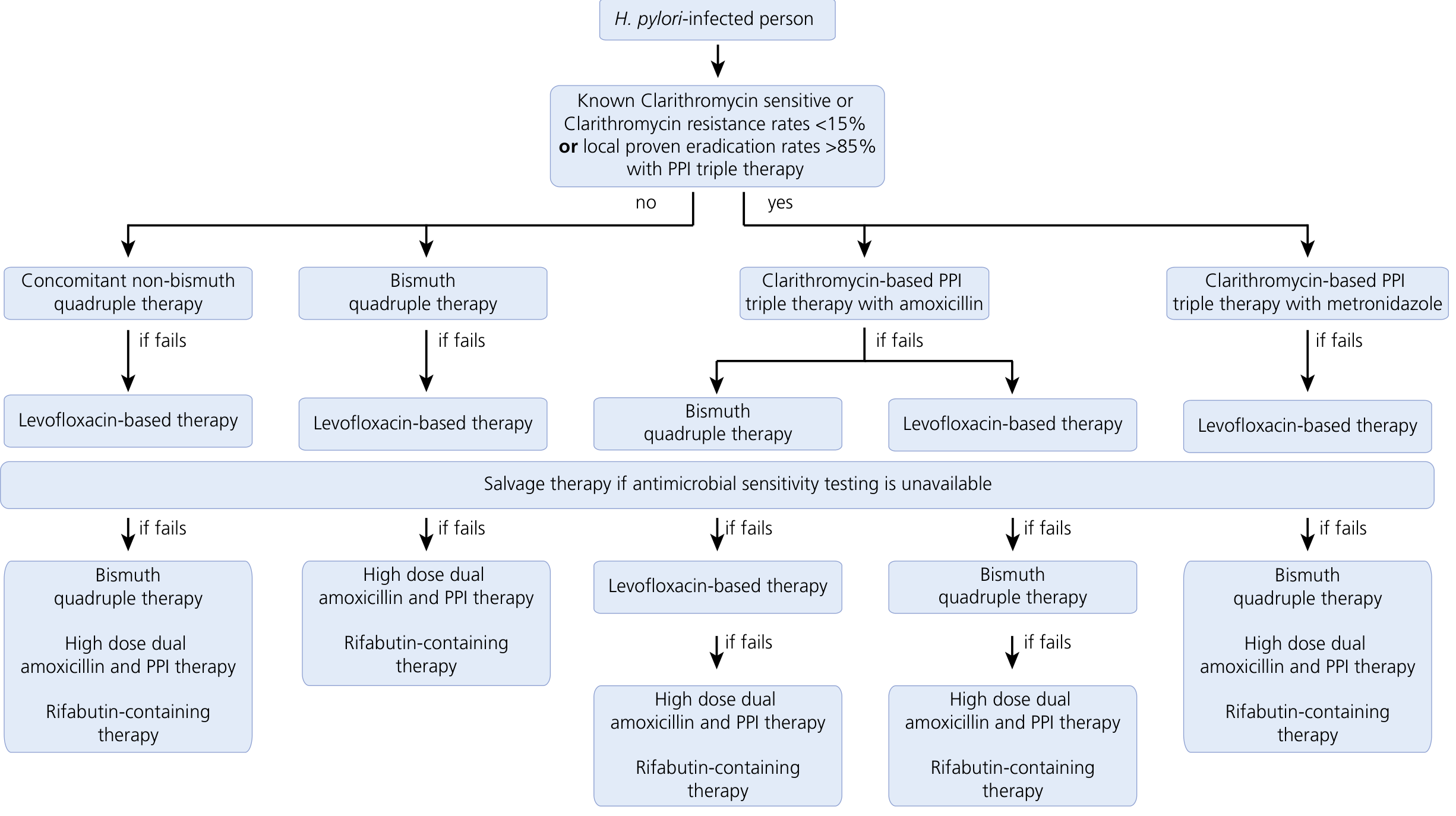
Figure: Therapeutic recommendations for H. pylori eradication based on local resistance patterns - Yamada's Textbook of Gastroenterology, 7th ed.
Second-Line Therapy (After First-Line Failure)
Failure is usually due to resistance to clarithromycin and/or metronidazole - avoid re-using those agents.
- Bismuth quadruple therapy (if not used first-line) - eradicates in ~80% of first-line failures
- Levofloxacin-based triple therapy - PPI + levofloxacin 500 mg once daily + amoxicillin 1 g twice daily for 14 days
Salvage (Third-Line) Therapy
For patients who fail two prior regimens, especially when susceptibility testing is unavailable:
- High-dose dual therapy - high-dose amoxicillin (1 g three to four times daily) + high-dose PPI
- Rifabutin-based triple therapy - PPI + rifabutin 150 mg twice daily + amoxicillin 1 g twice daily (FDA-approved as Talicia: omeprazole + rifabutin + amoxicillin)
At this point, susceptibility-guided therapy via culture or molecular testing is strongly preferred if available. - Yamada's Textbook of Gastroenterology, 7th ed., p. 1089
Key Drug Resistance Notes
| Antibiotic | Resistance Rate |
|---|---|
| Metronidazole | 20-80% worldwide |
| Clarithromycin | 10-50% (rising due to macrolide use for respiratory infections) |
| Levofloxacin | 10-50% in many regions (was rare a decade ago) |
| Amoxicillin | Rare - not clinically significant |
| Tetracycline | Rare - not clinically significant |
Goldman-Cecil Medicine, p. 1449
Confirming Eradication
Always test after treatment in patients with documented PUD or persistent/recurrent symptoms:
- Urea breath test (UBT) - 95% sensitivity and specificity; preferred for post-treatment confirmation
- Stool antigen test - equally acceptable
- Timing: test at least 4-6 weeks after completing all antibiotics AND after stopping PPIs for at least 2 weeks (PPIs cause false-negatives)
- Symptom to Diagnosis, 4th ed., p. 588
Special Considerations
- Vonoprazan (potassium-competitive acid blocker, 20 mg twice daily) can substitute for a PPI and achieves stronger acid suppression; increasingly used particularly in Asia
- Probiotics as add-on to standard therapy hasten symptom resolution and modestly improve eradication rates
- After successful eradication, reinfection risk is <1% per year in most settings
- Continue PPI after antibiotics only if symptoms persist or complicated ulcer disease exists - Goldman-Cecil Medicine, p. 1450
Recent Evidence (2024-2025)
- A 2025 meta-analysis in Gastroenterology (PMID 39824392) confirmed that H. pylori eradication significantly reduces gastric cancer incidence across both RCTs and observational studies - supporting population-wide test-and-treat strategies.
- A 2025 systematic review in Annals of Medicine (PMID 40697099) found that probiotic pretreatment before standard eradication therapy improves eradication rates and reduces adverse effects.
This is a shared conversation. Sign in to Orris to start your own chat.