
DD of child with failure to wt gain
I'll start with a quick answer while I pull from the medical library.
Failure to thrive (FTT) / failure to gain weight in a child has a broad differential spanning inadequate intake, malabsorption, and increased metabolic demand. Common causes include psychosocial/feeding issues, GERD, celiac disease, CF, and chronic infections.
Searching sources...
Reading File
Now let me search the library in parallel for FTT content:
Finding Sources
Finding Sources
Searching PubMed
"failure to thrive" child differential diagnosis
Good - found the key textbook sections. Let me read them now in parallel:
Reading File
Reading File
Good. Now let me get the detailed organic causes section and the FTT flowchart image:
Finding Sources
Loading Image
Now let me get more organic causes detail from the textbook:
Reading File
Finding Sources
Let me get the detailed organic FTT causes section from the Swanson's textbook answer key:
Reading File
I have enough comprehensive information. Let me compile the full answer now.
Differential Diagnosis: Failure to Thrive (FTT) / Failure to Gain Weight in a Child
Definition: FTT is broadly defined as weight consistently below the 3rd-5th percentile for age, or a sustained drop across 2 major percentile lines on a growth chart. ~90% of cases are nonorganic; ~10% are organic (or mixed).
Classification Framework
FTT is classically divided into three pathophysiologic categories:
| Mechanism | Question to ask | Examples |
|---|---|---|
| Inadequate intake | Is the child getting enough calories? | Psychosocial, feeding errors, poverty, anatomic |
| Inadequate absorption | Can the child absorb what it eats? | Celiac, CF, short gut, SIBO |
| Increased metabolic demand | Is the child burning too much? | CHD, chronic infection, hyperthyroidism, malignancy |
1. NONORGANIC CAUSES (~90%)
- Psychosocial / maternal deprivation - most common overall cause; parental neglect, lack of nurturing, parental depression or mental illness
- Errors in feeding technique - improper formula preparation (over-diluted), incorrect positioning, poor latch (breastfeeding)
- Inappropriate diet - excessive juice, early introduction of solids that displace calories, food restriction by parents
- Poverty / food insecurity - lower socioeconomic status, lower parental education level
- Behavioral feeding disorders - oral aversion, food refusal, sensory processing issues
2. ORGANIC CAUSES (~10%)
Inadequate Caloric Intake
- GERD / esophagitis - feeding refusal, vomiting, pain
- Oropharyngeal dysphagia - cleft palate, cricopharyngeal achalasia, laryngomalacia, choanal atresia
- Congenital heart disease (cyanotic) - fatigue during feeding, increased metabolic demand
- Neurologic disorders - cerebral palsy, hypotonia, neuromuscular diseases (poor suck/swallow)
- Lead poisoning - inner-city environments with older housing stock
- Prematurity - use corrected age on growth charts
Malabsorption / GI Causes
- Celiac disease - anti-tTG antibodies, biopsy; classic presentation with diarrhea, bloating
- Cystic fibrosis - exocrine pancreatic insufficiency, chronic pulmonary infections, sweat chloride test
- Cow's milk protein intolerance / food allergy - rectal bleeding, eczema, failure to gain in infants
- Short bowel syndrome - post-surgical
- Small intestinal bacterial overgrowth (SIBO)
- Chronic diarrhea (any cause) - parasites (Giardia, Cryptosporidium), inflammatory bowel disease
- Pancreatic insufficiency - Shwachman-Diamond syndrome in children
- Lysosomal storage/fat malabsorption disorders - intolerance to breast milk/formula is often first sign
Increased Metabolic Demand / Chronic Disease
- Chronic infections - HIV, TB, recurrent otitis media, UTI, parasites
- Congenital heart disease - especially cyanotic lesions
- Chronic renal disease / renal tubular acidosis - RTA is a classic cause in infants; check BUN/creatinine, urinalysis
- Hypothyroidism - check TSH/T4; also consider hyperthyroidism
- Diabetes mellitus / inborn errors of metabolism - check glucose, metabolic screen
- Malignancy - leukemia, lymphoma
- Obstructive uropathy (UPJO) - FTT is a recognized presentation in infants
Chromosomal / Genetic
- Turner syndrome - short stature, webbed neck, absent breast development
- Trisomy 21 (Down syndrome)
- Prader-Willi, Russell-Silver, Noonan syndromes
- Intrauterine growth restriction (IUGR)
Diagnostic Approach
Key history points: feeding history, stool character, parental heights, psychosocial environment, medications, travel, recurrent infections.
Physical exam: pattern of growth (weight only vs. weight + height vs. all three parameters affected guides diagnosis); dysmorphic features; organomegaly; signs of neglect.
Initial investigations:
- CBC, ESR
- Urinalysis + urine culture (rule out UTI/RTA)
- BUN, creatinine
- TSH, T4
- Serum lead level (inner-city, older housing)
- Liver enzymes
- Bone age radiograph (hand/wrist)
- Stool for ova and parasites
- Based on history: sweat chloride (CF), anti-tTG IgA (celiac), HIV, TB testing
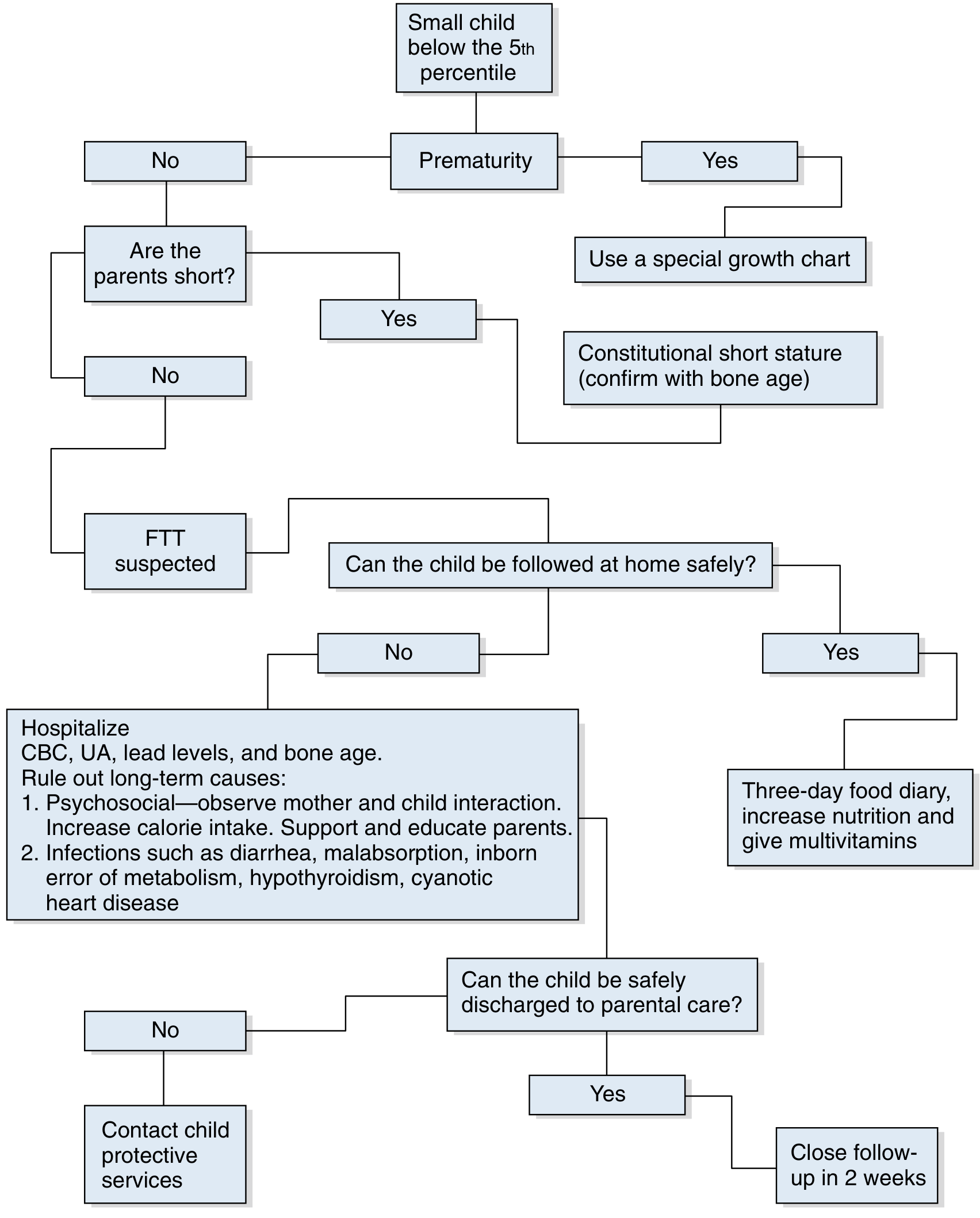
Diagnostic algorithm from Swanson's Family Medicine Review:
Key Pearls
- ~90% of FTT is nonorganic - always assess the psychosocial environment first
- Nonorganic FTT: weight is disproportionately low vs. height; organic FTT affecting all parameters suggests a systemic cause
- Children with a history of FTT remain at increased risk of recurrence even after normalization - long-term follow-up is important
- Appetite stimulants (cyproheptadine, megestrol) are NOT recommended unless significant underlying disease is identified
- Early intervention matters: FTT without treatment causes lasting neurodevelopmental sequelae
- If hospitalized and the child gains weight rapidly, this strongly supports nonorganic (psychosocial) etiology
Sources: Swanson's Family Medicine Review, pp. 557-560; Tietz Textbook of Laboratory Medicine 7e; Swanson's Family Medicine Review Chapter 104
This is a shared conversation. Sign in to Orris to start your own chat.