
A 50-year-old female patient come in OPD. Uh, when it is injected the antibiotic as per the disease, uh, whenever the antibiotic is administered through IV route, the patient shows severe anaphylactic shock. Uh, what was the first line, uh, treatment as per the WHO recommendation for the anaphylactic shock, and how to auscultate, how to escalate the disease, and the anaphylactic shock management, uh, as per WHO, and, uh, detailed explanation with diagrammatic representation? And the site of injection and the dosage of ADR in the patient.
WHO anaphylaxis management first line treatment epinephrine adrenaline guidelines 2024
"anaphylaxis" AND "management" AND "epinephrine"
https://www.resus.org.uk/sites/default/files/2021-05/Emergen…
WHO anaphylaxis grading severity classification Ring Messmer scale management stepwise escalation
Anaphylactic Shock: Complete Management Guide (WHO/International Guidelines)
CLINICAL SCENARIO
PART 1: PATHOPHYSIOLOGY (Brief)
Antibiotic (IV) → IgE on Mast Cells/Basophils
       ↓
   Degranulation
       ↓
  Histamine, Tryptase, Leukotrienes, Prostaglandins, PAF
       ↓
┌─────────────────────────────────────────────┐
│  Vasodilation → Hypotension                 │
│  Increased vascular permeability → Edema   │
│  Bronchospasm → Respiratory distress        │
│  Urticaria / Angioedema (skin/airway)       │
└─────────────────────────────────────────────┘
PART 2: RECOGNITION - HOW TO ASSESS (ABCDE)
Signs & Symptoms by System
| System | Signs & Symptoms (Approximate Incidence) |
|---|---|
| Skin/Mucosal | Urticaria, flushing, angioedema, pruritus (~90%) |
| Respiratory | Stridor, wheeze, bronchospasm, dyspnea, tachypnea (~50%) |
| Cardiovascular | Hypotension, tachycardia, shock, collapse (~33%) |
| GI | Nausea, vomiting, abdominal cramps, diarrhea (~25-30%) |
| CNS | Anxiety, confusion, syncope, altered consciousness |
| ENT | Throat tightness, tongue swelling, uvular edema (~50%) |
Diagnostic Criteria (NIAID/FAAN - WHO endorsed)
- Acute onset of skin/mucosal symptoms + at least one of: respiratory compromise OR hypotension/cardiovascular collapse
- Two or more of the following occurring rapidly after allergen exposure: skin/mucosal involvement + respiratory compromise + hypotension + persistent GI symptoms
- Hypotension alone after exposure to a known allergen
PART 3: SEVERITY GRADING - Escalation Scale (Ring & Messmer / WAO)
┌──────────────────────────────────────────────────────────────────┐
│              ANAPHYLAXIS SEVERITY GRADING                        │
├────────┬─────────────────────────────────────┬──────────────────┤
│ GRADE  │ CLINICAL FEATURES                   │ TREATMENT        │
├────────┼─────────────────────────────────────┼──────────────────┤
│  I     │ Skin only: urticaria, flush,        │ Antihistamine    │
│        │ angioedema — NO systemic symptoms   │ ± Steroids       │
├────────┼─────────────────────────────────────┼──────────────────┤
│  II    │ Mild-moderate multi-organ:          │ EPINEPHRINE IM + │
│        │ Hypotension, tachycardia,           │ Antihistamine +  │
│        │ mild bronchospasm, GI symptoms      │ Steroids + O₂    │
├────────┼─────────────────────────────────────┼──────────────────┤
│  III   │ Life-threatening:                   │ EPINEPHRINE IM   │
│        │ Severe bronchospasm, severe         │ (repeat q5 min)  │
│        │ hypotension, loss of consciousness  │ + IV Fluids +    │
│        │                                     │ O₂ + Position    │
├────────┼─────────────────────────────────────┼──────────────────┤
│  IV    │ Cardiac/Respiratory ARREST          │ CPR + IV/IO      │
│        │                                     │ Epinephrine      │
└────────┴─────────────────────────────────────┴──────────────────┘
This patient (IV antibiotic → severe anaphylaxis) = Grade III-IV emergency
PART 4: FIRST-LINE TREATMENT - WHO/International Consensus
★ ADRENALINE (EPINEPHRINE) = FIRST AND MOST IMPORTANT DRUG
"Intramuscular adrenaline is the first-line treatment for anaphylaxis - even if intravenous access is available."
PART 5: INJECTION SITE AND DOSAGE (ADR - Adrenaline)
Injection Site
         ANTEROLATERAL ASPECT OF THE THIGH
         (Middle third of outer thigh)

              ┌──────────────────┐
              │     OUTER THIGH  │
              │                  │
              │   ┌──────────┐   │
              │   │ INJECT   │   │
              │   │   HERE   │   │  ← Needle perpendicular to skin
              │   │ (middle  │   │     through clothing if needed
              │   │  third)  │   │
              │   └──────────┘   │
              │                  │
              └──────────────────┘

  Why thigh? Achieves HIGHER, FASTER peak plasma levels
  than deltoid (arm) or subcutaneous routes.

  Needle: 21G (green) or 23G (blue)
  Must penetrate INTO muscle tissue
Dosage Table
| Route | Adult Dose | Pediatric Dose | Concentration |
|---|---|---|---|
| IM (First-line) | 0.3-0.5 mg (0.3-0.5 mL) | 0.01 mg/kg (max 0.5 mg) | 1:1,000 (1 mg/mL) |
| Repeat IM | Every 5-10 min if no response | Same | Same |
| IV Bolus (refractory only) | 100 mcg over 5-10 min | 0.1-0.3 mcg/kg/min infusion | 1:10,000 (0.1 mg/mL) |
| IV Infusion | Start 1 mcg/min; titrate up | Titrate to response | 1 mg in 50 mL NS |
- IM Adrenaline: 0.5 mg (0.5 mL of 1:1000) into anterolateral mid-thigh
- Auto-injector: EpiPen® 0.3 mg or Anapen® 0.5 mg
- Repeat in 5 minutes if no improvement
⚠️ CRITICAL: IV adrenaline with 1:1,000 solution (meant for IM) instead of 1:10,000 (for IV) is a fatal dosing error. Only trained staff should give IV adrenaline with cardiac monitoring.
PART 6: FULL MANAGEMENT ALGORITHM (WHO/RCUK Framework)
╔══════════════════════════════════════════════════════════════════╗
║           ANAPHYLAXIS MANAGEMENT ALGORITHM                       ║
╠══════════════════════════════════════════════════════════════════╣
║  STEP 1: RECOGNIZE & CALL FOR HELP                               ║
║  • Identify anaphylaxis: skin + breathing/BP/GI involvement      ║
║  • Call resuscitation team / code blue                           ║
╠══════════════════════════════════════════════════════════════════╣
║  STEP 2: REMOVE TRIGGER                                          ║
║  • STOP the IV antibiotic infusion IMMEDIATELY                   ║
║  • Leave IV access in place                                      ║
╠══════════════════════════════════════════════════════════════════╣
║  STEP 3: POSITION PATIENT                                        ║
║  • Conscious + breathing normally → SITTING (relieves breathing) ║
║  • Hypotensive → LAY FLAT + LEGS ELEVATED (Trendelenburg)        ║
║  • Vomiting → RECOVERY POSITION (left lateral)                   ║
║  • Pregnant → LEFT LATERAL TILT                                  ║
╠══════════════════════════════════════════════════════════════════╣
║  STEP 4: ★ ADRENALINE (EPINEPHRINE) - FIRST LINE ★              ║
║  • IM: 0.5 mg (0.5 mL of 1:1,000) into anterolateral thigh      ║
║  • Repeat every 5 min if A/B/C problems persist                  ║
╠══════════════════════════════════════════════════════════════════╣
║  STEP 5: OXYGEN                                                  ║
║  • High-flow O₂: 10-15 L/min via non-rebreather mask            ║
║  • Target SpO₂ > 94%                                             ║
╠══════════════════════════════════════════════════════════════════╣
║  STEP 6: IV FLUIDS                                               ║
║  • Normal saline 0.9%: 500 mL - 1000 mL rapid bolus             ║
║  • May need 3-5 liters total in severe cardiovascular shock      ║
╠══════════════════════════════════════════════════════════════════╣
║  STEP 7: SECOND-LINE DRUGS                                       ║
║  • H1 Antihistamine: Chlorphenamine 10 mg slow IV/IM             ║
║  • H2 Antihistamine: Ranitidine 50 mg IV (adjunct)               ║
║  • Corticosteroid: Hydrocortisone 200 mg IV (prevents biphasic)  ║
╠══════════════════════════════════════════════════════════════════╣
║  STEP 8: BRONCHOSPASM (if persistent)                            ║
║  • Salbutamol (albuterol) nebulizer 2.5-5 mg                     ║
║  • IV Aminophylline if refractory                                ║
╠══════════════════════════════════════════════════════════════════╣
║  STEP 9: MONITORING                                              ║
║  • Continuous ECG, SpO₂, BP, RR every 5 min                     ║
╚══════════════════════════════════════════════════════════════════╝
PART 7: ESCALATION FOR REFRACTORY ANAPHYLAXIS
REFRACTORY ANAPHYLAXIS ESCALATION:

[2x IM Adrenaline failed]
         ↓
Call CRITICAL CARE / ICU TEAM
         ↓
Switch to IV ADRENALINE INFUSION
• 1 mg in 50 mL NS → start at 0.5 mL/min (= 10 mcg/min)
• Titrate to response
• Requires continuous cardiac monitoring
         ↓
If still refractory:
• Vasopressors: Noradrenaline 0.1-1 mcg/kg/min IV
• Vasopressin 40 units IV (one dose) - useful if beta-blockers involved
• Glucagon 1-2 mg IV (if patient on beta-blockers - bypasses beta receptor block)
         ↓
If Cardiac Arrest occurs:
• CPR per ALS protocol
• Adrenaline 1 mg IV every 3-5 min
• Consider ECMO if available
         ↓
Prolonged resuscitation may be required (hours to days)
PART 8: SUMMARY - DRUG DOSES AT A GLANCE
| Drug | Dose (Adult) | Route | Timing |
|---|---|---|---|
| Adrenaline (Epinephrine) | 0.5 mg (1:1000) | IM thigh | IMMEDIATELY - 1st line |
| Adrenaline (repeat) | 0.5 mg | IM thigh | Every 5 min PRN |
| Oxygen | 10-15 L/min | Non-rebreather | Immediately |
| 0.9% Normal Saline | 500-1000 mL | IV bolus | Immediately |
| Chlorphenamine | 10 mg | Slow IV/IM | After adrenaline |
| Hydrocortisone | 200 mg | IV | After adrenaline |
| Salbutamol | 2.5-5 mg | Nebulized | For bronchospasm |
| Glucagon (if on B-blocker) | 1-2 mg | IV | Refractory cases |
PART 9: OBSERVATION & DISCHARGE
- Minimum 6-8 hours observation after anaphylaxis
- Biphasic reaction risk: Symptoms can recur 8-11 hours after initial episode (4-5% incidence)
- Severe cases require 24-hour observation in hospital
- On discharge:
- Prescribe 2x EpiPen® auto-injectors for patient self-use
- Refer to allergist for allergen identification and desensitization
- Advise MedicAlert bracelet documenting antibiotic allergy
- Oral prednisolone 40 mg for 3 days + oral antihistamine
KEY TAKEAWAY - MEMORY AID
A - Adrenaline FIRST (IM thigh 0.5 mg)
B - Breathing: O₂ + position
C - Circulation: IV fluids (NS)
D - Drugs: Antihistamines + Steroids
E - Escalate if not responding (IV adrenaline infusion, ICU)
Source citations: Tintinalli's Emergency Medicine 9th Ed., Table 14-4 | Resuscitation Council UK 2021 Anaphylaxis Guidelines | 2024 GA2LEN International Consensus Report | AAAAI 2023 Practice Parameter Update
A 25-year-old patient come in OPD with the history of seizure disorder, taking Levoractam, uh, 500 mg, uh, BD, and taking Midazolam at night. Uh, having a history of seizure disorder from past six years, taking medications, and then come in OPD, uh, with the history of, uh, seizures of two episode past 24 hour. Uh, I re-- I suggest sodium valproate one gram loading dose and, uh, Levoractam loading dose. But again, seizure come, uh, after these injections. The reports are normal, CBC, CRP, uh, KFT, and, uh, LFT are normal. But, uh, now the patient, uh, having a seizure again. And what is the, uh, and, uh, I give two cc Midaz for the situation. And what was the further process I should evaluate for the patient? Suggest me.
refractory status epilepticus management guidelines 2024 levetiracetam valproate failed next steps
"status epilepticus" AND "refractory" AND "management"
new onset refractory status epilepticus workup investigations autoimmune encephalitis NMDA EEG MRI lumbar puncture
Clinical Assessment: Refractory Seizures in a Known Epileptic - What to Do Next
Understanding Where This Patient Is
- Known epileptic x 6 years on Levetiracetam 500 mg BD + Midazolam nightly
- 2 seizure episodes in the past 24 hours
- You gave: IV Sodium Valproate 1g loading dose + IV Levetiracetam loading dose
- Seizures continued
- You gave: IV Midazolam 2 cc (approximately 2 mg, which is a relatively small dose)
- Seizures still occurring
IMMEDIATE NEXT STEPS (Right Now, Before Anything Else)
┌─────────────────────────────────────────────────────────────────┐
│  AIRWAY - BREATHING - CIRCULATION  →  This is a CODE situation  │
│                                                                 │
│  1. Call for Neurology + Anesthesia / ICU team NOW             │
│  2. Prepare for intubation if not already done                 │
│  3. Continuous SpO₂, ECG, BP monitoring                        │
│  4. Secure LARGE BORE IV access (x2 lines)                     │
│  5. Bedside glucose check STAT                                 │
└─────────────────────────────────────────────────────────────────┘
Your Midazolam dose was subtherapeutic
- Loading dose: 0.2 mg/kg IV (for a 60 kg patient = 12 mg IV bolus)
- The 2 mg you gave is far below the therapeutic threshold for SE
THE STATUS EPILEPTICUS MANAGEMENT LADDER
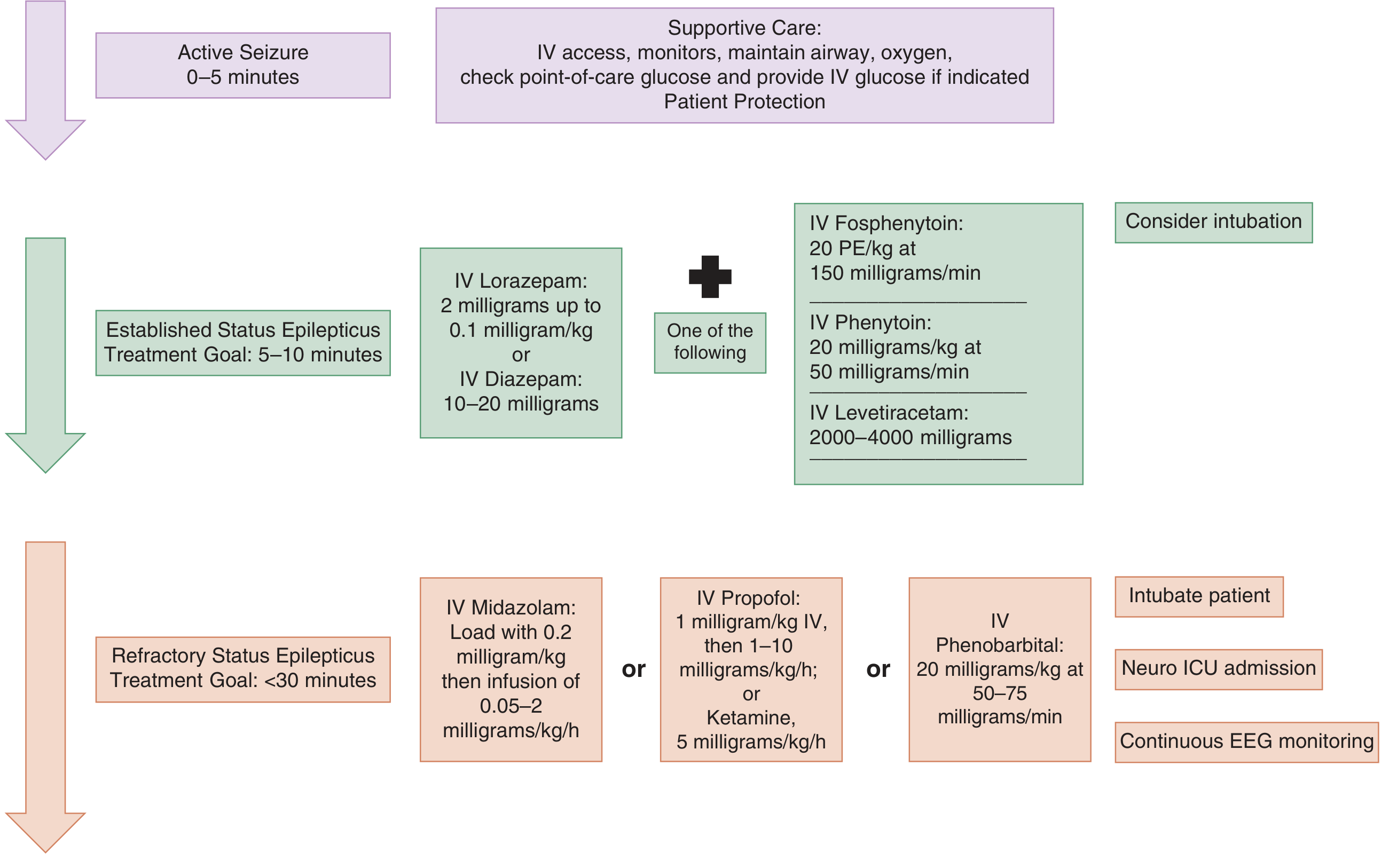
PHASE 1 (0-5 min) - You should have done this
- IV access, O₂, monitors, glucose check
- Patient protection from injury
PHASE 2 (5-20 min) - Established Status Epilepticus
| Drug | Dose | Notes |
|---|---|---|
| IV Lorazepam | 2-4 mg (0.1 mg/kg) IV | First-line benzodiazepine; preferred if IV access available |
| OR IV Diazepam | 10-20 mg | Shorter duration than lorazepam |
| OR IM Midazolam | 10 mg IM | If no IV access; proven non-inferior to lorazepam |
You gave "2cc Midaz" - if this was 2mg IV (1mg/mL), the dose was inadequate. Midazolam at the correct SE dose is 10 mg IM or 5-10 mg IV, repeatable at 5 min intervals.
| Drug | Loading Dose | Notes |
|---|---|---|
| Fosphenytoin/Phenytoin | 20 mg PE/kg IV at 150 mg/min | Monitor ECG - arrhythmia risk |
| Levetiracetam | 2,000-4,500 mg IV | You already gave this - was dose adequate? |
| Valproate | 20-40 mg/kg IV | You gave 1g - for a 60 kg patient, full dose = 1.2-2.4g |
| Phenobarbital | 20 mg/kg IV at 50-75 mg/min | Very effective; causes sedation |
| Lacosamide | 200-400 mg IV | Good option; less sedation |
Note on your doses: Valproate 1g is a reasonable starting dose but the upper range is 20-40 mg/kg. For a 60 kg patient that is 1200-2400 mg. Check if the full dose was given slowly over the appropriate time.
PHASE 3 (>20-30 min) - REFRACTORY Status Epilepticus ← WHERE YOUR PATIENT IS NOW
| Drug | Load | Infusion | Notes |
|---|---|---|---|
| IV Midazolam | 0.2 mg/kg IV bolus | 0.05-2 mg/kg/h infusion | Titrate to seizure suppression |
| OR IV Propofol | 1 mg/kg IV | 1-10 mg/kg/h infusion | Propofol infusion syndrome risk >48h |
| OR IV Phenobarbital | 20 mg/kg at 50-75 mg/min | 50-100 mg IV q12h | Highly effective; causes respiratory depression |
| OR Ketamine | 1-3 mg/kg IV bolus | 5 mg/kg/h infusion | NMDA antagonist; especially useful in refractory cases; may be neuroprotective |
PARALLEL WORKUP - WHY IS SHE STILL SEIZING?
Immediate Investigations to Order Now:
┌────────────────────────────────────────────────────────────────┐
│              MANDATORY WORKUP - DO THESE STAT                  │
├────────────────────────────────────────────────────────────────┤
│ 1. BLOOD GLUCOSE (point of care, immediate)                    │
│ 2. SERUM ELECTROLYTES: Na, K, Ca, Mg, Phosphate               │
│    - Hyponatremia, hypocalcemia, hypomagnesemia all cause      │
│      refractory seizures - CORRECT AGGRESSIVELY                │
│ 3. SERUM VALPROATE LEVEL + LEVETIRACETAM LEVEL                 │
│    - Was the patient compliant before? Sub-therapeutic?        │
│ 4. SERUM AMMONIA (if on valproate - risk of hyperammonemia)    │
│ 5. URINE DRUG SCREEN / TOXICOLOGY                              │
├────────────────────────────────────────────────────────────────┤
│              NEXT TIER (Once Stable / Intubated)               │
├────────────────────────────────────────────────────────────────┤
│ 6. MRI BRAIN (with FLAIR, DWI, contrast)                       │
│    - Look for: cortical lesion, mesial temporal sclerosis,     │
│      encephalitis (FLAIR hyperintensity), stroke, tumor        │
│    - CT brain if MRI not immediately available                 │
│ 7. CONTINUOUS EEG MONITORING                                   │
│    - Define seizure type and subclinical activity              │
│    - Guide titration of anesthetic infusion                    │
│    - Rule out non-convulsive SE when paralyzed/sedated         │
│ 8. LUMBAR PUNCTURE (after CT rules out raised ICP)             │
│    - CSF: cell count, protein, glucose, culture, PCR           │
│    - HSV encephalitis: start IV Acyclovir empirically          │
│    - Send: CSF NMDA-R antibodies, LGI1, CASPR2, GABA-B         │
│ 9. SERUM AUTOIMMUNE PANEL                                      │
│    - Anti-NMDA receptor, Anti-LGI1, Anti-CASPR2, Anti-AMPA    │
│    - Anti-GAD65, paraneoplastic panel (Anti-Hu, Anti-Yo)       │
│10. CT CHEST/ABDOMEN/PELVIS (if autoimmune suspected)           │
│    - Screen for occult malignancy (teratoma, thymoma, lymphoma)│
└────────────────────────────────────────────────────────────────┘
Why This Matters - The "New Refractory Seizures in Known Epileptic" Differential:
MOST COMMON CAUSES (Rule out systematically):

✦ MEDICATION NON-COMPLIANCE / SUBTHERAPEUTIC LEVELS
  → Check drug levels; ask about missed doses

✦ METABOLIC DERANGEMENT
  → Hyponatremia (Na < 130), hypoglycemia, hypocalcemia,
     hypomagnesemia, uremia

✦ SLEEP DEPRIVATION / INTERCURRENT ILLNESS / FEVER
  → Seizure threshold lowered; treat underlying cause

✦ DRUG INTERACTION / NEW MEDICATION
  → Any new drug started recently? Fluoroquinolones,
     antipsychotics, tramadol, isoniazid all lower seizure threshold

✦ CNS INFECTION
  → Bacterial meningitis, viral encephalitis (HSV),
     TB meningitis - DO lumbar puncture + empiric Acyclovir

✦ AUTOIMMUNE ENCEPHALITIS (KEY CONSIDERATION)
  → Anti-NMDA receptor encephalitis: most common autoimmune cause
     of refractory SE (accounts for ~40% of NORSE cases)
  → Can occur even in patients with KNOWN epilepsy
  → Symptoms: psychiatric changes, autonomic instability,
     movement disorders, refractory seizures
  → MRI: may show mesial temporal FLAIR hyperintensity
  → CSF: mild pleocytosis, elevated protein
  → EEG: "extreme delta brush" pattern is characteristic
  → TREATMENT: IV Methylprednisolone 1g/day x 5 days
                + IVIG 2 g/kg over 5 days
                + Plasmapheresis if no response

✦ STRUCTURAL LESION (NEW)
  → Stroke, bleed, tumor - needs urgent CT/MRI

✦ PNES (Psychogenic Non-Epileptic Seizures)
  → No EEG correlate, no post-ictal phase, no response to AEDs
  → Diagnosis of exclusion; video-EEG helpful
SPECIFIC FLAG: Start Empiric IV Acyclovir Now if Encephalitis Suspected
- IV Acyclovir 10 mg/kg q8h for suspected HSV encephalitis
- IV Ceftriaxone 2g q12h + IV Ampicillin 2g q4h if bacterial meningitis in differential
SUMMARY - YOUR IMMEDIATE ACTION PLAN
RIGHT NOW:
□ Call Neurology + ICU
□ Check bedside glucose STAT
□ Give adequate IV Lorazepam (4 mg IV) or repeat Midazolam properly
   (10 mg IM or 0.1-0.2 mg/kg IV)
□ Check electrolytes - correct hyponatremia/hypocalcemia/hypomagnesemia
□ Prepare for intubation

WITHIN 30 MINUTES:
□ If still seizing after 2 adequate BZD doses + valproate + levetiracetam
   → Intubate + start IV Midazolam infusion (0.2 mg/kg bolus → 0.05-2 mg/kg/h)
   OR IV Propofol 1 mg/kg bolus → infusion
   OR IV Phenobarbital 20 mg/kg

□ Order: CONTINUOUS EEG, MRI brain, LP (after CT), Autoimmune panel
□ Check: Serum valproate level, levetiracetam level, ammonia
□ Transfer: Neuro-ICU

ALSO CONSIDER ADDING (2nd antiepileptic you haven't used):
□ IV Lacosamide 200-400 mg IV (well tolerated, minimal drug interactions)
□ IV Phenobarbital 20 mg/kg (very effective, causes sedation)

IF AUTOIMMUNE ENCEPHALITIS SUSPECTED:
□ Empiric IV Methylprednisolone 1g/day + IVIG 2g/kg
   (Don't wait for antibody results - treatment delay worsens outcome)
Key Point on the Valproate + Levetiracetam Interaction
can i give injection diclofanac in same patient if he complaint about headache
diclofenac NSAID seizure threshold epilepsy valproate drug interaction contraindication
diclofenac NSAIDs lower seizure threshold CNS excitability post-ictal headache management safer alternatives
Can You Give Injection Diclofenac for Headache in This Patient?
Direct Answer: NO - Avoid Diclofenac in this patient
Reasons to AVOID Diclofenac Here
1. Drug Interaction with Sodium Valproate (Most Critical)
Diclofenac (NSAID)
        ↓
Highly protein-bound (>99% albumin binding)
        ↓
Displaces Valproate from protein binding sites
        ↓
FREE Valproate level rises → Valproate TOXICITY
(drowsiness, confusion, tremor, encephalopathy)

AND simultaneously:

NSAIDs inhibit CYP2C9
        ↓
Reduced valproate metabolism
        ↓
Further rise in valproate blood levels
2. NSAIDs Can Lower Seizure Threshold
3. Risk of Gastrointestinal Bleeding
4. Renal Risk in a Hemodynamically Compromised Patient
5. This is Post-Ictal Headache - Not a Primary Headache
What You SHOULD Give Instead
┌──────────────────────────────────────────────────────────────┐
│           SAFE ANALGESICS IN THIS PATIENT                    │
├──────────────────────────────────────────────────────────────┤
│                                                              │
│  FIRST CHOICE:                                               │
│  ✅ Paracetamol (Acetaminophen) 1g IV/oral                  │
│     - Safe with valproate and levetiracetam                 │
│     - No drug interactions in acute setting                  │
│     - No seizure threshold lowering                          │
│     - No GI or renal risk at standard doses                 │
│     - Dose: 1g IV over 15 min (or oral if patient is alert) │
│                                                              │
│  NOTE: Avoid paracetamol excess if on valproate long-term   │
│  (mild CYP interaction at high doses) - standard 1g dose    │
│  is perfectly safe                                           │
│                                                              │
├──────────────────────────────────────────────────────────────┤
│  IF HEADACHE IS SEVERE AND PATIENT IS AWAKE/ALERT:           │
│  ✅ Reassurance + oral fluids + rest                        │
│     Post-ictal headache typically resolves within           │
│     30-60 min of seizure cessation                          │
│                                                              │
├──────────────────────────────────────────────────────────────┤
│  ❌ AVOID:                                                   │
│  - Diclofenac (drug interaction + seizure threshold)        │
│  - Tramadol (DIRECTLY lowers seizure threshold)             │
│  - Ibuprofen (same NSAID concerns as diclofenac)            │
│  - Aspirin (affects platelet function + reye risk)          │
│  - Morphine/Opioids (respiratory depression with Midazolam) │
└──────────────────────────────────────────────────────────────┘
Important Clinical Reminder
Is this headache post-ictal, OR is it a sign of raised intracranial pressure / meningitis / subarachnoid hemorrhage?
- Thunderclap onset ("worst headache of life") → Urgent CT head - rule out SAH
- With fever + neck stiffness → Meningitis - LP + empiric antibiotics
- With papilloedema or focal neurology → Raised ICP - urgent CT before LP
- Post-seizure, gradual, diffuse → Post-ictal headache - Paracetamol 1g IV + reassurance