
Explain ulnar nerve anatomy
Reading File
The ulnar nerve is a major peripheral nerve of the upper limb, arising from the medial cord of the brachial plexus (C8-T1). It runs along the medial aspect of the arm and forearm, passes behind the medial epicondyle ("funny bone"), then enters the hand via Guyon's canal to supply intrinsic hand muscles and sensation to the medial 1.5 fingers.
Searching sources...
Finding Sources
Searching the Web
ulnar nerve anatomy course branches clinical
Good - I'll read the Gray's Anatomy section (best for anatomy) and the Neurology section in parallel.
Reading File
Reading File
Now let me read the hand section and look for images:
Reading File
Reading File
Excellent - I have rich content from Gray's Anatomy. Let me also fetch the two key images found:
Loading Image
Loading Image
I now have comprehensive material from Gray's Anatomy for Students. Here is the full, detailed answer:
Ulnar Nerve Anatomy
Origin and Root Values
The ulnar nerve arises from the medial cord of the brachial plexus, carrying fibers from roots C8 and T1 (with occasional C7 contributions). It is one of the five terminal branches of the brachial plexus.
Course
In the Axilla
The ulnar nerve enters the arm alongside the median nerve and the axillary artery, passing medial to the artery through the proximal regions.
In the Arm
The nerve has no major branches in the arm. It travels posteromedial to the brachial artery, then in the middle of the arm it penetrates the medial intermuscular septum to enter the posterior compartment, where it lies anterior to the medial head of triceps brachii. It then courses posterior to the medial epicondyle of the humerus - the point commonly known as the "funny bone" - before crossing into the anterior compartment of the forearm.
In the Forearm
The ulnar nerve enters the forearm by passing between the humeral and ulnar heads of flexor carpi ulnaris (FCU). It then descends the medial forearm in the plane between:
- Flexor carpi ulnaris (medially)
- Flexor digitorum profundus (laterally/deep)
In the distal forearm, it lies under the lateral lip of the FCU tendon. The ulnar artery accompanies the nerve, running lateral to it in the distal two-thirds of the forearm.
Forearm branches:
- Muscular branches - to FCU and the medial half of flexor digitorum profundus (FDP), arising soon after entering the forearm
- Palmar cutaneous branch - arises in the mid-forearm; supplies skin on the medial side of the palm (hypothenar eminence region)
- Dorsal cutaneous branch - arises in the distal forearm, passes deep to FCU posteriorly; supplies the posteromedial dorsum of the hand and most of the posterior surfaces of the medial 1.5 digits
At the Wrist - Guyon's Canal
The ulnar nerve (with the ulnar artery) enters the hand by passing superficial to the flexor retinaculum, immediately lateral to the pisiform bone. This fibro-osseous tunnel between the pisiform and hamate is called Guyon's canal.
In the Hand
Just distal to the pisiform, the nerve divides into two terminal branches:
Deep branch (mainly motor):
- Penetrates and supplies the hypothenar muscles (abductor digiti minimi, flexor digiti minimi, opponens digiti minimi)
- Arches laterally across the palm deep to the long flexors
- Supplies all interossei (7 in total: 4 dorsal, 3 palmar)
- Supplies adductor pollicis
- Supplies medial two lumbricals (ring and little fingers)
- Contributes articular branches to the wrist joint
- Note: the deep branch passes through a fibro-osseous tunnel between the hook of hamate and the flexor tendons - a site vulnerable to ganglion compression
Superficial branch (mainly sensory):
- Supplies palmaris brevis
- Divides into common and proper digital nerves for the little finger (all surfaces) and the ulnar side of the ring finger
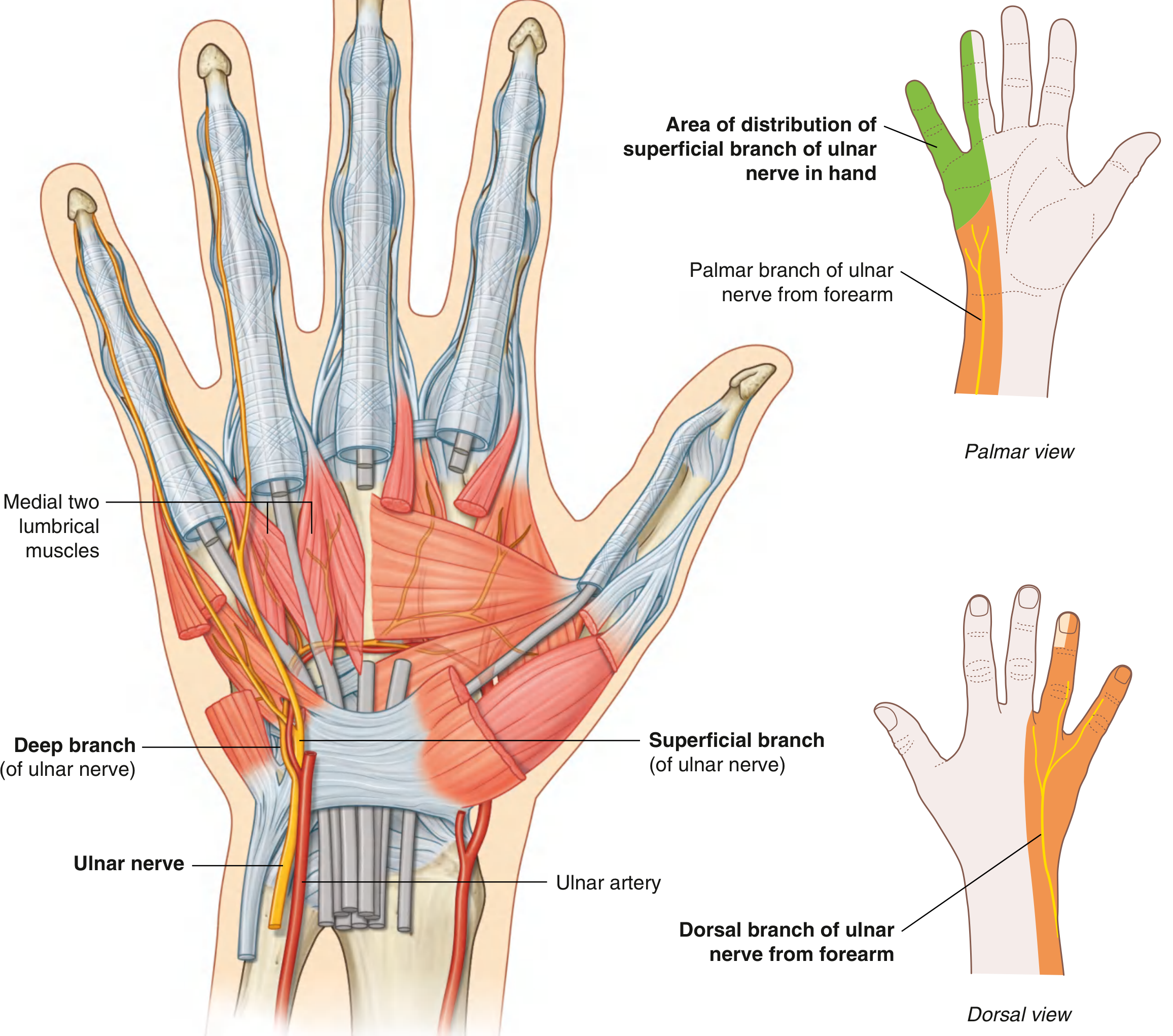
Summary of Motor Supply
| Region | Muscles Innervated |
|---|---|
| Forearm | Flexor carpi ulnaris; medial half of FDP (ring & little fingers) |
| Hypothenar eminence | Abductor digiti minimi, flexor digiti minimi, opponens digiti minimi |
| Deep palm | All interossei (4 dorsal, 3 palmar), adductor pollicis, medial 2 lumbricals |
| Superficial hand | Palmaris brevis |
The ulnar nerve supplies the majority of the intrinsic hand muscles - 15 of the 20 intrinsic muscles.
Sensory Supply
- Palmar surface: little finger and ulnar half of ring finger; medial palm (via palmar branch)
- Dorsal surface: posteromedial hand, little finger, ulnar side of ring finger (via dorsal branch)
- Occasionally extends to supply all of the ring finger and the ulnar side of the middle finger
Clinical Relevance
Two Common Injury Sites
1. At the elbow (cubital tunnel syndrome)
- Nerve lies vulnerable posterior to the medial epicondyle
- Compression here causes loss of FCU, medial FDP, and all intrinsic hand muscles
- Results in: weakness of wrist flexion (ulnar deviation lost), inability to flex ring and little fingertips (FDP), and loss of intrinsic hand muscles
- Sensory loss over medial 1.5 fingers and medial palm
2. At the wrist (Guyon's canal syndrome)
- Compression superficial to the flexor retinaculum near the pisiform
- Spares FCU and medial FDP (forearm branches already given off)
- Primarily affects intrinsic hand muscles
Ulnar Claw Hand
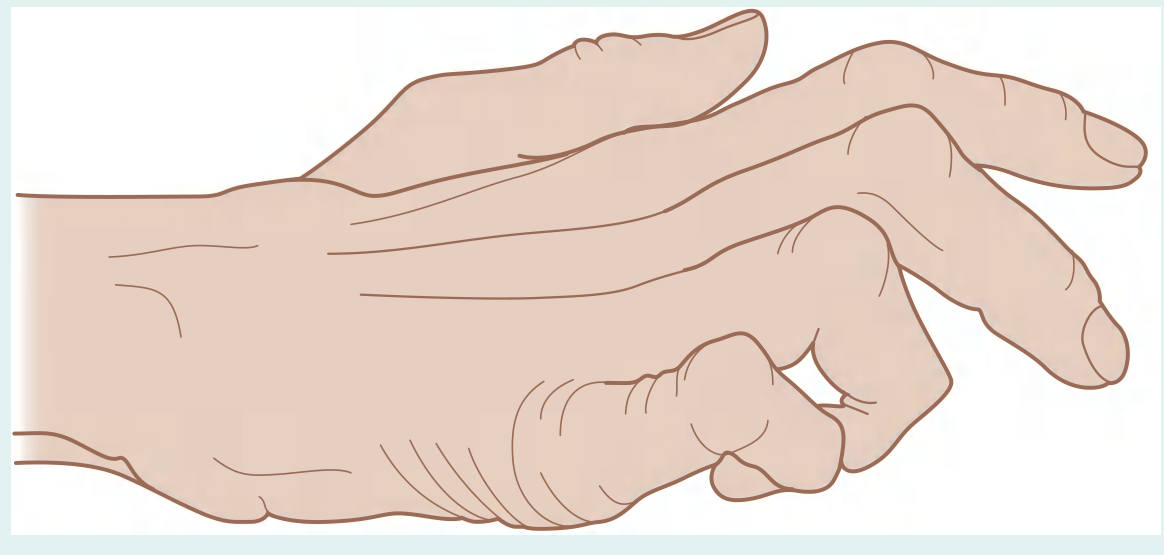
Ulnar nerve palsy produces the characteristic "claw hand" deformity:
- Metacarpophalangeal (MCP) joints hyperextended - because interossei and lumbricals (MCP flexors) are paralyzed
- Interphalangeal (IP) joints flexed - because FDP is unopposed by intrinsics
- Clawing is most pronounced in the ring and little fingers because the lateral two lumbricals (index and middle) are innervated by the median nerve
Paradox of elbow vs. wrist lesions: Clawing is actually worse with wrist lesions than elbow lesions. With an elbow lesion, the medial FDP is also paralyzed - it can no longer flex the DIP joints of ring and little fingers, so the claw is less pronounced. This is the "ulnar paradox".
Additional Clinical Features
- Wasting of the hypothenar eminence and dorsal interosseous spaces (guttering)
- Loss of finger abduction/adduction
- Loss of thumb adduction (positive Froment's sign - compensatory IP flexion of thumb when adducting)
- Sensory loss over the medial 1.5 digits and medial palm
Sources: Gray's Anatomy for Students, pp. 881, 905, 936-937, 952; Roberts and Hedges' Clinical Procedures in Emergency Medicine; StatPearls/NCBI
This is a shared conversation. Sign in to Orris to start your own chat.