
Taste pathway in detail for 20 marks with diagram and flow charts from Scott Brown, Cummings, stell and marans, Zakir Hussain, dhingra, hazarika and related articles with recent advances according to rguhs university
Reading File
Finding Sources
Searching PubMed
"taste" AND "gustatory pathway" AND "central processing"
Searching the Web
taste pathway anatomy gustatory pathway ENT RGUHS 20 marks detailed notes
Finding Sources
Finding Sources
Searching PubMed
"taste" AND "gustatory" AND "recent advances"
Reading File
Finding Sources
Reading File
Finding Sources
Reading File
Reading File
Reading File
Loading Image
Reading File
Finding Sources
Reading Web Page
https://pmc.ncbi.nlm.nih.gov/articles/PMC6989094
Reading File
Reading File
Loading Image
TASTE PATHWAY - Detailed Answer (20 Marks)
RGUHS Standard | Sources: Cummings, Scott-Brown (Stell & Maran Vol 2), Hazarika, Dhingra, Zakir Hussain, Recent PubMed Literature
INTRODUCTION
Taste (gustation) is a special visceral afferent (SVA) sense that allows evaluation of food and drink for nutritional value and toxin avoidance. The gustatory system integrates input from the oral cavity, pharynx, and epiglottis through a hierarchical pathway from peripheral receptor cells to the cerebral cortex.
- Cummings Otolaryngology, p. 1564: "The sensations of flavor while eating are more diverse than those of pure taste and result from the interaction of taste with the smell and texture of food."
- Scott-Brown's Vol 2 (Stell & Maran), p. 1412: Taste mechanisms involve "rather more complex permutations than sweet, bitter, salt and sour. Parallel smell appreciation adds savour to taste."
I. TASTE MODALITIES
Five primary taste qualities are recognized:
| Taste | Stimulus | Transduction Mechanism |
|---|---|---|
| Sweet | Sugars, artificial sweeteners | GPCR - T1R2+T1R3 heterodimer |
| Salty | NaCl (Na+) | ENaC ion channels (amiloride-sensitive) |
| Sour | Acids (H+) | Ion channels + intracellular pH change |
| Bitter | Alkaloids, toxins | GPCR - T2R family (25 receptors) |
| Umami | Glutamate (MSG) | GPCR - T1R1+T1R3 heterodimer |
A possible 6th taste - "Fat taste" (oleogustus) - has been proposed for lipids (Cummings, p. 1564).
II. PERIPHERAL RECEPTOR STRUCTURES
A. Taste Buds
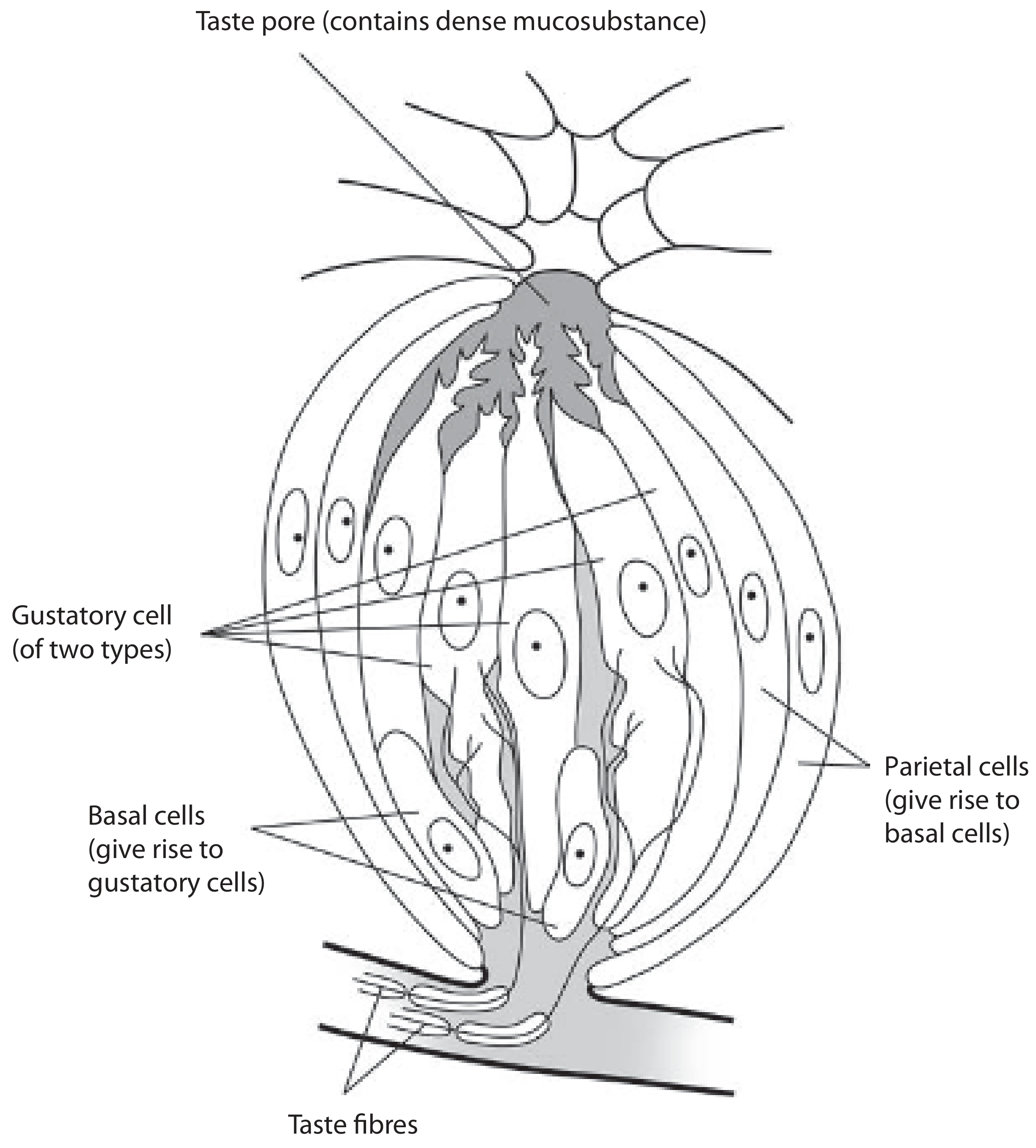
Structure:
- Barrel-shaped cluster of ~50-100 modified epithelial cells
- Open at the surface via a taste pore (containing dense mucosubstance)
- Microvilli (gustatory hairs) project into the pore
- Total ~2,000-5,000 taste buds in the human oral cavity
- Life span: ~10 days (Stell & Maran); ~2 weeks (Cummings)
Three cell types within the taste bud:
TASTE BUD CELL TYPES
├── Parietal (Sustentacular / Type I) cells
│   └── Support cells, give rise to basal cells
├── Basal (Stem) cells
│   └── Progenitor cells; give rise to gustatory cells
└── Gustatory (Receptor / Types II & III) cells
    ├── Type II: Express GPCRs; respond to sweet, bitter, umami
    └── Type III: Ion channel-based; respond to sour; form synapses
(Scott-Brown's Stell & Maran, p. 1412)
B. Tongue Papillae - Sites of Taste Buds
(Cummings, p. 1564 - Table 86.3)
| Papilla Type | Location | Taste Buds | Nerve Supply |
|---|---|---|---|
| Circumvallate (Vallate) | Single row of 7-10, anterior to sulcus terminalis | Present (most numerous per papilla) | CN IX (Glossopharyngeal) |
| Fungiform | Anterior dorsal tongue | Present | Chorda tympani (CN VII) |
| Foliate | Lateral tongue margins | Present | CN VII (anterior) + CN IX (posterior) |
| Filiform | Entire dorsal surface | ABSENT | Trigeminal (tactile only) |
Other sites: Soft palate, epiglottis (posterior surface), posterior pharyngeal wall, upper oesophagus (Stell & Maran, p. 1412). These decrease in number with age at ~1% per annum.
III. PERIPHERAL (AFFERENT) TASTE PATHWAY
FLOWCHART 1: Peripheral Pathway
TASTANT (dissolved in saliva)
         │
         ▼
Binds to TASTE RECEPTOR CELLS via taste pore microvilli
         │
         ▼
SIGNAL TRANSDUCTION (see below)
         │
         ▼
Neurotransmitter release at base of taste bud
         │
    ┌────┴─────────────────────────────┐
    │           CRANIAL NERVES        │
    ▼           ▼                     ▼
  CN VII      CN IX                 CN X
  (Facial)   (Glosso-             (Vagus)
             pharyngeal)
    │           │                     │
Chorda      Posterior                Superior
tympani +   1/3 tongue,              laryngeal
Greater     vallate papillae,        branch
petrosal    palatoglossal folds      │
nerve       (inferior ganglion       Inferior
    │       of IX)                   ganglion
    │           │                    of X (nodose)
Geniculate   Inferior ganglion       │
ganglion     of IX (petrosal)        │
    │           │                    │
    └─────┬─────┘                    │
          ▼                          ▼
     TRACTUS SOLITARIUS (descends in medulla)
          │
          ▼
     NUCLEUS SOLITARIUS (NTS) - Rostral part
     [FIRST SYNAPSE]
Key peripheral nerve details:
CN VII (Facial nerve):
- Chorda tympani: Carries taste from anterior 2/3 tongue (fungiform + foliate papillae). Joins lingual nerve (CN V3), passes through middle ear
- Greater petrosal nerve: Carries taste from soft palate taste buds, via nerve of pterygoid canal (Vidian nerve) → pterygopalatine ganglion → middle/posterior palatine nerves
- Cell bodies: Geniculate ganglion
- (Stell & Maran, p. 1412)
CN IX (Glossopharyngeal nerve):
- Posterior 1/3 tongue (circumvallate papillae), palatoglossal folds, oropharyngeal mucosa
- Cell bodies: Inferior (petrosal) ganglion of CN IX
CN X (Vagus nerve):
- Lowest part of tongue, epiglottis, hypopharynx
- Via superior laryngeal branch (internal branch)
- Cell bodies: Inferior (nodose) ganglion of CN X
- (Stell & Maran, p. 1412; Cummings, p. 1567)
Mnemonic (RGUHS favourite): "2/3 - 1/3 rule" - Anterior 2/3 = CN VII (chorda tympani); Posterior 1/3 = CN IX; Epiglottis/pharynx = CN X
IV. SIGNAL TRANSDUCTION MECHANISMS
(Cummings, pp. 1565-1568)
FLOWCHART 2: Transduction Pathways
SALTY (NaCl)                    SOUR (Acids)
    │                                │
Na+ enters via                  H+ ions enter cell
ENaC channels                   → intracellular pH ↓
(amiloride-sensitive)            → blocks K+ channels
    │                            → depolarization
    ▼                                │
DEPOLARIZATION ──────────────────────┘
    │
    ▼

SWEET / UMAMI / BITTER
    │
Tastant binds GPCR (T1R or T2R)
    │
    ▼
Gα activates → PLCβ2 → IP3
    │
    ▼
IP3 → Ca2+ release from ER
    │
    ▼
TRPM5 channel opens
    │
    ▼
DEPOLARIZATION → ATP release
    │
    ▼
ATP activates P2X receptors on
afferent nerve fibers
| Taste | Receptor Gene Family | Second Messenger |
|---|---|---|
| Sweet | T1R2 + T1R3 (GPCR) | PLC-β2 / IP3 / Ca²⁺ / TRPM5 |
| Umami | T1R1 + T1R3 (GPCR) | PLC-β2 / IP3 / Ca²⁺ / TRPM5 |
| Bitter | T2R1-T2R25 (GPCR, 25 types) | PLC-β2 / IP3 / Ca²⁺ / TRPM5 |
| Salty | ENaC (ion channel) | Direct Na⁺ entry → depolarization |
| Sour | OTOP1 channel + H+ | Direct proton entry → ↓pH → K+ blockade |
(Cummings, p. 1565-1567; Recent PubMed: Taruno & Gordon, Annu Rev Physiol 2023 [PMID: 36332657])
V. CENTRAL GUSTATORY PATHWAY
FLOWCHART 3: Central Pathway - Primates (Including Humans)
NUCLEUS TRACTUS SOLITARIUS (NTS) - Rostral/Gustatory nucleus
[Medulla oblongata - 1st ORDER NEURON ends here]
[Rostral-to-caudal organization: CN VII/IX rostral, CN X caudal]
         │
         ├──► SALIVARY NUCLEI (Superior + Inferior salivatory nuclei)
         │    [Reflex arc: ↑ salivation in response to taste]
         │
         ├──► DORSAL VAGAL NUCLEUS
         │    [Autonomic reflexes: gastric/pancreatic secretion]
         │
         ▼
VENTROPOSTEROMEDIAL NUCLEUS (VPMpc) of THALAMUS
[Medial to oral somatosensory area - 2nd ORDER NEURON ends here]
         │
         ▼
PRIMARY GUSTATORY CORTEX
[Insular-opercular region (Fronto-parietal operculum + Anterior Insula)]
[3rd ORDER NEURON ends here]
         │
         ▼
SECONDARY GUSTATORY CORTEX
[Caudolateral Orbitofrontal Cortex (OFC)]
[Integration: taste + smell + texture = FLAVOR]
         │
         ▼
    ┌────┴────────────────────┐
    ▼                         ▼
HYPOTHALAMUS              AMYGDALA
(Autonomic/metabolic       (Hedonic/emotional
 control)                   attributes of taste)
(Cummings, p. 1568; Scott-Brown Vol 2, p. 1412)
Key Cummings quote (p. 1568): "In primates, taste information projects directly to the gustatory thalamus...From the thalamus, taste information projects to the insular-opercular region of the cortex, which comprises the primary gustatory cortex, and then to a secondary gustatory cortical area located immediately anterior in the caudolateral orbitofrontal cortex. The secondary gustatory cortex projects to several regions of the ventral forebrain, including the hypothalamus and amygdala."
Human Gustatory Cortex Neuroimaging (Cummings, Fig. 86.9):
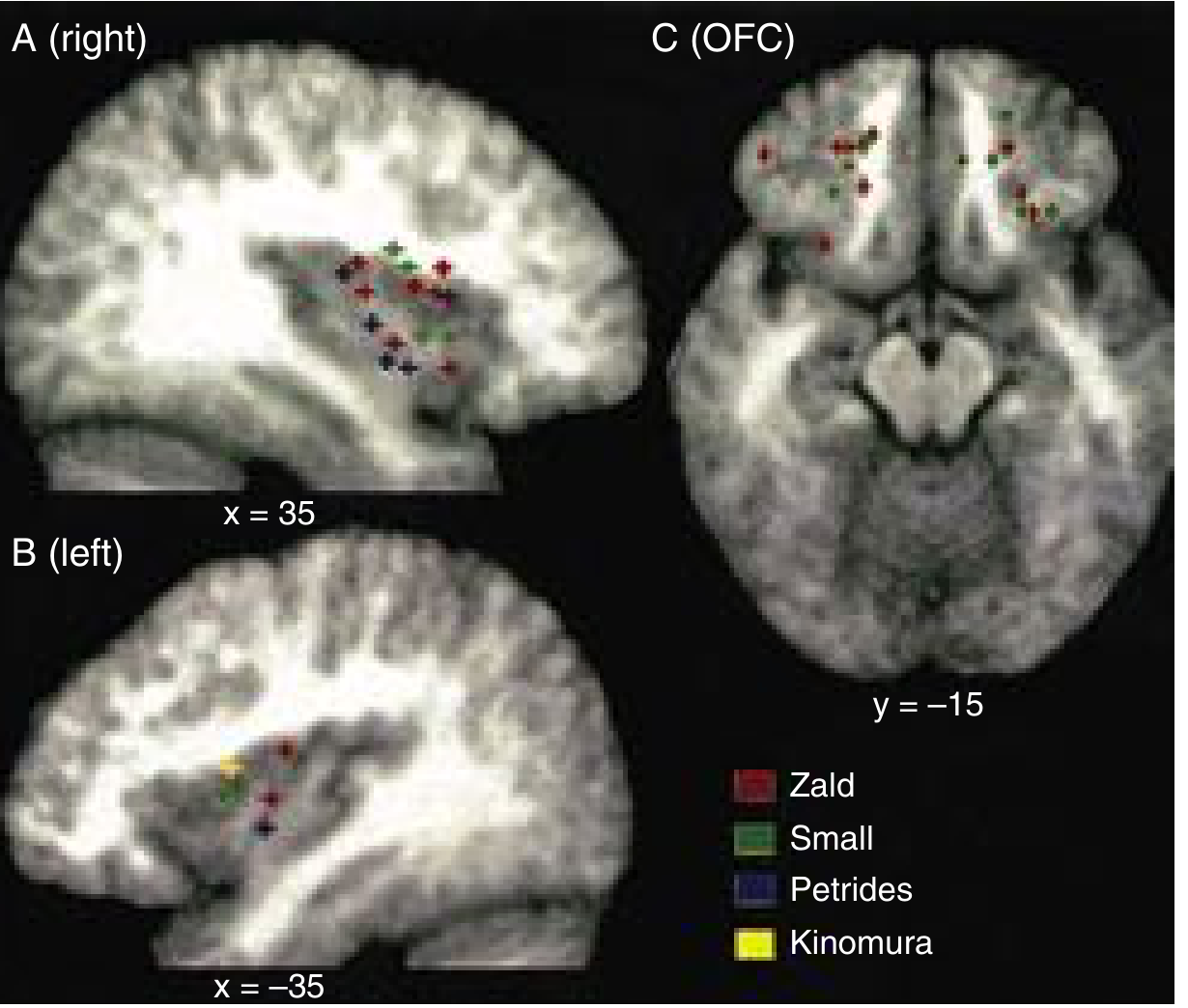
Rodent Pathway Difference (Cummings, p. 1568):
NTS (Medulla)
    │
    ▼ [EXTRA SYNAPSE - not in primates]
PARABRACHIAL NUCLEUS (Pons)
    │
    ├──► VPMpc (Thalamus) → Primary Gustatory Cortex (Insular)
    │    [Perceptual/discriminative pathway]
    │
    └──► AMYGDALA (directly)
         [Hedonic/motivational pathway]
VI. SUMMARY FLOWCHART - COMPLETE TASTE PATHWAY
TASTANT IN ORAL CAVITY
        │
        ▼
TASTE RECEPTOR CELLS in TASTE BUDS
(Circumvallate, Fungiform, Foliate papillae + Palate/Epiglottis/Pharynx)
        │
        ▼
SIGNAL TRANSDUCTION
(ENaC / OTOP1 / T1R/T2R GPCRs → TRPM5 → ATP release)
        │
        ▼
AFFERENT CRANIAL NERVES
┌────────┬────────────┬──────────┐
│ CN VII │   CN IX    │  CN X    │
│Chorda  │Glosso-     │Vagus     │
│tympani │pharyngeal  │(sup.     │
│+Gr.Pet.│            │laryngeal)│
└───┬────┴──┬─────────┴───┬──────┘
    │       │             │
Geniculate Inferior      Nodose
ganglion   ganglion (IX)  ganglion (X)
    │       │             │
    └───────┴─────────────┘
                │
                ▼
       TRACTUS SOLITARIUS
       (Descends in medulla)
                │
                ▼
    NUCLEUS SOLITARIUS (NTS)
    [Rostral = gustatory nucleus]
    [1ST CENTRAL SYNAPSE]
                │
    ┌───────────┼─────────────┐
    ▼           ▼             ▼
Salivary     Dorsal       MEDIAL
nuclei       vagal        LEMNISCUS
(reflex)     nucleus
             (autonomic)   │
                           ▼
              VPMpc of THALAMUS
              [2ND CENTRAL SYNAPSE]
                           │
                           ▼
              PRIMARY GUSTATORY CORTEX
              (Insula + Fronto-parietal operculum)
              [3RD CENTRAL SYNAPSE]
                           │
                           ▼
              SECONDARY GUSTATORY CORTEX
              (Caudolateral Orbitofrontal Cortex)
                           │
              ┌────────────┴────────────┐
              ▼                         ▼
         HYPOTHALAMUS               AMYGDALA
    (Feeding, metabolic         (Hedonic value,
     homeostasis)                food aversion/preference)
VII. REFLEXES MEDIATED BY TASTE PATHWAY
(Cummings, p. 1568)
- Salivary reflex: NTS → Superior + Inferior salivatory nuclei → ↑ salivation
- Gastric reflex: NTS → Dorsal vagal nucleus → ↑ gastric acid/pepsin secretion
- Pancreatic reflex: NTS → Dorsal vagal nucleus → ↑ pancreatic enzyme secretion
- Cephalic phase response: Anticipatory digestive secretions triggered by taste signals
VIII. CODING THEORIES
| Theory | Description | Current Status |
|---|---|---|
| Labeled-line coding | Each taste quality has dedicated nerve fibers | Supported by GPCR receptor specificity |
| Across-fiber (population) coding | Taste quality determined by pattern across many fibers | Also supported; explains complex tastes |
| Temporal coding | Time-dependent firing patterns encode taste identity | Emerging evidence from GC recordings |
(Cummings, p. 1569; [PMC6989094 - Central taste anatomy and physiology, Frontiers in Neuroscience 2020])
IX. RECENT ADVANCES (RGUHS 2023-2026)
(PubMed literature, date_range 2022-2026)
1. OTOP1 as the Sour Receptor (Major Advance)
- Otopetrin-1 (OTOP1) channel identified as the definitive proton channel for sour taste transduction. It gates protons (H+) directly, lowering intracellular pH and depolarizing Type III taste cells.
2. ENaC Second Subunit Identified for Salt
- The complete molecular composition of the amiloride-sensitive ENaC responsible for salty taste transduction has been further characterized - (Taruno & Gordon, Annu Rev Physiol 2023 [PMID: 36332657]).
3. Extragustatory Bitter Taste Receptors (T2Rs) in Head & Neck
- T2R receptors are expressed in airway epithelium, sinonasal mucosa, and middle ear - relevant to ENT practice. They mediate innate immune responses (antimicrobial peptide release, ciliary beat frequency) independent of classic taste function. (Harris, Lee & Carey, J Mol Med 2024 [PMID: 39317733]).
4. State-Dependent Taste Modulation
- Hunger, satiety, and internal metabolic state dynamically modify taste responses via genetically-defined neurons in the hypothalamus projecting back to NTS and gustatory cortex (Nakajima, Physiol Rep 2024 [PMID: 39523492]).
5. Gustatory Cortex as Multisensory Integrator
- The GC (insular cortex) is no longer viewed as a purely gustatory area. It processes somatosensory (texture, temperature), olfactory, and visceral signals simultaneously. Flavor perception is now understood as a distributed network across GC, piriform cortex, and OFC (Vincis & Fontanini, 2016; PMC6989094).
6. COVID-19 and Taste Loss
- Post-COVID ageusia/dysgeusia provided new insights into taste pathway vulnerability. Direct viral involvement of taste receptor cells (ACE2 receptor expression on taste buds) and retrograde neuronal damage via CN VII are proposed mechanisms.
7. Nucleus Accumbens Shell (NAcSh) - Descending Inhibition
- The NAcSh provides descending inhibitory modulation of brainstem taste reflexes, explaining how higher cortical/motivational states suppress or amplify gustatory responses.
X. CLINICAL CORRELATES (RGUHS Exam Perspective)
| Lesion Site | Effect on Taste |
|---|---|
| Chorda tympani (middle ear surgery) | Loss of taste, anterior 2/3 tongue (ipsilateral) |
| Bell's palsy (CN VII) | Dysgeusia/ageusia, anterior 2/3 ipsilateral tongue; "metallic taste" (Stell & Maran, p. 1412) |
| Glossopharyngeal nerve lesion | Loss of taste, posterior 1/3 tongue |
| NTS lesion (medullary stroke) | Complete ipsilateral taste loss + contralateral body sensory loss |
| Thalamic lesion (VPMpc) | Contralateral hemigustatory loss |
| Insular cortex lesion | Cortical ageusia (contralateral) |
| Anosmia | Perceived "taste loss" (actually flavor loss); patients describe food as "cardboard" (Stell & Maran) |
REFERENCES (Standard ENT Textbooks)
-
Cummings Otolaryngology Head and Neck Surgery, 7th ed. - Chapter 86: Gustatory Sensitivity, Gustatory Structures, Gustatory Transduction, Central Gustatory Pathways and Function (pp. 1564-1572) - Primary ENT reference for taste
-
Scott-Brown's Otorhinolaryngology, Head & Neck Surgery (Stell & Maran, Vol 2) - Chapter 111: Taste Mechanisms (pp. 1411-1412) - Peripheral anatomy and clinical correlation
-
Scott-Brown's Vol 1 - Chapter 110: Sense of Taste and Retronasal Olfaction
-
Dhingra PL - "Diseases of Ear, Nose and Throat" - Taste described under anatomy of tongue and chorda tympani; facial nerve and taste disturbance
-
Hazarika P - "Textbook of Ear, Nose and Throat Diseases" - Taste anatomy under physiology of tongue
-
Zakir Hussain - Indian ENT standard; taste pathway covered under Physiology of Nose and Special Senses
-
K.J. Lee's Essential Otolaryngology - Available in library (ISBN 9781260122237) - Taste under cranial nerve examination
-
Taruno A, Gordon MD. "Molecular and Cellular Mechanisms of Salt Taste." Annu Rev Physiol 2023. [PMID: 36332657]
-
Harris JC, Lee RJ, Carey RM. "Extragustatory bitter taste receptors in head and neck health and disease." J Mol Med 2024. [PMID: 39317733]
-
Nakajima KI. "Recent advances in genetically defined neurons that regulate internal-state-dependent taste modification." Physiol Rep 2024. [PMID: 39523492]
QUICK RECALL MNEMONIC (RGUHS Exam)
"7-9-10 to NST-T-I-O"
- 7 (VII) = Anterior 2/3 tongue (Chorda tympani + Greater petrosal → Geniculate ganglion)
- 9 (IX) = Posterior 1/3 tongue + vallate (Inferior petrosal ganglion)
- 10 (X) = Epiglottis + pharynx (Nodose ganglion)
- NST = Nucleus Solitarius (1st synapse, medulla)
- T = Thalamus - VPMpc (2nd synapse)
- I = Insula (Primary Gustatory Cortex, 3rd synapse)
- O = Orbitofrontal Cortex (Secondary Gustatory Cortex)
This is a shared conversation. Sign in to Orris to start your own chat.