
To determine the concentration of the serum by Liebermann-Burchard colorimetric method. Mathod of preparation in easy step and in easy language to learn reagent are Reagents are absolute alcohol, diethyl ether, acetic anhydride, standard solution of cholesterol.
Liebermann-Burchard colorimetric method cholesterol serum preparation procedure
https://pmc.ncbi.nlm.nih.gov/articles/PMC6815567
Liebermann-Burchard Colorimetric Method - Serum Cholesterol Estimation
What is This Test?
Principle (in simple words)
Reagents You Need
| Reagent | Purpose |
|---|---|
| Absolute alcohol (ethanol) | Dissolves serum lipids; removes water |
| Diethyl ether | Extracts cholesterol from serum |
| Acetic anhydride | Part of the color-developing reagent |
| Standard cholesterol solution | Known concentration for comparison |
| Concentrated sulfuric acid (H₂SO₄) | Part of the L-B reagent (color developer) |
| Glacial acetic acid | Often added as a diluent/stabilizer |
Note: Although not listed in your reagents, concentrated sulfuric acid is required to develop the color - it is always part of the L-B reagent. Glacial acetic acid is also typically used.
Preparation of Reagents - Step by Step
Step 1 - Prepare the Liebermann-Burchard (L-B) Reagent
- 1 part acetic anhydride
- 1 part glacial acetic acid (if using)
- Small amount of concentrated sulfuric acid (added last, drop by drop)
- Take a clean, dry glass tube or flask. Moisture ruins this reagent.
- Add 10 parts acetic anhydride into the tube. Keep it in an ice bath.
- Slowly and carefully, add 1 part concentrated sulfuric acid drop by drop while mixing gently.
- The mixture will heat up - this is normal. Keep cooling in ice.
- The final reagent should be clear and colorless.
- Use it fresh - prepare it just before use, or store in the dark at 4°C for a short time.
Safety tip: Always add acid to anhydride, never anhydride to acid. Keep away from water.
Step 2 - Prepare the Standard Cholesterol Solution
- Weigh out 100 mg of pure cholesterol accurately.
- Dissolve in absolute alcohol in a 100 mL volumetric flask.
- Make up to 100 mL with absolute alcohol. This gives 1 mg/mL.
- Dilute the stock in absolute alcohol to make concentrations like: 50, 100, 150, 200, 250 mg/dL.
- Use these to plot a calibration graph.
Step 3 - Prepare the Serum Sample (Extraction)
- Take 0.1 mL of serum in a clean, dry test tube.
- Add 2 mL of absolute alcohol - this precipitates proteins and releases lipids.
- Mix well and centrifuge for 5 minutes (or filter).
- Take the clear supernatant (alcoholic extract).
Some methods use a diethyl ether-alcohol mixture (3:1) for better extraction of cholesterol esters.
Step 4 - Color Development (The Reaction)
- Take the clear extract (0.5 or 1 mL) in a clean dry tube.
- Allow alcohol/ether to evaporate completely (or use a water bath at 37°C) - the tube must be completely dry.
- Dissolve the residue in 2 mL of glacial acetic acid.
- Add 2 mL of freshly prepared L-B reagent (acetic anhydride + H₂SO₄).
- Mix gently and let stand at room temperature (25°C) for 30-35 minutes in the dark.
- The solution turns blue-green.
Do not expose to light during incubation - it affects the color.
Step 5 - Measurement
- Read absorbance at 620 nm (or 640 nm) in a colorimeter or spectrophotometer.
- Use a reagent blank (all reagents but no sample) to zero the instrument.
- Run the standard alongside the test.
Calculation
Setting Up the Tubes - Quick Reference Table
| Tube | Serum | Standard | Absolute Alcohol | L-B Reagent |
|---|---|---|---|---|
| Blank | - | - | 0.5 mL | 2 mL |
| Standard | - | 0.5 mL | - | 2 mL |
| Test | 0.1 mL serum extract | - | - | 2 mL |
Key Points to Remember
- No water anywhere - water gives a brown/turbid color and ruins the test.
- Temperature matters - do the reaction at 25°C. Higher temperature speeds up color fading.
- Time matters - read between 30-35 minutes at 25°C (color fades after ~40 minutes).
- Make L-B reagent fresh each time if possible.
- Protect from light during color development.
- Normal serum cholesterol: 150-200 mg/dL (desirable range).
Why This Method Uses These Reagents
| Reagent | Why it's used |
|---|---|
| Absolute alcohol | Removes water from serum; precipitates proteins; dissolves cholesterol |
| Diethyl ether | Better lipid extraction; more complete recovery of cholesterol esters |
| Acetic anhydride | Reacts with cholesterol to form the colored compound |
| Standard cholesterol | Known reference point for calculating unknown concentration |
| H₂SO₄ (sulfuric acid) | Catalyst for the color reaction; produces the characteristic green color |
Make a flowchart poster of the complete procedure steps
A professional scientific flowchart poster titled "Liebermann-Burchard Colorimetric Method for Serum Cholesterol Estimation". Clean lab/medical style with a dark navy blue background and white/yellow/green text and boxes. The flowchart flows top to bottom with arrows connecting each step. Include these numbered steps as rounded rectangle boxes connected by downward arrows: TITLE at top (large, bold, white): "Liebermann-Burchard Colorimetric Method" subtitle "Serum Cholesterol Estimation" Then a horizontal row of 3 colored boxes labeled "REAGENTS REQUIRED": Absolute Alcohol | Diethyl Ether | Acetic Anhydride | Standard Cholesterol Solution | Conc. H₂SO₄ Then the flowchart steps in order: STEP 1 (blue box): "Prepare L-B Reagent" - "Mix acetic anhydride + glacial acetic acid in ice bath → Add conc. H₂SO₄ drop by drop → Keep cool. Use fresh." Arrow down STEP 2 (teal box): "Prepare Standard Cholesterol Solution" - "Dissolve 100 mg cholesterol in absolute alcohol → Make up to 100 mL (1 mg/mL stock) → Dilute to working standards: 50, 100, 150, 200 mg/dL" Arrow down STEP 3 (green box): "Extract Serum Sample" - "Take 0.1 mL serum → Add 2 mL absolute alcohol → Mix well → Centrifuge 5 min → Collect clear supernatant" Arrow down STEP 4 (yellow-green box): "Evaporate Solvent" - "Evaporate alcohol/ether completely (37°C water bath) → Tube must be completely DRY → No moisture allowed!" Arrow down STEP 5 (orange box): "Color Development Reaction" - "Dissolve residue in 2 mL glacial acetic acid → Add 2 mL fresh L-B reagent → Mix gently → Incubate at 25°C for 30-35 min in dark → Blue-green color develops" Arrow down STEP 6 (red-orange box): "Measure Absorbance" - "Read at 620 nm (colorimeter) → Zero with reagent blank → Run standard alongside test" Arrow down STEP 7 (gold box): "Calculate Concentration" - "Cholesterol (mg/dL) = (Absorbance of Test ÷ Absorbance of Standard) × Standard Concentration" At the bottom a highlighted box: "Normal Serum Cholesterol: 150–200 mg/dL" Key notes panel on the side: "⚠ No water contact | ⏱ Read at 30-35 min | 🌡 Maintain 25°C | 🔆 Protect from light" Overall style: clean, professional, academic laboratory poster with icons for each step, clear arrows, good spacing, suitable for printing as A3/A4 poster
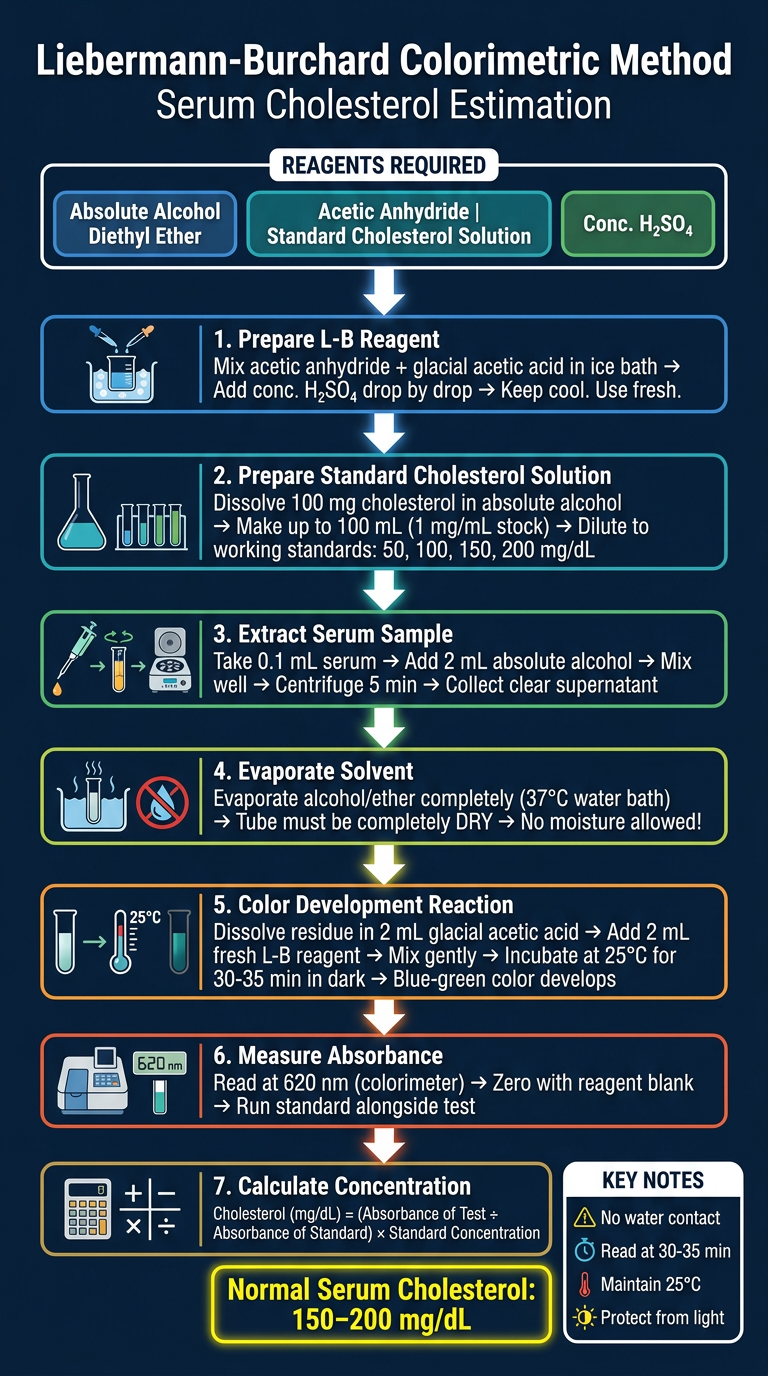
- Prepare L-B Reagent - acetic anhydride + H₂SO₄ in ice bath
- Prepare Standard Cholesterol Solution - stock and working dilutions
- Extract Serum Sample - alcohol precipitation + centrifuge
- Evaporate Solvent - completely dry tube
- Color Development - add L-B reagent, incubate 30-35 min at 25°C in dark
- Measure Absorbance - read at 620 nm
- Calculate Concentration - using the standard formula
To determine the polaride content in urine, the reagents are standard silver nitrate solution, standard potassium thiocyanate solution, ferric ammonium sulfate, and concentrated nitric acid. How is the process proceeded to make a flow chart representing all such like you have made upper case of the experiment of cholesterol, same as that flow chart.
Volhard method chloride determination urine silver nitrate potassium thiocyanate ferric ammonium sulfate procedure steps
To determine the colaride content in urine, the reagents are standard silver nitrate solution, standard potassium thiocyanate solution, ferric ammonium sulfate, and concentrated nitric acid. How is the process proceeded to make a flow chart representing all such like you have made upper case of the experiment of cholesterol, same as that flow chart.
A professional scientific flowchart poster titled "Volhard's Back-Titration Method" with subtitle "Determination of Chloride Content in Urine". Clean lab/medical style with a dark navy blue background, white and colored text and boxes, matching the style of a Liebermann-Burchard cholesterol flowchart poster. TOP SECTION: - Large bold white title: "Volhard's Back-Titration Method" - Subtitle in yellow: "Determination of Chloride (Cl⁻) Content in Urine" - A colored horizontal banner showing REAGENTS REQUIRED with 4 labeled pill-shaped badges: [Standard AgNO₃ Solution] [Standard KSCN Solution] [Ferric Ammonium Sulfate] [Conc. Nitric Acid (HNO₃)] PRINCIPLE BOX (light teal outlined box): "Cl⁻ + Excess AgNO₃ → AgCl↓ (white precipitate) + Excess Ag⁺ Excess Ag⁺ + KSCN → AgSCN SCN⁻ + Fe³⁺ → [FeSCN]²⁺ (Blood-red color = End Point)" Then the main flowchart with 7 steps flowing top to bottom with thick downward arrows between each step: STEP 1 (bright blue rounded box): "🧪 Collect & Prepare Urine Sample" "Take 1 mL of fresh urine in a conical flask Add 5 mL of distilled water to dilute Mix gently" ↓ arrow STEP 2 (teal rounded box): "⚗️ Acidify with Conc. HNO₃" "Add 2–3 mL of concentrated nitric acid Acidification prevents Fe³⁺ hydrolysis Ensures reaction occurs in acidic medium only" ↓ arrow STEP 3 (green rounded box): "🔬 Add Excess Standard AgNO₃" "Add known excess volume of standard AgNO₃ solution (e.g. 10 mL of 0.1N) Cl⁻ ions precipitate as white AgCl↓ Ensure AgNO₃ is in EXCESS of chloride present" ↓ arrow STEP 4 (yellow-green rounded box): "🌡️ Filter / Protect AgCl Precipitate" "Filter off AgCl precipitate OR Add 1 mL nitrobenzene to coat AgCl This prevents AgCl from reacting with KSCN (back-reaction error)" ↓ arrow STEP 5 (orange rounded box): "🔴 Add Ferric Ammonium Sulfate Indicator" "Add 1–2 mL of ferric ammonium sulfate solution Fe³⁺ acts as indicator Solution appears yellow-brown at this stage" ↓ arrow STEP 6 (red-orange rounded box): "🔁 Back-Titrate with Standard KSCN" "Fill burette with standard KSCN (0.1N) Titrate excess Ag⁺ with KSCN drop by drop End Point = Permanent blood-red / brick-red color [FeSCN]²⁺ complex forms → Record burette reading (V₁)" ↓ arrow STEP 7 (gold rounded box): "🧮 Calculate Chloride Content" "mEq of Cl⁻ = (mEq AgNO₃ added) − (mEq KSCN used) Chloride (mEq/L) = [(V_AgNO₃ × N_AgNO₃) − (V_KSCN × N_KSCN)] × 1000 / Volume of urine (mL) Normal urine chloride: 110–250 mEq/24 hours" BOTTOM PANEL (dark highlighted box): "Normal Value: 110–250 mEq/24 hrs | End Point: Permanent Blood-Red Color | Keep reaction in ACIDIC medium" RIGHT SIDE NOTES PANEL (vertical, warning yellow): "⚠ KEY POINTS: • Add AgNO₃ BEFORE HNO₃ • Always use EXCESS AgNO₃ • Protect from light (AgNO₃ is light-sensitive) • Filter AgCl or add nitrobenzene before back-titration • Read at permanent color change only" Overall style: clean, bold, academic lab poster, dark navy background, colored step boxes, white text, professional arrows, suitable for A3 print
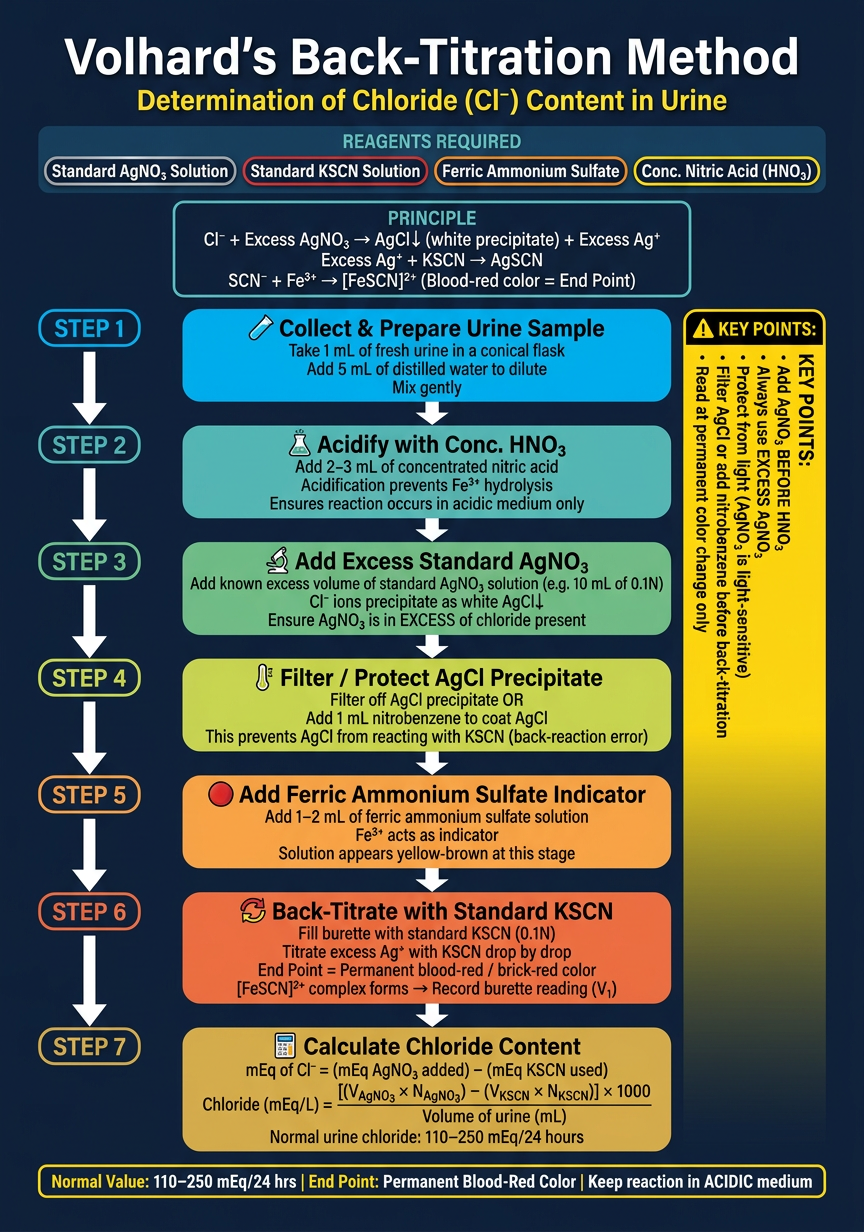
| Step | Action |
|---|---|
| 1 | Collect urine sample + dilute with distilled water |
| 2 | Acidify with conc. HNO₃ (prevents Fe³⁺ hydrolysis) |
| 3 | Add known excess standard AgNO₃ → AgCl white precipitate forms |
| 4 | Filter AgCl OR add nitrobenzene to protect it from back-reaction |
| 5 | Add ferric ammonium sulfate as indicator (Fe³⁺) |
| 6 | Back-titrate excess Ag⁺ with standard KSCN → end point = permanent blood-red color |
| 7 | Calculate: Cl⁻ (mEq) = mEq AgNO₃ added - mEq KSCN used |