
Serological markers for hepatitis b for saq from harsh mohan or robbins
Reading File
Now let me search both textbooks simultaneously for hepatitis B serological markers.
Finding Sources
Finding Sources
Let me search specifically for Harsh Mohan and Robbins books on hepatitis B.
Finding Sources
Finding Sources
I have Robbins & Kumar Basic Pathology and Robbins, Cotran & Kumar (Pathologic Basis of Disease). Let me search for hepatitis B serology in both Robbins books simultaneously.
Finding Sources
Finding Sources
Reading File
Reading File
Good - I have the Robbins content. Let me read more of Robbins Cotran (the larger one) for the serology section, and also look for serology images.
Reading File
Reading File
Excellent! I have the key serology content. Now let me also read earlier part of Robbins Basic Path for the serological markers section, and fetch the serology graph image.
Reading File
Loading Image
I now have all the content I need from Robbins Basic Pathology (Robbins & Kumar) and Robbins Cotran (Pathologic Basis of Disease), plus the classic serology graph. Note: Harsh Mohan's textbook is not in the library, but both Robbins books are available. Let me now read the remaining serology content from Robbins Basic Pathology.
Reading File
I now have all the content needed. Let me compile the comprehensive SAQ-style answer from Robbins.
Serological Markers of Hepatitis B Virus (HBV) Infection
Note: Harsh Mohan's textbook of pathology is not in the library, but both major Robbins books are available. The content below is drawn from Robbins & Kumar Basic Pathology (Fig. 14.10) and Robbins, Cotran & Kumar Pathologic Basis of Disease (Fig. 18.11), which contain identical, authoritative detail on this topic.
HBV Antigens and Proteins
The HBV genome has four open reading frames encoding:
| Protein | Description |
|---|---|
| HBsAg | Hepatitis B surface antigen - envelope glycoprotein; three forms (large, middle, small) |
| HBcAg | Hepatitis B core antigen - nucleocapsid protein; stays in hepatocytes, not detectable in serum |
| HBeAg | Secreted from the precore region; detected in serum; marker of active replication |
| HBV DNA polymerase | Reverse transcriptase activity; detected with active replication |
| HBx protein | Transcriptional activator; implicated in hepatocellular carcinoma |
Serological Markers - Detailed
1. HBsAg (Hepatitis B Surface Antigen)
- First marker to appear in serum, even before onset of symptoms (during incubation period)
- Peaks during acute symptomatic disease
- In self-limiting infection: declines to undetectable by 12 weeks (may persist up to 24 weeks)
- In chronic infection: persists indefinitely - the hallmark of chronic HBV
- Used for: diagnosis, blood bank screening, vaccination target
2. Anti-HBs (Antibody to HBsAg)
- Appears after resolution of acute disease, usually weeks to months after HBsAg disappears
- Indicates recovery and immunity
- Persists for life - basis of vaccination (HBsAg-containing vaccines)
- NOT produced in chronic HBV infection
- "Window period": gap between disappearance of HBsAg and appearance of anti-HBs - diagnosed in this period by IgM anti-HBc
3. HBeAg (Hepatitis B e Antigen)
- Appears in serum shortly after HBsAg (early in infection)
- Marker of active viral replication and high infectivity
- Persistence of HBeAg = strong indicator of progression to chronic hepatitis
- In resolved infection, it disappears as the infection peaks and wanes
- Caveat: HBeAg-negative mutant strains (precore mutants) exist - these do not produce HBeAg but still replicate and express HBcAg; HBV DNA remains detectable
4. Anti-HBe (Antibody to HBeAg)
- Appears as acute infection peaks and begins waning
- Signifies infection is on the wane
- In chronic infection: anti-HBe antibody is not produced or appears only very late
5. HBcAg (Hepatitis B Core Antigen)
- NOT detectable in serum - remains within hepatocytes
- Can be demonstrated only in liver biopsy (immunohistochemistry)
- Antibodies against it (anti-HBc) are the key serum markers
6. IgM Anti-HBc (IgM Antibody to HBcAg)
- Becomes detectable shortly before onset of symptoms, concurrent with elevated serum aminotransferases (reflecting hepatocyte destruction)
- Key marker during the "window period" when HBsAg has disappeared but anti-HBs has not yet appeared
- Over months, IgM anti-HBc is replaced by IgG anti-HBc
7. Total Anti-HBc (IgG Anti-HBc)
- Includes both IgM and IgG fractions
- IgG anti-HBc persists for life, even in chronic infection
- Total anti-HBc is elevated in both resolved and chronic infection
- Useful to distinguish: IgM anti-HBc = recent infection; IgG anti-HBc = past/chronic infection
8. HBV DNA (and HBV DNA Polymerase)
- Detectable in serum shortly after HBsAg
- Most sensitive marker of active viral replication
- Persists in chronic infection along with HBeAg
- Used to monitor antiviral treatment response
Classic Serology Graph (Robbins Fig. 14.10)
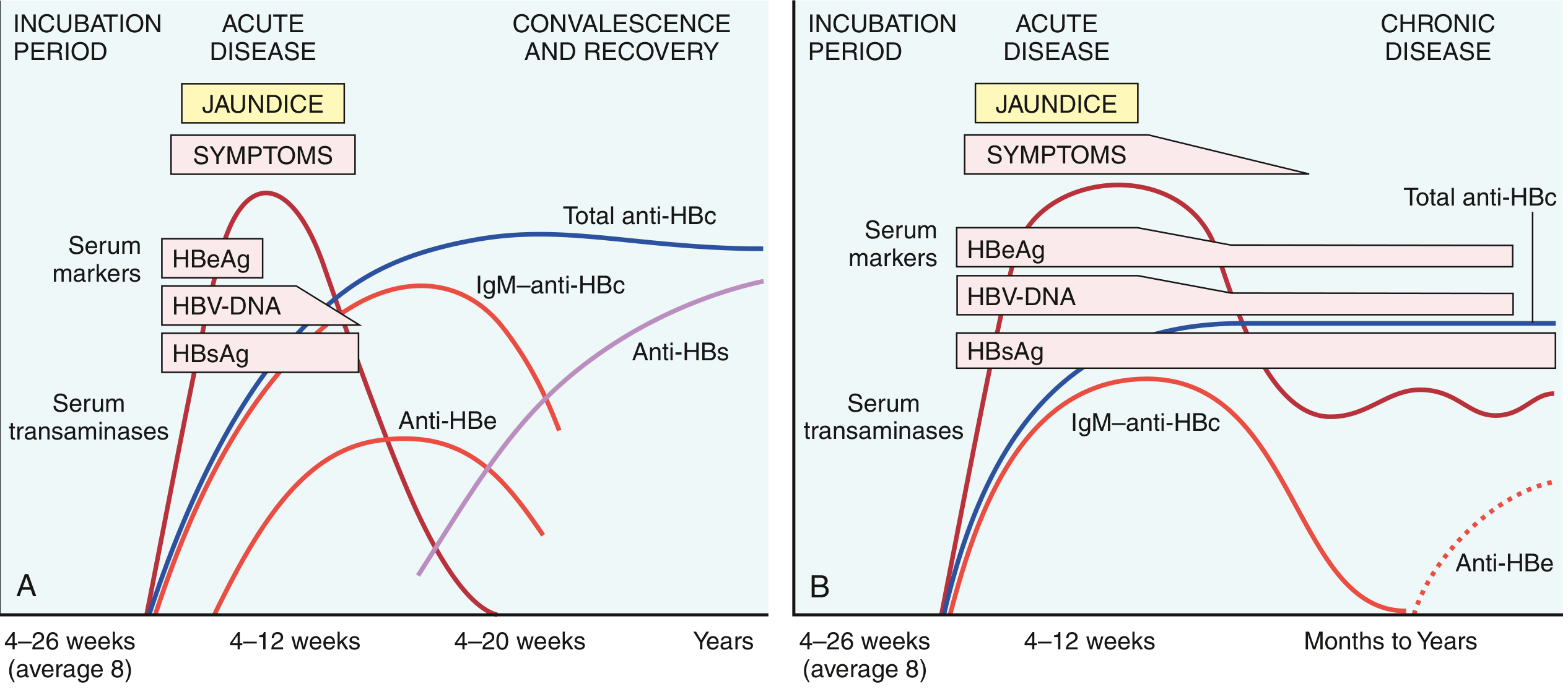
Fig. 14.10 - Temporal changes in serologic markers for hepatitis B viral infection. (A) Acute infection with resolution. (B) Progression to chronic infection. Total anti-HBc includes both IgM and IgG anti-HBc antibodies. - Robbins & Kumar Basic Pathology, p. 601-602
Summary Table: Interpretation of Serology Patterns
| Clinical State | HBsAg | Anti-HBs | HBeAg | Anti-HBe | IgM anti-HBc | IgG anti-HBc | HBV DNA |
|---|---|---|---|---|---|---|---|
| Acute infection (early) | + | - | + | - | + | - | + |
| Window period | - | - | - | +/- | + | + | +/- |
| Recovery / resolved | - | + | - | + | - | + | - |
| Chronic active (replicating) | + | - | + | - | - | + | + |
| Chronic (low replication) | + | - | - | + | - | + | low/- |
| Vaccinated (no infection) | - | + | - | - | - | - | - |
| Healthy carrier | + | - | - | + | - | + | low/- |
Key Points for SAQ
- HBsAg is the first marker; its persistence beyond 6 months defines chronicity
- Anti-HBs = immunity (from infection or vaccine); not seen in chronic disease
- IgM anti-HBc is the only marker present during the window period
- HBeAg + HBV DNA = active replication + high infectivity
- HBcAg is never detected in serum - only in liver biopsy
- Precore/core promoter mutants can have active infection with negative HBeAg but positive HBV DNA
- Anti-HBc (IgG) persists lifelong and marks past or ongoing HBV exposure
Sources: Robbins & Kumar Basic Pathology, pp. 600-602; Robbins, Cotran & Kumar Pathologic Basis of Disease, pp. 773-775
This is a shared conversation. Sign in to Orris to start your own chat.