
laser ,properties, production, types, physiological effects, precautions
Reading File
Now let me search the medical library for laser-related content across multiple topics in parallel.
Finding Sources
Finding Sources
The best source is Fitzpatrick's Dermatology with dedicated sections on LASER PRINCIPLES, LASER SAFETY, and LASER THERAPY. Let me read these in parallel.
Reading File
Reading File
Reading File
Good - I have the LASER PRINCIPLES section. Let me now read more of the Fitzpatrick laser chapter to get the full content on production, types, physiological effects, and the safety table.
Reading File
Reading File
Reading File
Now let me read the remaining key sections - the tissue interaction/physiological effects section, and the Fischer surgery laser section.
Reading File
Reading File
I now have comprehensive content. Let me also fetch the key tissue interaction diagram image, and read the remaining section on selective photothermolysis and physiological effects.
Reading File
Loading Image
I now have all the information needed for a comprehensive answer. Let me compile everything.
LASER: Properties, Production, Types, Physiological Effects, and Precautions
Source: Fitzpatrick's Dermatology, 9th Edition, Chapter 208 - Lasers and Flashlamps in Dermatology
1. What is a LASER?
LASER stands for Light Amplification by Stimulated Emission of Radiation. In its simplest form, a laser device creates energy as a beam of light that interacts with target tissue. All laser light travels at the speed of light (c = 2.998 × 10⁸ m/s) and has two major properties: wavelength (λ) and frequency (v), related by: c = λv. The energy of a photon increases with increasing frequency (and decreasing wavelength).
2. Properties of Laser Light
Laser light is fundamentally different from ordinary (incoherent) light. It has three defining properties:
| Property | Description |
|---|---|
| Monochromaticity | Single wavelength (one color) - produced by a specific lasing medium |
| Coherence | All photons are in phase, both temporally and spatially |
| Collimation | Parallel beam with minimal divergence - does not spread out |
In contrast, ordinary light (flashlight, sunlight) is polychromatic, incoherent, and divergent.
Additional parameters that define laser use:
- Fluence (radiant exposure) - energy per unit area (J/cm²)
- Irradiance (power density) - power per unit area (W/cm²)
- Pulse duration - continuous wave (CW) vs. pulsed (milliseconds, microseconds, nanoseconds, picoseconds)
- Spot size - diameter of the beam at the tissue surface
3. Production of Laser (How a Laser Works)
Every laser device has two essential components: an energy source and an optical resonator.
Step-by-step process (Stimulated Emission):
- Pumping - The energy source (electrical current, flashlamp, or another laser) excites electrons in the lasing medium to a higher energy state ("population inversion")
- Spontaneous emission - Some excited atoms spontaneously emit photons and return to ground state
- Stimulated emission - A passing photon stimulates an already-excited atom to release an identical photon (same wavelength, phase, direction) - this is the amplification step
- Optical resonator / cavity - The medium is enclosed in a tube with two parallel mirrors: one is fully opaque (reflective), the other is partially transmissible. Photons bounce back and forth between the mirrors, amplifying the beam each time
- Output - Photons exit through the partially transmissible mirror as a coherent, monochromatic, collimated beam
The Lasing Medium determines the wavelength and properties of the resulting laser. It can be:
- A solid (Nd:YAG crystal, ruby, alexandrite)
- A gas (CO₂, argon, excimer)
- A liquid (dye solutions - pulsed dye laser)
- A semiconductor (diode lasers)
- Fiber (glass tubes doped with rare-earth elements like erbium or thulium)
Delivery systems include:
- Articulated arms with mirrors - for CO₂ lasers
- Fiber optic cables - for Nd:YAG, diode, and Ho:YAG
- Micromanipulators coupled to microscopes - used in ENT and gynecology
Q-switching (for ultra-short pulses): An optical polarizer and nonlinear crystal are added to the resonator. By switching an electrical voltage, photon oscillation is blocked (building up excited atoms), then suddenly released - producing an extremely intense burst in the nanosecond-to-picosecond range.
4. Types of Lasers
Classified by Lasing Medium:
| Laser | Wavelength | Medium | Target | Applications |
|---|---|---|---|---|
| Excimer | 308 nm | Gas (XeCl) | DNA, proteins | Psoriasis, vitiligo (like narrow-band UVB) |
| Argon | 488/514 nm | Gas | Vascular, tissue | Telangiectases, syringoma, xanthelasma |
| Frequency-doubled Nd:YAG (KTP) | 532 nm | Solid | Vascular, pigment | Telangiectases, lentigines, tattoos |
| Pulsed Dye Laser (PDL) | 585-600 nm | Liquid dye | Vascular | Port-wine stains, rosacea, scars, keloids |
| Ruby | 694 nm | Solid (ruby) | Pigment/tattoo | Melanin lesions, blue/black/green tattoos |
| Alexandrite | 755 nm | Solid | Pigment, vascular, hair | Hair removal, tattoo removal, leg veins |
| Diode | 810 nm | Semiconductor | Hair, vascular | Hair removal, large vessels |
| Nd:YAG | 1064 nm | Solid | Vascular, deep | Vascular malformations, hair, deep pigment |
| Erbium:YAG (Er:YAG) | 2940 nm | Solid | Water in tissue | Ablative resurfacing (superficial) |
| CO₂ | 10,600 nm | Gas | Water in tissue | Ablative resurfacing, cutting, vaporization |
Classified by Clinical Use:
- Vascular lasers - PDL, KTP, Nd:YAG (target oxyhemoglobin)
- Pigment/tattoo lasers - Q-switched Ruby, Alexandrite, Nd:YAG (target melanin/ink)
- Hair removal lasers - Alexandrite, Diode, Nd:YAG (target follicular melanin)
- Ablative resurfacing - CO₂, Er:YAG (vaporize tissue - target water)
- Non-ablative resurfacing - 1320 nm Nd:YAG, 1450 nm diode, 1540 nm Er:glass (heat dermis without destroying epidermis)
- Fractional lasers - ablate microscopic columns of tissue, sparing surrounding skin
Classified by Pulse Mode:
- Continuous wave (CW) - constant beam
- Quasi-CW (chopped) - interrupted CW beam
- Pulsed - discrete pulses (ms, μs, ns, ps range)
- Q-switched - ultra-short pulses (ns/ps) with very high peak power
5. Physiological Effects of Laser on Tissue
When laser light reaches tissue, four interactions can occur:
- Reflection - beam bounces off the surface (stratum corneum reflects ~5% even perpendicularly)
- Scattering - beam deflects when it contacts small molecules; more common with shorter wavelengths; increases the effective irradiated area
- Transmission - beam passes through to deeper structures without being absorbed; more common with longer wavelengths
- Absorption - laser energy is converted to heat in the target chromophore - this is the therapeutic effect
Thermal Effects (Temperature-dependent):
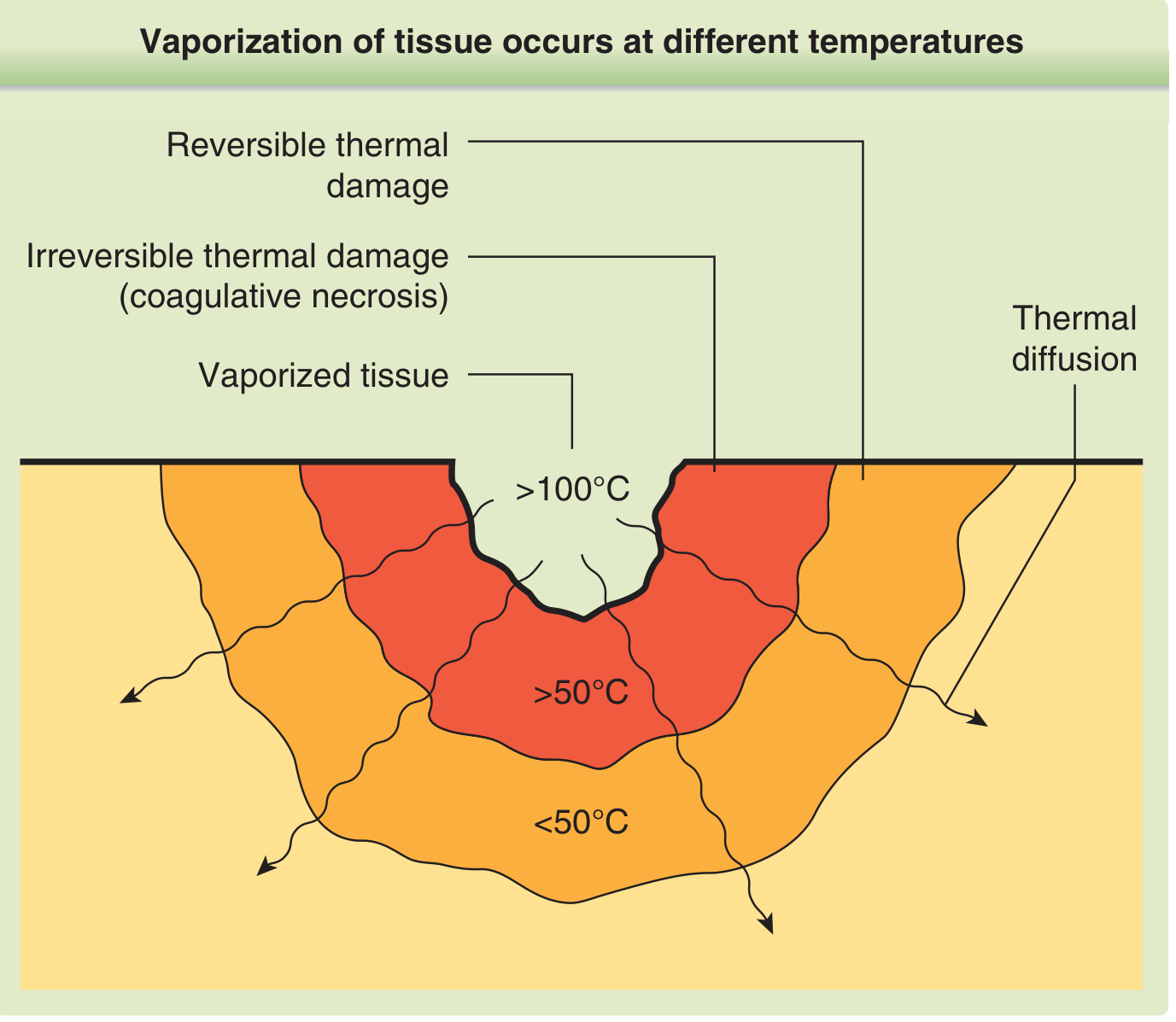
| Temperature | Effect |
|---|---|
| < 50°C | Reversible thermal damage, local vasodilation, inflammatory cascade activation |
| 50-100°C | Irreversible protein coagulation/denaturation, coagulative necrosis |
| > 100°C | Tissue vaporization - water turns to steam, generates plume; if energy is very high, steam deep in tissue cavities causes mechanical explosion and ulceration |
Energy equation: E (Joules) = P (watts) × t (seconds)
- Higher power + shorter pulse = more vaporization, less surrounding coagulation
- Lower power + longer pulse = less vaporization, more coagulative necrosis at edges
Selective Photothermolysis (SPT):
The principle governing selective laser-tissue interaction. To selectively destroy a target (chromophore) without damaging surrounding tissue, three conditions must be met:
- Correct wavelength - preferentially absorbed by the target chromophore (melanin, oxyhemoglobin, water, tattoo ink)
- Sufficient fluence - enough energy to heat the target to destructive temperatures
- Pulse duration ≤ Thermal Relaxation Time (TRT) - pulse must be shorter than the time the target takes to cool by 50%, so heat is confined to the target
Chromophores in skin and their absorption peaks:
- Oxyhemoglobin: 418, 542, 577 nm
- Melanin: broad absorption, decreasing with increasing wavelength
- Water: peaks at 2940 nm (Er:YAG), 10,600 nm (CO₂)
- Tattoo ink: variable (different dyes absorb different wavelengths)
6. Precautions and Safety
Regulatory Bodies:
- International Electrotechnical Commission (IEC)
- American National Standards Institute (ANSI Z136.3)
- FDA Center for Devices and Radiological Health (CDRH)
- OSHA
Skin Safety:
- Select the correct wavelength for the target chromophore and patient's skin type
- Darker skin types (Fitzpatrick IV-VI) require: lower fluences, longer pulse durations, longer wavelengths, higher cutoff filters
- Apply pre-cooling, intra-procedural cooling, and post-procedural cooling to protect the epidermis
- Ablative lasers carry higher risk of infection and scarring than vascular/pigment-specific or non-ablative types
- Fractional ablative lasers significantly reduce the risk compared to fully ablative
Eye Safety:
- 70% of laser ocular injuries result from lack of or improper eye protection
- Wavelengths 380-1400 nm are transmitted through the eye to the retina; the refractive media focuses them, increasing irradiance >10,000-fold at the retina
- Wavelengths < 380 nm are absorbed by the cornea, causing corneal injury or cataracts
- Wavelengths > 1000-1400 nm are absorbed by water in the cornea, causing corneal thermal damage
- Three types of ocular injury:
- Thermal (μs to seconds) - protein denaturation, retinal necrosis
- Mechanical (ps to ns) - plasma formation, pressure wave, tissue explosion
- Photochemical (> seconds, lower energy) - molecular bond breakage in nucleic acids/proteins
- The blink reflex (150-250 ms) and aversion response are NOT fast enough to protect from most laser pulses
- Safety goggles must have optical density (OD) ≥ 4 at the relevant wavelength and must match the specific laser being used
General Laser Safety Principles (Table 208-4):
| Precaution |
|---|
| Set realistic patient expectations; discuss procedure and side effects in detail |
| Select the correct device for the target chromophore and patient skin type |
| Lower fluences, longer pulse durations, longer wavelengths for darker skin types |
| Pre-cooling, intra-procedure cooling, post-procedure cooling |
| Avoid radiofrequency devices in patients with pacemakers or implantable devices |
| Lowest risk lasers: vascular, pigment-specific, non-ablative types |
| Ablative lasers: higher risk of infection and scarring |
| Appropriate, device-specific eye protection is mandatory for all personnel |
| Evacuate plume when vaporizing tissue (contains infectious particles, toxic chemicals) |
| Appoint a Laser Safety Officer (LSO) in all medical laser facilities |
| Use safety checklists (READ-DO or DO-CONFIRM type) |
Fire and Electrical Hazards:
- Laser-ignited fires are a real risk in OR settings (draping, oxygen-enriched environments)
- Wet towels/drapes around the operative field reduce fire risk
- Limit FiO₂ near the operative field when possible
Fitzpatrick's Dermatology, 9th Edition (ISBN: 9780071837781), Chapter 208 - Lasers and Flashlamps in Dermatology
This is a shared conversation. Sign in to Orris to start your own chat.