
आपने explain ECG विजुअल इमेज विजुअल सिस्टम।
Reading File
Finding Sources
Searching Images
normal ECG waveform diagram with P wave QRS complex T wave labeled
Searching the Web
ECG basics P wave QRS complex T wave explanation
Finding Sources
query_images_db
Searching Images
cardiac conduction system SA node AV node bundle of His Purkinje fibers diagram
Finding Sources
Reading File
query_images_db
ECG (इलेक्ट्रोकार्डियोग्राम) - विस्तृत समझ विज़ुअल्स के साथ
ECG हृदय की विद्युत गतिविधि (electrical activity) को कागज़ या स्क्रीन पर तरंगों (waves) के रूप में रिकॉर्ड करने की तकनीक है। हर धड़कन (cardiac cycle) में एक निश्चित पैटर्न बार-बार दोहराता है - जिसे P-QRS-T कहा जाता है।
हृदय की विद्युत प्रणाली (Conduction System)
धड़कन की शुरुआत SA node (Sino-Atrial node, दायें अलिंद में स्थित) से होती है, जो प्राकृतिक pacemaker है। संकेत यहां से फैलता है:
SA node → अलिंद (atria) → AV node → Bundle of His → Left/Right bundle branches → Purkinje fibers → निलय (ventricles)
ECG की तरंगें (Waves) - क्या दिखाती हैं
| तरंग | अर्थ |
|---|---|
| P wave | अलिंद का depolarization (अलिंद का सिकुड़ना शुरू) |
| PR interval | AV node से गुजरते समय विद्युत संकेत की देरी (सामान्य: 0.12-0.20 sec) |
| QRS complex | निलय का depolarization (निलय संकुचन की शुरुआत) - सामान्यतः 120 msec से कम होना चाहिए |
| ST segment | निलय संकुचन पूर्ण, repolarization शुरू |
| T wave | निलय का repolarization (विद्युत रूप से "रीसेट" होना, अगली धड़कन की तैयारी) |
| U wave (कभी-कभी) | कुछ मरीजों में दिखता है, अभी तक पूरी तरह स्पष्ट कारण नहीं |
नीचे एक textbook figure है जिसमें ECG waveform (P, R, T waves) को cardiac cycle (systole/diastole) के साथ दिखाया गया है:
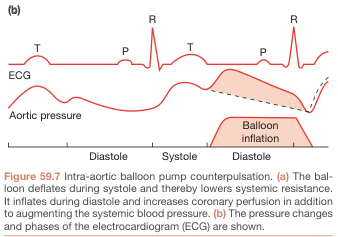
(Source: Bailey & Love's Short Practice of Surgery - यह figure मूल रूप से intra-aortic balloon pump की timing समझाने के लिए है, पर ऊपर की ECG trace में P, R, T waves साफ दिखती हैं)
Clinical महत्व (संक्षेप में)
- P wave गायब या असामान्य → atrial fibrillation, atrial flutter जैसी अलिंद की समस्याएं
- लंबा PR interval → AV block (first-degree heart block)
- चौड़ा QRS (>120 msec) → bundle branch block (left/right)
- T wave inversion / ST elevation या depression → myocardial ischemia/infarction (heart attack) का संकेत
Braunwald's Heart Disease textbook के अनुसार - "The 12-lead electrocardiogram (ECG)... Because of the close proximity of the atrioventricular node and proximal intraventricular conduction system to the aortic valve and root, perivalvular extension of infection... is the most common cause of new atrioventricular block" - यह दिखाता है कि ECG सिर्फ हृदय की सामान्य लय ही नहीं, बल्कि उससे जुड़ी जटिलताओं (जैसे infective endocarditis में conduction block) को भी पकड़ सकता है। - Braunwald's Heart Disease, 2 Vol Set
एक Real 12-Lead ECG कैसे दिखता है
नीचे एक वास्तविक clinical ECG image देखना मदद करेगा - अगर आप चाहें तो मैं normal sinus rhythm का actual traced 12-lead ECG image भी ढूंढ कर दिखा सकता हूं (मेरी image library में इसका direct match नहीं मिला, इसलिए ऊपर वाला conduction-timing figure सबसे नज़दीकी उपलब्ध विज़ुअल है)।
अगर आप किसी विशेष अभनॉर्मलिटी (जैसे MI, arrhythmia, bundle branch block) की ECG समझना चाहते हैं, तो बताएं - मैं उसके specific waveform pattern और textbook references के साथ विस्तार से समझा सकता हूं।
Vertigo explain briefly
Finding Sources
Searching the Web
vertigo causes types BPPV peripheral central brief explanation
Searching Images
Dix-Hallpike test BPPV vertigo diagram
Reading File
Vertigo - संक्षिप्त समझ
Vertigo एक लक्षण (symptom) है, बीमारी नहीं - इसमें व्यक्ति को ऐसा महसूस होता है जैसे वह या उसका आसपास का वातावरण घूम रहा है (spinning sensation), जबकि वास्तव में कुछ भी हिल नहीं रहा। यह सामान्य "dizziness" (जिसमें lightheadedness, presyncope, disequilibrium भी शामिल हो सकते हैं) से अलग है - vertigo खासतौर पर "घूमने" वाली सनसनी है।
कारण - दो मुख्य प्रकार
1. Peripheral Vertigo (सबसे common, ~90%) - भीतरी कान (inner ear) या vestibular nerve की समस्या से
- BPPV (Benign Paroxysmal Positional Vertigo) - सबसे सामान्य कारण; कैल्शियम कार्बोनेट के छोटे क्रिस्टल (otoconia) semicircular canals में हिल जाते हैं, सिर की पोज़िशन बदलने पर कुछ सेकंड का vertigo होता है
- Vestibular neuronitis - वायरल संक्रमण के बाद vestibular nerve में सूजन
- Meniere's disease - inner ear में fluid जमा होना, साथ में tinnitus और hearing loss भी होता है
2. Central Vertigo (कम common, पर ज़्यादा गंभीर) - brain/brainstem/cerebellum की समस्या से
- Stroke, brain tumor, multiple sclerosis, vestibular migraine
Peripheral बनाम Central - पहचान कैसे करें
| विशेषता | Peripheral | Central |
|---|---|---|
| समय अवधि | Episodic (कुछ सेकंड-मिनट) | Constant/लगातार |
| Nystagmus | Horizontal/rotary | Vertical (सिर्फ central में होता है) |
| न्यूरोलॉजिकल symptoms | नहीं होते | हो सकते हैं (weakness, slurred speech, loss of consciousness) |
| Hearing loss/tinnitus | हो सकता है | सामान्यतः नहीं |
जांच (Examination)
- Dix-Hallpike maneuver - BPPV की पहचान के लिए मुख्य टेस्ट
- Weber/Rinne test (सुनने की जांच), Romberg test (balance), gait examination, cranial nerve जांच
उपचार
- BPPV → Epley maneuver (canalith repositioning) से अक्सर तुरंत ठीक हो जाता है
- Vestibular neuronitis/Meniere's → antivertigo दवाएं (जैसे betahistine, meclizine), vestibular rehabilitation
- Central vertigo → underlying कारण (stroke, MS, tumor) का इलाज ज़रूरी, यह emergency भी हो सकती है
Red flag: अगर vertigo के साथ अचानक सिरदर्द, बोलने में दिक्कत, चलने में असंतुलन, या चेहरे/शरीर में कमजोरी हो - यह stroke का संकेत हो सकता है, तुरंत emergency care लें।
- Textbook of Family Medicine, 9th ed., p. 341
- Vertigo in Clinical Practice: Evidence-Based Diagnosis, NCBI Bookshelf (NBK482356)
अगर आप BPPV, Meniere's disease, या किसी specific प्रकार के vertigo के बारे में और गहराई से जानना चाहें तो बताएं।
In english
Vertigo - Brief Explanation
Vertigo is a symptom, not a disease itself - it's the sensation that you or your surroundings are spinning or moving, when in reality nothing is actually moving. It's distinct from general "dizziness" (which can include lightheadedness, presyncope, or disequilibrium) - vertigo specifically refers to that rotational/spinning sensation.
Causes - Two Main Types
1. Peripheral Vertigo (most common, ~90% of cases) - arises from a problem in the inner ear or vestibular nerve
- BPPV (Benign Paroxysmal Positional Vertigo) - the most common cause; tiny calcium carbonate crystals (otoconia) become dislodged into the semicircular canals, causing brief episodes of vertigo (seconds) triggered by head position changes
- Vestibular neuronitis - inflammation of the vestibular nerve, often following a viral infection
- Meniere's disease - fluid buildup (endolymphatic hydrops) in the inner ear, accompanied by tinnitus and hearing loss
2. Central Vertigo (less common, but more concerning) - arises from a problem in the brain/brainstem/cerebellum
- Stroke, brain tumor, multiple sclerosis, vestibular migraine
Peripheral vs Central - How to Distinguish
| Feature | Peripheral | Central |
|---|---|---|
| Duration | Episodic (seconds to minutes) | Constant |
| Nystagmus | Horizontal/rotary | Vertical (occurs only in central vertigo) |
| Neurologic symptoms | Absent | May be present (weakness, slurred speech, loss of consciousness) |
| Hearing loss/tinnitus | May be present | Usually absent |
Examination
- Dix-Hallpike maneuver - the key test for diagnosing BPPV
- Weber/Rinne tests (hearing), Romberg test (balance), gait assessment, cranial nerve examination
Treatment
- BPPV -> Epley maneuver (canalith repositioning) often provides immediate relief
- Vestibular neuronitis/Meniere's disease -> anti-vertigo medications (e.g. betahistine, meclizine), vestibular rehabilitation
- Central vertigo -> treatment of the underlying cause (stroke, MS, tumor) is essential; this can be a medical emergency
Red flag: If vertigo occurs with sudden severe headache, difficulty speaking, loss of coordination/balance, or facial/limb weakness, this may indicate a stroke - seek emergency care immediately.
- Textbook of Family Medicine, 9th ed., p. 341
- Vertigo in Clinical Practice: Evidence-Based Diagnosis, NCBI Bookshelf (NBK482356)
Let me know if you'd like a deeper dive into BPPV, Meniere's disease, or any other specific type of vertigo.
Give me the best nutrition. For hair growth.
Finding Sources
Searching the Web
best nutrients diet for hair growth biotin iron protein vitamin D zinc evidence
Searching PubMed
"hair loss" AND nutrition supplement
Reading Article
PMID: 36449274
Reading File
Best Nutrition for Hair Growth
The single most evidence-backed principle here: nutrients help hair growth mainly when you're deficient in them. If your diet is already balanced, extra supplementation gives little added benefit. A 2023 systematic review in JAMA Dermatology (Drake et al.) reviewed 30 studies and found genuine benefit from targeted nutrients only in people without adequate baseline levels - so identifying your gaps matters more than mega-dosing everything.
Top Nutrients with Real Evidence
| Nutrient | Why it matters | Best food sources |
|---|---|---|
| Protein | Hair is made almost entirely of keratin (a protein) - inadequate protein intake directly causes hair thinning and shedding | Eggs, fish, chicken, lentils, Greek yogurt, beans |
| Iron | Low iron/ferritin is one of the most common reversible causes of hair loss, especially in women | Red meat, spinach, lentils, pumpkin seeds (pair with vitamin C to boost absorption) |
| Vitamin D | Plays a role in the hair follicle growth cycle; deficiency is linked to alopecia areata and telogen effluvium | Fatty fish (salmon, mackerel), egg yolks, fortified milk, sunlight exposure |
| Zinc | Supports follicle repair and oil gland function around follicles; deficiency causes diffuse shedding | Oysters, beef, pumpkin seeds, chickpeas |
| Biotin (Vitamin B7) | Needed for keratin production, but true deficiency is rare in a normal diet - supplementation mainly helps if you're actually deficient | Eggs (cooked, not raw - raw egg white blocks biotin absorption), nuts, seeds, salmon |
| Omega-3 & Omega-6 fatty acids | Reduce follicle inflammation, support scalp health | Fatty fish, walnuts, flaxseed, chia seeds |
| Vitamin C | Boosts iron absorption and supports collagen production in hair structure | Citrus fruits, bell peppers, strawberries |
Practical Takeaways
- Fix deficiencies first - a simple blood test (ferritin, vitamin D, zinc, thyroid panel) is far more useful than guessing which supplement to buy.
- Whole foods over pills when possible - eggs, fish, leafy greens, beans, nuts, and seeds cover nearly every nutrient above.
- Don't over-supplement biotin - very high-dose biotin (common in hair gummies) can actually distort thyroid and cardiac lab test results, per the International Society of Hair Restoration Surgeons.
- Persistent or patchy hair loss needs a dermatologist, not just diet changes - nutrition helps with diffuse thinning tied to deficiency, but won't reverse androgenetic alopecia or autoimmune causes like alopecia areata on its own.
A related dermatology textbook note: biotin deficiency, when it does occur (e.g., malabsorption, raw egg consumption, certain anticonvulsants), can cause alopecia including loss of eyebrows/eyelashes alongside a distinctive skin rash - correcting the deficiency (about 10 mg/day biotin) resolves it. - Andrews' Diseases of the Skin, p. 558
Recent systematic reviews (2024-2025) on micronutrients and androgenetic alopecia (PMID: 39440586) and on dietary supplements via network meta-analysis (PMID: 41561175) reinforce that zinc and vitamin D correction show the most consistent benefit, while evidence for most other "hair vitamins" remains mixed - worth keeping in mind if you see strong marketing claims.
If you want, tell me if your hair loss is diffuse/general thinning vs. patchy/receding, and whether you have any known deficiencies - I can narrow this down further.
This is a shared conversation. Sign in to Orris to start your own chat.