
I am ophthalmologist resident I want proptosis etiology classification examination management all aspect covering entire topic in one poster card with all details with diagrams and chart
mkdir -p /home/daytona/workspace/proptosis-poster
~/proptosis-poster/make_poster.js
const pptxgen = require("pptxgenjs");

let pres = new pptxgen();
// Use LAYOUT_WIDE for a poster-style card: 13.3" x 7.5"
pres.layout = 'LAYOUT_WIDE';

// ─── COLOR PALETTE ───────────────────────────────────────────────
const BG        = "0A1628";   // Deep navy background
const PANEL     = "112240";   // Slightly lighter panel
const PANEL2    = "0D1E3A";   // Alt panel
const ACCENT1   = "00B4D8";   // Cyan accent
const ACCENT2   = "F77F00";   // Orange accent
const ACCENT3   = "43AA8B";   // Teal green
const ACCENT4   = "E63946";   // Red accent
const ACCENT5   = "A8DADC";   // Light blue
const WHITE     = "FFFFFF";
const LGRAY     = "B0C4D8";
const YELLOW    = "FFD166";
const PURPLE    = "7B2D8B";
const LPURPLE   = "C77DFF";

let slide = pres.addSlide();

// ─── FULL BACKGROUND ─────────────────────────────────────────────
slide.addShape(pres.shapes.RECTANGLE, {
  x: 0, y: 0, w: 13.3, h: 7.5,
  fill: { color: BG }, line: { color: BG }
});

// ─── HEADER BAND ─────────────────────────────────────────────────
slide.addShape(pres.shapes.RECTANGLE, {
  x: 0, y: 0, w: 13.3, h: 0.55,
  fill: { color: ACCENT1 }, line: { color: ACCENT1 }
});
slide.addShape(pres.shapes.RECTANGLE, {
  x: 0, y: 0.55, w: 13.3, h: 0.04,
  fill: { color: ACCENT2 }, line: { color: ACCENT2 }
});

// TITLE
slide.addText("PROPTOSIS — COMPLETE CLINICAL REFERENCE", {
  x: 0.15, y: 0.05, w: 9.5, h: 0.45,
  fontSize: 18, bold: true, color: BG,
  fontFace: "Calibri", align: "left", valign: "middle", margin: 0
});
slide.addText("Ophthalmology Resident Quick Reference  |  Kanski & Wills Eye Manual", {
  x: 9.7, y: 0.08, w: 3.4, h: 0.38,
  fontSize: 7.5, bold: false, color: BG,
  fontFace: "Calibri", align: "right", valign: "middle", margin: 0
});

// ─── LAYOUT: 4 columns below header ──────────────────────────────
// Col 1: x=0.1  w=3.1
// Col 2: x=3.3  w=3.1
// Col 3: x=6.5  w=3.1
// Col 4: x=9.7  w=3.5
const Y0 = 0.68;   // Top of content
const CH = 6.75;   // Content height

// ─── HELPER FUNCTIONS ────────────────────────────────────────────
function panelBg(x, y, w, h, color) {
  slide.addShape(pres.shapes.RECTANGLE, {
    x, y, w, h,
    fill: { color: color || PANEL },
    line: { color: ACCENT1, transparency: 75 },
    shadow: { type: "outer", color: "000000", blur: 4, offset: 1, angle: 135, opacity: 0.2 }
  });
}

function sectionHeader(text, x, y, w, color) {
  slide.addShape(pres.shapes.RECTANGLE, {
    x, y, w: w, h: 0.26,
    fill: { color: color || ACCENT1 },
    line: { color: color || ACCENT1 }
  });
  slide.addText(text, {
    x: x + 0.06, y: y, w: w - 0.08, h: 0.26,
    fontSize: 7.8, bold: true, color: BG,
    fontFace: "Calibri", align: "left", valign: "middle", margin: 0
  });
}

function bodyText(items, x, y, w, h, size) {
  // items: [{text, bold, color, bullet, indent}]
  let richArr = items.map((item, i) => ({
    text: item.text,
    options: {
      bold: item.bold || false,
      color: item.color || LGRAY,
      fontSize: size || 6.5,
      bullet: item.bullet ? { type: "bullet", code: item.bullet === "dash" ? "2013" : undefined } : false,
      indentLevel: item.indent || 0,
      breakLine: i < items.length - 1
    }
  }));
  slide.addText(richArr, { x, y, w, h, fontFace: "Calibri", valign: "top", margin: [2, 4, 2, 4] });
}


// ══════════════════════════════════════════════════════
// COLUMN 1: DEFINITION + CLASSIFICATION + PSEUDOPROPTOSIS
// ══════════════════════════════════════════════════════
let cx = 0.1;
panelBg(cx, Y0, 3.1, CH);

// --- DEFINITION ---
sectionHeader("📌  DEFINITION & BASICS", cx, Y0, 3.1, ACCENT1);
bodyText([
  { text: "Proptosis: Abnormal anterior displacement of the globe beyond the orbital rim", bold: false, color: WHITE },
  { text: "Exophthalmos: Term specifically for thyroid-related proptosis", color: LGRAY },
  { text: "Normal: ≤20 mm from lateral orbital rim to corneal apex (Hertel)", color: LGRAY },
  { text: "Abnormal: >20 mm or asymmetry ≥2–3 mm between eyes", bold: true, color: YELLOW },
  { text: "Measurement: Hertel exophthalmometer (Oculus)", color: LGRAY },
  { text: "  • Resting & Valsalva measurements", color: LGRAY },
  { text: "  • Axial proptosis → intraconal mass", color: ACCENT5 },
  { text: "  • Proptosis + dystopia → extraconal mass", color: ACCENT5 },
], cx + 0.06, Y0 + 0.28, 2.95, 0.9);

// --- CLASSIFICATION BY CAUSE ---
sectionHeader("🔷  ETIOLOGY CLASSIFICATION", cx, Y0 + 1.2, 3.1, ACCENT1);

// Six categories with color-coded mini-chips
const categories = [
  { label: "1. INFLAMMATORY", color: ACCENT3, items: [
    "Thyroid Eye Disease (TED) — MC cause in adults",
    "IOIS (Idiopathic Orbital Inflammatory Syndrome)",
    "Sarcoidosis",
    "GPA (Wegener's granulomatosis)",
    "IgG4-related orbital disease",
    "Reactive — paranasal sinusitis"
  ]},
  { label: "2. INFECTIOUS", color: ACCENT4, items: [
    "Orbital cellulitis",
    "Subperiosteal abscess (SPA)",
    "Mucormycosis (immunocompromised)",
    "Cavernous sinus thrombosis"
  ]},
  { label: "3. NEOPLASTIC", color: ACCENT2, items: [
    "PRIMARY: Cavernous hemangioma (MC benign adult), Optic nerve glioma, Meningioma, Dermoid cyst (MC in children), Solitary fibrous tumor, Lymphoma",
    "SECONDARY: Sinus extension, Intracranial meningioma, Lacrimal gland tumor",
    "METASTATIC: Breast, Lung, Prostate — assume mets if cancer Hx"
  ]},
  { label: "4. VASCULAR", color: LPURPLE, items: [
    "Carotid-cavernous fistula (CCF) — pulsatile proptosis",
    "Orbital varices — positional/intermittent",
    "Lymphangioma — hemorrhage → sudden onset",
    "Arteriovenous malformation"
  ]},
  { label: "5. TRAUMA", color: YELLOW, items: [
    "Retrobulbar hemorrhage — sight-threatening emergency",
    "Orbital fracture (blowout)",
    "Orbital foreign body",
  ]},
  { label: "6. CONGENITAL/STRUCTURAL", color: ACCENT5, items: [
    "Craniosynostosis (Crouzon, Apert)",
    "Neurofibromatosis (sphenoid wing dysplasia)",
    "Shallow orbit"
  ]}
];

let yPos = Y0 + 1.48;
categories.forEach(cat => {
  // Category header chip
  slide.addShape(pres.shapes.RECTANGLE, {
    x: cx + 0.06, y: yPos, w: 2.9, h: 0.17,
    fill: { color: cat.color, transparency: 20 },
    line: { color: cat.color }
  });
  slide.addText(cat.label, {
    x: cx + 0.08, y: yPos, w: 2.86, h: 0.17,
    fontSize: 6.0, bold: true, color: BG,
    fontFace: "Calibri", valign: "middle", margin: 0
  });
  yPos += 0.18;
  cat.items.forEach(item => {
    slide.addText("• " + item, {
      x: cx + 0.12, y: yPos, w: 2.82, h: 0.135,
      fontSize: 5.8, color: LGRAY, fontFace: "Calibri", valign: "top", margin: [1,2,1,2]
    });
    yPos += 0.138;
  });
  yPos += 0.03;
});

// --- PSEUDOPROPTOSIS ---
sectionHeader("⚠️  PSEUDOPROPTOSIS", cx, yPos + 0.02, 3.1, ACCENT3);
bodyText([
  { text: "• High myopia / Buphthalmos (large globe)", color: LGRAY },
  { text: "• Lid retraction (unilateral)", color: LGRAY },
  { text: "• Contralateral enophthalmos", color: LGRAY },
  { text: "• Facial asymmetry", color: LGRAY },
], cx + 0.06, yPos + 0.3, 2.95, 0.42);


// ══════════════════════════════════════════════════════
// COLUMN 2: CLINICAL EXAMINATION
// ══════════════════════════════════════════════════════
cx = 3.3;
panelBg(cx, Y0, 3.1, CH);

sectionHeader("🔬  CLINICAL EXAMINATION", cx, Y0, 3.1, ACCENT2);

// Systematic Exam steps
const examSteps = [
  { step: "1. HISTORY", color: ACCENT2, items: [
    "Onset: Acute (<48h) → infection/hemorrhage/trauma",
    "          Subacute (wks) → inflammation",
    "          Chronic (mos-yrs) → neoplasm",
    "Unilateral vs Bilateral",
    "Associated: pain, diplopia, vision loss, headache",
    "Systemic: thyroid Dx, cancer, DM, TB, sarcoid",
    "Positional change → venous/vascular"
  ]},
  { step: "2. INSPECT", color: ACCENT3, items: [
    "Direction of proptosis (axial vs eccentric)",
    "Eyelid: Retraction (TED — Dalrymple sign)",
    "         Lag on downgaze (von Graefe's sign)",
    "         Chemosis, injection, edema",
    "Pulsation → CCF, NF/sphenoid dysplasia",
    "S-shaped lid deformity → lacrimal gland tumor"
  ]},
  { step: "3. MEASURE", color: ACCENT1, items: [
    "Hertel exophthalmometer: base + reading",
    ">20 mm or ≥2–3 mm asymmetry = abnormal",
    "Palpebral aperture width",
    "Lagophthalmos (corneal exposure risk)"
  ]},
  { step: "4. PALPATE", color: YELLOW, items: [
    "Resistance to retropulsion (resistance → mass/edema)",
    "Palpate for mass: location, firmness, tenderness",
    "Auscultate for bruit → CCF/AVM",
    "Lacrimal gland palpation",
    "Regional lymph nodes"
  ]},
  { step: "5. OCULAR MOTILITY", color: LPURPLE, items: [
    "Restriction pattern:",
    "  TED: inferior rectus (↑gaze restricted) #1",
    "  Then medial, superior, lateral rectus",
    "Forced duction test (restrictive vs neurologic)",
    "Force generation test",
    "Cover test, prism assessment"
  ]},
  { step: "6. VISUAL FUNCTION", color: ACCENT4, items: [
    "Best corrected visual acuity",
    "Color vision (Ishihara/D15) — early ON compression",
    "Pupillary exam (RAPD)",
    "Visual fields (APD, cecocentral defect)",
    "Fundus: disc edema, optociliary vessels",
    "IOP in all positions of gaze"
  ]},
  { step: "7. SLIT LAMP", color: ACCENT5, items: [
    "Corneal exposure keratopathy",
    "Superior limbic keratoconjunctivitis (SLK)",
    "Conjunctival injection/chemosis",
    "Anterior segment: rubeosis?"
  ]}
];

let yp = Y0 + 0.28;
examSteps.forEach(step => {
  slide.addShape(pres.shapes.RECTANGLE, {
    x: cx + 0.06, y: yp, w: 2.9, h: 0.16,
    fill: { color: step.color, transparency: 25 },
    line: { color: step.color }
  });
  slide.addText(step.step, {
    x: cx + 0.08, y: yp, w: 2.86, h: 0.16,
    fontSize: 5.8, bold: true, color: BG,
    fontFace: "Calibri", valign: "middle", margin: 0
  });
  yp += 0.17;
  step.items.forEach(item => {
    slide.addText("• " + item, {
      x: cx + 0.12, y: yp, w: 2.82, h: 0.13,
      fontSize: 5.6, color: LGRAY, fontFace: "Calibri", valign: "top", margin: [0.5,2,0.5,2]
    });
    yp += 0.125;
  });
  yp += 0.04;
});


// ══════════════════════════════════════════════════════
// COLUMN 3: INVESTIGATIONS + TED (MOST COMMON CAUSE)
// ══════════════════════════════════════════════════════
cx = 6.5;
panelBg(cx, Y0, 3.1, CH);

sectionHeader("🧪  INVESTIGATIONS", cx, Y0, 3.1, ACCENT3);

const invRows = [
  { hdr: "BLOODS", color: ACCENT3, items: [
    "FBC, ESR, CRP (infection/inflammation)",
    "TFTs: TSH, free T4, T3",
    "TSH-receptor Ab (TRAb) — TED specific",
    "ANCA (GPA), ACE (sarcoid), IgG4",
    "FBS, HbA1c (mucor risk)",
    "Tumour markers if metastasis suspected"
  ]},
  { hdr: "IMAGING", color: ACCENT1, items: [
    "CT Orbit (HRCT) — FIRST LINE",
    "  → Bone erosion, bony lesions, sinuses",
    "  → Muscle enlargement pattern (TED)",
    "MRI Orbit — SOFT TISSUE detail",
    "  → Optic nerve, cavernous sinus, intracranial ext.",
    "  → Fat suppressed T1+Gd for infiltrative",
    "Doppler US — vascular lesions, CCF",
    "B-scan US — optic nerve sheath diam, mass",
    "CXR/CT Chest — sarcoid/lymphoma/mets"
  ]},
  { hdr: "ORBITAL US (B-SCAN)", color: ACCENT2, items: [
    "Cavernous hemangioma → high internal reflectivity",
    "Lymphangioma → irregular, no vascularity",
    "ON sheath >5mm → increased ICP"
  ]},
  { hdr: "HISTOPATHOLOGY", color: ACCENT4, items: [
    "Incisional / excisional biopsy",
    "Fine needle aspiration cytology (FNAC)",
    "  → Lymphoma, metastasis, lacrimal mass"
  ]},
  { hdr: "SPECIAL TESTS", color: YELLOW, items: [
    "CAS score (TED activity — 7 items)",
    "Hertel baseline + serial measurements",
    "Humphrey visual field",
    "VEP (optic nerve compression)",
    "IOP (↑ in upgaze >6 mmHg → TED)"
  ]}
];

let ypi = Y0 + 0.28;
invRows.forEach(row => {
  slide.addShape(pres.shapes.RECTANGLE, {
    x: cx + 0.06, y: ypi, w: 2.9, h: 0.16,
    fill: { color: row.color, transparency: 20 },
    line: { color: row.color }
  });
  slide.addText(row.hdr, {
    x: cx + 0.08, y: ypi, w: 2.86, h: 0.16,
    fontSize: 6.0, bold: true, color: BG,
    fontFace: "Calibri", valign: "middle", margin: 0
  });
  ypi += 0.17;
  row.items.forEach(item => {
    slide.addText("• " + item, {
      x: cx + 0.12, y: ypi, w: 2.82, h: 0.128,
      fontSize: 5.6, color: LGRAY, fontFace: "Calibri", valign: "top", margin: [0.5,2,0.5,2]
    });
    ypi += 0.126;
  });
  ypi += 0.04;
});

// TED section below if space
sectionHeader("🦋  TED (MC CAUSE) — CAS SCORE", cx, ypi + 0.02, 3.1, ACCENT2);
ypi += 0.22;
const casItems = [
  "1. Spontaneous retrobulbar pain",
  "2. Pain on upward/downward gaze",
  "3. Redness of eyelids",
  "4. Diffuse redness of conjunctiva",
  "5. Swelling of conjunctiva (chemosis)/plica",
  "6. Swelling of eyelid(s)",
  "7. Proptosis ≥2mm in 1–3 months",
  "CAS ≥3/7 = Active disease → immunosuppression",
];
casItems.forEach(item => {
  const isBold = item.startsWith("CAS");
  slide.addText(isBold ? item : "• " + item, {
    x: cx + 0.12, y: ypi, w: 2.82, h: 0.128,
    fontSize: 5.7, color: isBold ? YELLOW : LGRAY, bold: isBold,
    fontFace: "Calibri", valign: "top", margin: [0.5,2,0.5,2]
  });
  ypi += 0.126;
});


// ══════════════════════════════════════════════════════
// COLUMN 4: MANAGEMENT + KEY EMERGENCIES
// ══════════════════════════════════════════════════════
cx = 9.7;
panelBg(cx, Y0, 3.5, CH);

sectionHeader("💊  MANAGEMENT OVERVIEW", cx, Y0, 3.5, ACCENT4);

const mgmt = [
  { hdr: "TED — MILD", color: ACCENT3, items: [
    "Stop smoking (↓ severity 3×)",
    "Treat thyroid (euthyroid state)",
    "Selenium 200μg/day × 6 months",
    "Lubricants, prism glasses for diplopia",
    "Sunglasses for photophobia"
  ]},
  { hdr: "TED — MODERATE-SEVERE (Active, CAS≥3)", color: ACCENT2, items: [
    "IV methylprednisolone (EUGOGO protocol)",
    "  500mg/wk × 6 wks → 250mg/wk × 6 wks",
    "Teprotumumab (IGF-1R inhibitor) — 1st line USA",
    "Orbital radiotherapy (10-20 Gy, fractionated)",
    "Rituximab (anti-CD20) if steroid-refractory"
  ]},
  { hdr: "TED — SURGICAL (Inactive, stable ≥6 months)", color: YELLOW, items: [
    "SEQUENCE: Decompression → Strabismus → Lids",
    "1. Orbital decompression (proptosis >3mm mod-sev)",
    "   → Balanced (medial+lateral), 3-wall (severe)",
    "2. Strabismus surgery (restrictive diplopia)",
    "3. Eyelid: Recession for retraction / tarsorrhaphy"
  ]},
  { hdr: "ORBITAL CELLULITIS (Chandler Grade)", color: ACCENT4, items: [
    "I: Preseptal — oral amoxiclav, observe 24h",
    "II: Orbital — IV antibiotics (co-amoxiclav + metro)",
    "III: Subperiosteal abscess",
    "IV: Orbital abscess → surgical drainage",
    "V: Cavernous sinus thrombosis → IV + anticoag",
    "Causative: S. aureus, Strep, H. influenzae (children)"
  ]},
  { hdr: "NEOPLASTIC — BENIGN", color: ACCENT5, items: [
    "Cavernous hemangioma → observation or excision",
    "Dermoid cyst → complete excision (prevent rupture)",
    "Optic nerve glioma → observe (NF1), RT/chemo",
    "Meningioma → observe, RT, or surgery"
  ]},
  { hdr: "NEOPLASTIC — MALIGNANT", color: ACCENT4, items: [
    "Lymphoma → orbital RT ± systemic chemo/rituximab",
    "Metastasis → identify primary; palliative RT",
    "RMS (children) → chemo+RT, avoid exenteration",
    "Lacrimal gland AdCA → en bloc excision + RT"
  ]},
];

let ypm = Y0 + 0.28;
mgmt.forEach(sec => {
  slide.addShape(pres.shapes.RECTANGLE, {
    x: cx + 0.06, y: ypm, w: 3.34, h: 0.16,
    fill: { color: sec.color, transparency: 20 },
    line: { color: sec.color }
  });
  slide.addText(sec.hdr, {
    x: cx + 0.08, y: ypm, w: 3.3, h: 0.16,
    fontSize: 5.8, bold: true, color: BG,
    fontFace: "Calibri", valign: "middle", margin: 0
  });
  ypm += 0.17;
  sec.items.forEach(item => {
    slide.addText("• " + item, {
      x: cx + 0.12, y: ypm, w: 3.28, h: 0.13,
      fontSize: 5.7, color: LGRAY, fontFace: "Calibri", valign: "top", margin: [0.5,2,0.5,2]
    });
    ypm += 0.128;
  });
  ypm += 0.04;
});

// --- EMERGENCIES BOX ---
sectionHeader("🚨  SIGHT-THREATENING EMERGENCIES", cx, ypm + 0.02, 3.5, ACCENT4);
ypm += 0.22;
const emergencies = [
  { cond: "Retrobulbar hemorrhage", rx: "→ Lateral canthotomy + cantholysis STAT", color: ACCENT4 },
  { cond: "Orbital cellulitis w/ vision loss", rx: "→ Emergency surgical drainage", color: ACCENT4 },
  { cond: "TED optic neuropathy", rx: "→ IV MP 1g/day × 3d, urgent decompression", color: ACCENT2 },
  { cond: "Mucormycosis", rx: "→ IV liposomal AmB + surgical debridement", color: ACCENT4 },
  { cond: "Corneal exposure → perforation", rx: "→ Urgent tarsorrhaphy / decompression", color: YELLOW },
];
emergencies.forEach(e => {
  slide.addText([
    { text: e.cond + " ", options: { bold: true, color: e.color, fontSize: 5.8 } },
    { text: e.rx, options: { bold: false, color: LGRAY, fontSize: 5.6 } }
  ], {
    x: cx + 0.1, y: ypm, w: 3.3, h: 0.13,
    fontFace: "Calibri", valign: "top", margin: [1,2,1,2]
  });
  ypm += 0.132;
});

// --- QUICK REFERENCE CHART: Direction of Proptosis ---
ypm += 0.08;
sectionHeader("📐  DIRECTION → LIKELY LESION", cx, ypm, 3.5, ACCENT1);
ypm += 0.18;
const dirChart = [
  ["AXIAL (straight forward)", "Intraconal: Cavernous hemangioma, ON tumour"],
  ["DOWN & OUT", "Supermedial: Mucocele, frontal sinus"],
  ["UP (hyperglobus)", "Inferior: Maxillary sinus CA, floor mass"],
  ["DOWN (hypoglobus)", "Superior: Dermoid, lacrimal, meningioma"],
  ["PULSATILE", "CCF, NF (sphenoid dysplasia)"],
  ["INTERMITTENT", "Orbital varices (increases w/ Valsalva)"],
];
dirChart.forEach(row => {
  slide.addText([
    { text: row[0] + ": ", options: { bold: true, color: ACCENT5, fontSize: 5.5 } },
    { text: row[1], options: { color: LGRAY, fontSize: 5.5 } }
  ], {
    x: cx + 0.1, y: ypm, w: 3.3, h: 0.125,
    fontFace: "Calibri", valign: "top", margin: [0.5,2,0.5,2]
  });
  ypm += 0.126;
});

// ─── FOOTER ───────────────────────────────────────────
slide.addShape(pres.shapes.RECTANGLE, {
  x: 0, y: 7.38, w: 13.3, h: 0.12,
  fill: { color: ACCENT1 }, line: { color: ACCENT1 }
});
slide.addText("Sources: Kanski's Clinical Ophthalmology 10e | Wills Eye Manual 8e | EUGOGO Guidelines 2021  —  For Educational Use Only", {
  x: 0.2, y: 7.38, w: 12.9, h: 0.12,
  fontSize: 5.0, color: BG, fontFace: "Calibri",
  align: "center", valign: "middle", margin: 0
});

// ─── WRITE FILE ───────────────────────────────────────
pres.writeFile({ fileName: "/home/daytona/workspace/proptosis-poster/Proptosis_Clinical_Poster.pptx" })
  .then(() => console.log("SUCCESS: Poster saved."))
  .catch(e => console.error("ERROR:", e));
cd /home/daytona/workspace/proptosis-poster && node make_poster.js
ls -lh /home/daytona/workspace/proptosis-poster/
A comprehensive medical ophthalmology clinical reference poster card titled "PROPTOSIS — COMPLETE CLINICAL REFERENCE" for ophthalmology residents. Dark navy blue background. Four color-coded columns: Column 1 (cyan header) covers Definition showing Hertel measurement >20mm is abnormal, and Etiology Classification in 6 categories: Inflammatory (thyroid eye disease, IOIS, sarcoidosis, GPA, IgG4), Infectious (orbital cellulitis, subperiosteal abscess, mucormycosis), Neoplastic (cavernous hemangioma, dermoid, lymphoma, metastasis), Vascular (carotid-cavernous fistula, orbital varices, lymphangioma), Trauma (retrobulbar hemorrhage, blowout fracture), Congenital (craniosynostosis). Column 2 (orange header) shows Clinical Examination with 7 systematic steps: History onset patterns, Inspection for lid retraction/pulsation/direction, Measurement with Hertel exophthalmometer, Palpation and auscultation, Ocular motility with forced duction test showing TED inferior rectus pattern, Visual function including color vision and RAPD, Slit lamp for corneal exposure. Column 3 (teal header) covers Investigations: blood tests (TFTs TSH-receptor antibodies ANCA IgG4), CT orbit first-line for bone lesions, MRI for soft tissue, orbital B-scan, plus CAS Clinical Activity Score 7 items with score 3+ indicating active TED. Column 4 (red header) shows Management: TED mild (selenium 200mcg, selenium, lubricants), TED moderate-severe (IV methylprednisolone protocol, teprotumumab), TED surgical sequence (decompression then strabismus then lids), Orbital cellulitis Chandler grades I-V, benign and malignant neoplasms treatment. Red emergency box: retrobulbar hemorrhage lateral canthotomy, TED optic neuropathy IV methylprednisolone, mucormycosis liposomal amphotericin. Direction chart: axial proptosis means intraconal mass, pulsatile means CCF. Color-coded chips for each category. Professional medical poster design with cyan footer citing Kanski and Wills Eye Manual.
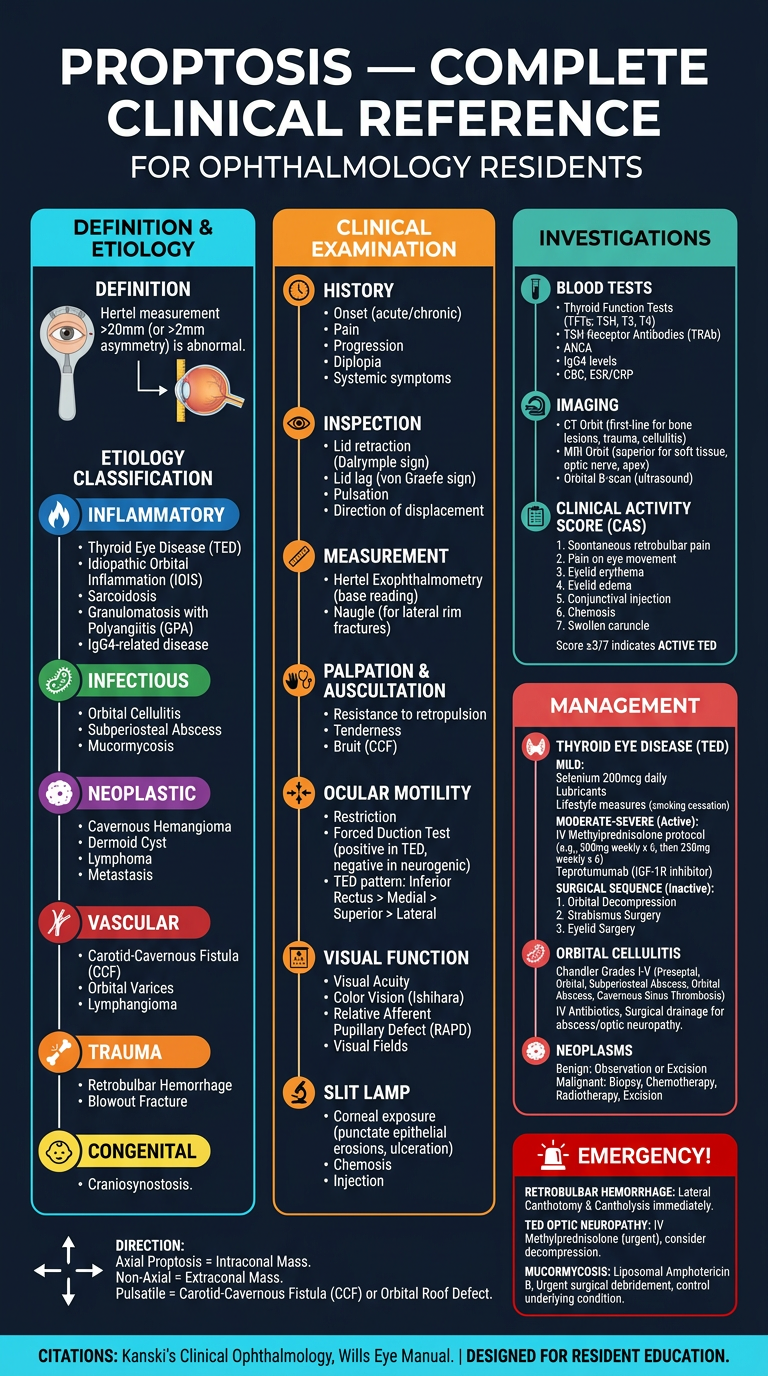
Download the full-detail poster card:
Proptosis Clinical Poster
Presentation · PPTX
What's covered across 4 color-coded columns:
- Hertel measurement: >20 mm or ≥2-3 mm asymmetry = abnormal
- 6 etiologic categories: Inflammatory / Infectious / Neoplastic / Vascular / Trauma / Congenital - each color-coded with key entities
- Pseudoproptosis causes (myopia, lid retraction, contralateral enophthalmos)
- History: onset pattern (acute vs subacute vs chronic) guides diagnosis
- Inspect: direction of proptosis, lid signs (Dalrymple, von Graefe), pulsation, S-shaped lid
- Measure: Hertel exophthalmometer technique
- Palpate + auscultate: resistance to retropulsion, bruit for CCF
- Ocular motility: TED restriction pattern (inferior rectus first), forced duction test
- Visual function: color vision (earliest sign of optic nerve compression), RAPD, VF
- Slit lamp: corneal exposure keratopathy
- Blood panel: TFTs, TRAb, ANCA, ACE, IgG4
- Imaging: CT orbit (first line, bone/sinuses), MRI (soft tissue, ON, cavernous sinus), Doppler US
- CAS 7-item activity score - ≥3/7 = active TED, treat with immunosuppression
- TED pathway: Mild → Selenium + lubricants | Moderate-severe active → IV methylprednisolone protocol / Teprotumumab | Surgical (inactive, stable ≥6 months) → Decompression → Strabismus → Lids
- Orbital cellulitis Chandler grades I-V with treatment escalation
- Benign vs malignant neoplasm management
- Emergency box: Retrobulbar hemorrhage (lateral canthotomy), TED optic neuropathy (IV MP 1g × 3d), Mucormycosis (liposomal AmB + debridement)
- Direction-to-diagnosis chart (axial = intraconal, pulsatile = CCF/NF, intermittent = varices)