
Teach me all about hyperbaric oxygen therapy for a emergency medicine resident
Reading File
Now let me search the library and PubMed in parallel for comprehensive HBOT coverage.
Finding Sources
Finding Sources
Searching PubMed
"hyperbaric oxygen therapy"[MeSH Terms] AND emergency medicine
Excellent - the key sources are Tintinalli's Emergency Medicine and Sabiston Surgery. Let me read those in parallel, plus get the physiology from Guyton/Hall and run a targeted PubMed search.
Reading File
Reading File
Reading File
Reading File
Searching PubMed
"hyperbaric oxygen therapy"[MeSH Terms] AND "carbon monoxide poisoning"[MeSH Terms]
Good data so far. Now let me read the full Tintinalli HBOT chapter content and the Rockwood fractures section for the detailed clinical indications (CO poisoning, decompression sickness, gas embolism), and search PubMed more broadly.
Reading File
Reading File
Searching PubMed
"hyperbaric oxygen"[MeSH Terms] AND "decompression sickness"[MeSH Terms]
Searching PubMed
"hyperbaric oxygen therapy"[MeSH Terms] AND indications
I now have the core of the Tintinalli chapter. Let me read the rest - the sections on decompression sickness, gas embolism, necrotizing fasciitis, contraindications, and the physiology table - plus fetch the chamber image and do a broader PubMed search.
Reading File
Searching PubMed
"hyperbaric oxygen"[MeSH Terms] AND "carbon monoxide" AND clinical trial
I now have comprehensive material from the Tintinalli chapter. Let me get the remaining sections on contraindications and the specific conditions table, and do a web search.
Reading File
Searching the Web
hyperbaric oxygen therapy UHMS approved indications 2024 emergency medicine
I now have everything I need - comprehensive data from Tintinalli's, Sabiston, Guyton, Rockwood, and web sources. Let me fetch the hyperbaric chamber image and compile the full response.
Loading Image
Loading Image
I now have all the material needed for a comprehensive, resident-level teaching guide. Let me compile everything.
Hyperbaric Oxygen Therapy (HBOT) - Emergency Medicine Resident Guide
Sources: Tintinalli's Emergency Medicine (Chapter 21), Sabiston Textbook of Surgery, Guyton & Hall Medical Physiology, Rockwood & Green's Fractures, UHMS Guidelines
1. What Is HBOT?
Hyperbaric oxygen (HBO) therapy is a medical intervention in which a patient breathes 100% oxygen inside a pressurized chamber at ambient pressure greater than 1 ATA (sea level). The combined effects of elevated pressure AND elevated oxygen tension produce systemic supraphysiologic oxygen delivery to perfused tissues.
Think of it as: HBO therapy = a drug (oxygen), delivered by a device (the chamber).
2. The Equipment
Monoplace chambers - accommodate one patient. The attendant monitors from outside via intercom. Pressurized with 100% oxygen. Can house ICU patients with specially designed monitors, IV pumps, and ventilators.
Multiplace chambers - treat multiple patients simultaneously. Pressurized with air; patients breathe 100% oxygen via tight-fitting mask, hood, or endotracheal tube. Medical personnel can enter and provide hands-on care.
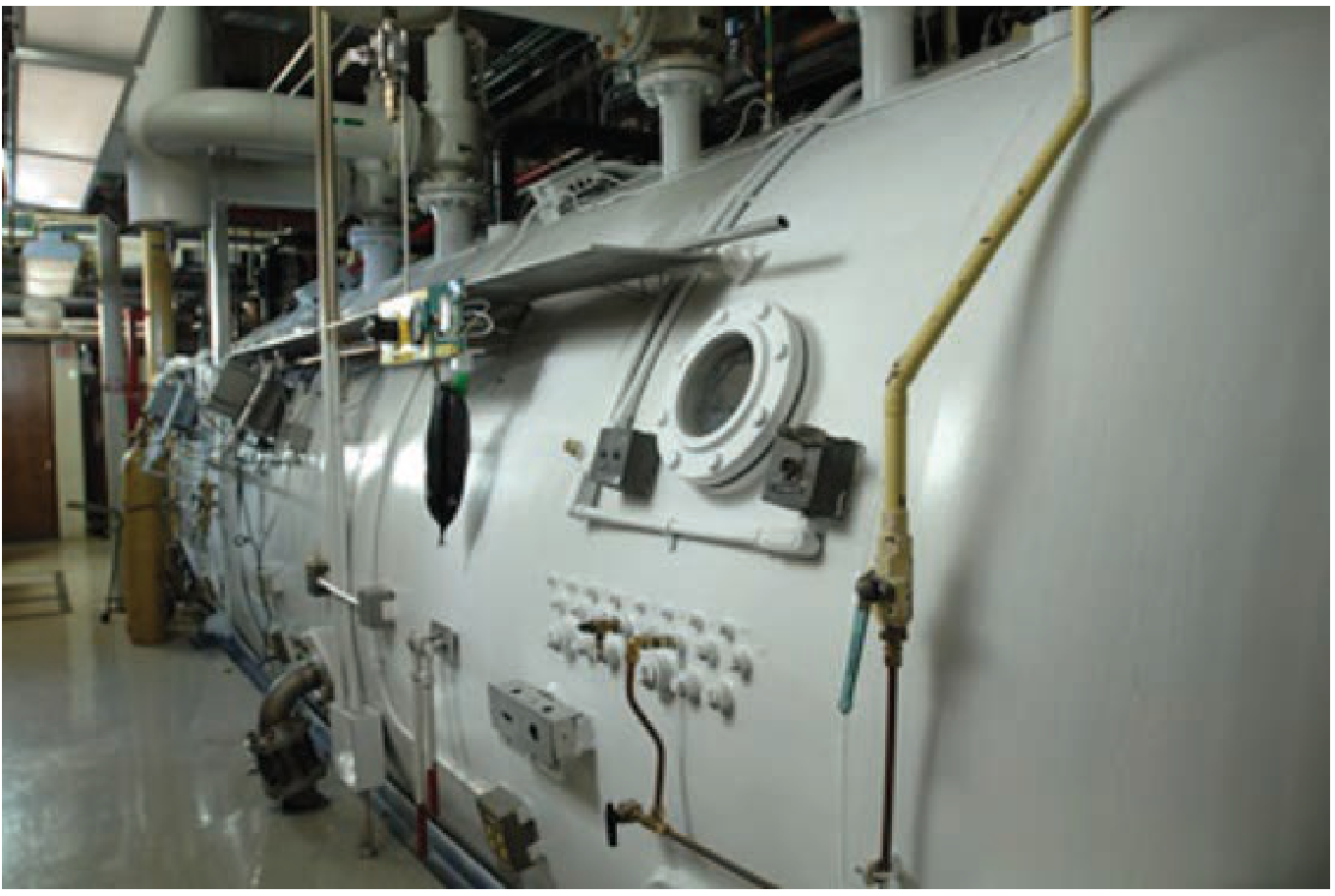
Exterior of a large multiplace chamber
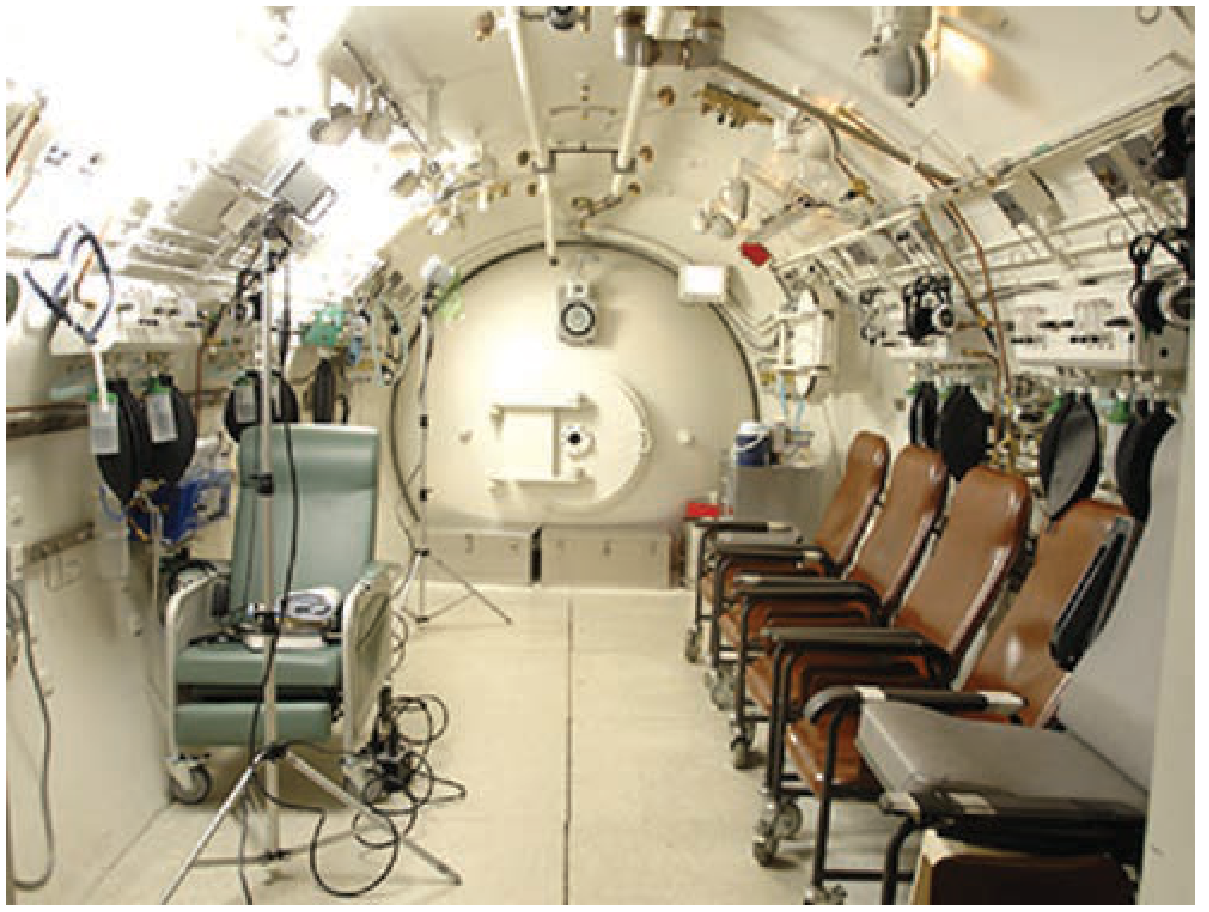
Interior of the same chamber - multiple patients can be treated simultaneously with staff inside
3. Key Physics & Physiology
Pressure Units
At sea level = 1 ATA = 760 mmHg = 101 kPa. HBO typically uses 2.0 to 3.0 ATA. A typical treatment runs 90-120 minutes.
How Oxygen Delivery Changes Under Pressure
| Condition | PaO2 | Dissolved O2 in plasma |
|---|---|---|
| Room air, 1 ATA | ~100 mmHg | ~0.3 vol% |
| 100% O2, 1 ATA | ~673 mmHg | ~1.5 vol% |
| 100% O2, 3 ATA | ~2200 mmHg | ~5.4 vol% |
At 3 ATA breathing 100% O2, dissolved plasma oxygen alone can sustain basal metabolic functions even in the complete absence of hemoglobin - clinically relevant in CO poisoning and severe anemia. (Tintinalli's Emergency Medicine, Chapter 21)
Hemoglobin saturates at ~100 mmHg PO2. Above that, all additional O2 delivery is via dissolved plasma oxygen, which obeys Henry's Law (proportional to partial pressure).
Two Mechanisms of Effect
1. Effects of elevated pressure (mechanical)
- Reduces bubble volume (Boyle's Law: PV = constant) - relevant in decompression sickness, arterial gas embolism
- Increases nitrogen washout from bubbles
- Reduces edema in post-traumatic tissue beds (vasoconstriction reduces inflow without reducing outflow)
2. Effects of hyperoxygenation (biochemical)
- Reverses tissue ischemia
- Induces reactive oxygen species (ROS) - this is BOTH the therapeutic mechanism AND the toxicity mechanism
- Stimulates the body's antioxidant enzyme system
- Upregulates endothelial NO synthase
- Induces angiogenesis (elevated O2 levels persist 2-4 hours post-treatment)
4. Beneficial Effects Table (Tintinalli's)
| Effect | Mechanism |
|---|---|
| Hyperoxygenation | Reverses tissue ischemia |
| Limits toxin production | Inhibits microbial endo- and exotoxin |
| Bacteriostatic/bactericidal | Direct effect on obligate anaerobes |
| Reduces tissue edema | Vasoconstriction-mediated reduction of inflow in post-traumatic beds |
| Stimulates angiogenesis | Oxygen-dependent collagen matrix production, growth factors, stem/progenitor cell mobilization from bone marrow |
| Promotes osteogenesis | Osteoblast stimulation and bone tissue regeneration in hypoxic bone |
| Promotes wound healing | Impairs B2 integrin function; amplifies O2 gradients around ischemic wounds |
| Diminishes inflammation | Lowers monocyte chemokine synthesis; ischemic preconditioning via HO-1, HSPs, HIF |
| Augments fibroblast replication | Increases collagen formation |
| Blunts ischemia-reperfusion injury | Protects endothelial tissue |
| Increases RBC deformability | Improves microcirculatory flow |
The elevated tissue oxygenation lasts 2-4 hours after the treatment ends, which explains why effects persist beyond the chamber time. (Tintinalli's Emergency Medicine, p. 179-180)
5. UHMS-Approved Indications (14 Official)
The UHMS 2022 Credentialing Guidelines define 14 accepted indications:
Emergency/Acute Indications (HIGH PRIORITY for EM residents):
1. Air or Gas Embolism
- Bubbles in arterial or venous circulation from trauma, iatrogenic causes (central line placement, surgery, lung biopsy), or diving
- HBOT reduces bubble size via Boyle's Law AND promotes nitrogen reabsorption
- HBO protocol: 6 ATA initially (Navy Treatment Table 6) to crush bubbles, then step down
- Time-critical - initiate as soon as possible; delay worsens outcomes
2. Carbon Monoxide Poisoning (one of your highest-yield topics)
- CO impairs hemoglobin function AND directly poisons the mitochondrial electron transport chain, inhibiting ATP formation
- HBO accelerates CO elimination: CO half-life on room air = ~5 hours, on 100% O2 NRB = ~60-90 min, on HBO = ~20-30 min
- HBO directly competes with CO at cytochrome oxidase
- Two studied protocols:
- Salt Lake City protocol: 3 ATA x 60 min → 2 ATA x 65 min; repeat x2 treatments at 6-12h intervals
- Philadelphia protocol: 2.8 ATA x 30 min → 2.0 ATA x 90 min (single treatment)
- Indications for HBO in CO poisoning (professional society consensus):
- Loss of consciousness at any point
- Neurologic signs/symptoms (confusion, ataxia, focal deficits)
- Cardiovascular compromise (ischemia, arrhythmia)
- COHb >25-30% (some centers use >25%, pregnant patients >15-20%)
- Severe metabolic acidosis
- Extremes of age (elderly, pediatric)
- Goal: reduce delayed neurologic sequelae (which develop 2-28 days post-exposure and affect up to 30% of moderate-severe cases)
- The landmark Weaver RCT (2002) showed HBO reduced neurologic sequelae from 46% to 25% at 6 weeks
3. Carbon Monoxide + Cyanide Poisoning
- Seen in closed-space fires burning synthetic materials
- CN and CO produce synergistic toxicity
- Standard CN antidote (hydroxocobalamin) remains primary; HBO is adjunctive
- HBO may directly reduce CN toxicity and augment antidote therapy
4. Decompression Sickness (DCS)
- Occurs when dissolved inert gas (nitrogen) comes out of solution and forms bubbles in tissues/blood after rapid ascent from depth (diving), or altitude ascent, or rapid decompression
- Type I DCS: musculoskeletal pain ("the bends"), skin ("the creeps"), lymphedema
- Type II DCS: neurologic (spinal cord or cerebral), inner ear ("the staggers"), cardiopulmonary ("the chokes")
- Mechanism: nitrogen bubbles obstruct microcirculation, activate complement, trigger inflammation
- HBOT is definitive treatment - recompression physically compresses bubbles, HBO promotes nitrogen elimination and reduces inflammation
- Contact the Divers Alert Network (DAN) at 1-919-684-9111 for 24/7 guidance on nearest chamber and treatment protocol
- Do NOT delay; field oxygen pre-treatment (100% NRB) while arranging transfer is appropriate
5. Clostridial Myositis/Myonecrosis (Gas Gangrene)
- Clostridium perfringens produces alpha-toxin and is an obligate anaerobe
- Growth is inhibited at tissue PO2 >70 mmHg; HBO directly kills the organism at high O2 tensions (Guyton & Hall, p. 563)
- HBO inhibits toxin production, limits spread, and may convert a previously near-100% fatal condition to a survivable one
- HBO is adjunctive to aggressive surgical debridement and antibiotics - never delays surgery
- Typical protocol: 3 ATA x 90 min, three times daily initially
6. Crush Injuries, Compartment Syndrome, Traumatic Ischemias
- HBO reduces edema, reverses ischemia, and blunts ischemia-reperfusion injury
- For established compartment syndrome: HBO is adjunctive after fasciotomy to prevent wound complications and accelerate recovery (~3-5 treatments needed)
- For threatened fasciotomy cases: HBO can reduce need for fasciotomy by reducing edema
- Also used in: threatened replants/digit amputations, frostbite, electrical injury, snake envenomation, high-pressure injection injuries
7. Necrotizing Soft Tissue Infections
- Mixed aerobic-anaerobic infections (Fournier's, necrotizing fasciitis)
- HBO kills obligate anaerobes, reduces toxin production, enhances leukocyte killing of aerobic organisms (oxygen-dependent oxidative burst)
- Always adjunctive to aggressive surgical debridement - this is the primary treatment
- HBO may reduce mortality and limit spread
Wound/Subacute Indications (EM should know these for referral):
8. Refractory Osteomyelitis
- Adjunctive to surgical debridement and antibiotics
- 14/15 studies in systematic review showed positive results; median remission rate 89% (Rockwood & Green)
- Evidence quality is moderate; UHMS gives "weak recommendation"
9. Arterial Insufficiencies
- Central retinal artery occlusion (CRAO) - most recently added UHMS indication; time-critical (treat within 24h)
- Diabetic foot ulcers with wound PO2 <35 mmHg (transcutaneous O2 pressure; in-chamber TcPO2 >200 mmHg predicts benefit)
- 90-120 min sessions at 1.9-2.5 ATA, once daily 5-6x/week; clinical improvement expected after 15-20 treatments
10. Delayed Radiation Injury
- Soft tissue and bony necrosis (osteoradionecrosis)
- Promotes angiogenesis in hypoxic irradiated tissue
- Standard wound protocol; 20-40 treatments typical
11. Compromised Grafts and Flaps
- HBO mobilizes stem cells, promotes angiogenesis, reduces edema in jeopardized tissue
12. Severe Anemia
- When transfusion is impossible (religious objection, unavailability, hemolytic reaction)
- At 3 ATA on 100% O2, dissolved plasma O2 alone can meet basal metabolic needs
13. Intracranial Abscess
- Adjunctive to surgical drainage and antibiotics
14. Acute Thermal Burns
- Protocol: 2.4 ATA x 100 min with two air breaks; starts 3x/day, tapers to 2x, then 1x/day
- Benefits: reduced fluid requirements (30-35% less), decreased mortality, fewer surgical procedures, shorter LOS (Tintinalli's, p. 181)
6. Emerging/Off-Label Indications (not UHMS-approved but in use)
As of 2024, emerging data supports potential use in: inflammatory bowel disease (UC/Crohn), post-COVID condition, TBI, stroke, frostbite, pyoderma gangrenosum, central retinal vein occlusion. These are not approved and coverage is typically not available. (IJMR Registry Study, 2024)
7. Transcutaneous Oxygen Pressure (TcPO2) - Key Monitoring Tool
Used primarily for wound indications to guide patient selection:
- TcPO2 <35 mmHg in room air = hypoxic wound (candidate for HBO)
- In-chamber TcPO2 >200 mmHg = predicts likely benefit from HBO
- If in-chamber TcPO2 does NOT rise above 200, patient is unlikely to respond; evaluate for vascular disease (Sabiston, p. 917)
8. Contraindications
Absolute Contraindications
| Contraindication | Reason |
|---|---|
| Untreated pneumothorax | Pressure changes will expand tension pneumothorax; life-threatening. Must be decompressed first. |
| Bleomycin (current or recent use) | HBO + bleomycin = severe pulmonary and cardiac toxicity (synergistic oxidative injury) |
| Doxorubicin (current or recent use) | Same mechanism |
| Disulfiram (Antabuse) | Blocks superoxide dismutase → dramatically increases oxygen toxicity risk |
Relative Contraindications
- Claustrophobia (may require anxiolytics)
- Untreated URI/sinusitis - inability to equalize barotrauma risk
- Seizure disorder - oxygen toxicity lowers seizure threshold
- COPD with CO2 retention - may suppress hypoxic drive
- Eustachian tube dysfunction
- High fever - increases seizure risk from O2 toxicity
- Implanted cardiac defibrillator or certain pacemakers (check with device manufacturer)
- Pregnancy (relative; used when benefit outweighs risk, e.g., CO poisoning)
- Asymptomatic pulmonary blebs - risk of pneumothorax
9. Complications (from the drug and the device)
Pressure-Related (Barotrauma)
| Complication | Notes |
|---|---|
| Middle ear barotrauma | Most common complication - ranges from TM hyperemia to perforation. Prevented by ear equalization (Valsalva). Can place myringotomy tubes. |
| Sinus squeeze | Frontal/maxillary sinus barotrauma |
| Pneumothorax | Life-threatening if tension; rare but must be excluded before treatment |
| Pulmonary over-pressurization | If patient breath-holds during decompression |
Oxygen Toxicity
| Toxicity | Features |
|---|---|
| CNS oxygen toxicity | Grand mal seizures; most dramatic; rare at therapeutic pressures; occurs especially at >3 ATA. Resolved by lowering pressure/O2. "Air breaks" (breathing air during treatment) reduce risk. |
| Pulmonary oxygen toxicity | Tracheobronchitis → ARDS. Related to total O2 dose (PO2 x time). Prevented by treatment duration limits and air breaks. |
| Ocular toxicity | Transient myopia (most common); resolves within weeks after treatment ends. Cataracts possible with prolonged courses. |
Air breaks - breathing compressed air for 5-10 minutes during a session - are standard practice to reduce cumulative oxygen toxicity.
Fire Risk
- High-pressure O2 environment dramatically increases fire risk
- Strict protocols: no petroleum-based products, no combustible materials, no electronics not approved for hyperbaric use
- This is why multiplace chambers are pressurized with air (not O2) despite patients breathing O2 through masks
10. Practical EM Workflow: When to Call for HBOT
EM Scenario → Consider HBOT consultation if:

CO Poisoning:
  → LOC, neuro sx, COHb >25%, CVS compromise, pregnancy, age extremes

Diving emergency:
  → Any DCS or arterial gas embolism → call DAN (1-919-684-9111) immediately
  → Start 100% O2 NRB during transfer

Gas gangrene (Clostridial):
  → After OR debridement and antibiotics → adjunctive HBO

Necrotizing fasciitis:
  → After OR debridement → adjunctive HBO

Crush injury / compartment syndrome:
  → Post-fasciotomy or threatened fasciotomy → adjunctive HBO

Acute thermal burn:
  → Significant burns → HBO consultation for early treatment

CRAO:
  → Within 24h of onset → urgent HBO (time-critical)

Severe anemia (no transfusion possible):
  → HBO as bridge therapy
11. Quick Reference Summary Card
| Condition | Pressure Protocol | Urgency |
|---|---|---|
| Arterial gas embolism | 6 ATA (Navy TT6), step down | IMMEDIATE |
| Decompression sickness | 2.8 ATA (Navy TT6) | URGENT (hours) |
| CO poisoning | 2.8-3 ATA x 60-90 min, ±repeat | URGENT |
| Gas gangrene | 3 ATA x 90 min, TID | EMERGENT (post-OR) |
| Crush injury/compartment | 2.4-2.8 ATA x 90-120 min | URGENT-SEMI-URGENT |
| Necrotizing fasciitis | 2.4-3 ATA x 90 min, TID | EMERGENT (post-OR) |
| Thermal burns | 2.4 ATA x 100 min, TID→BID→QD | URGENT |
| Diabetic wounds | 1.9-2.5 ATA x 90-120 min, QD | ELECTIVE |
| Osteoradionecrosis | 2.4 ATA x 90 min, QD | SEMI-ELECTIVE |
12. High-Yield EM Board/Clinical Pearls
-
HBO is a drug - it has dose-dependent toxicity, contraindications, and drug interactions (bleomycin, doxorubicin, disulfiram are absolute contraindications).
-
Never delay surgery for HBO in gas gangrene or necrotizing fasciitis - HBO is always adjunctive, never primary.
-
Pneumothorax must be treated before HBO - it is the only absolute contraindication related to the patient's acute condition in the ED.
-
CO poisoning is your most common EM-HBOT indication - know the indications for HBO vs. normobaric O2, the two protocols, and the goal of preventing delayed neurologic sequelae.
-
DCS and gas embolism are the two most pressure-responsive conditions - the physical effect of bubble compression is as important as the oxygenation.
-
Middle ear barotrauma is the most common complication - intubated/sedated patients cannot equalize; myringotomy may be needed before treatment.
-
At 3 ATA on 100% O2, dissolved plasma O2 alone sustains metabolism - this is why HBO works even in severe anemia or CO poisoning where hemoglobin is non-functional.
-
Air breaks are protective - ask why a protocol includes them (answer: limits cumulative O2 dose to prevent CNS and pulmonary toxicity).
-
TcPO2 guides wound patient selection - in-chamber TcPO2 >200 mmHg predicts response; <200 mmHg suggests vascular disease needs addressing first.
-
Know your local chamber - find out if your hospital has a hyperbaric unit, and if not, which facility is your regional referral center. DAN (1-919-684-9111) provides 24/7 guidance for diving emergencies nationwide.
References: Tintinalli's Emergency Medicine, 9e - Chapter 21 (LeGros & Murphy-Lavoie); Sabiston Textbook of Surgery, pp. 172-194, 917-920; Guyton & Hall Medical Physiology, p. 563; Rockwood & Green's Fractures in Adults, 10e, pp. 977-978; UHMS Credentialing Guidelines 2022; IJMR Registry Study 2024 - Emerging Indications
This is a shared conversation. Sign in to Orris to start your own chat.