
Sepsis
Reading File
The query is broad — sepsis covers definition, pathophysiology, diagnosis, and management. Let me clarify scope before diving deep.
Asking for Preferences
What aspect of sepsis are you looking for?
Finding Sources
Searching PubMed
"sepsis"[MeSH Terms] AND "management"[MeSH Terms]
Searching the Web
Surviving Sepsis Campaign guidelines 2024 update
The best comprehensive source is Rosen's Emergency Medicine. Let me read that block alongside a targeted search for pathophysiology and management.
Reading File
Finding Sources
Finding Sources
Good — I have the lab testing section. Let me now read the core definition/pathophysiology and management sections from Rosen's.
Finding Sources
Reading File
Excellent — I now have rich content on lab tests, procedures, and management. Let me read the earlier part of that block which should contain the definition and pathophysiology, and search for SOFA/Sepsis-3 criteria.
Finding Sources
Finding Sources
Excellent. Let me now read the key sections from Washington Manual (definition + SOFA), Robbins (pathophysiology), and Tintinalli (qSOFA criteria).
Reading File
Reading File
Reading File
I now have comprehensive content. Let me fetch the key pathophysiology diagram from Robbins and the SIRS/sepsis diagram from Tintinalli.
Loading Image
Loading Image
Reading File
I now have all the material needed for a comprehensive overview. Let me compile the full answer.
Sepsis — Comprehensive Overview
Definition (Sepsis-3, 2016)
Sepsis is defined as life-threatening organ dysfunction caused by a dysregulated host response to infection.
Septic shock is a subset of sepsis in which underlying circulatory and cellular metabolic abnormalities are profound enough to substantially increase mortality. It is identified clinically by:
- Vasopressor requirement to maintain MAP ≥ 65 mmHg, AND
- Serum lactate > 2 mmol/L despite adequate fluid resuscitation
Mortality in septic shock is approximately 40%.
The older SIRS-based definition (≥2 of: fever/hypothermia, tachycardia, tachypnea, leukocytosis/leukopenia) has been replaced by the SOFA score — sepsis is now diagnosed as a SOFA score increase ≥ 2 from baseline in the setting of suspected or confirmed infection. — Washington Manual of Medical Therapeutics, p. 295; Tintinalli's Emergency Medicine, p. 1039
SIRS vs. Sepsis vs. Infection
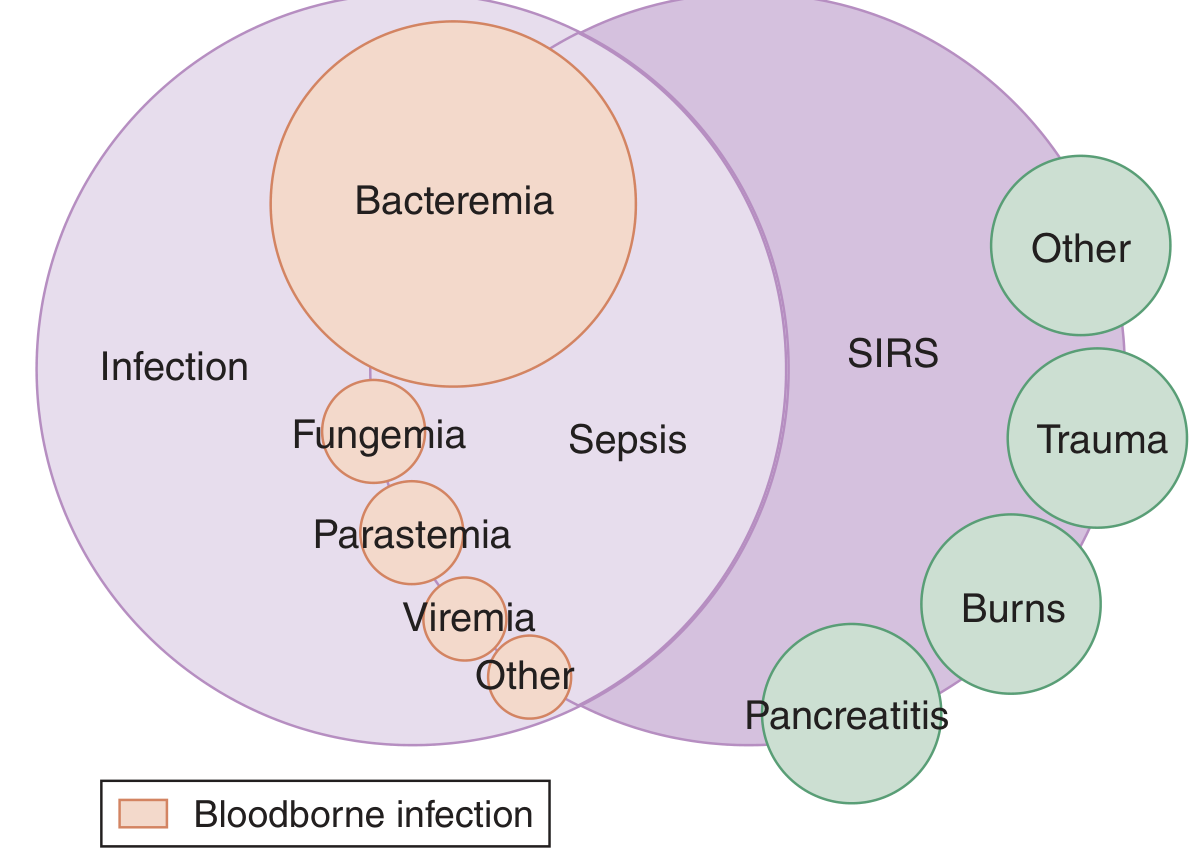
SIRS can occur without infection (trauma, burns, pancreatitis); sepsis sits at the intersection of SIRS and infection. — Tintinalli's Emergency Medicine
Pathophysiology
The cascade begins when microbial products (PAMPs — pathogen-associated molecular patterns) or injured-cell products (DAMPs) bind Toll-like receptors (TLRs) on innate immune cells (neutrophils, monocytes), triggering NF-κB activation and release of:
- Pro-inflammatory cytokines: TNF, IL-1, IL-12, IL-18, IFN-γ, HMGB1
- Reactive oxygen species, prostaglandins, platelet-activating factor (PAF)
- Complement cascade: C3a (mast cell activation), C5a (chemotactic), C3b (opsonin)
- Nitric oxide (NO): causes vascular smooth muscle relaxation → hypotension
Two critical downstream events drive organ failure:
-
Hyperinflammation → immunosuppression: The initial cytokine storm triggers counter-regulatory mechanisms (shift from Th1 to Th2, IL-10, lymphocyte apoptosis), leaving patients susceptible to secondary nosocomial infections.
-
Procoagulant–anticoagulant imbalance: Endothelial activation increases tissue factor expression, depletes protein C and thrombomodulin, and elevates PAI-1, causing microvascular thrombosis and DIC, impairing tissue perfusion and perpetuating organ injury.
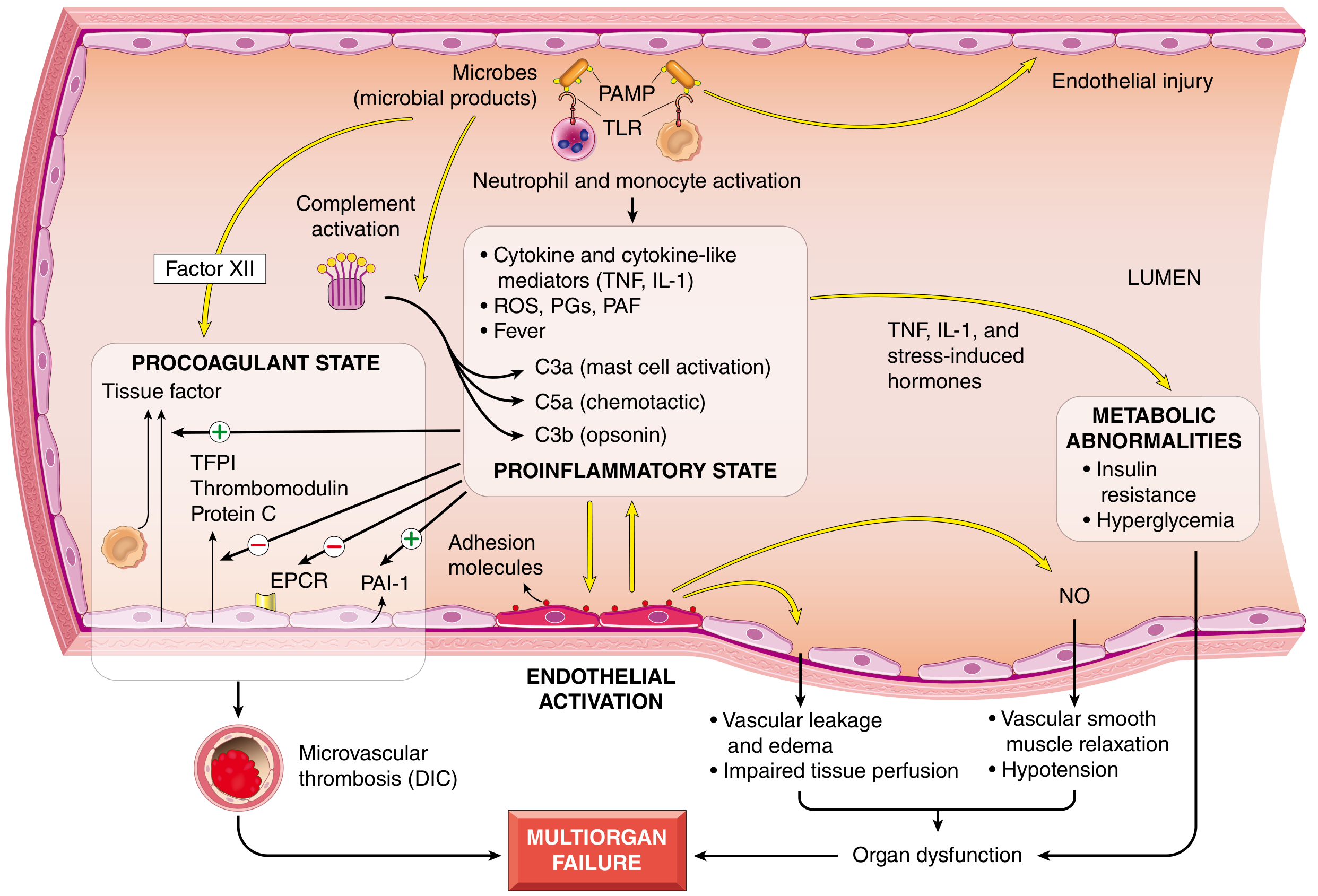
Microbial products activate TLRs → proinflammatory state → endothelial activation → vascular leakage, DIC, organ dysfunction. — Robbins Pathologic Basis of Disease, p. 135
Organ Complications
| Organ | Manifestation |
|---|---|
| Lung | ARDS — PaO₂/FiO₂ <300; bilateral infiltrates; mortality 27–45% by severity |
| Kidney | Acute kidney injury — elevated creatinine, reduced GFR |
| Coagulation | DIC — thrombocytopenia, elevated PT/aPTT, ↓ fibrinogen, ↑ fibrin split products |
| Liver | Elevated bilirubin/LFTs |
| Heart | Septic cardiomyopathy — reversible systolic/diastolic dysfunction; may present as "cold shock" |
| Metabolism | Lactic acidosis, hyperglycemia/insulin resistance |
Diagnosis
Screening Tools
- qSOFA (bedside, no labs): ≥2 of — altered mentation, RR ≥22/min, SBP ≤100 mmHg → warrants concern
- SOFA score: formal organ-dysfunction scoring across respiratory, coagulation, liver, cardiovascular, CNS, renal domains — increase ≥2 confirms sepsis
Key Laboratory Tests
| Test | Significance |
|---|---|
| Lactate | >2 mmol/L = tissue hypoperfusion; >4 mmol/L = ~28% mortality; serial clearance is prognostic |
| CBC | Leukocytosis/leukopenia, thrombocytopenia, bandemia ≥5–10% |
| Blood cultures | Before antibiotics if possible; only 30–40% of clinical sepsis has positive cultures |
| Procalcitonin / CRP | Elevated; procalcitonin best used for serial measurement and antibiotic stewardship |
| BMP/CMP | Anion-gap metabolic acidosis, elevated creatinine, low bicarbonate, electrolyte disturbances |
| Coagulation | PT, aPTT, fibrinogen, D-dimer — screen for DIC |
| Urinalysis + culture | Essential, especially in elderly patients |
| ABG | Classify acid-base; assess oxygenation |
Rosen's Emergency Medicine, p. 2757; Tintinalli's Emergency Medicine, p. 1039
Management (Surviving Sepsis Campaign Principles)
1. Early Fluid Resuscitation
- ≥ 30 mL/kg IBW IV crystalloid within the first hour
- Prefer balanced crystalloids (lactated Ringer's) over normal saline — associated with lower rates of renal dysfunction
- Reassess volume responsiveness continuously to avoid overload; adjust if concomitant heart failure
2. Vasopressors
- Start if MAP remains <65 mmHg despite adequate fluids
- Norepinephrine — first-line agent (fewer adverse events than dopamine)
- Vasopressin — second-line adjunct
3. Antimicrobials
- Broad-spectrum IV antibiotics immediately — delays increase mortality
- Obtain blood cultures before antibiotics if this can be done quickly, but do not significantly delay treatment
- De-escalate based on culture results and sensitivity data
- Procalcitonin can guide antibiotic duration/stewardship
4. Source Control
- Identify and control the anatomical source of infection as soon as possible (e.g., drain abscess, debride necrotizing tissue)
5. Additional Measures
- Glucose control: target <180 mg/dL
- Lung-protective ventilation if ARDS develops: low tidal volume (6 mL/kg IBW), PEEP optimization
- Corticosteroids (hydrocortisone 200 mg/day): considered in refractory septic shock
- Transfusion: current guidelines do not recommend transfusion to a specific hemoglobin threshold (targeting Hgb 7–9 g/dL is generally acceptable)
- Avoid colloids (albumin) — no significant benefit over crystalloids in most trials
6. Monitoring & Goals
- Lactate clearance (repeat measurement) — downtrending lactate mirrors clinical improvement
- Serial SOFA scores for organ trajectory
- CVP and dynamic parameters (pulse pressure variation, passive leg raise response) to guide ongoing resuscitation
Washington Manual of Medical Therapeutics, pp. 295–296; Rosen's Emergency Medicine, pp. 2757–2758; Surviving Sepsis Campaign (SSC) 2021 Guidelines
Summary Table
| Feature | Sepsis | Septic Shock |
|---|---|---|
| Definition | Infection + SOFA ≥2 | Sepsis + vasopressor-dependent + lactate >2 mmol/L |
| Hypotension | May be absent | Persistent despite fluids |
| Lactate | May be elevated | >2 mmol/L required for definition |
| Mortality | Significant | ~40% |
The SSC 2021 Guidelines remain the current international standard, with updated emphasis on post-ICU care and long-term sepsis sequelae. New SSC guideline updates have been released in 2024 by ESICM/SCCM with further refinements based on recent trial evidence.
This is a shared conversation. Sign in to Orris to start your own chat.