
Based on information in this pdf make notes on “varicella in pregnancy “ for md dermatology exam
Reading File
Running Command
cd /tmp/workspace && python3 -c " import pdfplumber with pdfplumber.open('attachments/fa5e232a-4e50-4020-8033-7cdfaeacb1f0/varicella_and_pregnancy.pdf') as pdf: print('pages:', len(pdf.pages)) for i, page in enumerate(pdf.pages): t = page.extract_text() print(f'--- PAGE {i+1} ---') print(t) " > extracted.txt 2>&1 wc -l extracted.txt
Reading File
Reading File
Reading File
Reading File
Searching Images
congenital varicella syndrome fetal limb defects skin scarring
Varicella in Pregnancy — MD Dermatology Exam Notes
(Based on: Ghosh S, Chaudhuri S. "Pregnancy and varicella infection: A resident's quest." Indian J Dermatol Venereol Leprol 2013;79:264-267)
1. Introduction / Epidemiology
- Varicella (chickenpox) confers lifelong immunity; second attacks are rare in immunocompetent people.
- Women who reach child-bearing age without immunity have a small but definite risk of developing chickenpox in pregnancy: 0.05–0.07%.
- Incidence in pregnancy: 2–3/1000 pregnancies.
- Risk is gestational-age dependent:
- Maternal risk of severe illness → greatest after mid-pregnancy (relative immunosuppression of pregnancy).
- Fetal risk of congenital infection → greatest when maternal infection occurs in the 1st or 2nd trimester.
2. Maternal Complications
- Varicella is more severe in adults (>15 yrs) and infants (<1 yr) than in children, with higher rates of:
- Pneumonia, hepatitis, encephalitis and higher mortality.
- Varicella pneumonia in pregnancy:
- Occurs in 10–20% of pregnant women with chickenpox.
- Severity increases with advancing gestation; highest risk in 3rd trimester.
- Mortality ~14% in pregnant women vs 10–11% in general adult population.
- Risk factors for varicella pneumonitis in pregnancy:
- 3rd trimester infection
- Cigarette smoking
- Chronic obstructive lung disease
- Systemic steroid use in preceding 3 months / immunosuppression
-
100 skin lesions or hemorrhagic lesions
3. Prevention of Maternal Varicella
- Determining immune status:
- Non-immune = no past history of varicella/vaccine, or VZV IgG seronegative.
- History of past chickenpox is 97–99% predictive of seropositivity.
- VZIG (Varicella Zoster Immunoglobulin):
- Pooled plasma from high-titer donors; given as post-exposure prophylaxis to non-immune pregnant women.
- Most effective within 72–96 hours of exposure (corresponds to immunoglobulin half-life).
- No therapeutic benefit once rash has already developed.
- Aciclovir as prophylaxis: suggested by some authors, best given on day 7 post-exposure; prophylactic role not firmly established.
- Varicella vaccine (Varivax):
- Live attenuated (Oka strain).
- Contraindicated in pregnancy and in those planning pregnancy within 1 month.
- Inadvertent vaccination in pregnancy is NOT an indication for termination.
- Can be given pre-pregnancy (≥1 month before conception) or post-partum in seronegative women.
4. Management of Maternal Varicella Infection
| Situation | Treatment |
|---|---|
| Significant maternal varicella (uncomplicated) | Oral Aciclovir 800 mg 5 times/day for 7 days, started within 24–72 hrs of rash onset |
| Progression to varicella pneumonitis | IV Aciclovir 10–15 mg/kg every 8 hrly for 5–10 days |
| Before 20 weeks gestation | Aciclovir = Pregnancy Category B — use only if benefit outweighs risk |
- Fetal ultrasound 5 weeks after primary infection + follow-up recommended for 1st/2nd trimester maternal varicella (screen for fetal abnormalities).
- Isolation advice: avoid contact with other pregnant women/neonates during infectious period — from 1–2 days before rash onset until all lesions crust (~5 days after rash onset).
- Symptomatic care and hygiene to prevent secondary bacterial infection.
5. Fetal / Neonatal Complications
Two distinct entities depending on timing:
- Fetal (Congenital) Varicella Syndrome = embryopathy.
- Neonatal Varicella = actual chickenpox infection in first 10–12 days of life (no embryopathy).
A. Maternal varicella in 1st and 2nd trimester → Fetal Varicella Syndrome
- Develops in <2% of babies born to mothers infected between 7–28 weeks gestation.
- Mechanism: transplacental infection, but syndrome results from a subsequent in-utero herpes zoster reactivation, not the initial infection — occurs only in a minority of infected fetuses.
- Mortality: 30% in first month of life.
- Clinical features:
- Low birth weight (LBW)
- Cutaneous scars in dermatomal distribution
- Papular lesions resembling connective tissue nevi
- Ocular: cataract, microphthalmia, chorioretinitis
- Bone and muscle hypoplasia (limb hypoplasia)
- Neurological: mental retardation, seizures, hydrocephalus, cortical atrophy, microcephaly
- Horner's syndrome, nystagmus
- Bladder and bowel sphincter dysfunction
B. Maternal varicella in 3rd trimester
| Timing of maternal rash relative to delivery | Outcome |
|---|---|
| Last 3 weeks to >5 days before delivery | 23% risk of neonatal varicella despite high maternal antibody titers (route: transplacental, ascending vaginal, or direct contact) |
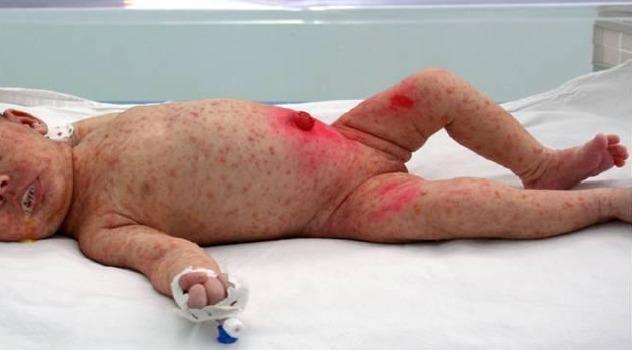
| 5 days before delivery to 2 days after delivery ("danger period") | 20–50% develop neonatal varicella; of these, 30% develop severe/fulminant neonatal varicella (disseminated cutaneous lesions + visceral involvement) |
- Why this window is most dangerous: it coincides with the time needed for maternal IgG to form and cross the placenta — the neonate doesn't get adequate passive antibody, combined with relative immaturity of the neonatal immune system.
- Chickenpox appearing after this period in the neonate is more likely post-natally acquired.
Below is a clinical photograph of neonatal varicella illustrating the polymorphic vesicular eruption described in the article (mother developed chickenpox close to delivery):
Management of Neonatal Varicella
- VZIG immediately after birth if maternal rash onset is 5 days before to 2 days after delivery.
- VZIG has reduced mortality in severe neonatal varicella from 31% to 7%.
- IV Aciclovir 10–15 mg/kg every 8 hours for 5–7 days, started within 24 hours of rash onset — reduces duration/severity.
- Delivery may be deliberately postponed (if in labor around the time of maternal rash) to allow maternal antibody transfer across placenta.
- No controlled trial yet proves efficacy of aciclovir/valaciclovir as post-exposure prophylaxis in neonates or pregnant women.
6. Quick Revision Table — Gestational Age vs Outcome
| Gestational timing of maternal varicella | Fetal/Neonatal risk |
|---|---|
| 1st/2nd trimester (7–28 wks) | Fetal varicella syndrome (<2%), 30% neonatal mortality if it occurs |
| Anytime before last month | Low risk to fetus per se; maternal risk (pneumonia) rises with gestation |
| 3 wks to >5 days before delivery | 23% neonatal varicella (adequate maternal Ab partly protective) |
| 5 days before to 2 days after delivery | 20–50% neonatal varicella; 30% of these severe/fulminant (highest risk window) |
| After this period | Likely post-natally acquired |
7. Key Exam Points to Remember
- Fetal varicella syndrome is due to reactivation (zoster) in utero, not the primary infection itself — commonly asked distractor.
- VZIG works only pre-eruption; useless once rash appears.
- Varicella vaccine is a live vaccine → absolute contraindication in pregnancy, but accidental vaccination is not an indication for MTP.
- The most dangerous period for the neonate is maternal rash 5 days before to 2 days after delivery — remember this exact window, it is frequently tested.
- Aciclovir in pregnancy = Category B; oral for uncomplicated maternal disease, IV for pneumonitis or neonatal disease.
- Classic triad-type features of congenital varicella syndrome: dermatomal cutaneous scarring + limb hypoplasia + CNS/eye anomalies.
Recent Evidence Check
I ran a quick check for recent systematic reviews/meta-analyses on this topic but did not have literature search access in this session to verify updates against current (2024-2026) guidance. The management principles above (VZIG timing, aciclovir dosing, the peripartum "danger window") remain the standard teaching per CDC/RCOG-based recommendations reflected in this article and are unlikely to have changed substantially, but for exam purposes it is worth cross-checking the current RCOG Green-top Guideline No. 13 ("Chickenpox in Pregnancy") for any updated dosing or antiviral recommendations if your syllabus references it.
This is a shared conversation. Sign in to Orris to start your own chat.